

Nestled in the mountainous region of Gangwon Province, South Korea, the Sangdong Tungsten Mine represents one of the most significant and strategic mineral development projects of the 21st century. Operated by Almonty Industries Inc., a leading tungsten producer, the mine is poised to become a cornerstone of the global critical minerals supply chain. Historically one of the world’s largest tungsten mines before its closure in the 1990s, its modern revival leverages cutting-edge mineral processing technology to extract high-purity scheelite (a primary tungsten ore) from its vast resources. This state-of-the-art facility is not only crucial for South Korea’s quest for resource autonomy but also plays a vital role in supplying tungsten, an essential metal for aerospace, defense, electronics, and industrial applications, to the international market.
- Location & Operator: Gangwon Province, South Korea. Operated by Almonty Industries Inc.
- Primary Product: High-grade scheelite concentrate, targeting a final product containing approximately 65% WO₃ (tungsten trioxide).
- Design Throughput: The processing plant is designed for a nominal feed rate of 80 tonnes per hour (tph), equivalent to 1,920 tonnes per day (tpd), with built-in provisions for a future capacity expansion up to 100 tph.
- Target Recovery: Extensive pilot plant testing supports an overall average tungsten recovery rate of approximately 85%.
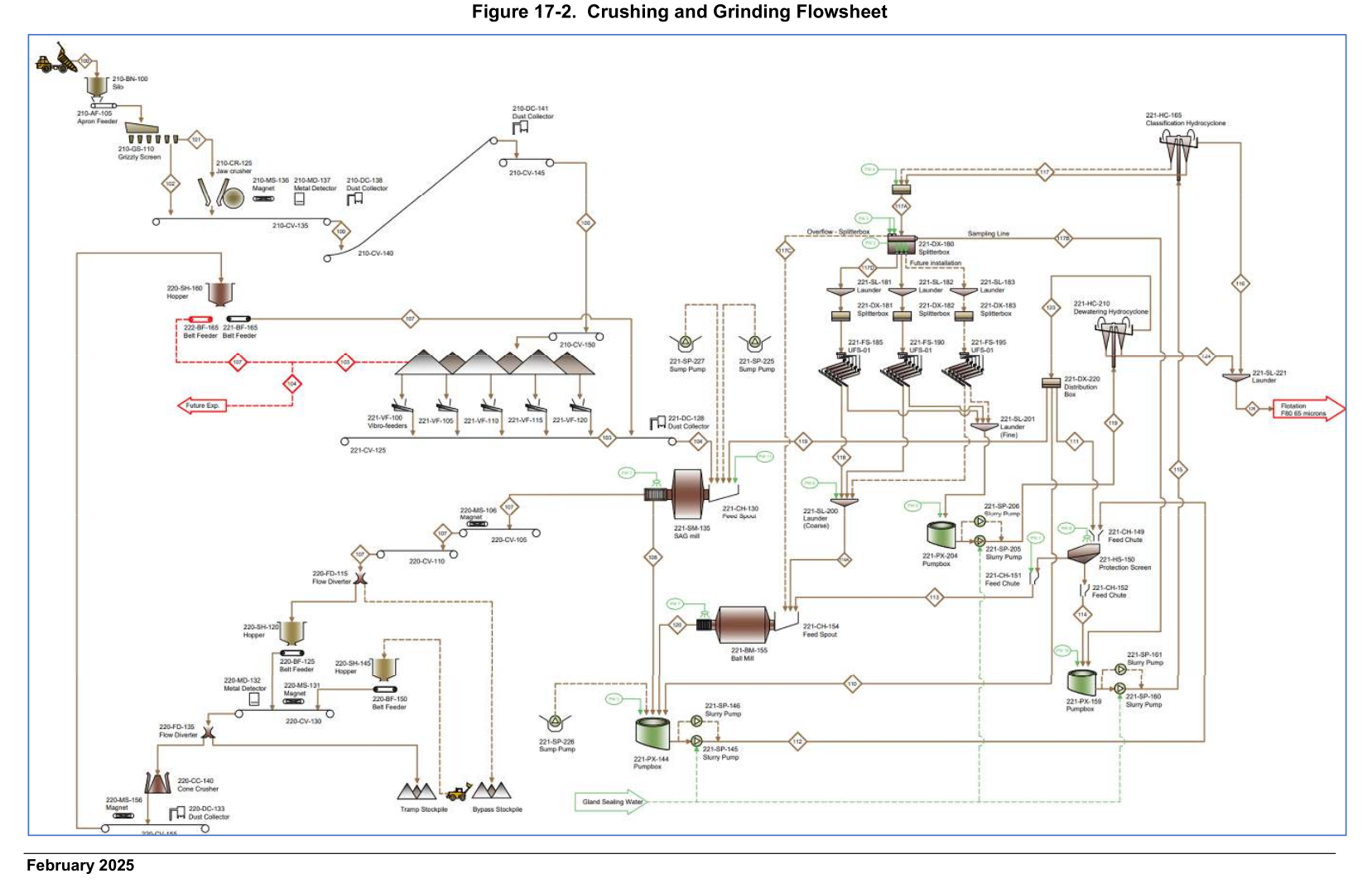
- Process Flow: The comprehensive circuit includes Primary, Secondary, and Tertiary Crushing → Coarse Ore Stockpiling → Two-Stage Grinding (SABC circuit: Semi-Autogenous Grinding mill and Ball mill) → Sulphide Flotation Circuit (Rougher and two Cleaner stages) → Scheelite Flotation Circuit (Rougher, Scavenger, and four-stage Cleaning) → Concentrate Thickening & Filtration → Tailings and Waste Water Management.
- Crushing: ROM ore is reduced to a nominal P80 of 100mm via a jaw crusher, with a design capacity of up to 270 dmt/h. A covered coarse ore stockpile with a 10,000 dmt capacity ensures consistent feed.
- Grinding: A two-stage SABC (Semi-Autogenous Grinding mill, Ball mill, and Crusher) circuit is designed to achieve a precise target grind size of P80 65 microns, optimal for liberating scheelite particles for flotation.
- Flotation Reagents: Key reagents include Aero 3473 collector and MIBC frother for sulphide removal, and TOFA (Tall Oil Fatty Acid) as the primary collector for scheelite, with sodium carbonate and sodium silicate used as modifiers and depressants.
- Water & Energy: The plant features advanced water treatment facilities and has a total installed power of approximately 4,006 kW, utilizing energy-efficient strategies like variable speed drives.
- Manpower: The concentrator is expected to be staffed by a total of 36 personnel, including 28 hourly operational employees and 8 salaried supervisors and engineers.
- Pilot Plant: An on-site 3-tonne-per-hour pilot plant has been used for metallurgical test work and remains available for future optimization and testing.
Source: NI 43-101 Technical Report Date: February 2025
