


Goldgroup Mining Inc.'s Don David Gold Mine in Oaxaca, Mexico, is an operating underground mine and processing facility that produces gold, silver, copper, lead, and zinc concentrates from polymetallic sulfide ore. Mining and milling operations commenced in 2010, and the plant currently processes ore from the Arista, Switchback, and Three Sisters underground mines.
Critical Data
| Parameter | Value | Unit | Notes |
|---|---|---|---|
| Plant throughput (2025) | 271,404 | tonnes | Annual ore processed |
| Average production rate (2025) | 1,189 | tpd | Design capacity not stated |
| Gold recovery | 71.46 | % | Average for Arista ore |
| Silver recovery | 84.4 | % | Average for Arista ore |
| Copper recovery | 62.3 | % | Average for Arista ore |
| Lead recovery | 63.4 | % | Average for Arista ore |
| Zinc recovery | 76.1 | % | Average for Arista ore |
| Average gold head grade | 0.85 | g/t | 2025 average |
| Average silver head grade | 216.52 | g/t | 2025 average |
| Average copper head grade | 0.156 | % | 2025 average |
| Average lead head grade | 0.69 | % | 2025 average |
| Average zinc head grade | 1.75 | % | 2025 average |
| Ball mill 1 power | 798 | kW | 3.2 m diameter, 4.29 m length |
| Ball mill 2 power | 597 | kW | 3.2 m diameter, 3.68 m length |
| Maximum crushing rate | ~110 | tonnes/h | Plant design value |
| Leach tank capacity | 170 | m³ | Per tank, five tanks total |
| Filter press capacity | 50-60 | tph | Combined, two presses installed |
| Tailings moisture after filtration | ~14 | % | Cake moisture |
| Thickener underflow solids | ~50 | % | Tailings slurry |
| Regrind target size | 50 | microns | For sulfur flotation concentrate |
| Third filter press installation | Q2 2026 | – | Commissioning planned Q3 2026 |
Overview
The Don David Gold Mine processing facility, known as the DDGM Processing Facility, is located near the mine site in Oaxaca, Mexico. The plant was built to process polymetallic ore from the Arista vein system and consists of two main circuits: a sequential flotation circuit for sulfide ore and an agitated cyanide leach circuit originally designed for oxide ore.
The Arista open pit was depleted in May 2021 and now serves as a deposition area for thickened tailings. A surface paste fill plant was constructed in 2019, using approximately 30% of mill tailings mixed with cement for underground backfill.
In 2025, several circuits were decommissioned. The gravity circuit and intensive leaching system were taken out of service. The sulfur flotation agitated leach tank and Merrill-Crowe circuit were also decommissioned. The agitated leach circuit had been decommissioned earlier in 2023, though the report notes it could be restarted if required.
Production for 2025 totaled 271,404 metric tonnes of ore processed. The plant yielded 5,300 ounces of gold, 1,594,301 ounces of silver, 264 metric tonnes of copper, 1,192 metric tonnes of lead, and 3,613 metric tonnes of zinc. The average production rate was 1,189 tonnes per day.
Metallurgical recoveries from Arista mine ore averaged 71.46% for gold, 84.4% for silver, 62.3% for copper, 63.4% for lead, and 76.1% for zinc. Head grades for 2025 averaged approximately 0.85 g/t gold, 216.52 g/t silver, 0.156% copper, 0.69% lead, and 1.75% zinc.
The flotation circuit produces three saleable concentrate products: a copper concentrate containing gold and silver, a lead concentrate containing gold and silver, and a zinc concentrate containing gold and silver. These concentrates are sold to various buyers located in Mexico. Doré produced from the gravity circuit is sold to precious metals refiners and mints.
Key Process Stages
The processing plant operates with distinct stages for the flotation and leach circuits. The flotation circuit includes crushing and milling, gravity concentration, differential flotation for copper, lead, and zinc, sulfur flotation, followed by thickening, filtering, and shipping. The agitated leach circuit, though decommissioned, included milling of sulfur flotation concentrate, leaching, counter current decantation, Merrill-Crowe zinc precipitation, and bullion furnace production of doré.
Crushing begins with ore trucked from the mine and discharged onto ground. A front-end loader feeds ore into a primary jaw crusher. Material from the primary crusher is screened on a double deck screen. Material from the first deck goes to a secondary cone crusher, then recirculates back to the screen. Oversize from the second deck goes to a tertiary cone crusher and also recirculates. Fine particles passing the double deck screen at minus 9.5 mm are stockpiled before feeding the ball mills. The maximum crushing rate is about 110 tonnes per hour.
The grinding circuit uses two parallel ball mills, each in closed circuit with hydrocyclones. Cyclone overflow reports to flotation. A portion of cyclone underflow goes to the gravity circuit, while the rest returns to the ball mill for further grinding. One ball mill measures 3.2 meters in diameter by 4.29 meters in length, driven by a 798 kW motor. The second ball mill measures 3.2 meters in diameter by 3.68 meters in length, driven by a 597 kW motor.
The differential flotation circuit treats ore from the Arista vein system, which consists of clean primary sulfides with high recoveries. Cyclone overflow feeds a conditioning tank for reagent addition. Slurry flows through four copper rougher cells followed by four copper scavenger cells. Copper scavenger concentrate returns to the rougher feed. Copper rougher concentrate is cleaned through a second and third cleaner circuit. Concentrate from the third copper cleaner goes to a thickener, then is filtered in a pressure filter to produce a saleable copper concentrate.
Copper scavenger tailings feed the lead rougher circuit. Lead rougher concentrate goes to a first and second cleaner circuit. Lead second cleaner concentrate feeds the lead concentrate thickener, and thickened lead concentrate is filtered in a pressure filter. Lead scavenger tailings feed the zinc circuit.
Tailings from the lead scavenger go to a zinc conditioning tank. Slurry feeds zinc rougher cells. Concentrate from the first two rougher cells goes to a second zinc cleaner, while concentrate from the last two rougher cells goes to a first zinc cleaner. Concentrate progresses through second and third zinc cleaner cells. Third cleaner concentrate is pumped to the zinc concentrate thickener and filtered in a pressure filter to produce a saleable zinc concentrate.
Tailings from the zinc rougher feed the first scavenger cell, with concentrate returning to the zinc conditioner. Tailings go to a second zinc scavenger cell, then pass through a trash screen before pumping to the sulfur flotation cell.
A flotation circuit was installed at the tail of the zinc flotation circuit in 2022. This circuit floats remaining sulfur associated with gold. Sulfur concentrate recovered is leached in the agitated cyanide circuit that was previously used for oxide leaching.
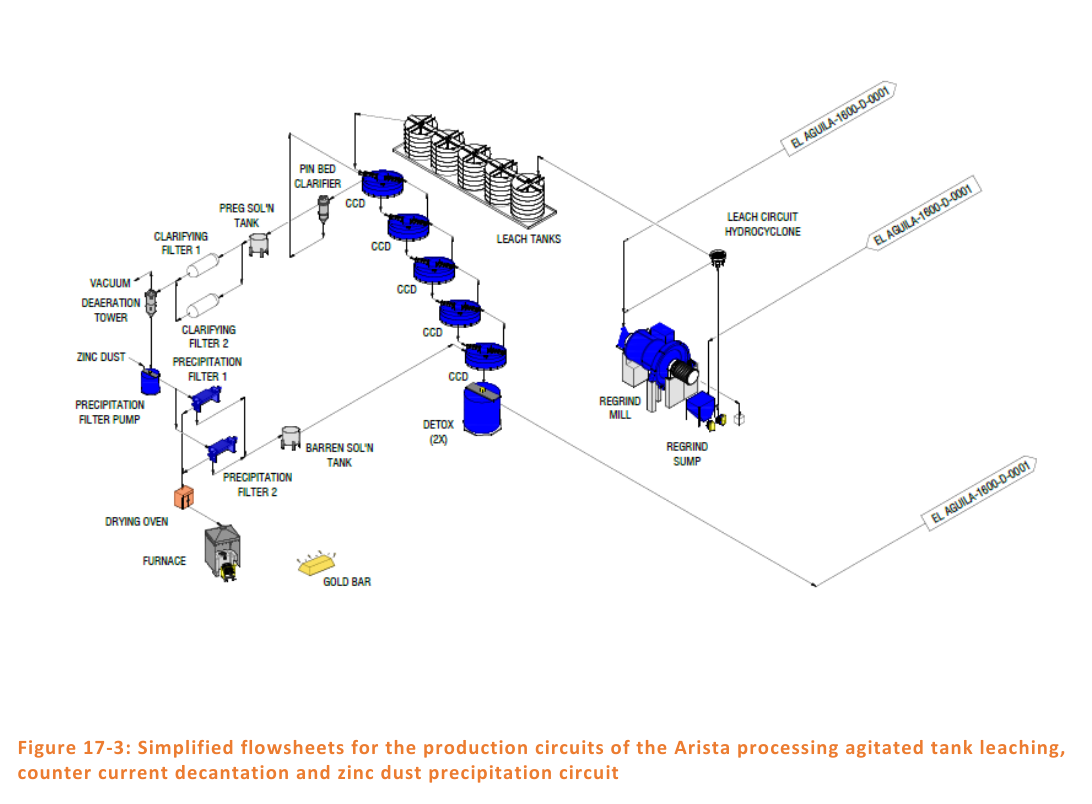
After trash removal through a static screen, slurry is pumped into the bulk sulfur flotation rougher circuit. Sulfur flotation concentrate is reground in the old oxide circuit ball mill. The regrind ball mill operates in closed circuit with a hydrocyclone, targeting a grind size of 50 microns for leaching. Leaching uses sodium cyanide and lime for pH control. The circuit consists of five agitated tanks with 170 cubic meters capacity each, with air injection. When leaching is complete, slurry flows through five counter current wash clarifiers. Washed solution goes to a clarifying filter, then to a deaeration tower. Zinc powder is added for precipitation. The precipitated sludge passes through a press filter to remove humidity, then calcines in a drying oven, is melted in a furnace, and poured into a cascade stand to produce gold doré. Solid tailing from the clarifier circuit goes to cyanide destruction and returns to the zinc scavenger cell.
Tailings from the rougher sulfur flotation go to the tailings thickener. Thickener underflow at approximately 50% solids is distributed to two parallel holding tanks that provide temporary storage and continuous supply to the filter presses. These tanks also supply the paste plant as required. The dry stack filtering plant was designed for three parallel vertical plate press filters, with two currently installed. The two filters can process 50 to 60 tonnes per hour of solid tailings combined. Process water and rinse water are recycled to the processing plant. Filter cake containing approximately 14% moisture moves by conveyor to a single radial stacker conveyor, which layers tailings in the depleted open pit area where they naturally dewater and are compacted for stability.
A third filter press has been purchased. It will be installed in Q2 2026 and commissioned in Q3 2026. This third filter will provide contingency for tailings dewatering and reduce pressure on equipment during maintenance.
When the underground mine needs paste backfill, thickened slurry goes to the paste backfill plant instead of the dry stack press filter.
Additional Interesting Data and Summary
The Don David Gold Mine laboratory was designed and constructed on site for sample assaying and metallurgical testing. The laboratory employs 23 staff dedicated to sample preparation, assaying, and metallurgical testing. The Arista Laboratory prepares approximately 100 samples per day and conducts more than 400 assays daily using atomic absorption and fire assay methods. Between 5 and 10 metallurgical tests are performed per day.
Sample preparation involves reception and identification, drying, primary through tertiary crushing to about 4 mm, homogenization, splitting using a Jones splitter, pulverization in spray rings to 100% minus 100 mesh, and sample control and analysis.
Fire assaying uses 5 to 20 grams of sample mixed with lead-based flux, fused at 1050 degrees Celsius for 50 minutes, cupelled at 940 degrees Celsius for 45 minutes, with the resulting doré button dissolved in nitric acid for 25 minutes. Gold is weighed on a microbalance.
The laboratory uses X-ray fluorescence, atomic absorption spectroscopy for gold, silver, and base metals, and conducts metallurgical tests including Denver flotation cell testing, cyanide bottle tests, particle size analysis, specific gravity determination on drill cores, sedimentation and flocculation tests, and vacuum filtration.
Quality control procedures include use of primary and secondary certified standard samples analyzed at month end. The laboratory is not currently accredited but has work instructions for all analyses and QA/QC controls. Duplicate analysis has been conducted since January 2020, with over 523 duplicates performed. Results show 80% of gold analysis fell under 20% relative error, 80% of silver and lead analysis fell under 10% relative error, 80% of copper analysis fell under 9% relative error, and 80% of zinc analysis fell under 6% relative error.
Key Processes
- Run-of-mine ore is crushed through a three-stage crushing circuit (primary jaw, secondary cone, tertiary cone) with a double deck screen producing minus 9.5 mm feed for grinding
- Two parallel ball mills in closed circuit with hydrocyclones grind the ore, with one mill driven by 798 kW and the other by 597 kW
- A sequential differential flotation circuit produces three concentrates: copper-gold-silver, lead-gold-silver, and zinc-gold-silver
- A sulfur flotation circuit installed in 2022 recovers remaining gold associated with sulfur from zinc circuit tailings
- The agitated cyanide leach circuit (decommissioned in 2023) previously treated sulfur flotation concentrate with five 170 m³ tanks, counter current decantation, and Merrill-Crowe zinc precipitation
- Tailings are dewatered through two vertical plate filter presses to approximately 14% moisture for dry stack deposition in the depleted open pit, with a third filter press to be installed in Q2 2026
- A paste fill plant uses approximately 30% of mill tailings mixed with cement for underground backfill
- An on-site laboratory conducts assay and metallurgical testing using fire assay, atomic absorption, and X-ray fluorescence methods
Source: NI 43-101 Technical Report on the Don David Gold Mine, Oaxaca, Mexico, March 30, 2026. Project website: Don David Gold Mine
Additional process diagram from the technical report
Consolidated report summaries
The following former standalone pages about this operation were consolidated here on October 25, 2026. They are retained for source traceability; dates and figures reflect each report’s own effective date and may be superseded by the current information above.
DDGM Processing Facility: Polymetallic Flotation and Leaching Circuits
Overview
The DDGM Processing Facility is a sophisticated mineral processing plant handling polymetallic ore from the Arista and Switchback underground mines. The facility features both sequential flotation (sulfide) and agitated cyanide leach (oxide) circuits, producing three separate saleable concentrates (gold-copper, silver-lead, and zinc) along with doré bars. Commissioned in 2010, the plant has undergone several upgrades including the 2014 installation of a Gekko Systems InLine Leach Reactor™ and a 2022 sulfur flotation circuit addition.
Key Process Stages
- Crushing and Milling: Three-stage crushing (jaw + 2 cone crushers) reduces ore to -9.5mm, followed by parallel ball mill circuits (3.2m diameter mills with 798kW and 597kW motors)
- Differential Flotation: Sequential production of Cu/Au/Ag, Pb/Ag/Au, and Zn concentrates through multi-stage cleaning circuits
- Gravity Concentration: Knelson concentrator processes cyclone underflow (decommissioned in 2024)
- Sulfur Flotation: Added in 2022 to recover residual gold-bearing sulfur from zinc tailings
- Agitated Leaching: 5-tank cyanide circuit (170m³/tank) with CCD washing and Merrill-Crowe precipitation (decommissioned in 2023)
- Tailings Management: Dual filter presses (50-60 TPH combined) produce dry stack tailings at 14% moisture for open pit deposition
Critical Data
| Parameter | Value |
|---|---|
| 2024 Throughput | 356,633 tonnes (977 tpd average) |
| Metal Production (2024) | 9,906 oz Au, 919,836 oz Ag, 642t Cu, 2,682t Pb, 7,744t Zn |
| Metallurgical Recoveries | 77.1% Au, 88.3% Ag, 69% Cu, 68.3% Pb, 79.8% Zn |
| Head Grades (2024) | 1.12 g/t Au, 90.88 g/t Ag, 0.26% Cu, 1.1% Pb, 2.72% Zn |
| Crushing Capacity | 110 tonnes/hour |
| Ball Mill Specifications | Mill 1: 3.2m x 4.29m (798kW), Mill 2: 3.2m x 3.68m (597kW) |
| Leach Tank Capacity | 5 x 170m³ agitated tanks |
| Tailings Moisture | 14% after filtration |
Laboratory Capabilities
The on-site laboratory processes 100 samples/day with 400+ daily assays using:
- Fire assay (5-20g samples at 1050°C)
- XRF spectroscopy (3-5 min/sample)
- Atomic absorption spectroscopy (2 Perkin Elmer units)
- Full metallurgical testing suite including flotation, cyanidation, and filtration tests
Technical Insights into the Aquila Mineral Processing Circuit: Optimizing Polymetallic Recovery at the Don David Gold Mine
Overview
The Aquila mine, widely recognized as the flagship asset of the Don David Gold Mine (DDGM) complex under the stewardship of Gold Resource Corporation (GRC), represents a cornerstone of polymetallic mineral processing in the Oaxaca region of Mexico. Specifically located within the San Jose de Gracia district, the Aquila project (often referred to in technical literature as ‘El Aguila’) has evolved from a high-grade open-pit operation into a sophisticated underground mining complex that targets the Arista and Switchback vein systems. This project is significant not only for its consistent production of precious metals—gold and silver—but also for its critical output of base metals, including copper, lead, and zinc.
The significance of the Aquila processing plant lies in its versatile “differential flotation” flowsheet, which was specifically designed to handle the complex mineralogy of the Arista deposit. Since declaring commercial production on July 1, 2010, the facility has processed over 5.9 million tonnes of ore, yielding substantial quantities of gold and silver. The technical success of Aquila is rooted in its ability to adapt to varying ore types, transitioning seamlessly from oxide-rich surface material to the deeper, sulfide-rich polymetallic ores encountered in the underground levels. The mine serves as a model for resource optimization, utilizing a dual-recovery approach that combines gravity concentration, intensive leaching, and multi-stage flotation to maximize the economic return from every tonne of processed ore.
From an industrial perspective, the Aquila mine is a testament to the longevity and potential of epithermal vein systems in the Mogollon Transition. With ongoing exploration revealing underexplored extensions of known veins, the processing circuit continues to undergo technological upgrades to maintain high recovery rates even as head grades fluctuate. The operation’s focus on operational excellence, environmental stewardship, and technical innovation makes it a pivotal study in modern mineral processing.
Key Process Stages
The Aquila mineral processing circuit is a comprehensive facility designed to produce three separate base metal concentrates and high-purity gold-silver doré. The circuit is characterized by its flexibility, allowing for the differential separation of sulfides while simultaneously capturing coarse precious metals. The primary stages of the processing circuit include:
- Primary Crushing: Run-of-Mine (ROM) ore is reduced using a high-capacity jaw crusher. The station typically features a fixed grizzly and a vibrating grizzly feeder to ensure a consistent feed size of 80% passing (P80) approximately 75 mm.
- Grinding and Classification: The secondary reduction stage utilizes a SAG and ball mill configuration (SAB circuit). The grinding circuit is designed to achieve a target grind size of 80% passing 106 µm, which is essential for liberating the fine-grained sulfides prior to flotation.
- Gravity Concentration: Integrated into the grinding circuit is a gravity recovery loop featuring batch centrifugal concentrators (such as Knelson or Falcon units). This stage captures “free gold” grains that are too heavy for standard flotation.
- Intensive Leaching: The gravity concentrate is treated in a Gekko intensive cyanide reactor (Sepro Leach Reactor). This high-efficiency system rapidly dissolves gold and silver from the gravity-concentrated material.
- Differential Flotation: This is the heart of the polymetallic circuit. It consists of three sequential flotation banks:
- Copper Circuit: Utilizes specific collectors and pH control to separate chalcopyrite from other sulfides.
- Lead Circuit: Recovers galena from the copper tails.
- Zinc Circuit: Employs copper sulfate activation to recover sphalerite.
- Sulfur Flotation (2022 Upgrade): A modern addition to the circuit, this stage recovers remaining gold associated with sulfur from the zinc flotation tailings. The resulting bulk sulfide concentrate is then sent to an agitated leach circuit.
- Agitated Leaching and Merrill-Crowe: The bulk sulfide concentrates and intensive leach residues undergo cyanide leaching in agitated tanks. Gold and silver are then recovered from the pregnant solution using the Merrill-Crowe zinc precipitation process, leading to the production of high-grade doré bars.
Critical Data
The following table summarizes the nominal technical parameters and performance data for the Aquila mineral processing facility based on recent operational reports.
| Parameter | Value | Unit |
|---|---|---|
| Nominal Throughput Capacity | 2,000 | tonnes per day (tpd) |
| Design Annual Capacity | 730,000 | tonnes per annum (tpa) |
| Typical Gold Recovery | 88.0 – 92.0 | % |
| Typical Silver Recovery | 80.0 – 85.5 | % |
| Grind Size (P80) | 106 | micrometers (µm) |
| Ball Mill Power (Estimated) | 1,200 – 1,500 | kW |
| CIL/Agitated Leach Residence Time | 24 – 48 | hours |
| Number of Final Concentrates | 3 | (Cu, Pb, Zn) |
Technical Details and Sustainability
The Aquila mine represents a sophisticated intersection of metallurgy and environmental engineering. One of the most technically challenging aspects of the Aquila circuit is the management of the differential flotation sequence. Because the Arista vein system is polymetallic, the circuit must precisely balance reagent dosages—such as xanthates for collection and zinc sulfate for depression—to prevent the misplacement of minerals. For instance, the copper circuit must suppress galena and sphalerite while successfully floating chalcopyrite. Failure to maintain these balances can lead to “penalties” at the smelter due to concentrate impurity. The recent addition of a sulfur flotation cell system in 2022 exemplifies GRC’s commitment to “scavenging” every possible ounce of gold, ensuring that minerals previously lost to tailings are now captured in a bulk sulfide concentrate for agitated leaching.
Sustainability is a core component of the Aquila operational philosophy. In the water-scarce environment of Oaxaca, the plant employs a rigorous water recycling program, recovering up to 85% of process water from tailings thickeners and filtration systems. The move toward dry-stack tailings technology is a significant environmental milestone for the project. By filtering tailings to a low moisture content and stack-placing them, the mine minimizes the risk associated with traditional tailings dams and reduces the overall footprint of the waste management facility. Furthermore, the use of cyanide destruction circuits (SO2/Air or similar) ensures that any residual cyanide in the leach tailings is neutralized to levels well below international environmental safety standards before final disposal.
Looking to the future, the technical legacy of the Aquila mine continues to influence the company’s development pipeline, including the Back Forty project in Michigan. The metallurgical lessons learned at Aquila—particularly in the recovery of precious metals from complex sulfide matrices—are directly applicable to the VMS (Volcanogenic Massive Sulfide) deposits found in the Great Lakes region. As the Aquila mine continues to deepen its underground operations, the processing circuit remains a dynamic entity, constantly optimized through real-time monitoring and advanced metallurgical testing at partner laboratories like ALS. This dedication to technical refinement ensures that Aquila remains a premier producer of high-grade concentrates for years to come.
Source: Aquila
Source: NI 43-101 Technical Report
This article provides an overview of mineral processing developments based on publicly available technical reports and industry analysis.
Technical report and processing history
The following archived source profiles have been consolidated here to preserve the project’s processing history and study context.
Don David Gold Mine — 2022 Technical Report
Don David Gold Mine — 2022 Technical Report
| Company | Don David Gold Mine |
| Mine | Don David Gold Mine |
| Date | 2022 |
| Region | Mexico |
| Commodities | Gold, Silver, Copper, Lead, Zinc |
Executive Summary
The Don David Gold Mine (DDGM) processing facility currently mills and processes ore from the Arista and Switchback underground mines through a flotation circuit. The facility also includes an agitated cyanide leach circuit for oxide ore. The Arista processing plant produces three separate saleable concentrate products (gold-copper, silver-lead, and zinc) from polymetallic ore. The Aguila open pit was depleted in May 2021 and is now used for thickened tailings storage. In 2022, the plant processed 493,026 metric tonnes of ore, yielding significant quantities of gold, silver, copper, lead, and zinc.
Mining operations at the DDGM property commenced in 2010, initially processing open-pit ore from the Manto-Vein before transitioning to underground mining of the Arista and Baja veins. The underground mine utilizes overhand mechanized cut and fill and long-hole open stoping methods, with voids backfilled using waste rock and mill tailings mixed with cement. A surface paste fill plant was constructed in 2019 to support this backfilling operation. The processing plant includes crushing, milling, gravity concentration, differential flotation, and leaching circuits, with tailings managed through thickening, filtering, and dry stacking or paste backfill.
In 2022, the average production rate was 1,465 tpd. Metallurgical recoveries averaged 83.71% for gold, 92% for silver, 76.2% for copper, 75.2% for lead, and 83.6% for zinc. The facility includes a dedicated laboratory for assaying samples and metallurgical testing, utilizing fire assay, atomic absorption, and X-ray fluorescence techniques. Concentrates are sold to buyers in Mexico, while doré is sold to refiners such as Asahi Refining USA, Inc.
Website: https://goldresourcecorp.com/projects/don-david-gold-oaxaca-mexico/history/
Report Date: 2022
Region: Mexico
Project Status:
Commodity: Gold, Silver, Copper, Lead, Zinc
Throughput:
Mine Life:
Mine Type:
Ore type:
Don David Gold Mine — 2021 Recovery Methods Report
Don David Gold Mine — 2021 Recovery Methods Report
| Company | Aguila Resources |
| Mine | Don David Gold Mine |
| Date | 2021 |
| Region | Mexico |
| Commodities | Gold, Silver, Copper, Lead, Zinc |
| Status | Operating |
Executive Summary
The Don David Gold Mine (DDGM) processing facility operates a dual-circuit system designed to handle both sulfide and oxide ores. The sulfide circuit, primarily processing ore from the Arista and Switchback underground mines, utilizes a sequential flotation process to recover gold, silver, copper, lead, and zinc. The oxide circuit processes ore from the depleted Manto Vein open-pit using agitated cyanide leaching. In 2021, the plant processed 501,978 metric tons of ore at an average rate of 1,512 tpd, yielding significant quantities of precious and base metals.
Metallurgical recoveries for the Arista mine ore averaged 81% for gold, 92% for silver, 80% for copper, 80% for lead, and 82% for zinc. The facility includes advanced gravity concentration via a Knelson Semi-Continuous Concentrator and an InLine Leach Reactor (ILR) for upgrading gravity concentrates to doré. Tailings management has transitioned towards a dry stack facility with paste backfill capabilities to support underground mining operations and ensure environmental stability.
Processing Overview
The crushing circuit employs a Pioneer jaw crusher and cone crusher to reduce ore to -95 mm. Grinding is achieved via Allis-Chalmers ball mills and hydro-cyclones. The flotation circuit is differential, producing separate copper, lead, and zinc concentrates. The leaching circuit uses agitated cyanide tanks and Merrill Crowe zinc precipitation.
Reports
Website: https://goldresourcecorp.com/projects/don-david-gold-oaxaca-mexico/exploration/el-aguila-project/
Report Date: 2021
Region: Mexico
Project Status: Operating
Commodity: Gold, Silver, Copper, Lead, Zinc
Throughput:
Mine Life:
Mine Type:
Ore type:
NI 43-101 Technical Report – DDGM Resource and Reserve Update
NI 43-101 Technical Report – DDGM Resource and Reserve Update
| Company | Gold Resource Corporation |
| Mine | Don David Mine |
| Date | 2020 |
| Region | Oaxaca, Mexico |
| Commodities | Gold, Silver, Copper, Lead, Zinc |
Executive Summary
The Don David Mine, operated by Don David Gold Mexico (DDGM), a subsidiary of Gold Resource Corporation, is located in Oaxaca, Mexico. The mine has been in commercial production since July 2010, primarily processing ore from the Arista underground mine and the Aguila open pit. The processing plant, known as the Aguila Plant, utilizes a dual circuit system: a differential flotation circuit for sulfide ores (producing copper, lead, and zinc concentrates) and an agitated cyanide leach circuit for oxide ores (producing gold and silver doré). As of December 31, 2020, the plant operated at an average throughput of approximately 1,829 tonnes per day. The mine life is estimated at 4 years with remaining reserves, and the operation is currently in the production phase.
The mine employs conventional mining methods including overhand mechanized cut and fill and long-hole open stoping for the underground Arista mine. Infrastructure includes a processing plant, tailings storage facility, and power generation connected to the Mexican Federal Electricity Commission grid. Environmental permits are in place, and the company maintains a focus on community relations and social responsibility in the surrounding areas of San José de Gracia and San Pedro Totolapam.
Website: https://goldresourcecorp.com/projects/don-david-gold-oaxaca-mexico/history/
Report Date: 2020
Region: Oaxaca, Mexico
Project Status:
Commodity: Gold, Silver, Copper, Lead, Zinc
Throughput:
Mine Life:
Mine Type:
Ore type:
DDGM — 2023 Technical Report
DDGM — 2023 Technical Report
| Company | DDGM |
| Date | 2023 |
| Region | Mexico |
| Commodities | Gold, Silver, Copper, Lead, Zinc |
Executive Summary
The DDGM Processing Facility processes ore from the Arista and Switchback underground mines through a flotation circuit. The facility includes a sequential flotation (sulfide) circuit and an agitated cyanide leach (oxide) circuit. In 2023, the plant processed 458,111 metric tonnes of ore, yielding significant quantities of gold, silver, copper, lead, and zinc. Mining operations utilize underground methods including cut and fill and long-hole open stoping, with paste fill backfilling implemented since 2019.
The processing plant produces three separate saleable concentrate products (gold-copper, silver-lead, and zinc) from polymetallic ore. A gravity concentrator using Knelson technology enhances separation based on particle density. In 2022, a new flotation circuit was installed to recover remaining sulphur associated with gold, which is then leached in the agitated cyanide circuit. Doré is sold to refiners such as Asahi Refining USA, Inc.
Website: https://www.tdvmasons.org/district-info/ddgm-message/
Report Date: 2023
Region: Mexico
Project Status:
Commodity: Gold, Silver, Copper, Lead, Zinc
Throughput:
Mine Life:
Mine Type:
Ore type:
