

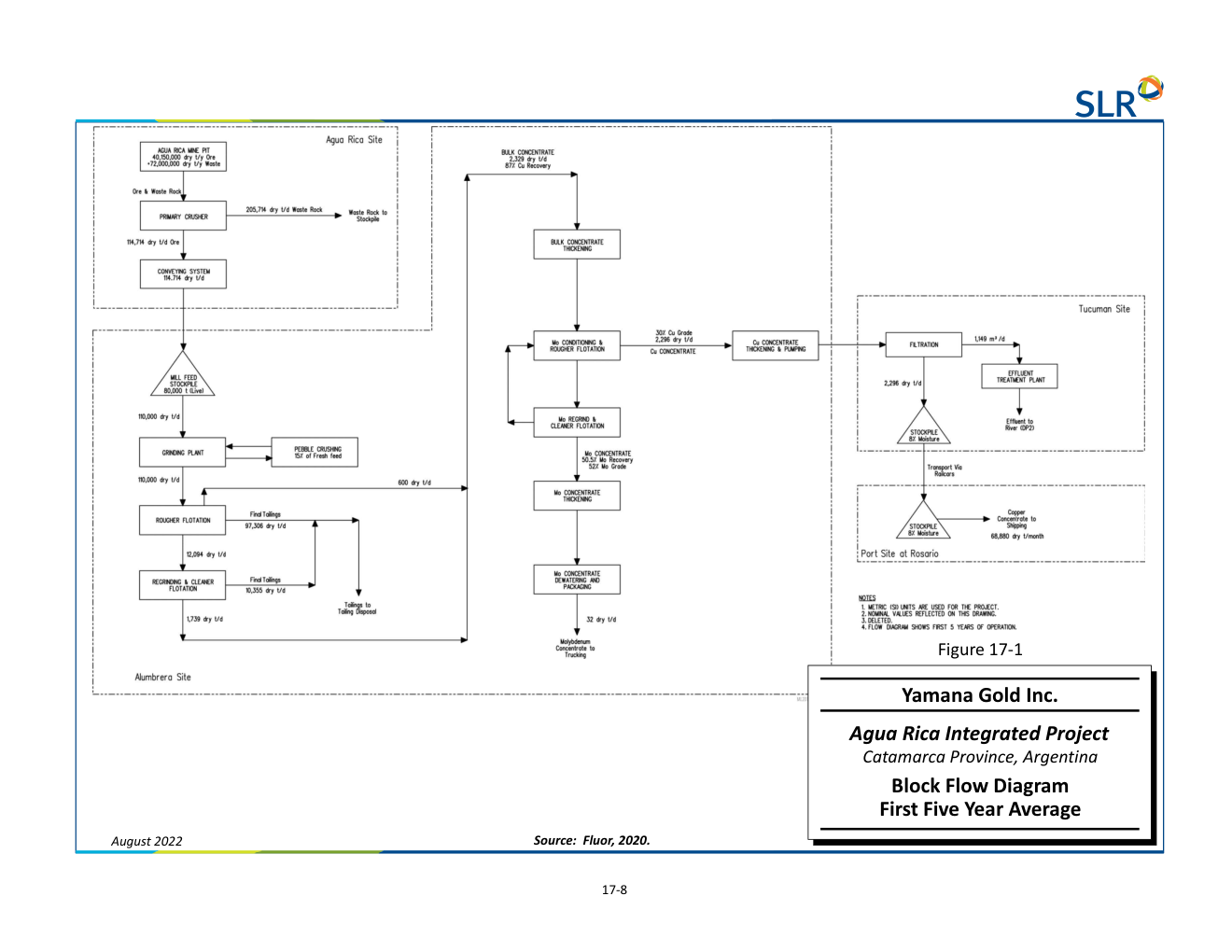
This report outlines the process design, metallurgical considerations, and infrastructure plans for the Agua Rica Integrated Project, which will utilize the existing Alumbrera facilities to treat ore from the Agua Rica mine.
The Agua Rica Integrated Project is designed to increase the existing Alumbrera concentrator capacity from its current 90,000 tpd to a nominal throughput of 110,000 tpd (40 Mtpa). The process design criteria, updated for the 2022 Technical Report, define the engineering specifications for the facilities, including the effluent treatment plant, reagents, and plant services. Where site-specific data were not available, criteria were developed from reasonable assumptions using data from previous and similar process applications. A key logistical difference from earlier studies is that waste will be trucked to a dump close to the mine rather than being crushed and conveyed to the Campo Arenal area. The plant will treat ore delivered from the Agua Rica mine pit, with the design incorporating primary crushing, grinding, and bulk copper-molybdenum flotation, followed by separate processing and handling for each concentrate.
Critical Data
| Parameter | Value | Unit | Notes |
|---|---|---|---|
| Ore Processing Rate (Nominal) | 110,000 | tpd | Dry |
| Ore Processing Rate (Design) | 121,000 | tpd | Dry |
| Ore Processing Rate (Nominal) | 40,150,000 | tpa | Dry |
| Operating Days per Year | 350 | days/year | |
| Operating Hours per Day | 24 | hours/day | |
| Primary Crushing Throughput (Nominal) | 6,828 | tph | Total dry |
| Primary Crushing Throughput (Design) | 7,852 | tph | Dry |
| Grinding – Hourly Throughput (Nominal) | 4,982 | tph | Dry |
| Grinding – Hourly Throughput (Design) | 5,480 | tph | Dry |
| Grinding – Design Factor | 1.10 | – | |
| Overall Plant Operating Time | 92 | % | |
| Ball Mill Circuit Product, P80 | 150 | µm | From 2012 test work |
| BWI, Weighted Average (Year 1) | 10.6 | kWh/t | From 2012 test work |
| Crusher Utilization (Design) | 70 | % | Equivalent to 16.8 h/day |
| Overland Conveyor Utilization (Design) | 90 | % | Equivalent to 21.6 h/day |
| Molybdenum Concentrate Storage (A-frame) | 60,000 | wmt |
Overview
The project aims to extend the life of the existing Alumbrera processing complex by treating ore from the Agua Rica deposit. The process plant design focuses on increasing throughput and reconfiguring the existing circuitry to handle the new ore type while maintaining the recoveries of copper and molybdenum. A significant portion of the design work involved revisiting the 2013 feasibility study and 2019 pre-feasibility study to incorporate new metallurgical analysis and optimize the flotation and regrinding stages. The existing Alumbrera plant offers substantial infrastructure, including a pipeline for concentrate transport, which the project will continue to use.
Key Process Stages
The metallurgical process consists of several distinct stages, from primary crushing to final filtered and dried concentrates. The grinding circuit will use the existing SAG and ball mills. The flotation circuit will be expanded and reconfigured based on a coarse cleaning concept from the 2019 analysis. The design includes both copper and molybdenum processing lines, along with ancillary services like concentrate handling and filtration.
Primary Crushing
A primary gyratory crusher will be used. It will be fed Run-of-Mine (ROM) material by 320 t haul trucks via one of two dump stations to a dump pocket situated directly above the crusher. The dump station and pocket will be designed to minimize haul truck maneuvers, and the arrangement will provide mobile equipment access to the pocket for maintenance activities like excavating dead material and replacing liners. The crusher has a design throughput of 7,852 dry tph. A dedicated control room will be provided for the primary crushing plant.
Conveying
A series of six overland conveyors will transport crushed ore from the primary crusher to the existing stockpile. The design criteria for this system is a 90% utilization, which equates to 21.6 h/day. The final conveyor routing was determined by an evaluation aimed at minimizing civil costs, ensuring equipment selection within current operating ratings, and providing component standardization. This process also included a review of the primary crushing and mine services area location and layout in 2019.
Grinding
The nominal grinding capacity will be increased to 110,000 tpd when Agua Rica ore is introduced. Due to the softer nature of the Agua Rica ore, only the two original grinding lines will be required for the target throughput. The circuit configuration was reviewed during the PFS-A phase, considering the potential use of all installed equipment, including the smaller SAG mill 3. The design incorporates a design factor of 1.10 and a product size of 80% passing 150 µm. The weighted average Bond Work Index for year 1 is 10.6 kWh/t.
Flotation
The flotation circuit will be expanded with a parallel circuit to increase capacity. The circuit will incorporate mechanical flotation cells for the rougher, first cleaner, and second cleaner stages. Column cells will be used for the third and fourth cleaner stages for both copper and molybdenum. The 2019 metallurgical analysis, which forms the basis for the final circuit configuration, recommends an updated design featuring a coarse cleaning concept and an expanded regrind stage. The existing Jameson cells will not be removed and are not required for the new design.
Regrinding
Additional regrind capacity will be installed by operating the existing BM 12 mill in parallel with a new 3,000 kW mill to meet the process requirements. This is necessary because the current molybdenum circuit does not include a regrind system. The expanded regrind circuit is a key component of the final configuration to ensure overall metallurgical recoveries are achieved.
Molybdenum Circuit
A parallel molybdenum flotation circuit, similar to the current design, will be added to meet the capacity requirement. The molybdenum circuit includes a regrind step. Concentrate from the final molybdenum flotation cleaner will be thickened in two high rate thickeners (one existing, one future) operating in parallel. The thickener underflow is sent to molybdenum filters (one existing, one future), which are disc type filters. The resulting cake will be further dried in screw type molybdenum dryers to produce the final molybdenum concentrate product, which will be packaged and transported off site. Filtrate from the filters will be routed back to the molybdenum concentrate thickener feed box.
Copper Concentrate Handling
Copper concentrate will be sent to two existing 30 m high rate thickeners operating in series. There is an option to route the concentrate to two new high rate thickeners if future test work indicates they are required. The concentrate will be transported via the existing Alumbrera pipeline. The project has examined historical pipeline performance data to understand the long-term capacity constraints, including a theoretical maximum based on the best historical month of 80,364 t (dry). It is expected that in some years, concentrate production may exceed the pipeline’s capacity.
Arsenic Management
A key metallurgical challenge is the arsenic content of the Agua Rica concentrate. Many major smelters and several countries will not accept copper concentrates with more than 0.5% As. The issue is approached in two primary ways: the application of metallurgical processes for arsenic removal, and a restricted mine plan combined with concentrate blending. Concentrate blending is recommended as the base case for the next stage of study. Metallurgical arsenic removal processes are considered a potential future opportunity, not part of the current base case.
Plant Services
The power required for the project will be supplied by Alumbrera’s existing power line. Water will be supplied from sources outlined in the report’s water management section. Other services include compressed air, process water, gland seal water, fire water, potable water, and nitrogen.
Additional Interesting Data and Summary
The project’s viability is heavily reliant on the existing infrastructure at Alumbrera, most notably the pipeline system and the existing plant equipment. A logistics study was conducted to evaluate the transport of concentrate under the new operating scenario. For pipeline performance, historical data indicates an actual full train is loaded and dispatched every two days. The filter plant's condition and capacity were reviewed, with visits conducted to discuss operations with senior staff and collect data. The theoretical maximum pipeline capacity is inferred to be around 80,364 t (dry) based on the best historical month (December). The final molybdenum concentrate will be produced and packaged for transport, and dryers will be provided to ensure the final product meets specifications. The existing control room will be upgraded to include the operation of the new equipment.
Key Processes
- Primary crushing with a gyratory crusher fed by haul trucks.
- Grinding in existing SAG and ball mills.
- Bulk copper-molybdenum flotation with mechanical cells and column cells.
- A parallel molybdenum flotation circuit and regrind stage.
- Concentrate dewatering and drying using thickeners, filters, and screw dryers.
- Concentrate transport via the existing Alumbrera pipeline.
Source: Agua Rica Integrated Project , 2022 Technical Report, 2022.
Project website: Agua Rica Integrated Project, 2022 Technical Report
