

The Wood Mountain Project centers on Whitemud Resources Inc.'s Gollier Creek metakaolin facility in Saskatchewan, which is being modified to replace an inefficient rotary calcining system with a flash calciner configuration.
Whitemud Resources Inc.'s Gollier Creek metakaolin facility was designed to produce metakaolin through a process of drying, size and density classification to reject silica, and calcining to convert kaolin to metakaolin. The processing plant operated intermittently from 2008 to 2010, and again in 2012 for approximately three months. Operations were challenged by poor economics, partly resulting from inefficiencies in the processing plant.
In Q1 2024, Fortress Engineering Ltd. produced a Design Basis Memorandum for Gollier Creek that highlighted inefficiencies in the original design responsible for the facility's poor economics. The memorandum identified the creation of a large circulating load of metakaolin from the rotary calciner and cooler back to the rotary dryer, caused by high gas velocities in this equipment and the lack of adequate gas-solid separation. An additional concern was the unfavorable carbon footprint of the process due to the use of pulverized coal as a heat source in the calciner.
The facility is expected to be recommissioned in H2 of 2024 following modifications that began in December 2023. The updated design replaces the rotary calciner, cooler, and coal pulverizing plant with a flash calciner heated by the existing 60 GJ rotary dryer burner converted to natural gas, plus a dust collector (baghouse). Previous operating experience demonstrated that run-of-mine (ROM) material fed to the plant should contain less than 8% moisture to minimize material handling difficulties, and preferably greater than 6% moisture to minimize dust generation. Spreading material outdoors for a day before introducing it into the process was found effective in reducing moisture content through evaporation to acceptable levels.
Critical Data
| Parameter | Value | Unit | Notes |
|---|---|---|---|
| Plant operating time | 183 | days/annum | July to December |
| Plant operating schedule | 7 | days/week | Initially one week on, one week off |
| Utilization | 83 | % | Not stated |
| Operating hours | 24 | hr/day | Not stated |
| Plant feed rate | 55 | tph | Design criterion |
| Metakaolin production rate | 10.5 | tph | Design criterion |
| Temperature of rotary dryer gas discharge | 315 | °C | Supplementary heat from 17 GJ natural gas trim burner |
| Temperature of flash calciner gas | 1,650 | °C | Design criterion |
| Temperature in calciner dust collector (calciner exhaust gas) | 250 | °C | Design criterion |
| Temperature at bulk cooler discharge (metakaolin) | 80 | °C | Design criterion |
| Connected load | 1.7 | MW | Electricity from SaskPower regional grid |
| Annual production | 20,000 | tpa | Approximate, at 19% yield |
| Product yield | 19 | % per tonne of ore processed | Approximate |
| ROM moisture content | 8 | % | Maximum to minimize material handling difficulties |
| ROM moisture content | 6 | % | Minimum to minimize dust generation |
Overview
The Gollier Creek metakaolin facility was originally designed to process kaolin ore through drying, classification, and calcination. The plant operated intermittently between 2008 and 2012 but struggled economically due to processing inefficiencies, primarily a large circulating load of metakaolin caused by inadequate gas-solid separation in the rotary calciner and cooler circuit. A 2024 design review by Fortress Engineering identified these issues and proposed a revised configuration using a flash calciner with natural gas heating, replacing the original coal-fired rotary system. The mine and process are planned to operate six months per year (July to December), initially on an alternating weekly schedule, to produce approximately 20,000 tpa of metakaolin.
Key Process Stages
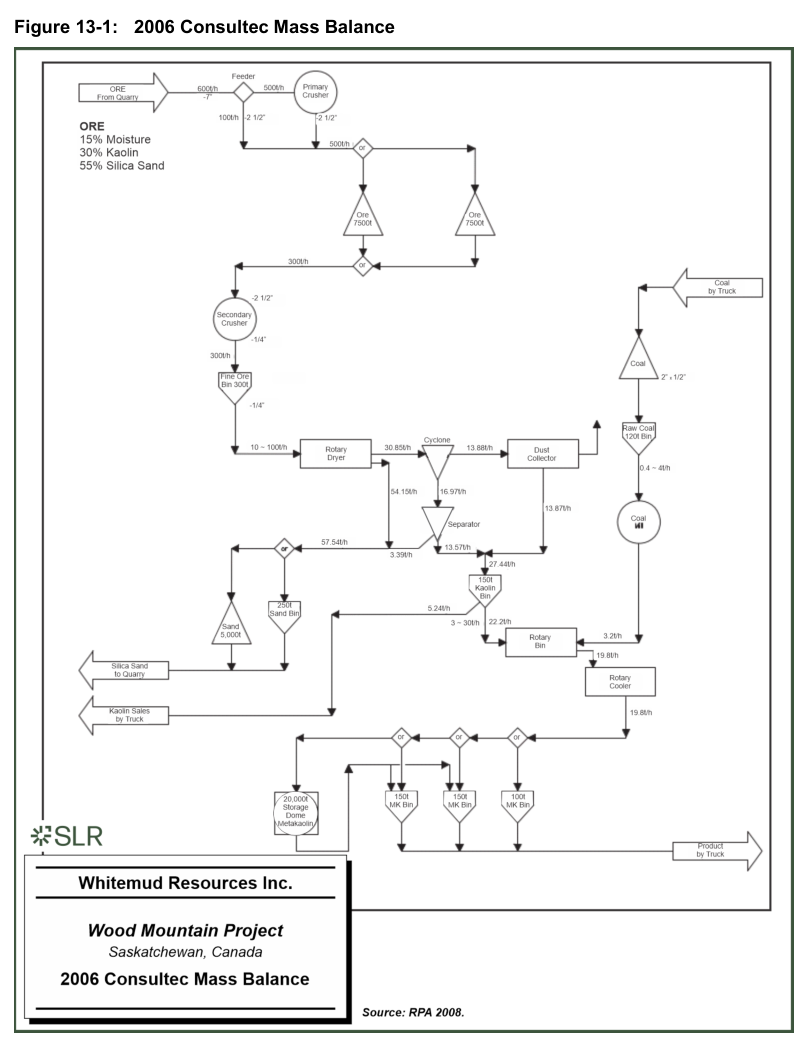
The original 2008-2012 process involved transporting feed ore to the plant site and stockpiling it, with two stockpiles used alternately: one receiving ore from the crusher while the other was reclaimed by a front-end loader to feed the plant. Raw ore was reclaimed from the stockpile and fed by conveyor to a fine ore storage bin that fed the dryer. Dust collection was provided at all transfer points to control dust emissions.
The dryer operated in co-current mode with hot gases from the rotary calcining kiln, rotary cooler, and a coal-fired hot gas generator. Light kaolin particles and fine silica sand were swept from the dryer by exhaust gases pulled by an induced draft fan (the main process fan) and recovered in a baghouse. The primary fuel source was lignite coal, which was pulverized in a Raymond coal mill and transported to the calcining kiln burner by the main process induced draft fan after being densified in a cyclone.
Cooling air was drawn through the cooler by the dryer vent fan countercurrent to product flow. Cooled metakaolin was discharged from the cooler and transferred pneumatically via pipeline to storage bins and a 20,000 t storage dome. Product was then transported by contract services to the Scout Lake terminal for rail shipment.
In the 2024 modified design, the rotary calciner, cooler, and coal pulverizing plant are replaced with a flash calciner heated by the existing 60 GJ rotary dryer burner using natural gas, supplemented by a 17 GJ natural gas trim burner to increase air temperature entering the rotary dryer to 315°C. The gas discharge of the dryer was modified after test runs. Air and combustion gases move material through the flash calciner and dust collector. The discharge end of the rotary dryer has been modified. Additional equipment includes air locks and pneumatic conveyor system upgrades downstream of the dust collector, with rotary air locks replacing slide gate valves at kaolin and metakaolin transfer points to ensure positive seals and minimize leaks. A glycol cooling loop and support equipment will be used in the metakaolin bulk cooler. Natural gas is supplied by Sask Energy through an existing two-inch supply pipeline.
The process is dry and does not use water. Key consumables include crusher wear parts, conveyor belting and idlers, and filter bags.
Additional Interesting Data and Summary
Moisture management is critical for plant operation. Previous operating experience showed that ROM material should contain less than 8% moisture to minimize material handling difficulties and preferably greater than 6% moisture to minimize dust generation. Spreading material outdoors for a day was found effective in reducing moisture content through evaporation to acceptable levels, and this method may be used during future operations when necessary.
Quality control involves measuring chemical oxides using a PANalytical Epsilon1 X-Ray Spectrometer, with key parameters including Al₂O₃, SiO₂, SO₃, K₂O, and Na₂O. Product acceptance criteria also include the percent less than 20 µm. Thermal properties are measured using a Mettler-Toledo TGA/DSC 3+ STARe instrument with Thermogravimetric Analysis and Differential Scanning Calorimetry. Testing follows CSA A 3004, ASTM C 311, or additional customer specifications.
Critical processes will be monitored using statistical process control (SPC) charts designed to indicate when process adjustments are necessary. Target values for all process indicators are defined in the Production Operating Instructions or plant Internal Quality Objectives.
Key Processes
- Drying in a rotary dryer with co-current gas flow, heated by natural gas burner and supplementary trim burner
- Size and density classification to reject silica
- Calcining in a flash calciner at 1,650°C to convert kaolin to metakaolin
- Dust collection via baghouse
- Cooling in a glycol-cooled bulk cooler to 80°C
- Pneumatic conveying to storage bins and 20,000 t storage dome
- Quality assurance using X-ray spectrometry for chemical oxides (Al₂O₃, SiO₂, SO₃, K₂O, Na₂O) and TGA/DSC for thermal properties
- Moisture management through outdoor spreading to achieve 6-8% feed moisture
Source: Wood Mountain Project , 2024 Technical Report, 2024. Project website: Wood Mountain Project (https://millmatters.com/wood-mountain-project-2024-technical-report/)
Project website: Wood Mountain Project, 2024 Technical Report
