

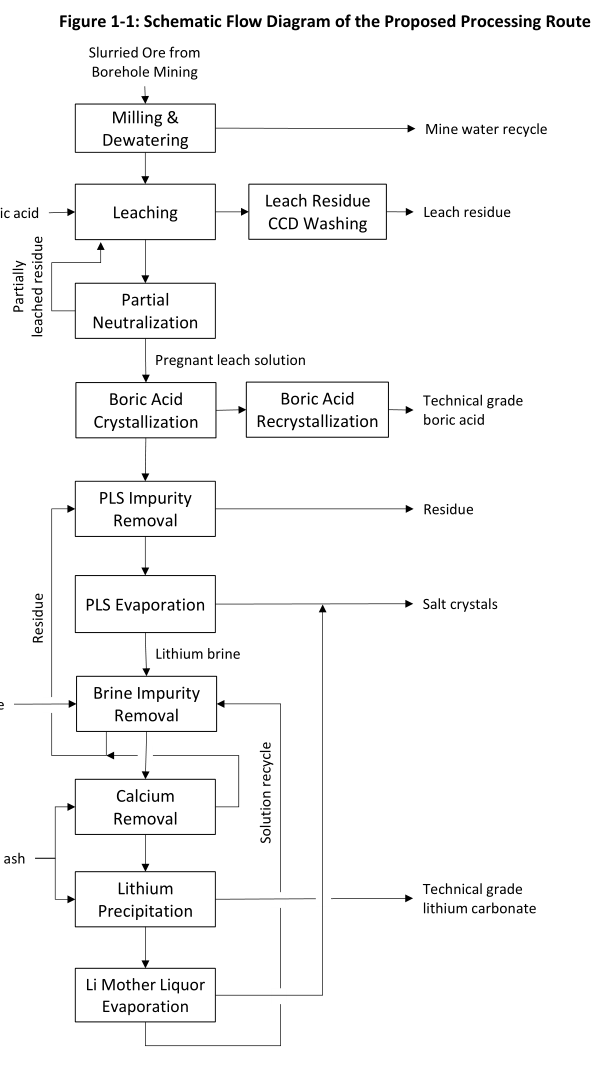
This report summarizes the proposed process plant design for the Bonnie Claire Lithium Project, covering ore milling, leaching, crystallization, impurity removal, and product recovery circuits, as presented in the 2025 technical report.
Report context
The Bonnie Claire Lithium Project processing information in this article is drawn from the 2025 Preliminary Economic Assessment Technical Report, dated September 8, 2025. The report describes a proposed process plant designed to produce technical grade lithium carbonate and boric acid from the lower zone of the Bonnie Claire deposit, with the flowsheet based on metallurgical testwork and industry benchmark data.
Processing route
Ore Milling and Dewatering
The proposed process plant is designed to treat 8,000 metric tonnes per day of mined material. Run-of-mine material, delivered as a dilute slurry from borehole mining, is received in a surge tank. The slurry is processed through a ball milling circuit to reduce coarse material and increase reactivity of calcite grains. A hydrocyclone cluster targets an overflow size of 80% passing 106 µm, with underflow returning to the ball mill.
Dewatering occurs in two stages, first through a 67 m diameter high-rate thickener, then decanter centrifuges achieving 60% solids cake. The repulped cake feeds the Counter Current Leaching circuit, while mill water is recycled to the borehole mining area.
Counter Current Leaching and Residue Washing
The leaching circuit combines centrifuge cake with pregnant leach solution and intermediate leach solution from the first CCD thickener stage. The circuit comprises neutralization tanks and leach tanks with total residence times of one and four hours respectively. Concentrated sulfuric acid is added in the leach tanks for complete lithium leaching.
Leach discharge reports to an 8-stage CCD thickener circuit recovering dissolved lithium and boron. Process water is added at the final stage, with counter-current flow maintaining lithium concentration gradients. The final underflow is dewatered in a recessed chamber filter press, with cake conveyed to tailings and filtrate recycled.
The leach reactions are highly exothermic, with off-gas captured, pressurized, and injected into the neutralization tank to maintain PLS temperature above 70°C, increasing boric acid solubility.
Boric Acid Recovery
PLS from the leach circuit reports to a two-stage cooling crystallization circuit for boric acid recovery. Draft-tube crystallizers operate under progressively lower vacuum, flashing solution to a final temperature of 17°C. The first stage uses cooling tower water, the second chilled water. Crystals are separated on a belt filter, washed, and advanced to recrystallization.
Crude boric acid crystals are redissolved and recrystallized in a two-stage draft-tube circuit, then dewatered in pusher centrifuges with washing, dried in a rotary dryer, and packaged in 1 m³ bulk bags.
PLS Impurity Removal and Evaporation
Filtrate from crude boric acid crystallization is heated and treated in reactors operating at 95°C with 12 hours residence time. Magnesium hydroxide precipitate from the lithium brine impurity removal circuit serves as neutralizing reagent, with pH increased above 4.5 for aluminium precipitation. The slurry is filtered, with a portion of filter cake recycled as seed, and filtrate advancing to PLS Evaporation.
The PLS evaporator is a 4-stage forced circulation, draft-tube circuit operating under slight vacuum with final stage temperature of 75°C. Lithium concentrates to 0.65 wt%, with magnesium, sodium, iron, calcium, and boron crystallizing as mixed sulfate salts and boric acid. Crystals are debrined in a screen-scroll centrifuge.
Lithium Brine Impurity Removal
Lithium brine from evaporation is treated in surge tanks, then advanced to impurity removal tanks where hydrated lime raises pH to 11, precipitating magnesium, ferrous iron, and boron. The slurry is filtered through a recessed chamber filter press, with a portion of filter cake recycled to PLS impurity removal as neutralizing reagent. The remaining cake is washed and conveyed to tailings.
Calcium and magnesium are precipitated to trace levels using sodium carbonate. The slurry is thickened, with underflow recycled to PLS Impurity Removal, and overflow pre-heated prior to lithium carbonate precipitation.
Lithium Carbonate Precipitation and Product Handling
The purified lithium brine reports to a precipitation reactor operating above 85°C with internal baffling to increase solids content and improve crystal growth. Sodium carbonate precipitates lithium carbonate. The underflow slurry is dewatered on a belt filter, washed, dried in a rotary dryer, cooled, and packaged in 1 m³ bulk bags as technical grade lithium carbonate.
Lithium Mother Liquor Evaporation and Bleed
Lithium-depleted solution from carbonate removal is concentrated in a 3-stage forced circulation evaporation circuit driven by low-pressure steam. Operating under slight vacuum with final stage temperature of 65 to 70°C, lithium reaches 0.60 wt% while sodium and potassium crystallize as mixed sulfate salts. Crystals are debrined in a pusher centrifuge.
The majority of mother liquor is recycled to Lithium Brine Impurity Removal for lime pulping. The remaining bleed is treated with sodium carbonate in a separate tank, with precipitated lithium carbonate recycled and lithium-depleted solution removed from the circuit. The destination of this bleed solution is not yet determined.
Sulfuric Acid Plant and Utilities
A dedicated 3,700 metric tpd sulfuric acid plant uses sulfur burning with double conversion, double adsorption technology, including tails gas scrubbing. A waste heat boiler generates high-pressure steam for a back-pressure turbine, with low-pressure steam used for thermal evaporation. Process condensate is recovered and returned to the boiler system.
Services include fresh water, process water, process condensate, cooling water, chilled water, gland seal water, potable water, and fire water systems. Boiler feed water is treated and high-pressure steam generated at the acid plant.
Reagents
- Sulfur: Delivered molten in tanker trucks, stored heated, used in acid plant
- Sulfuric acid: Produced on site at 98% concentration, distributed to leaching and precipitation circuits
- Soda Ash: Stored in silo, dissolved using local process solutions, used in brine impurity removal, lithium carbonate precipitation, and bleed treatment
- Hydrated Lime: Stored in silo, pulped, delivered via ring main, used in lithium brine impurity removal
- Flocculant: Dissolved using process water, used in dewatering, leaching, and residue washing circuits
Key reported parameters
| Parameter | Value | Basis |
|---|---|---|
| Plant feed rate | 8,000 tpd / 2,920,000 tpa | Design |
| Lithium feed grade | 4,720 ppm | Average |
| Boron feed grade | 1.62% | Average |
| Lithium recovery | 85% | Projected |
| Boron recovery | 44% | Projected |
| Lithium carbonate production | 62,400 tpa | Projected |
| Boric acid production | 118,700 tpa | Projected |
| Sulfuric acid plant capacity | 3,700 tpd | Design |
| Cyclone overflow size | 80% passing 106 µm | Design |
| Thickener underflow solids | 35% | Design |
| Centrifuge cake solids | 60% | Design |
| Neutralization temperature | >70°C | Operating |
| Leach residence time | 1 hour (neutralization) / 4 hours (leach) | Design |
| CCD stages | 8 | Design |
| CCD underflow solids | 35% | Design |
| Wash rate | 0.75 t/t underflow solution | Design |
| Boric acid crystallization temperature | 17°C | Design |
| PLS impurity removal temperature | 95°C | Operating |
| PLS impurity removal residence | 12 hours | Design |
| PLS evaporation stages | 4 | Design |
| PLS evaporation final stage temp | 75°C | Design |
| Lithium concentration after evaporation | 0.65 wt% | Design |
| Lithium brine impurity removal pH | 11 | Design |
| Lithium carbonate precipitation temp | >85°C | Design |
| Mother liquor evaporation stages | 3 | Design |
| Mother liquor evaporation final temp | 65–70°C | Design |
| Lithium concentration after evaporation | 0.60 wt% | Design |
Project website: https://nevadalithium.com/bonnie-claire-project/
Project website: https://iconicminerals.com/news/iconic-initiates-plan-of-operations-permitting-for-bonnie-claire-lithium-project/
Technical qualifications
The following limitations apply to the information presented in this article:
- The process flowsheet is proposed design, not an operating plant description
- Metallurgical testwork was performed on samples from the lower zone of the Bonnie Claire deposit only
- Production figures are projected, based on average feed grades and projected recoveries
- The destination of the lithium mother liquor bleed solution has not yet been determined
- The report is a Preliminary Economic Assessment, not a feasibility study
- Cost estimates referenced in the report are provided in Section 21 of the source document and are not summarized here
Source: Bonnie Claire Lithium Project, Preliminary Economic Assessment Technical Report, September 8, 2025, Section 17.0 Recovery Methods and Section 17.1 Overview.
