

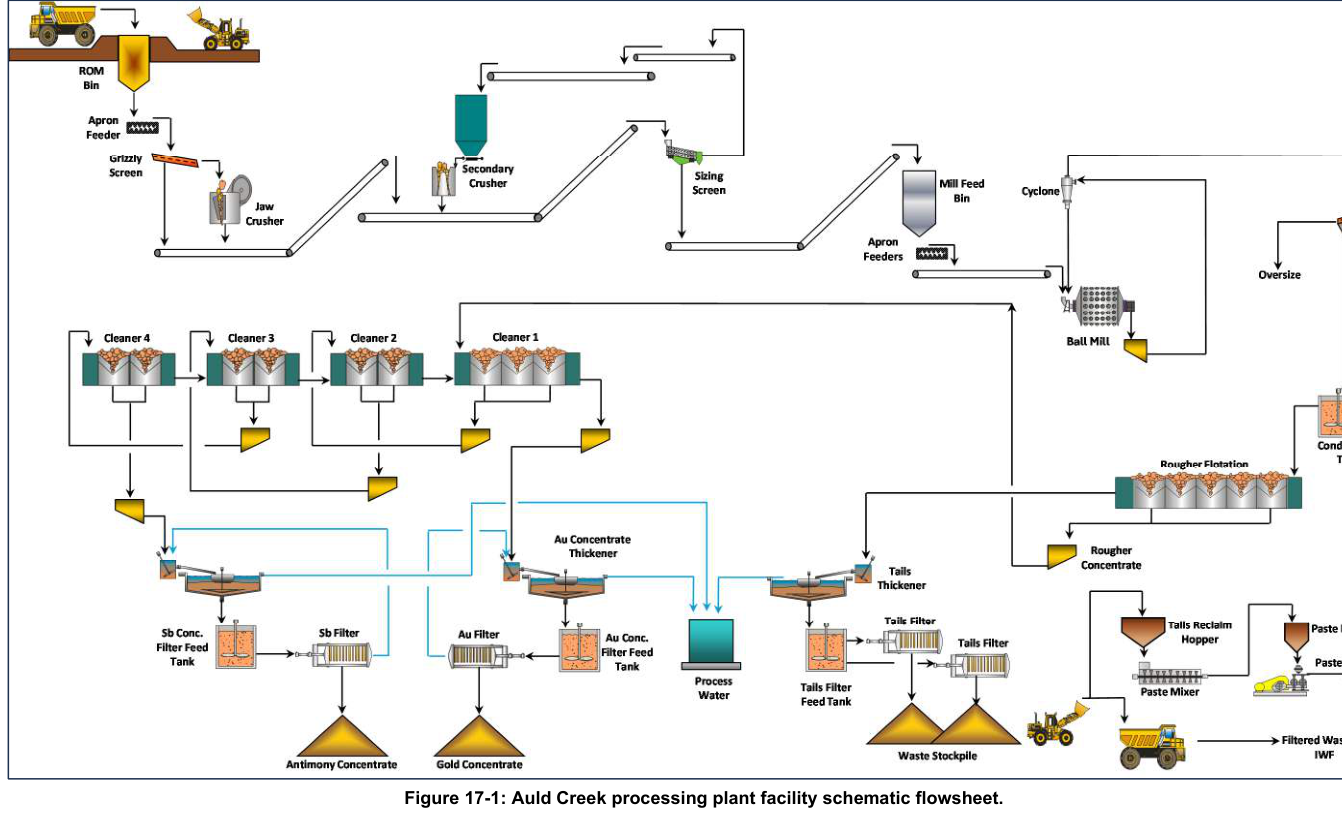
The PEA for Rua Gold's Auld Creek project in New Zealand's South Island outlines a flotation-based processing plant designed to produce separate antimony and gold concentrates from underground ore.
The Auld Creek Gold-Antimony Project is an exploration-stage project held by Reefton Resources Pty Limited, a wholly owned subsidiary of Rua Gold Inc., located in the Reefton Goldfield in the West Coast region of New Zealand's South Island. The project sits within exploration permit EP 60648, covering 40.6405 km² directly south of the town of Reefton, mostly within Victoria Forest Park. Rua Gold completed the acquisition of Reefton Resources from Siren Gold Ltd in November 2024. The mining method selected for the base case is overhand cut-and-fill, with a nominal production rate of about 250 ktpa and a projected mine life of roughly six to seven years based on current mineral resources. Rua Gold plans to commence a Pre-Feasibility Study after the PEA, aiming for production to start in mid-2027. The target commodities are gold and antimony, present as orogenic-style mineralisation within steeply dipping shear zones cutting folded Greenland Group metasedimentary rocks.
Critical Data
| Parameter | Value | Unit | Notes |
|---|---|---|---|
| Nominal plant throughput | 0.25 | Mtpa | ROM ore feed |
| Ball Mill Work Index | 16.0 | kWh/t | ALS Metallurgical Report A25728 |
| Ball Mill Work Index closing screen | 150 | µm | ALS Metallurgical Report A25728 |
| Solids specific gravity | 2.86 | Not applicable | ALS Metallurgical Report A25728 |
| Flotation grind size | 106 | µm | 80% passing |
| Annual Sb concentrate production | 2,798 | tpa | Design basis |
| Annual Au production | 14,613 | oz | Design basis |
| Crushing circuit availability | 70 | % | 18 hours/day, 365 days/year |
| Crushing rate | 54 | tph | Nominal |
| Grinding circuit availability | 91.3 | % | 24 hours/day, 365 days/year |
| Grinding throughput | 31.3 | tph | Nominal |
| Ball mill installed power | 800 | kW | Single 10.5 ft × 15.5 ft EGL grate discharge mill |
| Ball mill power draw | 626 | kW | At pinion, 674 kW at motor |
| Rougher flotation residence time | 18 | min | Six cells, scale-up factor of 2.5 applied to lab data |
| Cleaner flotation residence time | 38 | min | Four stages, scale-up factor of 2.5 applied to lab data |
| Rougher mass yield to concentrate | 6–8 | % | Design target |
| Cleaner mass yield to final Sb concentrate | 1.4–1.8 | % | Design target |
| Stibnite concentrate thickener diameter | 4 | m | Required diameter 1.9 m; 4 m provides margin |
| Au concentrate thickener diameter | 4 | m | Required diameter 3.5 m; 20% margin |
| Tails thickener diameter | 10 | m | Required diameter 7.9 m; 20% margin |
| Sb concentrate target moisture | <12 | % | Filtered product |
| Au concentrate target moisture | <12 | % | Filtered product |
| Tails filtration operating utilisation | 85 | % | 90% availability, 94% utilisation |
Overview
The processing plant design covers all ore processing activities from crushing through to concentrate storage in one-tonne bulk bags. The flowsheet also includes a tailings filtration circuit, with filtered tailings either transported to dry-stacked storage or used for paste backfill production. The circuit produces two separate saleable products: an antimony-rich concentrate and a gold concentrate.
The design basis starts with a two-stage crushing circuit and crushed ore storage, followed by ball milling with cyclone classification. Bulk rougher flotation produces a combined Sb-Au concentrate, and four stages of differential cleaning separate the antimony and gold values. Both concentrates go through thickening, filtration, and bagging. Tailings are thickened and filtered before disposal.
The annual production targets are 2,798 tonnes of antimony concentrate and 14,613 ounces of gold, processing 0.25 Mtpa of run-of-mine ore. The crushing area operates 18 hours per day for 365 days, while all other process areas run two 12-hour shifts per day for 365 days.
Key Process Stages
ROM ore from the underground mine arrives with a maximum lump size of 500 mm and a P80 of 250 mm. Articulated haul trucks rear-dump into the ROM bin, which is fitted with a 700 mm static grizzly. A mobile rock breaker manages oversize material. The ROM pad offers 10,000 tonnes of storage capacity, and ore not direct-tipped is reclaimed by front-end loader.
A vibrating grizzly screen with 75 mm bar spacing feeds the primary jaw crusher. The C80 jaw crusher handles a maximum lump size of 600 mm and rates at 110 tph with a closed side setting of 80 mm. Crusher product combines with grizzly undersize on the screen feed conveyor, fitted with a weightometer for mass accounting and a continuous belt magnet for tramp metal removal.
Oversize material from the double-deck sizing screen, with top deck openings of 35 mm and lower deck openings of 20 mm, reports to the secondary crusher feed bin. An HP200 cone crusher operates in closed circuit with a maximum capacity of 120 tph at a 13 mm closed side setting. A metal detector and static magnet on the secondary crusher feed conveyor trigger a bypass chute on metal detection events. Screen undersize at P80 15 mm conveys to the mill feed bin.
The 750-tonne live capacity mill feed bin provides 24 hours of surge capacity at the design throughput. Duty and standby variable speed apron feeders withdraw crushed ore onto the ball mill feed conveyor, which has a weightometer for feed rate control and mass accounting.
The grinding circuit consists of a single grate discharge ball mill with 800 kW installed power. Under nominal conditions the mill operates at 72% of critical speed with a 30 wt% ball charge, drawing 626 kW at the pinion. The grate discharge design is intended to reduce overgrinding of brittle minerals such as stibnite. The mill operates in closed circuit with four 250 mm cyclones handling a 300% circulating load. Cyclone overflow at 30 wt% solids constitutes flotation feed.
Bulk rougher flotation uses six mechanically agitated forced-air cells, each of 5 m³ volume, providing a circuit residence time of 18 minutes. A scale-up factor of 2.5 was applied to laboratory bench-scale data. The design mass yield to concentrate is 6–8%. Froth crowders are specified because the launder lip loading of 0.07 t/m/h and froth carry rate of 0.19 t/m²/h sit well below industry norms. Localised covers over the flotation cells mitigate rainfall effects in the open-air plant design.
Flotation feed passes through a trash screen with 0.63 mm apertures before reaching the conditioning tank. PAX collector and lead nitrate activator are added in the rougher conditioner tank. Frother, either W24 or H27, is added at the first and third rougher cells as required. A multi-stage metallurgical sampler sends a portion of rougher feed, concentrate, and tails to an on-stream analyser for real-time analysis, with shift composites prepared for assay.
The four-stage cleaner circuit uses progressively smaller cells: Cleaner 1 has three 1.5 m³ trough cells providing 13 minutes residence time, Cleaner 2 has three 0.5 m³ cells providing 8 minutes, and Cleaners 3 and 4 each have two 0.5 m³ cells providing 5 minutes. Total cleaner residence time is 38 minutes. The stages are arranged so tailings from each stage gravitate to the preceding stage while concentrates pump forward. Tails from Cleaner 1 constitute the final gold concentrate. Concentrate from Cleaner 4 becomes the stibnite concentrate feed.
The stibnite concentrate thickener was sized using benchmark settling data of 0.150 t/m²/h in the absence of specific test work. At a design solids loading of 3.5 ktpa, a 1.9 m diameter thickener would suffice, but the design accommodates a 4 m diameter unit providing margin and commonality with the gold concentrate thickener. Thickener underflow at 55–60% solids feeds an 11 m³ agitated filter feed tank with 24 hours capacity.
Stibnite concentrate filtration uses benchmark data of 100 kg/m²/h, giving a required area of 4.4 m² for a design solids loading of 0.003 Mtpa at 85% availability. The filter frame is fitted with 20 plates of 600 mm × 600 mm, but has capacity for 60 plates. Target moisture content is below 12%. Filtered concentrate discharges to a storage bunker and loads into one-tonne bags, each weighed and manually sampled.
The gold concentrate thickener also uses the 0.150 t/m²/h benchmark. At a design solids loading of 9.5 ktpa, a 3.5 m thickener would suffice, and the design again uses a 4 m unit providing a 20% margin. The 40 m³ agitated filter feed tank provides 24 hours storage. Gold concentrate filtration requires 14.3 m² of area at a solids loading of 0.01 Mtpa. The frame holds 40 plates with capacity for 60. Target moisture remains below 12%.
Flotation tails thickening uses a benchmark settling rate of 0.600 t/m²/h. The required diameter is 7.9 m for a design solids loading of 0.237 Mtpa, and the design accommodates a 10 m thickener. Underflow at 55–60% solids feeds a 750 m³ agitated tank with 24 hours capacity. Duty and duty tails filters operate at 85% utilisation, equating to 7,446 operating hours per annum at a nominal capacity of 31.8 tph. Filtered tails are recovered by front-end loader and trucked to dry-stacked storage or to the paste plant stockpile.
A paste backfill plant was initially included in the PEA scope but was removed from cost estimates at the conclusion of the study as a late change. The paste plant still appears in engineering deliverables such as site layouts. Mine backfill strategy and paste plant requirements will be reassessed for the PFS.
Additional Interesting Data and Summary
Reagent systems include PAX collector delivered in 185 kg drums and mixed to a 10 wt% solution in a stacked tank design. Lead nitrate arrives in 1,000 kg bulk bags and mixes to a 20 wt% solution. Frother comes in 1,000 L intermediate bulk containers connected to a standpipe. Flocculant powder arrives in 25 kg bags and mixes through a proprietary system to a 0.25 wt% storage concentration.
Water services include a process water ring-main fed primarily by thickener overflows and filter filtrates, with makeup from the raw water circuit. Raw water comes from Devils Creek and serves crusher dust suppression, reagent makeup, process water makeup, the on-stream analyser, and the potable water treatment plant. Gland service water is sourced from process water through a sand filter to manage the positive water balance created by filtered tailings disposal. Firewater is supplied from the plant raw water tank through a system with electric jockey, electric firewater, and diesel standby pumps. Potable water is treated by reverse osmosis for calcium, magnesium, and chloride removal and serves the OSA, safety showers, and eye-wash stations.
Low-pressure air for flotation comes from two blowers in duty-standby configuration. High-pressure plant air at 700 kPag comes from two compressors, also duty-standby, with the full supply dried. Filtration air at 1,000 kPag uses a separate pair of compressors. A dedicated spillage handling thickener returns all spillage to the main circuit to prevent over-dilution and unstable flotation operation.
The report benchmarks the process against other antimony producers. Hillgrove Mine in New South Wales historically produced a stibnite concentrate containing over 90% of the Sb and 10–20% of feed gold. Larvotto Resources recently completed a Definitive Feasibility Study for a Hillgrove restart with sequential selective flotation. Augusta Mine at Costerfield, Victoria, processed 75 ktpa of ROM ore with two-stage cleaner flotation producing a stibnite concentrate. Consolidated Murchison in South Africa achieved 80–88% antimony recovery to a concentrate grading above 56% Sb. The Sunshine Mine in Idaho is not a useful benchmark because its antimony occurs as argentiferous tetrahedrite rather than stibnite.
Key Processes
- Two-stage crushing: primary jaw crusher and closed-circuit secondary cone crusher
- Ball milling with hydrocyclone classification to produce flotation feed at 80% passing 106 µm
- Bulk rougher flotation with six forced-air cells and 18 minutes residence time
- Four-stage differential cleaner flotation producing separate Sb and Au concentrates
- Stibnite concentrate thickening, filtration, and bagging in one-tonne bags
- Gold concentrate thickening, filtration, and bagging in one-tonne bags
- Flotation tails thickening, filtration, and dry-stacked disposal
- Reagent systems for PAX collector, lead nitrate activator, frother, and flocculant
- Dedicated spillage handling thickener for circuit stability
- Low-pressure and high-pressure air services for flotation and filtration
Source: Technical Report on the Preliminary Economic Assessment (PEA) for the Auld Creek Gold-Antimony Project, New Zealand, 19 June 2026. Project website: Auld Creek Gold-Antimony Project
