

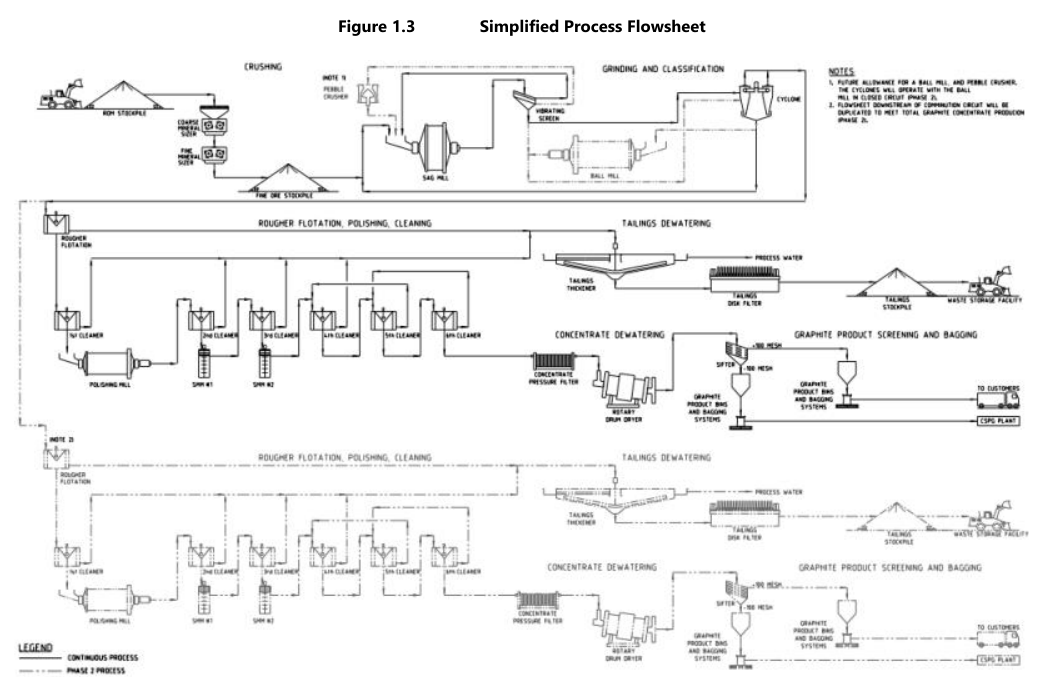
The Bamastar project's process plant will use a phased flowsheet designed around crushing, SAG milling, and multi-stage flotation to produce a high-grade graphite concentrate.
The Bamastar Graphite Project is in the development stage. The process design is based on a phased approach flowsheet designed for the recovery of graphite, while minimizing initial capital expenditure and operating costs. The main design criteria for equipment selection included suitability for duty, reliability, and ease of maintenance. The plant layout provides ease of access to all equipment for operating and maintenance requirements while facilitating ease of concurrent construction in multiple areas. The design basis allows for processing soft oxide material in the earlier years and harder fresh material in Phase 2.
The process design consists of several unit operations. A crushing plant will use a coarse mineral sizer and a fine mineral sizer in series to provide a crushed product with an 80% passing size (P80) of 70 mm. Grinding and classification will be carried out in a SAG mill operated in closed circuit with cyclones to achieve a P80 of 200 µm. The circuit includes a vibrating screen on the SAG mill discharge. Layout allowance is provided for the future installation of a ball mill and a pebble crusher in the grinding circuit to meet increased throughput during the Phase 2 expansion. The graphite flotation circuit consists of one stage of rougher flotation followed by six stages of cleaning, with two polishing steps for graphite recovery and grade improvement. The concentrate is dewatered in a filter press followed by a rotary dryer. The tailings are dewatered in a conventional thickener followed by a disc filter to produce dry stackable tailings.
Critical Data
| Parameter | Value | Unit | Notes |
|---|---|---|---|
| Daily Throughput (Phase 1) | 3,871 | t/d | |
| Average Annual Throughput (Phase 1) | 1,300,000 | tpy | |
| Daily Throughput (Phase 2) | Not stated | t/d | |
| Average Annual Throughput (Phase 2) | 2,600,000 | tpy | |
| Crusher Circuit Operating Percentage | 70.0 | % | |
| Processing Plant Operating Percentage | 92.0 | % | |
| Filtration Operating Percentage | 80.0 | % | |
| Crushing Operating Hours Per Year | 6,132 | h/y | |
| Milling Operating Hours Per Year | 8,059 | h/y | |
| Filtration Operating Hours Per Year | 7,008 | h/y | |
| Head Grade | 2.11 | % C(g) | Not stated |
| Graphite Concentrate Production (Phase 1) | 25,220 | tpy | |
| Overall Concentrate Grade | 98.3 | % | |
| Overall Graphite Recovery | 90.3 | % | |
| Concentrate Moisture Content | 0.5 | % | |
| Crushed Product P80 | 70 | mm | |
| Ground Product P80 | 200 | µm | |
| Concentrate Product (Nominal) | Not stated | % |
Overview
The Bamastar project process plant is designed with a phased approach. The flowsheet is engineered to handle both soft oxide material in the early years and harder fresh material in the later Phase 2. The process design focuses on a simple and efficient flowsheet while minimizing initial capital and operating costs. The key equipment was selected for suitability, reliability, and ease of maintenance.
Key Process Stages
The processing plant is designed in distinct stages, starting with crushing and grinding. The crushing plant consists of a coarse mineral sizer and a fine mineral sizer in series to process both soft oxide material in the earlier years of the mine plan and harder fresh material in Phase 2. The discharge from the coarse mineral sizer feeds the fine mineral sizer to produce a crushed material with a P80 of 70 mm. The crushed material is stockpiled in a fine mineralized material stockpile, which is designed to store 24 hr of feed, decoupling the crushing plant from the milling section.
The grinding section consists of a SAG mill, a vibrating screen, and cyclones for processing the oxide mineralized material during Phase 1. The SAG mill is operated in closed circuit with cyclones to produce a ground product with a P80 of 200 µm. The oversize material from the vibrating screen is recycled to the SAG mill, and the undersize is pumped to the cyclones. In the future, a ball mill and a pebble crusher will be added to the grinding circuit to process the increased throughput in Phase 2. The oversized material from the vibrating screen will feed the pebble crusher in the SAG mill circuit.
The flotation circuit consists of rougher flotation followed by six stages of cleaner flotation for graphite grade improvement. Most of the liberated graphite is recovered in the rougher stage. The cleaner circuit includes three concentrate polishing steps in the 1st, 2nd, and 3rd cleaner flotation stages. Tailings from the 1st through 4th cleaner stages, along with the rougher tails, report to the tailings thickener.
Graphite concentrate dewatering will be carried out in a filter press followed by a rotary dryer to reduce moisture to 0.5%. The dried graphite concentrate will be screened to produce two products; one +100 mesh and one -100 mesh. Tailings dewatering is performed using a conventional thickener followed by a disc filter to produce dry stackable tailings. The filtered tailings will be sent to the waste storage facility.
Three types of water will be used in the plant: process, potable, and raw water. Plant and instrument air will be supplied from air compressors. The flowsheet downstream of comminution is duplicated for Phase 2.
Additional Interesting Data and Summary
The process design is centered on a phased approach to match production with the mine plan. The Phase 1 flowsheet is designed to produce 25,000 tpy graphite concentrate. To meet the increased throughput in Phase 2, the flowsheet downstream of comminution (flotation, graphite product dewatering, drying, bagging, and tailings dewatering) will be duplicated to produce another 25,000 tpy concentrate. This means the concentrator will have two processing lines in parallel, each line producing 25,000 tpy of graphite concentrate for a total 50,000 tpy graphite concentrate.
The design emphasizes decoupling the crushing plant from the milling section via a fine material stockpile. This helps to smooth feed variations and allows for independent operation. The use of a standard SAG mill circuit with provisions for a pebble crusher and ball mill indicates a conventional approach to hard-rock grinding. The multi-stage cleaner flotation with integrated polishing steps is designed to achieve a high-grade concentrate product.
Key Processes
- Crushing: Coarse and fine mineral sizers in series to produce a P80 of 70 mm.
- Grinding: SAG mill in closed circuit with cyclones to achieve a P80 of 200 µm.
- Flotation: One stage of rougher flotation followed by six stages of cleaner flotation, including three polishing steps.
- Dewatering: Filter press and rotary dryer for concentrate; thickener and disc filter for dry stackable tailings.
Source: Bamastar Graphite Project , 2024 Technical Report, 2024. Project website: [Project Name](URL)
Project website: Bamastar Graphite Project, 2024 Technical Report
