

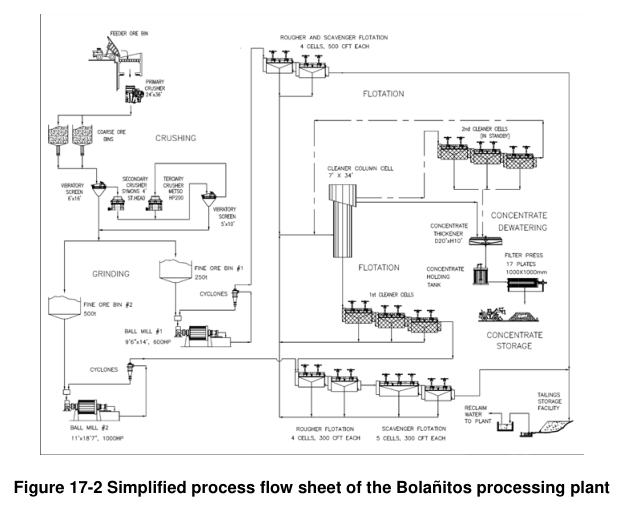
This profile describes the Bolañitos flotation plant as it operated in 2011, based on the December 31, 2011 effective-date Technical Report for the Guanajuato Mines Project. The plant processed ore from the Cebada and Bolañitos-Lucero mines on a campaign basis, producing a single concentrate trucked to Guanaceví for doré production.
Report context
The Bolañitos plant is one of two processing facilities described in the 2011 Technical Report for Endeavour Silver Corp.’s Guanajuato Mines Project, Guanajuato State, Mexico. The report was signed March 30, 2012 with an effective date of December 31, 2011. The processing description draws on Sections 13.0 (Mineral Processing and Metallurgical Testing) and 17.0 (Recovery Methods) of that report. All data show 2011 operating performance and 2011 metallurgical testing. The plant is not a stand-alone doré producer; its concentrate is shipped to the Guanaceví plant for final smelting.
Processing route
Ore receiving and crushing
Run-of-mine ore from the Cebada and Bolañitos-Lucero mines arrives at the plant in the size range of 250 to 375 mm. A primary jaw crusher receives the ore, after which two ore bins, each with a 450 t capacity, allow different ore types to be crushed and stored independently. This bin arrangement optimises plant availability and reduces change-over time when switching between ore sources.
Secondary cone crushing reduces ore to 50 mm, followed by tertiary crushing to 9–10 mm. After tertiary crushing, a second set of two ore bins, each with a 120 t capacity, provides additional plant flexibility. A conveyor belt beneath the tertiary crusher bins is fitted with a weightometer that is regularly checked and re-calibrated by plant operators. Manual samples are taken at this point to determine the plant head grade.
Grinding and flotation
Two ball mills grind the crushed material to 65% passing 74 microns. The grinding product is then subjected to conventional flotation in both column and tank cells. Automatic samplers collect samples of tailings and concentrate. A single concentrate is produced, grading approximately 11.61 kg/t silver and 169 g/t gold.
Dewatering and product dispatch
The flotation concentrate is dewatered in a conventional thickener, followed by filtration and drying in a warm air drier (gas drier). At the maximum processing rate of 1,200 t/d, the plant produces between 5 and 13 t/d of concentrate. The dried concentrate is stored and sampled for grade and moisture content before being trucked to Endeavour Silver’s Guanaceví plant, where it is added to the mill stream for doré production. The Bolañitos plant does not produce doré directly.
Tailings and water management
Tailings are sampled automatically from the pulp sent to the tailings facility. The report does not provide details on tailings disposal method, water recovery circuits, or reagent addition systems. Reagent dosages are varied per ore type during campaign milling, but specific reagent types and consumption rates are not given for the production circuit.
Metallurgical balance and sampling
Key points in the process circuit are sampled to generate a monthly metallurgical balance and for quality control:
- Head grade from the conveyor feeding the milling circuit
- Wet head grade from the pulp feeding the flotation circuit
- Concentrate grade from the pulp of the final product going to thickening
- Tails grade from the pulp sent to the tailings facility
Samples are prepared and analyzed at the Bolañitos mine laboratory, which produces a daily report containing gold and silver grades for each of three 8-hour shifts. The laboratory also measures sample moisture content for dry tonnage calculations. A metallurgical balance for the concentrates is generated each shift using gold grade, silver grade, percent moisture, and tonnage from the weightometer on the grinding circuit feed belt. After filtering and drying, concentrate samples are taken for grade and moisture content, and the daily calculated balance is checked against the mass of concentrate produced. The daily balance forms the basis of the monthly reconciliation report, which is reviewed by senior staff and cross-checked against the mass and grade of dried concentrate samples.
Key reported parameters
| Parameter | Value | Basis |
|---|---|---|
| Plant throughput (2011) | 238,797 t | Actual annual production |
| Feed grade – silver | 183 g/t | Actual annual average |
| Feed grade – gold | 2.51 g/t | Actual annual average |
| Silver recovery | 84.9% | Actual annual average |
| Gold recovery | 86.2% | Actual annual average |
| Gold production | 16,608 oz | Actual annual total |
| Silver production | 1,192,335 oz | Actual annual total |
| Concentrate grade – silver | ~11.61 kg/t | Reported typical |
| Concentrate grade – gold | ~169 g/t | Reported typical |
| Concentrate production rate | 5–13 t/d | At 1,200 t/d processing rate |
| Maximum processing rate | 1,200 t/d | Design capacity |
| Grind size | 65% passing 74 microns | Operating target |
| Primary crusher feed size | 250–375 mm | Operating range |
| Secondary crusher product | 50 mm | Operating target |
| Tertiary crusher product | 9–10 mm | Operating target |
| Ore bin capacity (primary) | 2 × 450 t | Design |
| Ore bin capacity (secondary) | 2 × 120 t | Design |
Project website: https://www.mining.com/endeavour-silver-sells-bolanitos-mine-to-guanajuato-in-50m-deal/
Metallurgical testwork results (2011)
| Parameter | Value | Basis |
|---|---|---|
| Cebada concentrate – Ag extraction (24 hr, bottle roll) | 87% average | Testwork result |
| Cebada concentrate – Au extraction (24 hr, bottle roll) | 55% average | Testwork result |
| Cebada concentrate – Au extraction (CIL) | ~80% | Testwork result |
| Bolañitos concentrate – Ag extraction | 73% average | Testwork result |
| Bolañitos concentrate – Au extraction | 93% average | Testwork result |
| Blend composite – Ag extraction (72 hr, bottle roll) | 90–98% range | Testwork result |
| Blend composite – Au extraction (72 hr, bottle roll) | 83–96% range | Testwork result |
| Lime consumption (blend composite) | ~0.5 kg/t | Testwork average |
| Sodium cyanide consumption (blend composite) | ~32 kg/t | Testwork average |
Technical qualifications
The processing descriptions in Sections 13.0 and 17.0 of the Technical Report are based on 2011 operating data and 2011 metallurgical testing. The report explicitly states that metallurgical testwork results for improved extractions were not easily duplicated and that several leaching variables required optimisation. Endeavour Silver planned continued testing in 2012 at both the Guanaceví and G&T Metallurgical laboratories. The concentrate is trucked to Guanaceví for doré production, not smelted at Bolañitos. The flowsheet (Figure 17.1) is supplied by Endeavour Silver and dated January 2012. All recovery figures are actual 2011 operating averages, not design targets or testwork projections. The report does not describe tailings dam specifications, water balances, reagent consumption in the production circuit, or equipment sizing details. No resource or reserve figures are included in this profile.
Source: Endeavour Silver Corp., Technical Report on the Resource and Reserve Estimates for the Guanajuato Mines Project, Guanajuato State, Mexico, Effective Date December 31, 2011, Signing Date March 30, 2012. Sections 13.0 (Mineral Processing and Metallurgical Testing) and 17.0 (Recovery Methods). No original page numbers cited.
