

A three-phase plant expansion plan moves from a 22,000 t/d silver-lead-zinc concentrator to a dual processing configuration that includes a dedicated gold recovery circuit by Year 9.
The Carangas Project is located in the Carangas District in the western part of the Oruro Department of Bolivia, approximately 190 kilometers southwest of Oruro City. New Pacific Metals Corp. holds the project through a Mining Association Contract with Minera Granville S.R.L., a private Bolivian company, and the property comprises two Prospecting and Exploration Licenses covering 39 square kilometers. The project, which sits at 3,900 to 4,100 meters above sea level on the Andean plateau, is at the preliminary economic assessment stage. A mineral resource estimate with an effective date of March 31, 2026, was reported for the Upper Silver Zone, Middle Zinc Zone, and Lower Gold Zone. Construction timing was not stated in the supplied report material.
Critical Data
| Parameter | Value | Unit | Notes |
|---|---|---|---|
| Phase 1 nominal throughput | 22,000 | t/d | Years 1 to 5 |
| Phase 2 nominal throughput | 44,000 | t/d | Years 6 to 8 |
| Phase 3 gold plant throughput | 22,000 | t/d | Years 9 to 16 |
| Annual throughput, single concentrator | 8.0 | Mt/a | Dry basis |
| Primary crushing availability | 75 | % | 6,570 operating hours per year |
| Grinding and flotation availability | 91.3 | % | 7,998 operating hours per year |
| Concentrate filtration availability | 89 | % | 7,796 operating hours per year |
| Crushing circuit product size, P80 | 125 | mm | Design value |
| Grinding circuit product size, P80 | 75 | μm | Design value |
| Silver-lead concentrate minimum silver grade | 2000 | g/t | Design value |
| Silver-lead concentrate minimum lead grade | 24.0 | % | Design value |
| Zinc concentrate minimum grade | 45.8 | % | Design value |
| Gold leach extraction | 95.0 | % | Design value |
| Silver leach extraction | 64.0 | % | Design value |
| Leach residence time | 48 | h | Design value |
| Cyanide detoxification residence time | 90 | min | Design value |
| Circuit feed cyanide concentration, design | 560 | mg/L CNWAD | Value appears twice in source as 530 and 460, flagged for review |
| Circuit discharge cyanide concentration | 5.0 | mg/L CNWAD | Design value |
| Phase 1 installed load | 41.0 | MW | Crushing and process plant |
| Phase 2 installed load | 82.0 | MW | Crushing and process plant |
| Phase 3 installed load | 79.4 | MW | 38.4 MW for gold plant |
Overview
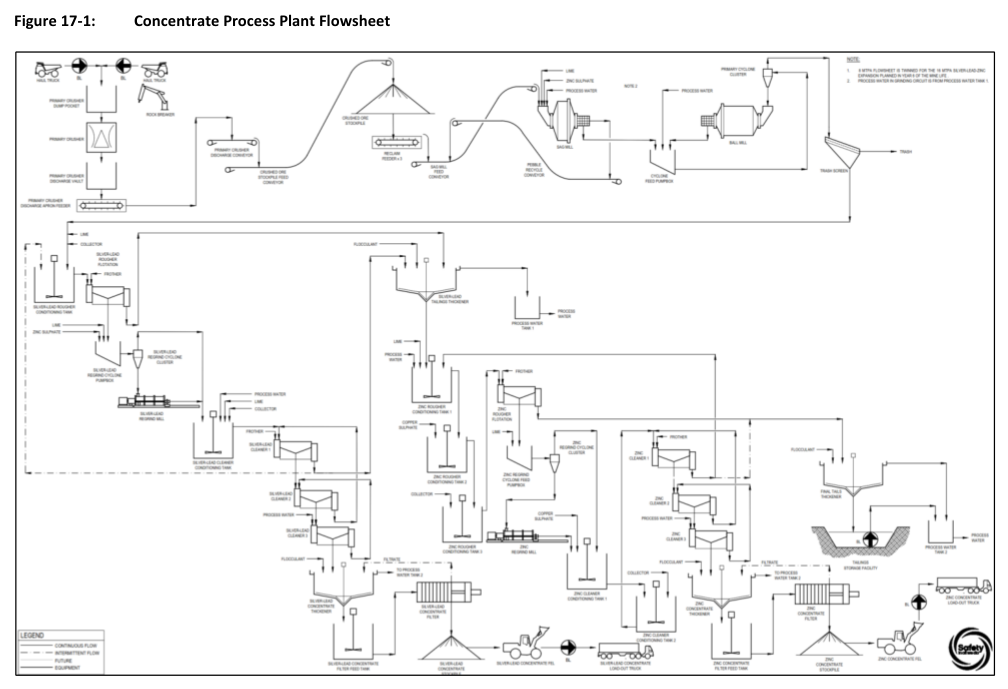
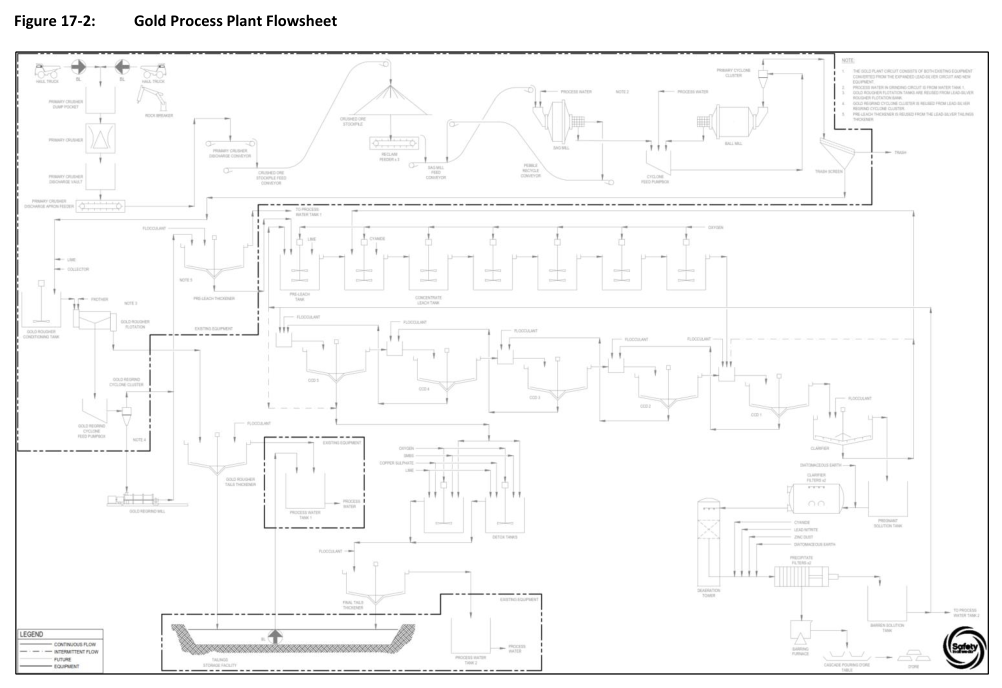
The processing strategy for the Carangas Project follows a staged development of capacity over the life of mine. Phase 1, covering Years 1 to 5, treats mineralized material through a single silver-lead-zinc flotation plant at a nominal design throughput of 22,000 tonnes per day, producing a silver-lead concentrate and a zinc concentrate. Phase 2, Years 6 to 8, expands capacity to 44,000 tonnes per day by installing a twinned 22,000 tonnes per day plant that duplicates the principal unit operations. In Year 9, one of the two plants is converted for gold treatment, with the comminution and rougher flotation circuits retained and dedicated gold recovery equipment added, including cyanide leaching, counter-current decantation thickeners, Merrill Crowe, and refining. One silver-lead-zinc concentrator continues operating alongside the gold plant. This dual configuration runs until Year 16, when the gold plant converts back to a concentrator circuit for the remainder of the life of mine.
The flowsheet relies on conventional technologies common in silver, lead, zinc, and gold processing plants operating 24 hours per day, 365 days per year. Design work is based on preliminary metallurgical laboratory testing and preliminary economic modelling.
Key Process Stages
The crushing circuit uses a single-stage open-circuit gyratory crusher rated at 550 kW, located near the run-of-mine blending stockpiles. Feed material with a maximum lump size of 800 mm arrives by 140 tonne haul trucks. The crusher product at 125 mm reports to a conical coarse material stockpile with roughly 16 hours of live capacity. Reclaim feeders in a tunnel below the stockpile discharge onto the SAG mill feed conveyor.
Grinding consists of a SAG mill followed by a ball mill in closed configuration with cyclones. The circuit operates at a nominal throughput of 1,000 tonnes per hour. Cyclone overflow at 30% solids reports to a trash screen and then to the lead-silver rougher flotation conditioning tank. Lime and zinc sulfate are added at the cyclone feed pumpbox. The SAG mill sizing uses drop-weight test data supplied by the client from internal company databases, not from Carangas Project samples, and the design includes an increased SAG mill factor to account for the absence of project-specific coarse material competency test work.
Silver-lead flotation uses rougher cells, regrinding, and three stages of cleaning. Equipment sizing is based on testwork from ALS Metallurgy in Kamloops. The regrind circuit targets a product size of 20 µm. Cleaner 3 concentrate reports to a dedicated high-rate thickener, and the underflow goes to a pressure filter at 60% solids. Filter cake at 10% moisture discharges to the concentrate stockpile.
Zinc flotation follows the same general arrangement, with rougher flotation, regrind, and three cleaning stages. The lead-silver tailings thickener underflow feeds the zinc rougher conditioning tanks, where lime, copper sulfate, and collector are added in sequence. The regrind circuit targets 20 µm. The cleaner 3 concentrate reports to a zinc concentrate thickener and pressure filter.
Phase 3 equipment includes a pre-leach thickener, six leach tanks of 1,941 cubic meters each, five counter-current decantation thickeners at 17 meters diameter, a clarifier, and a Merrill Crowe circuit with polishing filters, deaeration tower, and precipitation filters. Zinc powder addition targets greater than 99% precipitation of gold and silver. The refinery dries the precipitate, blends it with fluxes, and smelts in an electric furnace to produce doré bars.
Tailings from the CCD train enter two parallel cyanide detoxification tanks for 90 minutes. The circuit uses the sulfur dioxide/air method with sodium metabisulfite and copper sulfate catalyst, reducing weak acid dissociable cyanide from 560 mg/L to no more than 5.0 mg/L. A high-rate tailings thickener recovers process water before the slurry reports to the tailings storage facility.
Additional Interesting Data and Summary
Plant feed grades for the silver zone show silver at 55.92 g/t for Years 1 to 8 and 26.66 g/t for Years 9 to 16. The gold zone feed carries 11.92 g/t silver and 0.74 g/t gold. Recoveries to the silver-lead concentrate are 80.5% for silver in Years 1 to 8 and 77.8% in Years 9 to 16. Gold recovery to doré is 93.0%. The design criteria for the concentrate plant use a feed grade of 47.0 g/t silver, while the gold plant design uses 0.8 g/t gold.
Comminution test work on three samples produced rod mill work index values of 10.1 to 12.3 kWh/t, ball mill work index values of 10.7 to 12.8 kWh/t, and abrasion index values of 0.038 to 0.075 grams. The design criteria use a 75th percentile ball mill work index of 12.8 kWh/t for the concentrate plant and 12.7 kWh/t for the gold plant.
Raw water consumption is estimated at 3,400,000 cubic meters per annum per concentrator and 4,300,000 cubic meters per annum for the gold plant. Installed power loads are 41.0 MW in Phase 1, 82.0 MW in Phase 2, and 79.4 MW in Phase 3. Process operations staffing is estimated at 102 people for Phase 1 and 189 people for Phases 2 and 3. General and administrative staffing is 57 people for Phase 1 and 92 people for Phases 2 and 3.
Oxygen for the gold plant comes from an on-site vacuum swing adsorption plant producing 92% purity oxygen at 6 bar gauge. High-pressure air at 750 kPa is generated by compressors and dried for plant and instrument air service.
Key Processes
- Primary crushing with gyratory crusher to 125 mm
- Coarse ore stockpiling with 16 hours live capacity
- SAG mill and ball mill grinding with cyclone classification to 75 µm
- Silver-lead flotation with rougher, regrind, and three cleaning stages
- Zinc flotation with rougher, regrind, and three cleaning stages
- Concentrate thickening and pressure filtration for both concentrate streams
- Gold flotation using retained rougher circuit from converted concentrator
- Pre-leach thickening followed by six-stage cyanide leaching
- Counter-current decantation with five thickeners and pregnant solution clarifier
- Merrill Crowe zinc cementation with polishing filters and deaeration
- Refinery smelting to produce doré bars
- Cyanide detoxification using sulfur dioxide/air method
- Tailings thickening and disposal to tailings storage facility
Source: Carangas Project: NI 43-101 Technical Report and Preliminary Economic Assessment, Oruro, Bolivia, August 13, 2026. Project website: Carangas Project
Additional process diagram from the technical report
Technical report and processing history
The following archived source profiles have been consolidated here to preserve the project’s processing history and study context.
Carangas Deposit — 2024 Technical Report
Carangas Deposit — 2024 Technical Report
| Company | Pacific New Metals Corp |
| Date | 2024 |
| Commodities | Silver, Lead, Zinc |
| Mine Type | Open Pit |
| Throughput | 4,000,000 tpa |
| Status | Development (PEA) |
Executive Summary
This NI 43-101 Technical Report presents the Preliminary Economic Assessment (PEA) for the Carangas Deposit, prepared for Pacific New Metals Corp in September 2024. The project is currently at a scoping level of engineering, with the processing plant designed to treat 4.0 million tonnes of mill feed annually. The operation is planned as an open-pit mine delivering ROM mineralized material to a process plant utilizing a standard grinding-flotation facility.
The selected processing route employs a SABC circuit (SAG mill, Ball mill, Pebble crusher) followed by sequential selective flotation. This method was chosen over cyanide leaching alternatives due to superior economics and operational simplicity. The plant is designed to produce two distinct concentrates: a silver/lead concentrate and a zinc/silver concentrate, with total silver recovery projected at 87.3% over the life of the mine.
Key operational parameters include a throughput of 12,000 tonnes per day and a grinding circuit targeting a P80 of 75 μm. The flotation circuits are designed to reject pyrite and non-sulfidic gangue minerals, with specific reagent programs for silver/lead and zinc/silver separation. The project remains in the development phase pending further test work and engineering refinement.
Reports
Website: https://www.newpacificmetals.com/projects/carangas/
Report Date: 2024
Region:
Project Status: Development (PEA)
Commodity: Silver, Lead, Zinc
Throughput: 4,000,000 tpa
Mine Life:
Mine Type: Open Pit
Ore type:
