Mineral Processing Circuit

Bell Mountain Project — Updated Preliminary Economic Assessment

This Updated Preliminary Economic Assessment outlines the recovery methods for the Bell Mountain Project deposits, including Spurr, Varga, Sphinx, and East Ridge. Based on surface proximity and preliminary metallurgical test work, valley leach is the anticipated recovery method. The mineralized material features a significant silver content with a 25:1 Ag:Au ratio in some areas.

Bell Mountain Project — Updated Preliminary Economic Assessment Read Post »
San Ramon Deposit — 2014 Technical Report

The San Ramon project, developed by Red Eagle Mining Corporation in Colombia, outlines a proposed processing facility for an underground mining operation. The design focuses on a Carbon-in-Leach (CIL) circuit capable of processing 1,000 tonnes per day of gold-bearing material. The facility includes primary and secondary crushing, ball-mill grinding, agitated leaching, and precious-metal recovery via electrowinning and smelting to produce a gold doré product.

San Ramon Deposit — 2014 Technical Report Read Post »

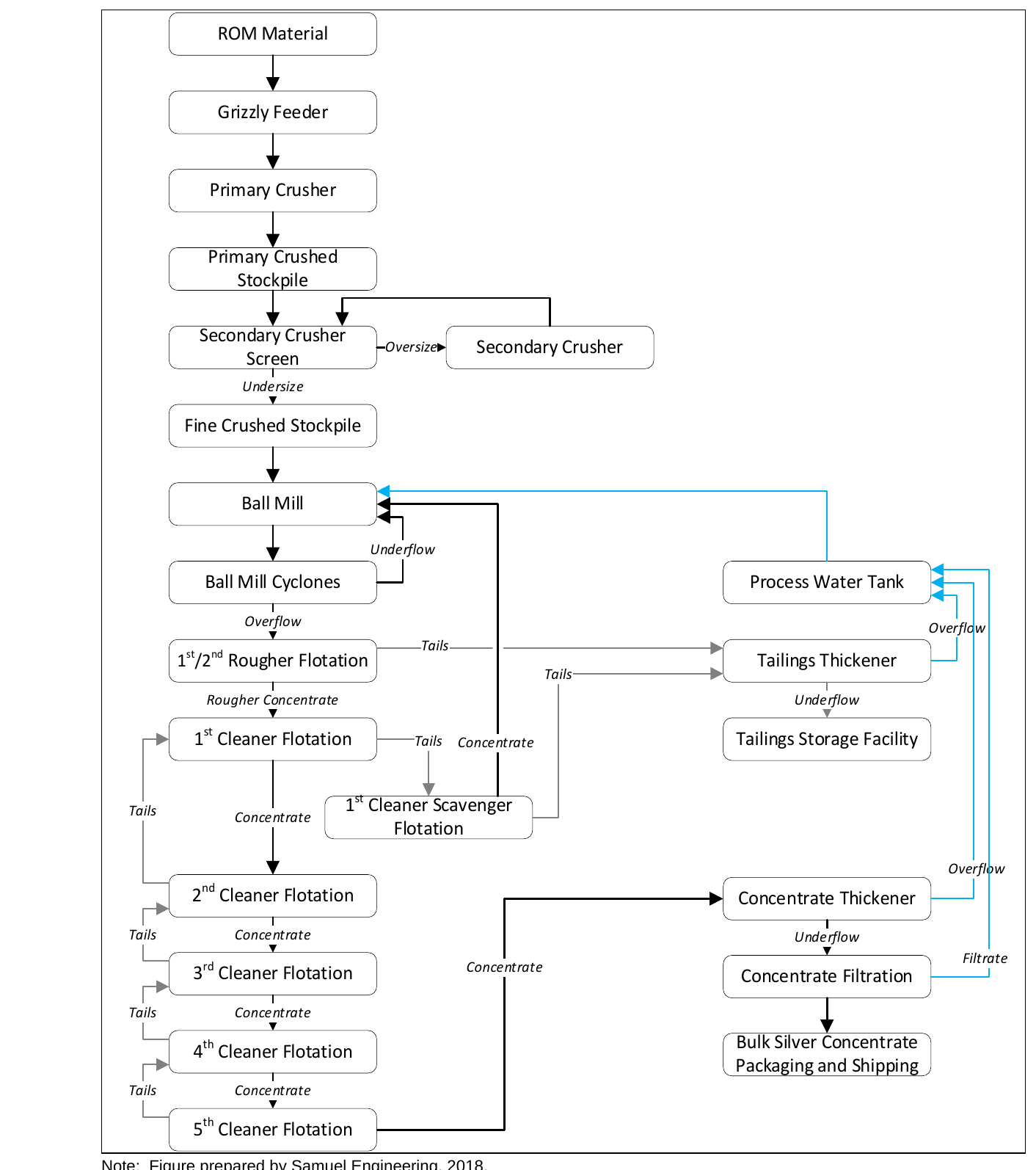
El Quevar process flowsheet: El Quevar Proposed Block Flow Diagram

El Quevar Project — 2018 Technical Report

This section of the NI 43-101 Technical Report details the proposed recovery methods for the El Quevar Project, focusing on the processing plant design to recover silver from the Yaxtché sulfide deposit. The design basis is established to process 1,200 tonnes per day of mineralized material sourced from an underground mine. The objective is to produce a bulk silver concentrate with a target grade of approximately 11.5 kg/t Ag through conventional crushing, grinding, and flotation techniques.

El Quevar Project — 2018 Technical Report Read Post »

Azatek Deposit — 2016 Technical Report

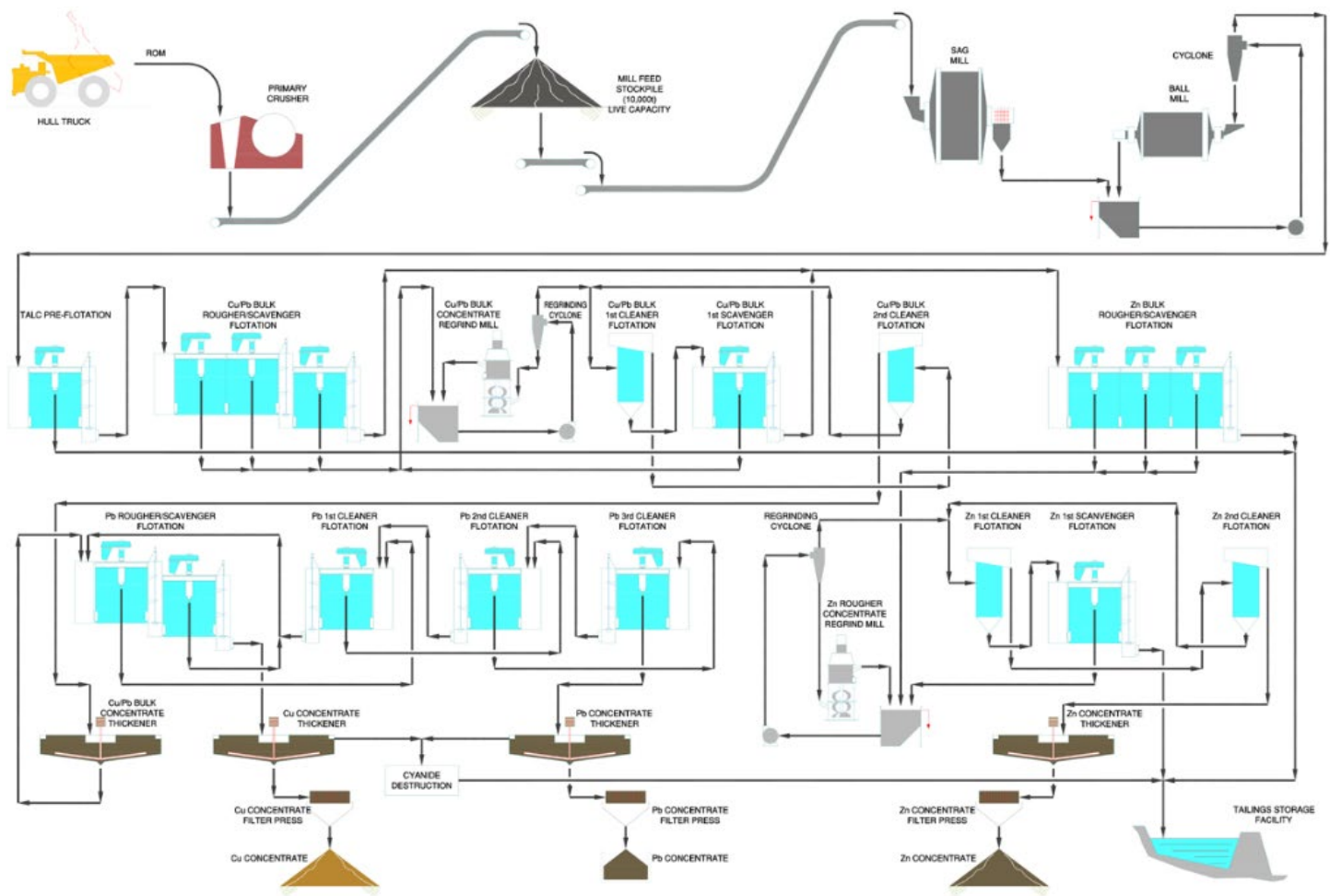
The 2016 Preliminary Feasibility Study for the Azatek deposit outlines two processing approaches due to the complex mineral composition of the ore. The preferred method involves recovery of all components via bulk gold-bearing concentrates using gravity-flotation or direct bulk flotation, rather than selective processing circuits. The ore is characterized as gold-sulphide, polymetallic, or lead-antimonic, containing gold, silver, lead, antimony, and zinc.

Azatek Deposit — 2016 Technical Report Read Post »

Charley Creek Rare Earth Project — 2013 Technical Report

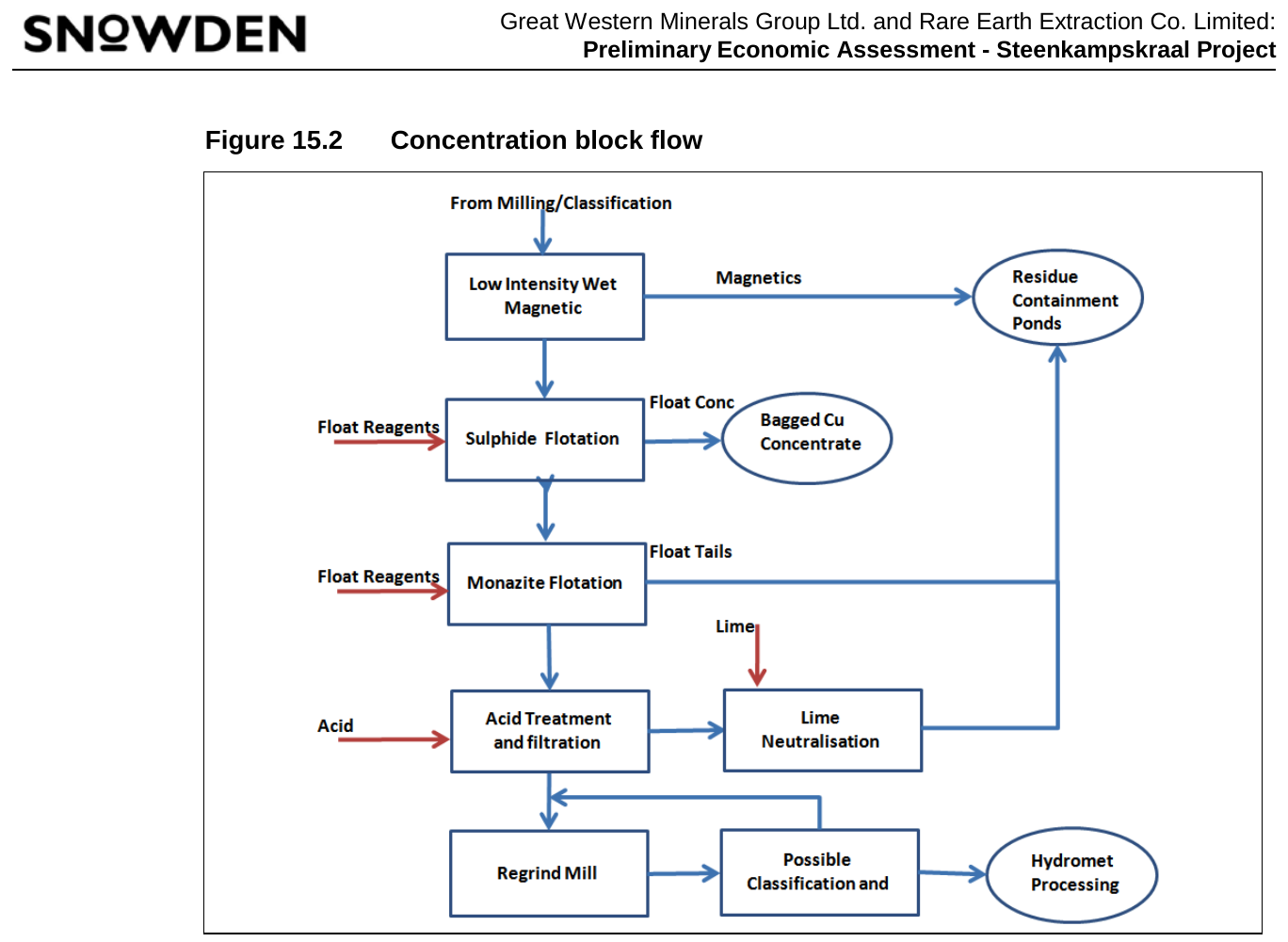
The Charley Creek Rare Earth Project, proposed by Pancontinental Uranium Corporation, outlines a comprehensive recovery method for an alluvial deposit carrying heavy minerals. The mine site processing involves two wet plants and one dry plant designed to produce a REO concentrate grading around 40% TREOs. The wet plant utilizes scrubbing, hydrocycloning, and spiral gravity separation to upgrade the concentrate, while the dry plant employs electrostatic and magnetic separation to further refine the product. By-products include ilmenite and zircon concentrates.

Charley Creek Rare Earth Project — 2013 Technical Report Read Post »

Riotinto process flowsheet: Simplified process flowsheet (Tetra Tech 2022)

Riotinto — 2023 Technical Report

The Riotinto concentrator processes copper sulfide mineralized material using conventional froth flotation to produce a copper concentrate. The plant employs a combination of existing equipment associated with historical operations as well as expanded and upgraded facilities. Since refurbishment and re-commissioning in June 2015, the process was upgraded and successfully expanded to 9.5 Mtpa and is currently operating at above 15 Mtpa.

Riotinto — 2023 Technical Report Read Post »

Tugaske Project — 2021 Technical Report

This technical report outlines the recovery methods for the Tugaske Project located in Saskatchewan, Canada. The process plant is designed to produce 250,000 tonnes per year of saleable Muriate of Potash (MOP). The operation utilizes solution mining techniques, involving the injection of heated brine into underground sylvinite ore deposits to selectively dissolve potassium chloride (KCl). The resulting production brine is processed through a multi-stage crystallization circuit to recover KCl crystals.

Tugaske Project — 2021 Technical Report Read Post »

CPP — North Dry Ridge Recovery Methods

This section outlines forward-looking information regarding handling and processing methods, plant design, and equipment selection for the CPP project. It details the current Wash Plant flowsheet performance and its suitability for future extraction ores, specifically North Dry Ridge and Husky1. The text reviews future beneficiation plant flowsheets, including modifications to process high MgO ores efficiently.

CPP — North Dry Ridge Recovery Methods Read Post »

Figure 17-1: Simplified Amerigo Process Flowsheet

Minera Valle Central Operation — 2022 Technical Report

The Minera Valle Central (MVC) operation processes fresh tailings from Codelco’s El Teniente and historic tailings from the Cauquenes impoundment. The plant utilizes hydrocyclones for classification, ball mills for grinding, and a flotation circuit including conventional cells, columns, and cascade skim flotation to produce copper and molybdenum concentrates. The bulk concentrate is reground and cleaned followed by selective flotation for molybdenum separation. Final tailings from both circuits report to thickening before final discharge to the El Teniente tailings channel. The target fresh tailings concentrator throughput is 140,000 TPD, while Cauquenes has a target throughput of 40,000 TPD.

Minera Valle Central Operation — 2022 Technical Report Read Post »

Scroll to Top