Mineral Processing Circuit

Figure 17-2: Churchrock Section 8 Flow Sheet

Churchrock Uranium Project — 2024 Technical Report

This NI 43-101 Technical Report outlines the recovery methods for the Churchrock Uranium Project, focusing on a Preliminary Economic Assessment (PEA). The project utilizes an In-Situ Recovery (ISR) method where lixiviant is circulated through a wellfield to extract uranium underground. The process involves a two-site operation: a Satellite Plant at Churchrock for ion exchange recovery and a Central Processing Plant (CPP) at Crownpoint for elution, precipitation, and drying.

Churchrock Uranium Project — 2024 Technical Report Read Post »
Gibraltar Technical Report — March 2022

The Gibraltar Technical Report outlines the recovery methods for the Gibraltar Mine, focusing on the processing of sulphide and oxide ores. Sulphide ore is processed at a rate of 85,000 tons per day through two bulk concentrators to produce a concentrate containing copper, molybdenum, and silver. The bulk concentrate is combined and processed through a single molybdenum flotation plant where molybdenum is separated from the copper via selective flotation. The molybdenum concentrate is dewatered and bagged for shipment, while the underflow becomes the final copper concentrate.

Gibraltar Technical Report — March 2022 Read Post »

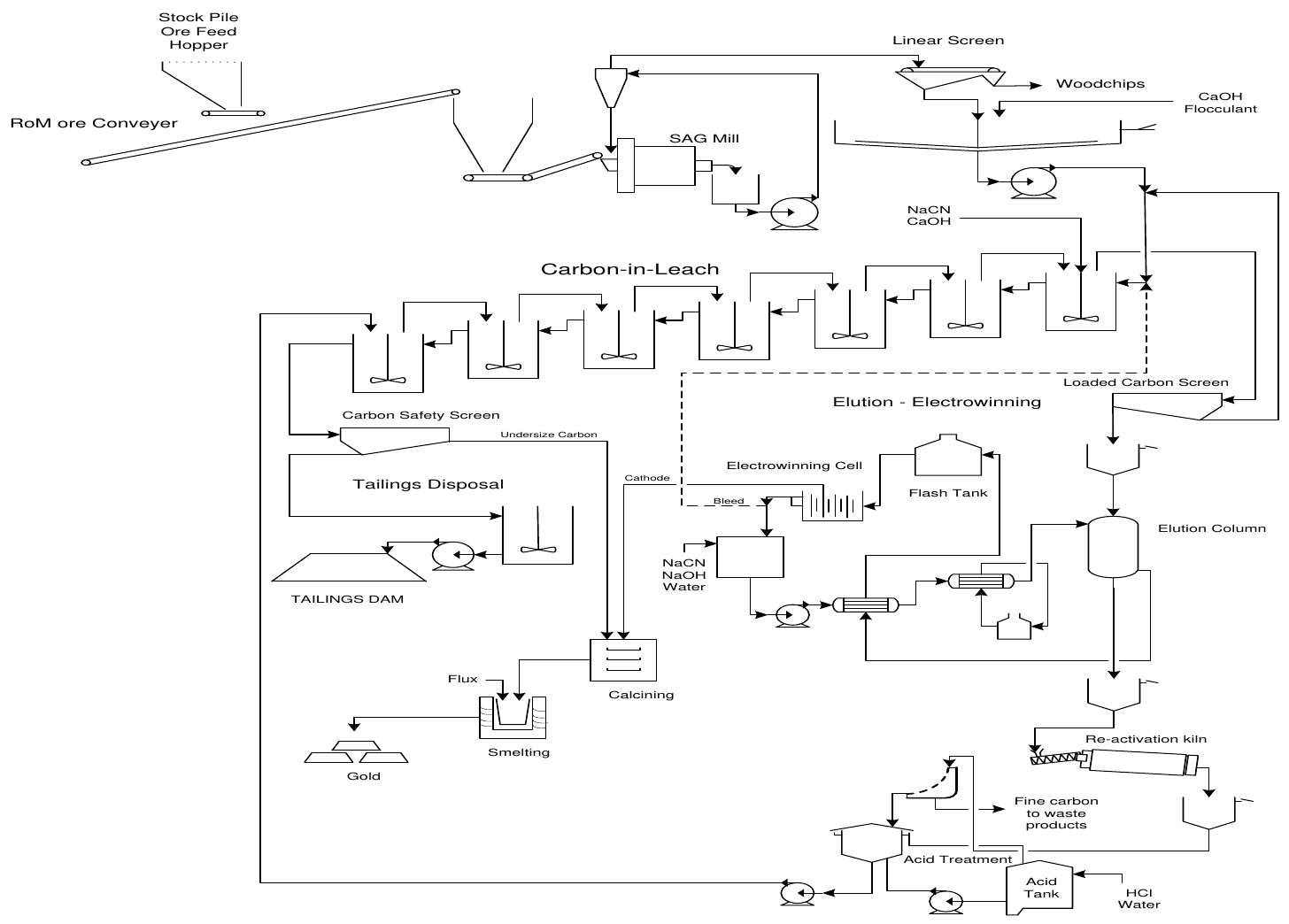
De Bron-Merriespruit (DBM) Project process flowsheet: DBM Process Flowsheet

De Bron-Merriespruit PFS Picks ROM Milling and CIL With Zadra Elution for Free State Gold Reefs

This report outlines the recovery methods for the De Bron Merriespruit (DBM) Project, focusing on gold recovery. Uranium recovery was evaluated as a potential byproduct but excluded due to marginal economics and additional capital costs. The processing plant is designed for a throughput of 80,000 tonnes per month, utilizing direct SAG milling followed by a Carbon-in-Leach (CIL) circuit. The CIL circuit is optimized at eight stages to minimize carbon inventory and gold lock-up, with a target recovery of 96.2%.

De Bron-Merriespruit PFS Picks ROM Milling and CIL With Zadra Elution for Free State Gold Reefs Read Post »

Molejón Plans to Heap Leach Low-Grade Oxide Ore in Panama Beside Its Existing Mill, Crushing to 80% Passing 3 Inches and Agglomerating With Cement and Lime

Behre Dolbear’s May 2012 report for Petaquilla Minerals describes a double-lined pad with two 5-meter lifts, and warns against compacting agglomerated ore with heavy equipment.

Molejón Plans to Heap Leach Low-Grade Oxide Ore in Panama Beside Its Existing Mill, Crushing to 80% Passing 3 Inches and Agglomerating With Cement and Lime Read Post »

Figure 17-1: Greens Creek Mill Flowsheet

Greens Creek Polymetallic Mine — 2019 Technical Report

This NI 43-101 Technical Report details the operational status and life-of-mine plan for the Greens Creek Polymetallic Mine in Alaska, operated by Hecla Mining. The mine has been operational for 30 years, with continuous operation for the last 23 years. It is an underground mine targeting massive sulfide mineralization in a temperate rainforest environment. The current mine life extends to 2030, with infrastructure primarily located at the 920/860 mine area and the Hawk Inlet camp.

Greens Creek Polymetallic Mine — 2019 Technical Report Read Post »

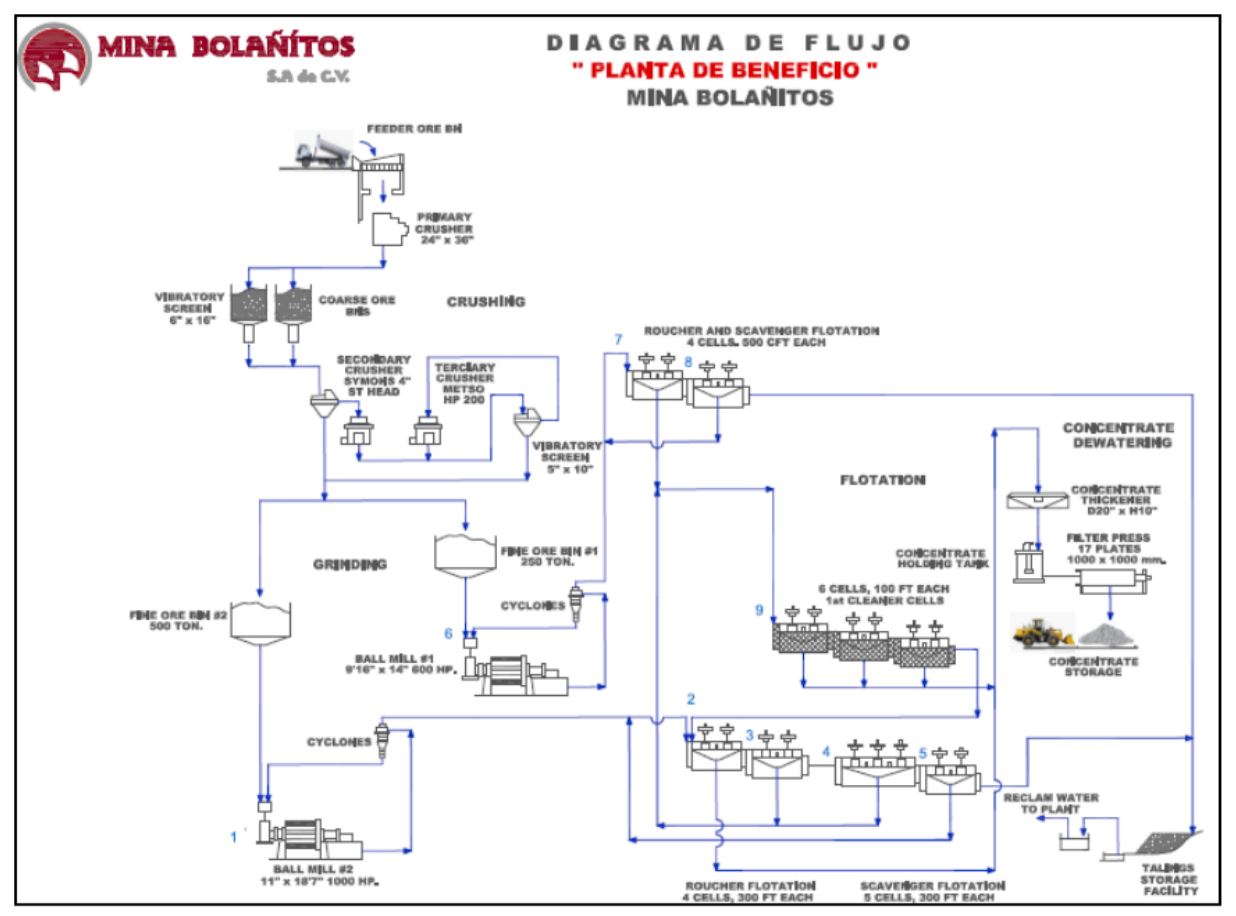
Bolañitos process flowsheet: Process Flow Sheet of the Bolañitos Plant (Guanajuarto Silver)

Bolañitos Mill Runs Near 1,100 t/d in Campaigns, Recovering 89.5% of Gold and 84.4% of Silver by Flotation

The 2021 production data for the Bolañitos plant indicates a throughput of 418,514 tonnes of ore, grading 42 g/t silver and 2.02 g/t gold. Recoveries averaged 87% for silver and 90.7% for gold, resulting in 483,507 oz of silver and 24,730 oz of gold recovered. The plant operated at an average throughput of 1,163 tonnes per operating day, slightly exceeding the planned rate of 1,100 t/d, with only 4 days of maintenance downtime recorded.

Bolañitos Mill Runs Near 1,100 t/d in Campaigns, Recovering 89.5% of Gold and 84.4% of Silver by Flotation Read Post »

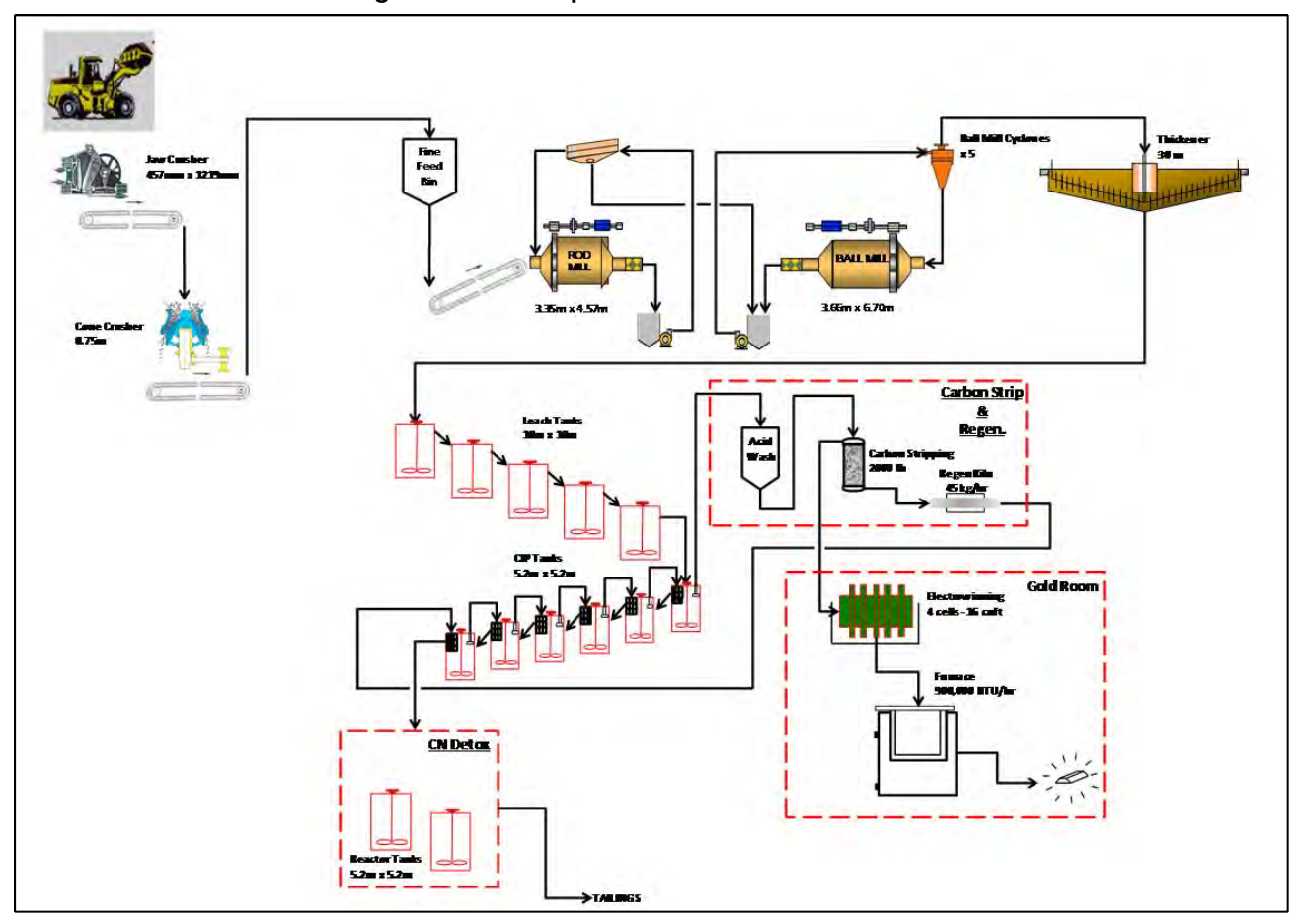
Red Mountain Gold Project process flowsheet: Simplified Process Flow Sheet

Red Mountain Gold Project — Preliminary Economic Assessment Report

The Red Mountain Gold Project Preliminary Economic Assessment Report outlines the proposed recovery methods for extracting gold and silver from mine feed. The process involves stage crushing using a jaw and cone crusher, followed by grinding in a rod and ball mill circuit to a target grind size of 95% passing 38 µm. The crushed feed is processed at a nominal rate of 1000 t/d.

Red Mountain Gold Project — Preliminary Economic Assessment Report Read Post »

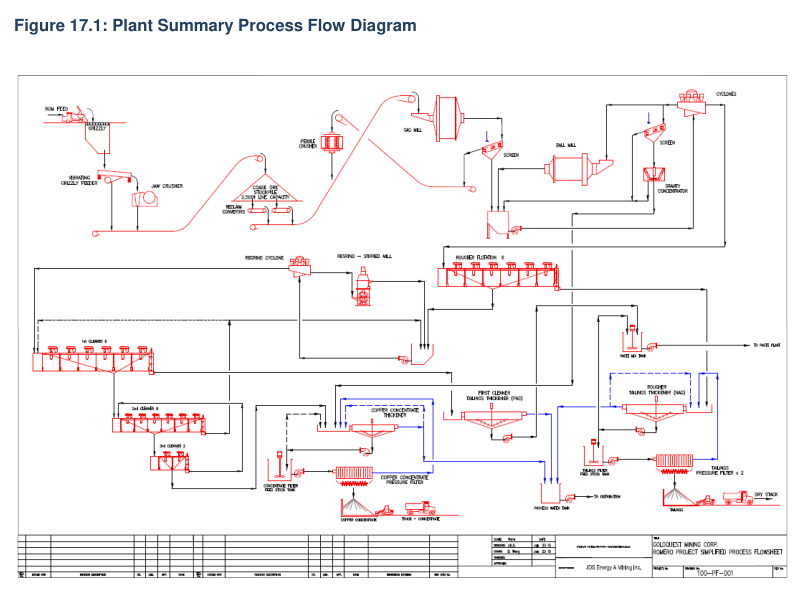
Figure 17.1: Plant Summary Process Flow Diagram

Romero Project — Preliminary Economic Assessment Technical Report

This report outlines the conceptual flowsheet for the Romero Project Preliminary Economic Assessment (PEA). The process is designed to treat 1,400,000 tonnes per year of ore, with a daily throughput of 4,000 tonnes. The metallurgical strategy focuses on recovering copper into a concentrate containing approximately 20% copper, along with gold and silver credits.

Romero Project — Preliminary Economic Assessment Technical Report Read Post »

Figure 17-2. Heap Leach Process Block Flow Diagram

Sheep Mountain Preliminary Feasibility Study — 2021

The Sheep Mountain Project is a uranium recovery facility utilizing conventional heap leaching technology, a process established globally for oxidized ores. The operation involves stacking mined material on a double-lined heap leach pad, applying an acidic leaching solution containing sulfuric acid and an oxidant, and collecting the pregnant leach solution (PLS) for processing. Over a 12-year mine life, the project is designed to recover an average of 1.4 million pounds of U3O8 annually.

Sheep Mountain Preliminary Feasibility Study — 2021 Read Post »

Scroll to Top