

This feasibility study examines the proposed open pit mining and processing operation for the Cerro Blanco gold-silver deposit in Jutiapa, Guatemala.
Report context
The N.I. 43-101 Technical Report and Feasibility Study for the Cerro Blanco Gold Project was prepared with an effective date of February 22, 2022, and an issue date of April 6, 2022, on behalf of Bluestone Resources Inc. The report documents a proposed open pit mining operation processing crushing, grinding, cyanidation leaching and refining to recover gold and silver. The Project was originally studied and permitted for a high-grade underground operation in 2007. Prior to the current open pit scenario, three technical reports were prepared studying an underground mining scenario: a preliminary economic assessment (March 20, 2017), an updated preliminary economic assessment (June 2, 2017) and a feasibility study (January 29, 2019). A fourth report (preliminary economic assessment dated February 28, 2021) was prepared for an open pit development scenario.
Processing route
Comminution Circuit
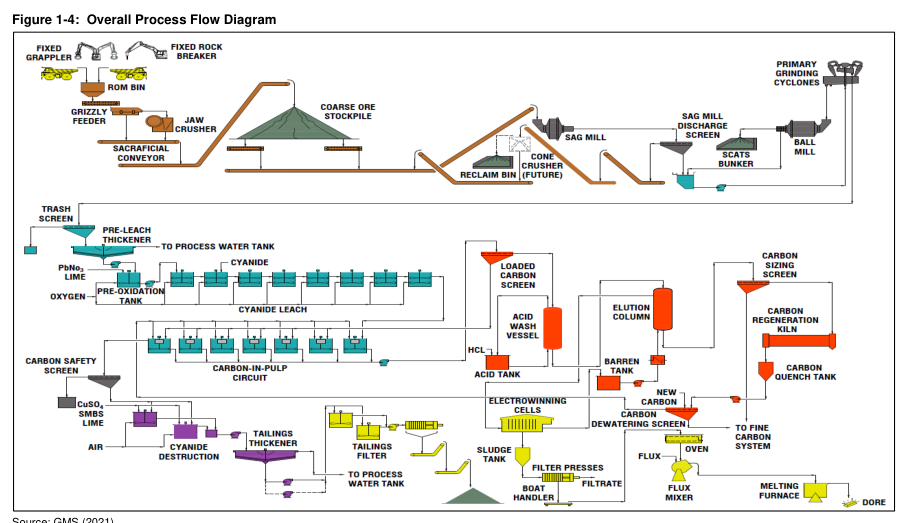
The proposed process plant will treat 4.0 million tonnes per year of ore. The comminution circuit is designed to produce a particle size of 80% passing (P80) 53 µm (design). The process will consist of primary crushing, grinding, pre-leach thickening, cyanide leaching, carbon-in-pulp (CIP), carbon elution and gold recovery circuits.
Crushing plant availability is set at 75%, while grinding, leach and gold recovery availability is 92%. Tailings filtering circuit availability is 85% through the use of standby equipment in critical areas, an inline crushed ore stockpile and reliable power supply.
Leaching and Gold Recovery
The flowsheet involves direct cyanide leaching. Prior to leaching, ground sample undergoes a two-hour pre-oxidation step with oxygen. Leach residence time is 36 hours to achieve optimal gold and silver extraction. The leach solution contains 500 ppm NaCN with pulp pH maintained at 10.5 using lime. Lead nitrate is added at a dosage of 250 g/t.
Gold recovery is achieved through carbon-in-pulp (CIP) adsorption, followed by carbon elution, electrowinning and refining circuits to produce doré.
Cyanide Destruction and Tailings Handling
CIP tailings are treated in a cyanide destruction circuit designed to produce weak acid dissociable (WAD) cyanide levels of less than 10 ppm. Tailings are dewatered through thickening and filtration to produce a filtered tailings product. All tailings samples were successfully thickened to high densities achieving minimum thickener underflow densities of 50%. The filtered tailings are deposited in an engineered dry stack tailings facility (DSTF).
Reagent Handling and Storage
Reagent handling and storage facilities are designed for sodium cyanide, quick lime, lead nitrate, copper sulphate, sodium metabisulphite, sodium hydroxide, hydrochloric acid, flocculant, activated carbon, antiscalant and gold room smelting fluxes.
Metallurgical Testwork Programs
BaseMet (2018) Program
Initial testwork at Base Metallurgical Laboratories Ltd. (BaseMet) in Kamloops, Canada, tested ore samples at depth when the Project was considering an underground mine operation.
BaseMet (2020a) Program
Bond Ball Mill Work Index results were determined. The average BWi was 20 kWh/t. No distinct variation in BWi was observed between various lithological zones.
BaseMet (2020b) Program
This program included chemical composition, mineral content, comminution testing, gravity and leaching testwork, settling tests, optimization testing, oxygen uptake rate determination, carbon adsorption tests and cyanide destruction tests.
BaseMet (2021) Scoping Program
Scoping metallurgical testwork was completed.
BaseMet (2021-2022) Feasibility Program
The feasibility metallurgical testwork program was organized and completed over two main phases, with an additional sub-test program (Phase 1B) to investigate poor metallurgical performance of some Phase 1 samples.
Phase 1 – Variability Assessment: This program evaluated direct cyanide leaching. Samples were ground to P80 of 53 µm. Considerable variability in metallurgical performance was observed. Three metallurgical ore domains were identified in the Salinas zone: Zone 1 (+85% recoveries), Zone 2 (60-85% recoveries) and Zone 3 (less than 60% recoveries).
Phase 1B – Investigation of Poor Metallurgical Performance: Tests included adjusting process parameters, repeat tests, diagnostic leach tests and flotation tests. Gold deportment and geological studies confirmed that low recoveries of Zone 3 samples were due to very fine (<5 µm) locked-up gold grains within approximately 1 Mt of predominately strongly silicified and un-oxidized Scgl conglomerates at their deepest level in the South Zone, which were consequently designated as waste in the mine plan. A flotation circuit could increase gold recovery of Zone 2 by approximately 10%, but a trade-off study concluded it was not economically feasible to add this circuit.
Phase 2 – Mine Plan Composites and Engineering Data: Two composite samples represented Years 1 to 3 and Years 4 to 6 of mining. Optimization testing evaluated primary grind sizing at P80 of 53 µm and 75 µm and sodium cyanide concentration on gold and silver extraction. No statistically significant difference in gold leach performance was found between the grind sizes for both composites. Gold extraction was 94% and 92% for Composites 1 and 2 respectively. Gold extractions were completed within 24 hours.
Comminution Testing Results
RWi tests indicated ore was moderately hard, averaging 18 kWh/t. The average A x b value from SMC test was 39.3, indicating samples classified as hard by the JKTech report. The HIT A x b value averaged 39.2. Bond abrasion indices averaged 0.47, considered moderate to highly abrasive. No specific trend was identified relating physical property or geological lithology to hardness.
Gold and Silver Recovery Modeling
Gold and silver recoveries were evaluated based on whole-of-ore leach test results from BaseMet test programs (2020b, 2021, 2022). Test results showed no difference in gold recoveries between north and south zones. Gold recovery is more a function of lithology and grades. A first order reaction formula was developed using all high-grade results, Phase 2 results, Salinas samples less than 1 g/t Au and Salinas samples producing greater than 80% recovery. This equation estimates recovery for the first six years of mining. A separate recovery equation was developed for Salinas Zones 1 and 2 for subsequent mining years. An average of test results was used for silver recovery.
Gold Deportment
Deportment studies completed by Surface Science Western (SSW) indicated that approximately 99% of gold occurs in electrum as free or exposed grains, with lesser amounts as native gold and kustelite.
Key reported parameters
| Parameter | Unit | Value | Basis |
|---|---|---|---|
| Nominal throughput | Mt/a | 4.0 | Design |
| Life-of-mine mill feed | Mt | 53.9 | Reserve estimate |
| Average gold grade (LOM) | g/t | 1.64 | Reserve estimate |
| Average silver grade (LOM) | g/t | 7.27 | Reserve estimate |
| Gold recovery (LOM) | % | 93.0 | Recovered from testwork |
| Silver recovery (LOM) | % | 84.3 | Recovered from testwork |
| Average payable gold | oz/year | 193,000 | Life-of-mine |
| Primary grind size (design) | P80 µm | 53 | Design criterion |
| Leach residence time | hours | 36 | Design criterion |
| Bond Ball Mill Work Index (average) | kWh/t | 20 | Testwork (2020a) |
| RWi (average) | kWh/t | 18 | Testwork |
| SMC A x b (average) | 39.3 | Testwork | |
| Bond abrasion index (average) | 0.47 | Testwork | |
| Gold extraction (Composite 1, Years 1-3) | % | 94 | Phase 2 testwork (2022) |
| Gold extraction (Composite 2, Years 4-6) | % | 92 | Phase 2 testwork (2022) |
| Mine life | years | 14 | Reserve estimate |
| Peak mining rate | Mt/a | 21 | Proposed design |
| Strip ratio (overall) | W:O | 2.7 | Reserve estimate |
| Mining dilution factor | % | 6.7 | Reserve estimate |
| WAD cyanide target | ppm | <10 | Design criterion |
| Crushing plant availability | % | 75 | Design criterion |
| Grinding/leach/gold recovery availability | % | 92 | Design criterion |
| Tailings filtering circuit availability | % | 85 | Design criterion |
Project website: https://gmining.com/projects/cerro-blanco/
Project website: https://www.juniorminingnetwork.com/junior-miner-news/press-releases/585-tsx/ora/173416-aura-completes-the-acquisition-of-bluestone.html
Technical qualifications
The metallurgical testwork was completed at Base Metallurgical Laboratories Ltd. (BaseMet) in Kamloops, Canada, on ore samples at depth when the Project was considering an underground mine operation, and subsequently on ore samples near surface in the Salinas Zone to support the FS and proposed open pit mine operation. Vendor tailings dewatering tests were completed by Metso:Outotec using laboratory equipment at SGS Lakefield. Gold deportment studies were completed by Surface Science Western (SSW) at the University of Western Ontario.
The mineral resource estimate was prepared by Mr. Garth Kirkham, P. Geo., of Kirkham Geosystems Ltd., an independent qualified person as defined by N.I. 43-101. The mineral reserves were prepared by G Mining Services Inc. (GMS).
All mineral resources have been estimated in accordance with Canadian Institute of Mining and Metallurgy and Petroleum (CIM) definitions as required under National Instrument 43-101 (N.I. 43-101), with an effective date of December 31, 2020. Mineral reserves have an effective date of November 1, 2021.
The mineral resource estimate is reported at a base case above a 0.4 g Au/t cut-off. Mineral reserves are estimated at a cut-off grade of 0.50 g/t Au Eq using long-term metal prices of US$1,550/oz Au and US$20/oz Ag. Mineral resources are inclusive of mineral reserves.
Tailings from the Project are classified as potentially acid generating based on acid base accounting results. The dry stack tailings facility is designed as an engineered facility.
—
Source: N.I. 43-101 Technical Report & Feasibility Study of the Cerro Blanco Gold Project, Department of Jutiapa, Guatemala, effective date February 22, 2022, issue date April 6, 2022. Sections 1.9 (Mineral Processing & Metallurgical Testing), 1.10 (Mineral Resource Estimate & Methodology), 1.11 (Mineral Reserves), 1.12 (Mining), 1.13 (Recovery Methods), 13 (Mineral Processing & Metallurgical Testing), 17 (Recovery Methods).
