

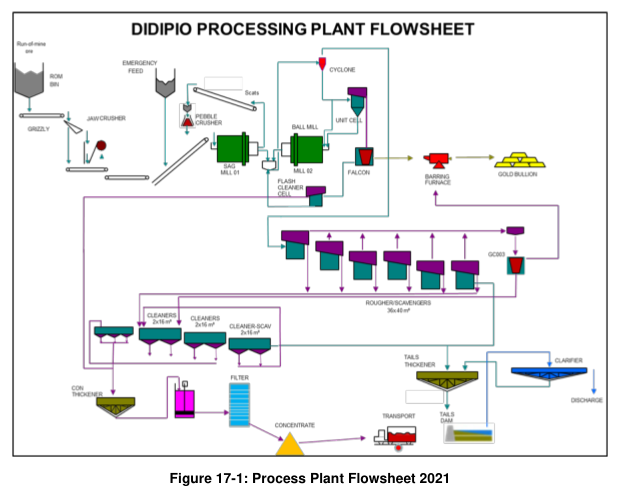
Source: OceanaGold Corporation (2026)
Website: https://oceanagold.com/operations/didipio
Critical Data
| Parameter | Value | Unit | Notes |
|---|---|---|---|
| Throughput | 4.3 | Mtpa | Permitted capacity; actual operation at 4–4.1 Mtpa (2022–2025) |
| Mill Power | 4,300 | kW | Each SAG and ball mill, with wound rotor induction motor and LRS/SER; total 8,600 kW |
| Target Grind Size | 120 | μm (P80) | Primary grind for flotation feed; coarsening to 150 μm reduces gold recovery by 0.4% |
| Head Grade | Not specified | Head grade data not provided in Section 17 | |
| Recovery % | Cu 91.8%, Au 89.1% | % | Average recoveries over project life to date (2013–2025) |
| Processing Capacity | 11,780 | tpd | Based on 4.3 Mtpa at 365 days |
| Energy Consumption | Not specified | kWh/t | Energy data not provided in Section 17 |
| Water Consumption | Not specified | m³/t | Water consumption data not provided in Section 17 |
| Operating Hours | 87–94% utilization | annual | Historical mill utilization (2013–2021); target 92–93% after restart |
Overview
OceanaGold Corporation operates the Didipio Mine on Luzon Island, Philippines, a copper-gold operation that employs a robust combination of conventional SAG mill/ball mill grinding, gravity gold recovery, and froth flotation to produce high-quality copper-gold concentrate and gold doré bars. The process plant, originally designed for 2.5 Mtpa, was debottlenecked to exceed 3.5 Mtpa by 2014 and later permitted for 4.3 Mtpa in 2022. Following a suspension from June 2019 to November 2021 due to FTAA renegotiations, full production resumed by Q2 2022, and throughput now consistently operates at 4–4.1 Mtpa. The significance of this facility lies in its proven ability to achieve average copper recovery of 91.8% and gold recovery of 89.1% over the project life. The flowsheet integrates a SABC (SAG mill, ball mill, pebble crusher) circuit, a Flash Flotation Rougher within the grinding circuit, and multiple Falcon gravity concentrators to recover coarse free gold. Key reagents include collectors CMS2500 and SIBX, frother Flotanol 10379, and sulfuric acid for pH control. Tailings are managed via a high-rate thickener and a paste backfill plant, with a portion sent to the tailings storage facility. Concentrate is filtered, trucked to San Fernando port, and shipped in 5.5 kt or 11 kt lots. The plant uses a Yokogawa CentumVP DCS for process control and has a metallurgical laboratory for routine testing. Continuous improvement projects focus on maximizing mill utilization (target 92–93%) and achieving the 4.3 Mtpa permit limit, ensuring the Didipio Mine remains a key asset in OceanaGold’s portfolio.
Key Process Stages
- Stage 1: Primary Crushing & Ore Handling — ROM ore dumped from trucks or FEL into a 100-t live capacity bin via an 800 mm grizzly. A single toggle jaw crusher reduces 900 mm feed to a P80 of 100 mm. Crushed ore is conveyed to a transfer bin with 15 minutes live capacity or diverted to a 20,000 t emergency stockpile for 24+ hours of crusher downtime.
- Stage 2: SABC Grinding Circuit — A 7.3 m diameter × 4.57 m EGL SAG mill (4,300 kW, with SER speed control) and a 5.5 m diameter × 8.38 m ball mill (4,300 kW) operate in closed circuit with 19 Cavex 15-inch hydrocyclones. Pebbles (scats) from the SAG trommel are crushed to -12 mm in a Sandvik CH-440 crusher. Target ball charge is 13% with media addition of 0.20 kg/t. Mill load is monitored via trunnion hydrostatic pressure and vibration scanner for real-time charge condition.
- Stage 3: Gravity Gold Recovery — Three Falcon concentrators capture free gold: SB2500 (coarse from Flash Flotation Rougher), SB750 (fine rougher concentrate), and SB5200 (coarse from mill discharge). Concentrates are tabled on Gemini and Deister shaking tables, with table tails retreated in smaller SB250 units. Dried gravity concentrates are smelted in a diesel-fired furnace to produce gold/silver doré bars (85% Au, up to 15% Ag).
- Stage 4: Froth Flotation Circuit — Cyclone overflow feeds a rougher bank of six Outotec TC-40 tank cells with progressively increasing froth crowders. Rougher concentrate passes through the SB750 gravity concentrator then to cleaner (TC-10 cells) and re-cleaner banks. Cleaner-scavenger cells recirculate tailings to rougher feed. FrothSense and a Metso Courier 6 on-stream analyzer (Cu, Fe, solids) automate control. Sulfuric acid dosing maintains slurry pH below 9.5 to maximize gold-bearing pyrite recovery.
- Stage 5: Concentrate Handling & Tailings Management — Final concentrate thickened in a 12 m diameter high-rate thickener, then filtered via an Outotec PF-930 pressure filter (26 plates) to 8% moisture, stockpiled for 15 days, and trucked to Poro Point. Flotation tailings are thickened in a 20 m diameter high-rate thickener with flocculant, then pumped via a steel/HDPE line 2 km to the TSF. Approximately 40–50% of tailings are diverted to the paste backfill plant for underground stope filling.
Additional Interesting Data and Summary
The Didipio Mine process plant has demonstrated robust operational performance since commissioning in 2013, achieving design throughput within a year and progressively debottlenecking to reach 4 Mtpa by 2022. Key technical data from Section 17 reveals that the SAG mill operates with a target ball charge of 13% and media consumption of 0.20 kg/t, while the grinding circuit’s load control integrates feed size analysis, mill vibration intensity, and power draw. The flotation circuit uses collectors CMS2500 and SIBX along with frother Flotanol 10379; sulfuric acid dosing was installed after 2022 to combat pH increases from paste backfill contamination (6–12% binder) that depressed pyrite recovery. Concentrate grades consistently range 21–24% copper, with gold content varying in line with head grades and silver payable at 80–90 g/t. No penalty elements are present. The plant’s gravity circuit—three Falcon concentrators (SB2500, SB750, SB5200) combined with shaking tables—has been optimized to divert more gold to doré, reducing concentrate gold grade slightly but improving overall revenue. Tailings management is split: 40–50% of tailings feed a paste backfill plant for underground stope support, with the remainder sent to the TSF via a 2 km line. A booster pump station installed in 2024 accommodates higher head from TSF lifts and increased throughput. Decant water (~340 m³/h) is recycled, and excess is treated before discharge. Environmental considerations include water treatment plant operation and dust suppression sprays at crushing points. Economically, the plant’s high availability (87–94% historically) and consistent recoveries support strong cash flow. The planned debottlenecking to 4.3 Mtpa in 2026 will further improve economies of scale, with ongoing capital improvements targeting liner life and maintenance intervals. The metallurgical laboratory supports ongoing optimization, and the Yokogawa DCS provides precise control. Sustainability initiatives include paste backfill use reducing surface tailings footprint and water recycling. The future outlook is positive: with increasing underground ore proportion, pH control via sulfuric acid dosing and optimized gravity recovery will remain critical. The Didipio Mine’s recovery methods stand as a benchmark for integrated copper-gold processing, achieving both high metal recovery and concentrate quality while adapting to changing feed characteristics.
Key Processes: Flotation, Gravity Separation, SAG Mill, Ball Mill, Crushing
Target Commodities: Gold, Silver, Copper
Technical report and processing history
The following archived source profiles have been consolidated here to preserve the project’s processing history and study context.
Didipio Gold/Copper Operation — 2022 Technical Report
Didipio Gold/Copper Operation — 2022 Technical Report
| Company | OceanaGold Corporation |
| Date | 2022 |
| Region | Luzon Island, Philippines |
| Commodities | Gold, Copper, Silver |
| Mine Type | Open Pit / Underground |
| Throughput | 3.5 Mtpa (Nameplate), 4.0 Mtpa (Capable) |
| Status | Operating |
Executive Summary
This NI 43-101 Technical Report details the recovery methods and operational performance of the Didipio Gold/Copper Operation in the Philippines. The processing plant utilizes a conventional SAG mill/ball mill grinding circuit combined with gravity gold recovery and froth flotation for copper and gold concentrate recovery. The plant achieved its nameplate throughput of 3.5Mtpa in 2014 and has been capable of processing up to 4.0Mtpa with further potential for 4.3Mtpa. Operations were suspended in October 2019 but restarted in November 2021 following FTAA renegotiation, with full production expected in Q2 2022.
The metallurgical performance has been consistent since stable operation was achieved in 2013, with average copper recovery of 93.2% and gold recovery of 89.8%. The process includes a paste back-fill plant treating 40-50% of tailings to reduce TSF volume. Future development projects include a gravity circuit upgrade to improve gold recovery and a Controlled Potential Sulphidisation (CPS) project to mitigate copper recovery losses from oxidised stockpile ore.
Operational Details
Website: https://oceanagold.com/operations/didipio
Report Date: 2022
Region: Luzon Island, Philippines
Project Status: Operating
Commodity: Gold, Copper, Silver
Throughput: 3.5 Mtpa (Nameplate), 4.0 Mtpa (Capable)
Mine Life:
Mine Type: Open Pit / Underground
Ore type:
