

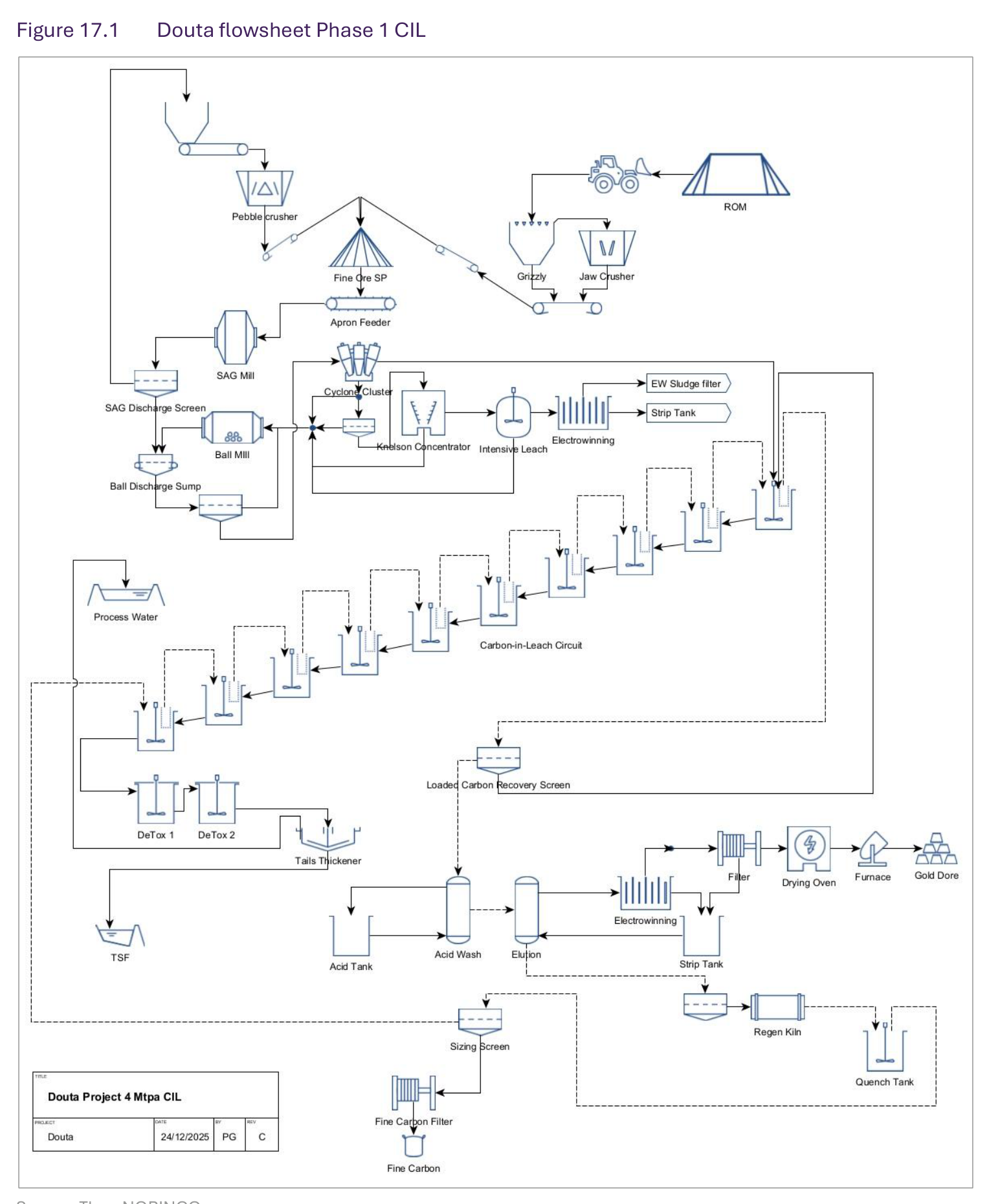
Source: Thor Explorations Ltd (2026)
Website: https://thorexpl.com/projects-operations/douta-project/
Critical Data
| Parameter | Value | Unit | Notes |
|---|---|---|---|
| Throughput (Phase 1) | 4,000,000 | tpa | 4 Mtpa for oxide/transitional ore; plant operates 330 days/year, equivalent to ~12,121 tpd |
| Throughput (Phase 2) | 2,400,000 | tpa | 2.4 Mtpa for fresh ore; ~7,273 tpd |
| SAG Mill Power | 9 | MW | 8.53 m dia. x 4.5 m EGL, VFD drive |
| Ball Mill Power | 9 | MW | 7.32 m dia. x 11.0 m EGL, VFD drive |
| Target Grind Size | Not specified | μm | Based on metallurgical test work; not provided in source |
| Head Grade | Not specified | g/t | Head grades for oxide/transitional/fresh not provided in Section 17 |
| Recovery % | Not specified | % | High for oxide; variable for fresh; exact recoveries not disclosed in source |
| Crushing Utilization | 75 | % | Based on operating experience |
| Milling Utilization | 90.4 | % | 330 operating days per year |
| Operating Hours | 24 | hours/day | Continuous operation assumed; not explicitly stated but typical for gold plants |
Overview
Thor Explorations Ltd., a Canadian mineral exploration and development company, is advancing the Douta Gold Project in Southeast Senegal, with a Preliminary Feasibility Study (PFS) effective January 2026. The project employs a robust two-phase gold recovery strategy designed to maximize overall recovery while minimizing operating costs. Phase 1 targets cyanide-soluble gold from oxide and transitional ores using conventional Carbon-in-Leach (CIL) technology, which achieves high leaching recoveries and is well-proven in the industry. Phase 2 addresses the refractory gold hosted in sulphides and silicates present in fresh ore, where direct CIL yields lower, variable recoveries. A heavy fuel oil suspension roasting (SR) circuit is added to the flowsheet for Phase 2, which removes organic carbon, oxidizes sulphides, and thermally cracks silicate and sulphide minerals to expose gold particles for subsequent cyanidation. The plant is designed to process 4 Mtpa during Phase 1 and 2.4 Mtpa during Phase 2, with an average life-of-mine (LOM) ore blend of 28.68% oxide, 14.47% transitional, and 56.84% fresh. The process facility includes primary crushing via a jaw crusher, a conventional SABC (SAG mill, ball mill, pebble crusher) comminution circuit, gravity recovery with a Knelson concentrator and intensive cyanidation, a ten-stage CIL circuit, and gold recovery via acid wash, elution, and electrowinning. Cyanide destruction in tailings is achieved using the INCO Sulphur Dioxide/Air process. This integrated approach allows Thor Explorations to efficiently treat the diverse ore types at Douta, ensuring high gold recovery across the project’s life.
Key Process Stages
- Stage 1: Primary Crushing and Stockpiling – Run-of-mine (ROM) ore from the Douta pit is dumped directly into a single primary jaw crusher. A fixed rock breaker handles oversize. Crushed ore is conveyed to a crushed ore stockpile with a live capacity of 24 hours of mill feed (at 4 Mtpa). Four variable-speed apron feeders reclaim ore onto the SAG mill feed conveyor. Dust collection and an emergency ore bin are included for operational flexibility. The crushing circuit operates at 75% utilization.
- Stage 2: Comminution (SABC Circuit) – The grinding circuit comprises an 8.53 m diameter by 4.5 m EGL SAG mill (9 MW VFD drive) and a 7.32 m diameter by 11.0 m EGL ball mill (9 MW VFD drive). Pebbles from the SAG mill discharge screen are crushed by a pebble crusher and returned to the SAG mill feed. Cyclone underflow is split: a portion feeds the gravity circuit, and the remainder returns to the ball mill. The target grind size is optimized for subsequent leaching. Process water and lime (for pH control) are added to the SAG mill feed.
- Stage 3: Gravity and Intensive Cyanidation – A bleed from the cyclone underflow is fed to a Knelson centrifugal concentrator. The high-specific-gravity concentrate is periodically discharged to an Acacia intensive cyanidation reactor, where gold is leached under high-cyanide conditions. The pregnant solution is electrowon in a dedicated cell. Gravity tailings are returned to the mill feed for further liberation. This step captures free gold, particularly from oxide and transitional ores, improving overall recovery.
- Stage 4: Carbon-in-Leach (CIL) Circuit – Trash screen undersize from the grinding circuit feeds a ten-stage CIL tank train. Slurry flows by gravity through inter-connected tanks fitted with dual impeller agitators and woven-wire inter-tank screens for carbon retention. Fresh/regenerated carbon is added counter-currently from Tank 10. Oxygen is sparged into the first five tanks to enhance gold dissolution. Cyanide and caustic are added for leaching and pH control. Loaded carbon advances to the acid wash section. In Phase 2, the CIL circuit treats the roasted product after regrinding.
- Stage 5: Acid Wash, Elution, Electrowinning, and Gold Smelting – Loaded carbon batches are acid-washed with dilute hydrochloric acid to remove scale and trash, then eluted at 140°C and 600 kPa using hot caustic cyanide solution. The pregnant eluate is cooled to ~95°C and sent to electrowinning cells with stainless steel mesh cathodes. Gold sludge is washed off, dried, and smelted to produce gold doré. Barren carbon is reactivated in a kiln and returned to the CIL circuit. A separate gravity electrowinning circuit handles solution from the Acacia reactor.
Additional Interesting Data and Summary
The Douta Gold Project recovery methods incorporate several additional technical considerations and auxiliary systems. The comminution circuit includes a pebble crusher with metal detection and bypass facilities to protect equipment. Gravity recovery utilizes a Knelson concentrator and an Acacia intensive cyanidation reactor, with the pregnant solution processed in a dedicated electrowinning cell. The CIL circuit comprises ten tanks with oxygen sparging in the first five tanks to enhance gold dissolution; dissolved oxygen is manually monitored. Cyanide destruction is achieved using the INCO Sulphur Dioxide/Air process before tailings are thickened and pumped to the tailings storage facility (TSF). For Phase 2, the pre-roasting dewatering circuit includes a thickener and filter press, followed by a product storage silo and the heavy fuel oil suspension roaster. The roaster calcine is repulped and reground prior to entering a reduced-capacity CIL circuit. Elution operates at 140°C and 600 kPa, with a regenerative heat exchanger to recover thermal energy. Electrowinning cells use sludging-type mesh cathodes; barren electrolyte is recycled. Carbon is reactivated in a kiln after elution. Environmental controls include a hydrogen cyanide gas monitor in the leach area and an event pond for slurry recovery. The plant is designed to treat the LOM ore blend (28.68% oxide, 14.47% transitional, 56.84% fresh) with Phase 2 activation planned for Year 5. The project’s significance lies in its ability to handle refractory gold through innovative suspension roasting, a technology adapted from iron ore beneficiation. Sustainability initiatives include recycling of process water and cyanide destruction, though specific water and energy consumption metrics are not provided. The future outlook includes continued optimization through additional metallurgical test work and the phased capital deployment strategy. Overall, the Douta Gold Project represents a technically robust approach to gold recovery in a challenging ore deposit, leveraging both conventional CIL and cutting-edge roasting to maximize economic returns.
Key Processes: CIP/CIL, Cyanidation, Gravity Separation, SAG Mill, Ball Mill, Crushing
Target Commodities: Gold, Copper
