

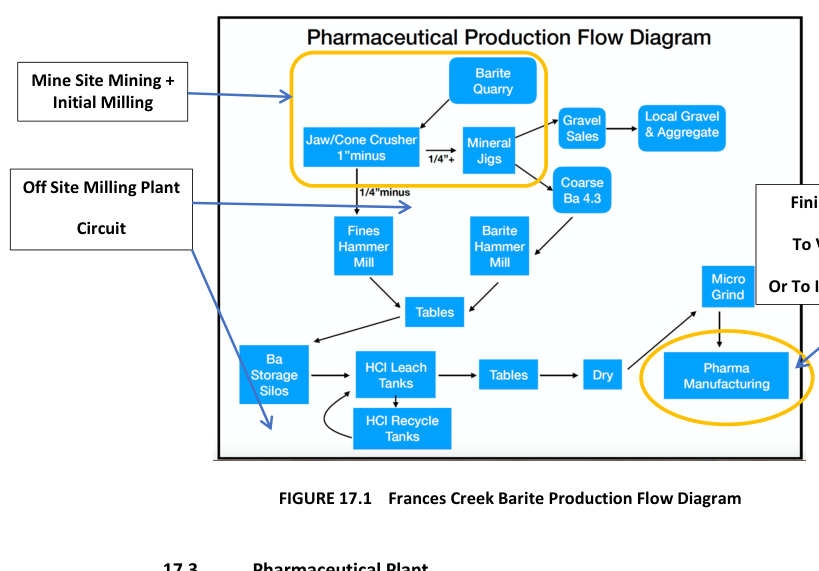
Voyageur has outlined a conceptual processing plan for its exploration-stage Frances Creek barite project, covering on-site crushing and gravity separation, an off-site milling and acid-washing circuit, and a potential pharmaceutical-grade blanc fixe production route.
Although Canadian National Instrument 43-101 does not require recovery method details for exploration-stage projects, Voyageur’s exploration and mining departments have formulated a conceptual Milling Plan for the Frances Creek Prospect. The plan is presented in the technical report for investor review, with more detailed information to be prepared for the next 43-101 report, which will be a Pre-Feasibility Study.
The proposed flow sheet uses conventional gravity separation for barite, followed by acid treatment and fine grinding to produce a high-purity powder. A separate pharmaceutical plant is being studied to convert a portion of this powder into Barium Contrast Suspension (BCS) for medical imaging markets. The complete circuit includes an on-site recovery plant, an off-site milling and finishing plant, and a stand-alone pharmaceutical operation.
Critical Data
| Parameter | Value | Unit | Notes |
|---|---|---|---|
| On-site crushing and gravity separation cost | $4 | $/tonne | Estimated |
| Crushed ore top size | 1 | inch | Minus 1 inch feed to mineral jigs |
| Jig concentrate density | 4.1-4.3 | specific gravity | Depending on ore quality |
| Jig screen undersize | 1/8 | inch | Minus 1/8 inch reports to wilfley tables |
| Coarse barite recovery | 95 | % | Based on past Tiger Ridge mine experience |
| Fines recovery | 70 | % | Conservative estimate for Frances Creek, based on Tiger Ridge |
| Milled concentrate size | 35 | mesh | After hammer or roller milling |
| Jet mill product size | 1-10 | micron | Final barite powder |
| Road gravel production | 2-3 | km road per year | From all waste rock |
| Road gravel sales price | 10-20 | $/tonne | Based on local aggregate sales |
| Annual road gravel revenue | 78,000 | $/year | Estimated |
| On-site electrical power source | Not applicable | Diesel generators | Off-grid generation |
| Off-site electrical power source | Not applicable | Grid | Detailed requirements not estimated |
| On-site water source | Not stated | Frances Creek | Assumed |
| Off-site water source | Not stated | Municipal supply | Assumed |
| Blanc fixe process | Not applicable | Carbothermal reduction followed by sulfate precipitation | BaSO₄ + 4 C → BaS + 4 CO; BaS + H₂SO₄ → BaSO₄ + H₂S |
Overview
The Frances Creek Prospect is at the exploration stage, and the technical report presents conceptual recovery methods that have not yet been detailed in engineering design. The plan comprises three principal components: a mine-site recovery plant, an off-site milling and acid-washing plant, and a pharmaceutical plant for producing BCS.
The mine-site plant will perform crushing and gravity separation at an estimated cost of $4 per tonne. The off-site plant will further process the concentrate through milling, acid treatment, and micro-grinding. The pharmaceutical plant is at a feasibility-study stage and would use a blanc fixe precipitation process to produce barium sulfate in excess of current pharmaceutical grades.
All waste rock produced from mining is planned to be sold as road gravel. Estimated production would cover approximately 2-3 km of road per year.
Key Process Stages
The process begins at the mine site, where ore is crushed to minus 1 inch and processed across mineral jigs. The jigs upgrade the barite to a density of 4.1-4.3, depending on ore quality. Fines of minus 1/8 inch pass through the jig screens and are captured on wilfley tables for concentration.
Recovery of coarse barite is expected to be high at 95%, based on past work at the Tiger Ridge mine. However, recovery rates for barite fines are lower. Ultra-fine barite is lost across the mine, crushing, jigging, and table circuits due to the soft and fragile nature of high-purity barite. When explosives are used, a portion of the barite becomes ultra-fine dust and is generally lost during processing. Voyageur conservatively estimates a 70% recovery rate for fines on the Frances Creek property, based on past experience at the Tiger Ridge Mine. Blasting techniques will require experimentation to determine the least impactful method to reduce losses from the high-purity Frances Creek mineralization.
The off-site milling plant will receive barite concentrate by truck. The concentrate will be milled to 35 mesh using either a hammer mill or roller mill. The milled material will then be run across wilfley tables for further upgrading to high-purity barite. To eliminate trace metals, the 35-mesh tabled concentrate will be sent to an HCl acid bath. This material will then be returned and run across the wilfley tables for a final upgrade. After drying, the material proceeds to a jet mill grinding facility, which grinds the 35-mesh material down to 1-10 microns. The final barite powder is then packaged and sold to industrial, paint, and pharmaceutical markets.
The pharmaceutical plant will mix the final barite powder with food additives and preservatives to create Voyageur's BCS. The other main ingredients are emulsifier, food-grade starch, sugar, flavoring additives, and water. Voyageur is contemplating manufacturing fluid and dry products.
Additional Interesting Data and Summary
BCS is used as a contrast medium ingested by patients prior to receiving radiographic and magnetic imaging of the gastrointestinal tract. The BCS allows doctors to see a higher contrast image of the patient's GI tract for better identification of tumors, etc. If Voyageur is able to produce BCS, this would be the highest end use for barite products produced from the Frances Creek Prospect.
The precipitation process to produce highly pure barium sulfate involves the carbothermal reduction of barite with coke to give barium sulfide. Barium sulfide is soluble in water and is readily converted to the oxide, carbonate, and halides. To produce highly pure barium sulfate, the sulfide or chloride is treated with sulfuric acid or sulfate salts. The barium sulfate produced in this way is often called blanc fixe, French for "permanent white." Blanc fixe is the form of barium encountered in consumer products such as paints.
Since the detailed design of both the on-site and off-site milling and finishing plants is still in the conceptual stage, details as to energy, water, and process material requirements have not yet been estimated. Electrical energy will be generated for the on-site mill from diesel generators. Electrical energy for the off-site milling and finishing plant will come from the grid. The detailed power requirements and attendant costs are yet to be determined. It is assumed that on-site water will come from Frances Creek and that off-site water will come from municipal supply. These details will be presented in the next 43-101 report, which will be a Pre-Feasibility Study.
Key Processes
- On-site crushing of ore to minus 1 inch
- Gravity separation using mineral jigs, upgrading barite to 4.1-4.3 density
- Wilfley table concentration of fines (minus 1/8 inch)
- Off-site hammer or roller milling to 35 mesh
- HCl acid bath for trace metal removal
- Wilfley table re-treatment and final upgrade
- Jet mill grinding to 1-10 microns
- Blanc fixe precipitation for pharmaceutical-grade barium sulfate
- BCS formulation with food additives, emulsifier, starch, sugar, and flavoring
Source: Frances Creek Prospect Technical Report, report date Unknown.
Project website: Frances Creek Prospect Technical Report
