

Overview
Nestled approximately 175 kilometers north of Red Lake in Northwestern Ontario, the PAK Lithium Project represents one of North America’s most significant and strategically important lithium developments. Operated by Frontier Lithium Inc., this world-class asset is poised to become a cornerstone of the continent’s electric vehicle (EV) battery supply chain. The project encompasses two primary pegmatite deposits—Spark and PAK—which together hold a substantial resource of high-purity, chemical-grade spodumene ore. The defining feature of the PAK Project is its integrated mine and processing facility, designed to produce an average of 201,000 tonnes per annum of a premium 6.0% Li₂O spodumene concentrate over a 31-year mine life, with total production estimated at 6.07 million tonnes. This operation is critical for supplying the essential raw materials needed for lithium-ion batteries, supporting the global transition to clean energy. The feasibility study, detailed in a comprehensive NI 43-101 Technical Report, outlines a sophisticated mineral processing circuit that incorporates cutting-edge technology like X-ray transmission (XRT) ore sorting and a multi-stage concentration process to achieve an impressive life-of-mine lithium oxide recovery of 77.6%. With construction slated to begin and production targeted for 2030, the PAK Project is not just a mining endeavor but a pivotal part of Canada’s and the world’s sustainable energy future.
Key Process Stages
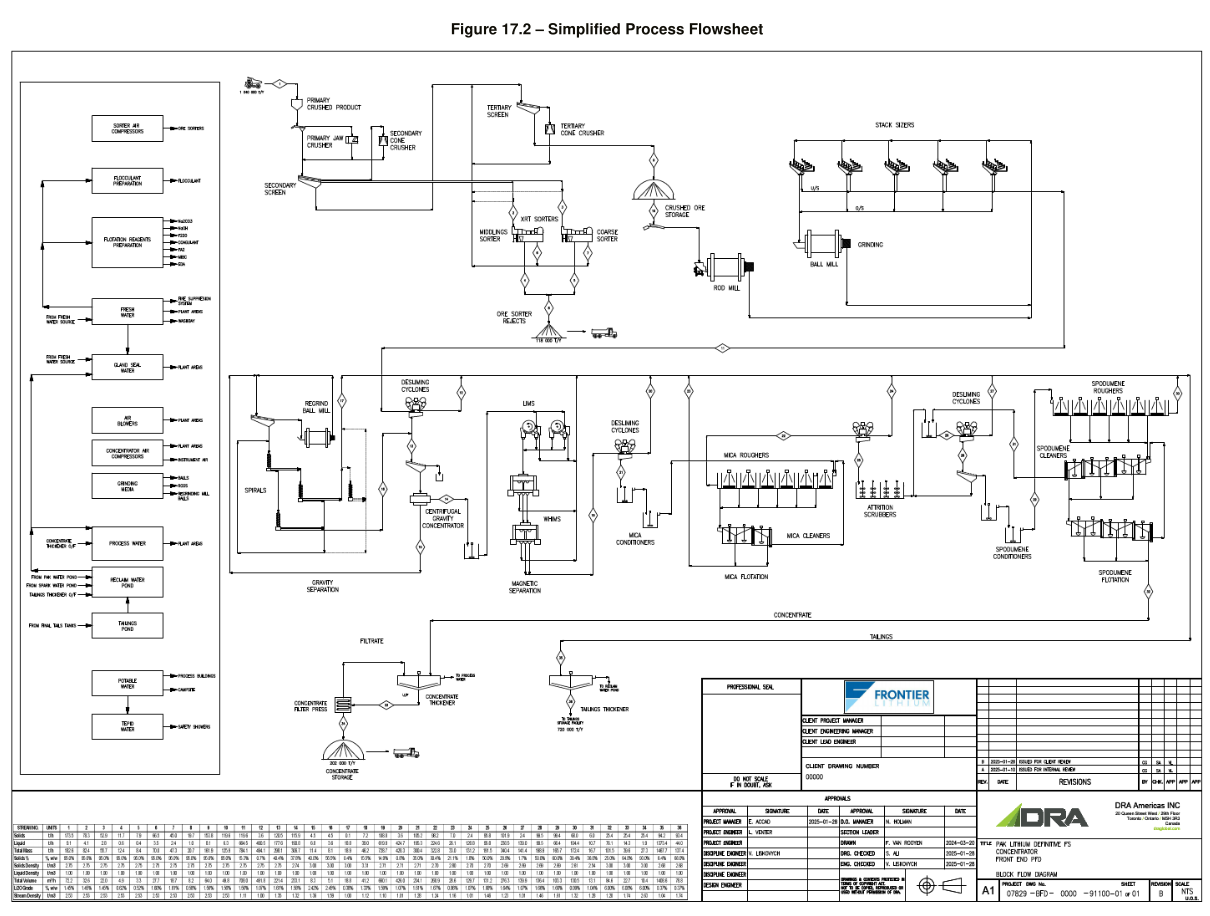
The PAK Lithium Project’s concentrator is engineered with a complex, multi-stage flowsheet specifically designed to liberate and concentrate spodumene from hard rock ore while efficiently rejecting iron and other impurities to meet strict chemical-grade specifications. The design, with a nominal throughput of 1.04 million tonnes per annum (2,849 tpd), is based on extensive metallurgical test work and is optimized for the ore’s competency and hardness.
- Stage 1: Three-Stage Crushing & XRT Ore Sorting Run-of-Mine (ROM) ore, with a top size (F100) of 600 mm, is first reduced by a 110 kW, 31″ x 43″ single-toggle jaw crusher. The secondary crushing stage involves a 185 kW cone crusher operating in closed circuit with a triple-deck vibrating screen (50/25/13 mm apertures). A tertiary stage, featuring a 260 kW cone crusher and a single-deck screen (13 mm aperture), further reduces the product to a P80 of 9.5 mm. A key innovation is the integration of two XRT ore sorters, which process a split feed of +13-25 mm and +25-55 mm material to pre-concentrate the ore by rejecting ~15% of the mass as waste, primarily composed of iron-bearing mafic silicates, significantly upgrading the feed to the grinding circuit.
- Stage 2: Grinding & Classification The crushed and sorted ore is ground in a two-stage comminution circuit. Primary grinding is performed in an open-circuit, 500 kW rod mill (3.05m D x 4.57m EGL), reducing the feed from an F80 of 9.5 mm to a T80 of 1,000 µm. Secondary grinding occurs in a 750 kW ball mill (3.2m D x 5.18m EGL) operating in closed circuit with five (5) operating 8-deck wet vibrating fine screens with a 300 µm aperture. This achieves the target final grind size of a P80 of 200 µm, which is critical for optimal mineral liberation.
- Stage 3: Desliming, Gravity, & Magnetic Separation The ground slurry is first deslimed using hydrocyclones to remove the -15 µm fraction, which reports to tails. The underflow feeds a continuous centrifugal gravity concentrator to recover tantalum and arsenic. Gravity concentrate is reground in a 45 kW ball mill. Tailings from gravity separation proceed to magnetic separation, first through two Low-Intensity Magnetic Separators (LIMS) to remove grinding media fragments, followed by two stages of Wet High-Intensity Magnetic Separation (WHIMS) at 10,000 Gauss to remove weakly magnetic iron-bearing minerals, rejecting a combined 6% of the feed mass.
- Stage 4: Mica & Spodumene Flotation The non-magnetic stream from WHIMS is conditioned to a pH of 10.5 and fed to a mica flotation circuit (rougher and cleaner banks) using Flotigam EDA collector, rejecting 7.3% of the mass. The mica-free tailings are then dewatered, and the underflow is subjected to high-intensity attrition scrubbing in a bank of five cells to clean particle surfaces. The scrubbed product is conditioned to a pH of 8.5 and fed to the spodumene flotation circuit. Using a combination of fatty acid collectors (Sylfat FA-2/TPA-100) and MIBC frother, the spodumene is floated through rougher, first cleaner, and second cleaner stages to produce the final concentrate, representing a mass pull of 19.7% of the original ROM feed.
- Stage 5: Concentrate & Tailings Handling The spodumene concentrate slurry is thickened in a 12-meter diameter high-rate thickener to 64% solids. The underflow is filtered using a vertical pressure filter (Larox type) to produce a filter cake with 93% solids moisture content, which is conveyed to an 8,000-tonne live capacity conical stockpile for load-out. All tailings and process water streams are collected and pumped to a 16-meter diameter high-compression tailings thickener. The thickened underflow (68% solids) is pumped to the Tailings Management Facility (TMF), while the overflow is sent to a reclaim water pond for treatment and recycling back into the process circuit, minimizing fresh water consumption.
Critical Data
The following table presents the key technical and operational parameters that define the performance and efficiency of the PAK Lithium Project’s processing circuit.
| Parameter | Value | Unit | Notes |
|---|---|---|---|
| Annual Throughput (LOM Avg.) | 1,040,000 | tpa | Dry tonnes of ore |
| Daily Throughput (LOM Avg.) | 2,849 | tpd | Dry tonnes of ore |
| Design Hourly Throughput | 138 | tph | For equipment sizing |
| Concentrate Production (LOM Avg.) | 201,000 | tpa | At 6.00% Li₂O grade |
| Li₂O Recovery (LOM Avg.) | 77.6 | % | Weighted average for Spark & PAK ore |
| Concentrate Mass Pull | 19.7 | % | Percentage of ROM feed |
| Target Grind Size (P80) | 200 | µm | Ball mill product size |
| Rod Mill Specific Energy | 3.34 | kWh/t | |
| Ball Mill Specific Energy | 4.79 | kWh/t | |
| Total Power Consumption | 44.6 | kWh/t | Per tonne of ROM ore processed |
| XRT Sorter Waste Rejection | 15 | % | Of ore sorting feed mass |
| Operating Hours (Concentrator) | 21.6 | hours/day | Based on 90% operating time |
Additional Interesting Data and Summary
Beyond the impressive technical specifications, the PAK Lithium Project is a benchmark for modern, sustainable mining. The entire operation is designed with a strong emphasis on water stewardship and energy efficiency. The site operates with a sophisticated water management system that prioritizes recycling. Fresh water is used only for makeup, gland seals, fire protection, and potable water, with the majority of process water being reclaim water sourced from the tailings thickener overflow, mine collection ponds, and the TMF. This closed-loop approach drastically reduces the project’s environmental footprint and ensures no water is taken from the nearby Pakeagama Lake. The project’s power will be supplied by the Watay Powerline, a major grid connection initiative in Northwestern Ontario, enhancing its sustainability credentials. The estimated power consumption is 44.6 kWh per tonne of ore, resulting in an annual demand of 46.3 million kWh.
From an economic standpoint, the project is a major investment in the Canadian critical minerals sector. The detailed feasibility study underpins a robust financial model, with recent reports projecting a significant net present value. The partnership with the Government of Canada, announced in early 2025, to expand the production of strategic battery materials further highlights the project’s national strategic importance. It is expected to generate substantial long-term employment and economic benefits for local Indigenous communities and the region as a whole. The use of advanced process control, including a Courier 8X SL on-stream analyzer (LIBS technology) for real-time monitoring of Li, Fe, and other elements, ensures optimal recovery and consistent concentrate quality. The project is permitted to ramp up to full production within nine months of commissioning, showcasing the robustness of the circuit design and the quality of the ore body. The PAK Lithium Project is not merely a mining operation; it is a fully integrated, technologically advanced, and environmentally conscious supplier of a critical material for the global energy transition.
Source: NI 43-101 Technical Report | Project: Standards of Disclosure for Mineral Project | Date: May 2025
Further Reading
- PAK Lithium Project, Frontier Lithium Inc. | PAK Lithium …
- RESOURCE | ASSETS
- Frontier Lithium study projects Ontario PAK Project worth …
- Government of Canada to partner with Frontier Lithium Inc. …
