

Overview
Nestled in the resource-rich James Bay region of Québec, Canada, the Shaakichiuwaanaan Project represents a major step forward in North America’s critical minerals supply chain. Owned and operated by PMET Resources Inc. (formerly Patriot Battery Metals Inc.), this advanced-stage project is centered on the high-grade CV5 spodumene pegmatite, a significant source of lithium essential for the global transition to electric vehicles and renewable energy storage. The recently completed NI 43-101 Technical Report and Feasibility Study, dated October 2025, outlines a robust, large-scale operation designed for long-term, sustainable production. The project’s cornerstone is a state-of-the-art mineral processing facility engineered to produce a high-quality, battery-grade spodumene concentrate. With a planned annual throughput of 5.1 million tonnes, the facility is a testament to modern mineral processing design, employing a sophisticated, multi-stage Dense Media Separation (DMS) circuit to efficiently upgrade the ore. This project not only underscores Québec’s position as a leading mining jurisdiction but also highlights the industry’s shift towards more energy-efficient and environmentally considered processing technologies to meet the growing demand for lithium.
Key Process Stages
The Shaakichiuwaanaan processing plant is engineered as a gravity-based beneficiation facility, specifically designed to exploit the coarse-grained nature of the spodumene mineralization. The circuit avoids energy-intensive fine grinding and chemical flotation, instead relying on physical property differences. The entire operation is structured around two identical, parallel process trains for redundancy and operational flexibility, each capable of handling 50% of the total plant feed. The journey from run-of-mine (ROM) ore to final spodumene concentrate involves several meticulously designed stages.
- Stage 1: Run-of-Mine Handling & Three-Stage Crushing Circuit: ROM ore, with a top size of 1 meter, is delivered by truck. It can be fed directly to the primary crusher or stockpiled (with a 21-day live capacity). The crushing circuit reduces the ore to a target size of 9.5 mm top size (P100) to prepare it for DMS. This involves a primary jaw crusher, followed by secondary and tertiary cone crushers in closed circuit with vibrating screens to ensure precise size control.
- Stage 2: DMS Feed Preparation & Classification: The crushed ore is stored in a fine ore stockpile dome, acting as a buffer. It is then meticulously screened to separate it into distinct size fractions optimal for DMS efficiency. Key fractions are: Coarse (-9.5 mm to +3.4 mm), Fine (-3.4 mm to +1.6 mm), and Ultrafine (-1.6 mm to +0.65 mm). Material finer than 0.65 mm is deemed too fine for effective DMS and is bypassed directly to tailings.
- Stage 3: Multi-Stage Dense Media Separation (Core Beneficiation): This is the heart of the concentrator. Each size fraction is processed in dedicated DMS circuits using a ferrosilicon medium. The coarse fraction undergoes a unique two-stage DMS process for higher recovery, the fine and ultrafine fractions are treated in single-stage circuits. The DMS cyclones separate high-density spodumene (sinks) from low-density waste rock (floats) based on a specific gravity cut-point.
- Stage 4: Re-crush and Scavenging DMS Circuit: To maximize recovery, the “middlings” stream from the secondary coarse DMS (material with a SG between ~2.65 and 2.90) is not discarded. It is sent to a High-Pressure Grinding Rolls (HPGR) unit to liberate more spodumene, then re-screened and fed to a dedicated “recrush” DMS circuit for a final upgrade opportunity.
- Stage 5: Magnetic Separation & Final Product Handling: All DMS concentrate streams are combined and passed through high-intensity magnetic separators. This critical step removes iron-bearing minerals to ensure the final spodumene concentrate meets the strict market specification of less than 2% Fe₂O₃. The non-magnetic, cleaned concentrate is dewatered and conveyed to a covered storage pile for load-out.
- Stage 6: Tailings and Bypass Fines Dewatering: All reject streams (DMS floats and the sub-0.65 mm bypass fines) are sent to a thickener and then a belt filter for dewatering. The resulting filter cake, along with coarser rejects, is transported to a tailings storage facility. A portion is earmarked for future use in paste backfill, enhancing the project’s sustainability profile.
Critical Data
The feasibility of the Shaakichiuwaanaan Project is underpinned by a comprehensive set of design criteria and performance metrics. The table below summarizes the key operational and metallurgical parameters extracted from the NI 43-101 Technical Report, providing a clear snapshot of the plant’s intended scale and efficiency.
| Parameter | Value | Unit | Notes |
|---|---|---|---|
| Annual ROM Throughput | 5.1 | Million tonnes per annum (Mtpa) | Nominal design capacity |
| Plant Feed Grade (Li₂O) | 1.31 | % | Average during full production (Years 4-18) |
| Target Concentrate Grade (Li₂O) | 5.50 | % | Product specification |
| Lithium Recovery (at 1.31% feed) | 65.0% (Min) | % | Minimum target; actual modeled recovery is ~69.5% |
| Annual Concentrate Production | 756,087 | tonnes per annum (tpa) | At 5.50% Li₂O grade |
| Concentrator Availability | 85 | % | Equivalent to 7,446 operating hours/year |
| Crushing Plant Availability | 68 | % | Equivalent to 5,957 operating hours/year |
| Target Crushed Product Size (P100) | 9.5 | mm | Top size for DMS feed |
| DMS Feed Size Fractions | Coarse: 56.4%, Fine: 17.0%, Ultrafine: 8.3% | wt.% of plant feed | Remaining 18.2% is bypass fines (<0.65 mm) |
| Key Consumable (DMS Medium) | Ferrosilicon 270D | – | Dense medium for separation |
Additional Interesting Data and Summary
The Shaakichiuwaanaan processing circuit is notable not just for its scale but for its sophisticated application of DMS technology. The decision to use a three-size-fraction DMS plant, including an ultrafine circuit, is a direct response to the ore’s favorable mineralogy—characterized by large, liberated spodumene grains. This design minimizes the “particle size effect” that can hamper recovery in traditional single-fraction DMS plants, contributing to the project’s expected recovery of approximately 69.5% Li₂O, which is considered high for a DMS-only operation. The technical report includes a detailed recovery model, showing recovery as a function of head grade, with a theoretical maximum recovery of 75%. The use of parallel process trains enhances operational flexibility and mitigates risk, allowing one train to be maintained while the other operates.
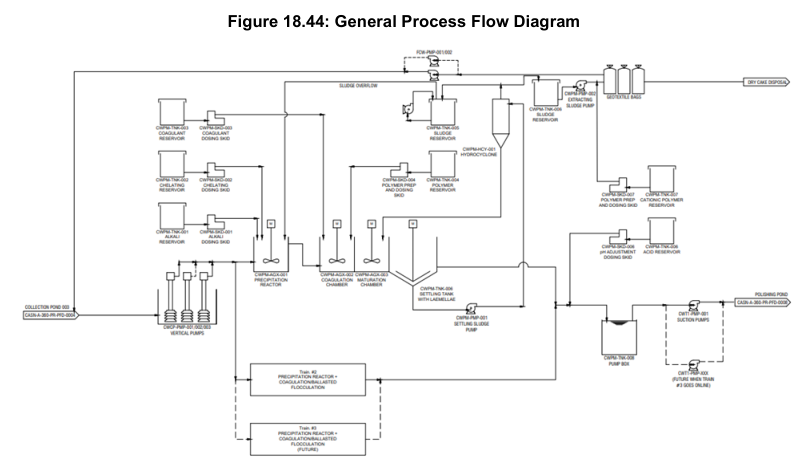
From a sustainability and economic perspective, the gravity-based DMS process offers significant advantages. It typically has a lower energy footprint compared to flotation circuits and uses water-based, non-toxic reagents (primarily ferrosilicon and flocculant). The project incorporates a comprehensive water management plan, with a dedicated water treatment facility to handle bleed streams and maximize water recycling, a crucial consideration in the James Bay environment. The study also identifies several future optimization opportunities, including the potential integration of ore sorting for high-dilution material and by-product recovery circuits for tantalum, caesium, and rubidium. These avenues could further enhance project economics and resource utilization post start-up.
In summary, the Shaakichiuwaanaan Project’s processing plant, as detailed in the 2025 Feasibility Study, presents a well-engineered, economically robust, and environmentally considered pathway to producing a key battery raw material. Its design reflects current best practices in spodumene processing and positions PMET Resources as a future significant supplier in the North American lithium market.
Source: NI 43-101 Technical Report | Feasibility Study | Project: Shaakichiuwaanaan Project | Date: October 2025
Further Reading
- Shaakichiuwaanaan – CV5 lithium-only project, Canada
- PMET Resources Delivers Positive CV5 Lithium-Only Feasibility Study for Its Large-Scale Shaakichiuwaanaan Project
Technical report and processing history
The following archived source profiles have been consolidated here to preserve the project’s processing history and study context.
Shaakichiuwaanaan Project — 2025 Technical Report
Shaakichiuwaanaan Project — 2025 Technical Report
| Company | CV5 |
| Date | 2025 |
| Region | James Bay, Québec, Canada |
| Commodities | Lithium (Spodumene) |
| Mine Type | Open Pit |
| Throughput | 5,100,000 tpa |
| Annual Production | 756,087 tpa Spodumene Concentrate |
| Status | Development |
Executive Summary
This NI 43-101 Technical Report outlines the Feasibility Study for the Shaakichiuwaanaan Project, a lithium pegmatite deposit located in James Bay, Québec, Canada. The project is currently in the development stage, with a proposed mineral processing facility designed to produce spodumene concentrate from Run-of-Mine (ROM) material. The facility is engineered to process 5.1 million dry tonnes per annum (tpa) of mineralized material with a feed grade of 1.31% Li2O.
The processing circuit utilizes a gravity-based beneficiation approach, featuring a three-stage crushing circuit followed by a multi-stage Dense Media Separation (DMS) process. The design includes two identical parallel process trains, each handling 50% of the capacity. The plant aims to produce 756,087 tpa of spodumene concentrate at a grade of 5.50% Li2O, achieving a minimum lithium recovery of 65.0%. The facility also incorporates magnetic separation to reduce iron impurities to below 2.0% Fe2O3 and includes dewatering and tailings handling systems.
Key operational metrics indicate a crushing plant availability of 68% and a concentrator availability of 85%. The project design supports full production from Years 4 to 18 of the mine life. Recommendations include further optimization of the magnetic separation circuit and potential integration of ore sorting or by-product recovery for tantalum, caesium, and rubidium.
Processing Profile
- Crushing: Primary Jaw Crusher, Secondary Cone Crusher, Tertiary Cone Crusher
- Milling: N/A
- Separation: Dense Media Separation (Coarse, Fine, Ultrafine), High-Intensity Magnetic Separation
- Dewatering: Thickeners, Belt Filters
- Leaching: N/A
Website: https://www.pmet.ca/projects/shaakichiuwaanaan/
Report Date: 2025
Region: James Bay, Québec, Canada
Project Status: Development
Commodity: Lithium (Spodumene)
Throughput: 5,100,000 tpa
Mine Life:
Mine Type: Open Pit
Ore type:
Optimizing Lithium Recovery: A Technical Deep Dive into the Causeway Zone Mineral Processing Infrastructure
Overview
The Causeway Zone represents a critical geological and infrastructural focal point within the world-class Shaakichiuwaanaan Project (formerly the Corvette Project), situated in the prolific James Bay region of Quebec, Canada. Managed by Patriot Battery Metals (now PMET Resources Inc.), the Causeway Zone is essentially the central spine of the CV5 spodumene pegmatite, specifically the area where the mineralization extends beneath a natural land bridge and water crossing at Lake 001. This project has gained international recognition as one of the largest and highest-grade hard-rock lithium deposits in North America, serving as a cornerstone for the emerging domestic battery supply chain.
The significance of the Causeway Zone lies not only in its exceptional mineralogy—dominated by coarse-grained spodumene—but also in its logistical and environmental complexity. Being located beneath and adjacent to Lake 001, the development of the Causeway Zone requires a sophisticated mining and processing strategy that balances high-tonnage extraction with rigorous environmental stewardship. The project utilizes a hybrid approach, incorporating both open-pit and underground mining methods to maximize resource recovery while minimizing the surface footprint near sensitive aquatic habitats. As the lithium market shifts toward sustainable and localized production, the Causeway Zone’s technical framework provides a blueprint for large-scale, low-carbon mineral processing. The integration of high-efficiency Dense Media Separation (DMS) technology ensures that the project remains economically viable even in fluctuating market conditions, positioning Quebec as a premier Tier-1 mining jurisdiction for the green energy transition.
Key Process Stages
The mineral processing circuit for the Causeway Zone material is designed to handle high volumes of spodumene pegmatite with a focus on gravity-based separation to maintain a low environmental and chemical footprint. The circuit is characterized by a “lithium-only” flowsheet that prioritizes the production of a high-quality 6% Li2O spodumene concentrate. The process stages are as follows:
- Run-of-Mine (ROM) Preparation: Material is transported via mine trucks to primary stockpiles. The ROM system includes a dedicated dump pocket and a reclaim system designed for a 21-day residence time to ensure consistent mill feed.
- Three-Stage Crushing: The ore undergoes primary jaw crushing, followed by secondary and tertiary cone crushing in closed circuits. The goal is to produce a crushed product of 100% passing 16 mm and approximately 80% passing 6.5 mm, optimizing liberation for the subsequent DMS stages.
- Classification and Sizing: A sophisticated screening system utilizes double-deck DMS sizing screens. The material is categorized into three primary size fractions: Coarse (9.5 mm to 4 mm), Fine (4 mm to 1.4 mm), and Ultrafine (1.4 mm to 0.65 mm).
- Dense Media Separation (DMS) Circuits:
- Coarse DMS: Processes the largest fraction to recover high-grade spodumene.
- Fine DMS: Targets the intermediate fraction, utilizing ferrosilicon as the dense medium.
- Ultrafine DMS: Extracts lithium from the smallest viable fraction, significantly boosting overall recovery.
- Recrush Circuit: Middlings from the primary DMS stages are recrushed and reintroduced to the circuit to maximize liberation.
- Magnetic Separation: Final DMS concentrates pass through high-intensity magnetic separators to remove iron-bearing minerals (such as mica and tourmaline), ensuring the final product meets strict glass and battery-grade specifications.
- Tailings and Fines Management: Fines smaller than 0.65 mm bypass the DMS circuit. Tailings are dewatered and filtered for storage, while water is recycled back into the process plant to minimize fresh water consumption.
Critical Data
The following technical parameters define the processing capabilities and economic benchmarks for the Causeway Zone and the broader CV5 pegmatite operations:
| Parameter | Value | Unit |
|---|---|---|
| Nominal Peak Throughput | 5.1 | Mtpa |
| Stage 1 Design Capacity | 2.5 | Mtpa |
| Life of Mine (LOM) | 19 | Years |
| Primary Crusher Size (p80) | 125 | mm |
| Final Crusher Product (p80) | 6.5 | mm |
| DMS Lower Cut Size | 0.65 | mm |
| DMS Upper Cut Size | 9.5 | mm |
| Target Concentrate Grade | ~6.0 | % Li2O |
| ROM Stockpile Capacity | 288,000 | tonnes |
Technical Details and Sustainability
A defining technical characteristic of the Causeway Zone’s processing strategy is the heavy reliance on Dense Media Separation (DMS) over traditional flotation methods. DMS technology leverages the specific gravity differences between spodumene (approx. 3.1) and common silicate waste minerals like quartz and feldspar (approx. 2.6–2.7). By utilizing a purely physical separation process, the project significantly reduces the need for chemical reagents, which not only lowers operating costs but also drastically simplifies the environmental permitting process. This is particularly crucial given the Causeway Zone’s proximity to Lake 001. The exclusion of flotation chemicals means that the process water is easier to treat and recycle, minimizing the risk of contamination to the local watershed.
From a sustainability perspective, the project is designed to integrate with Quebec’s renewable energy grid. The use of Hydro-Québec’s low-carbon hydroelectricity to power the 10 MW milling clusters and crushing circuits allows the project to maintain one of the lowest carbon footprints per tonne of lithium concentrate produced globally. Furthermore, the decision to minimize impacts on fish habitats in Lake 001—by optimizing the pit limits and utilizing a hybrid mining scenario—demonstrates a proactive approach to ESG (Environmental, Social, and Governance) standards. The project’s water management plan involves maintaining water diversion within the same watershed, ensuring that the local hydrological balance is preserved throughout the 19-year life of the mine.
The future outlook for the Causeway Zone involves a phased expansion. Stage 1 focus is on establishing the first 2.5 Mtpa circuit, with Stage 2 doubling the capacity to 5.1 Mtpa by Year 2 of operations. This modular approach allows for the optimization of recovery rates as geological knowledge of the Causeway Zone matures. As the project moves into the feasibility study phase, further metallurgical testwork will focus on refining the “Ultrafine” DMS recovery and exploring the potential for byproduct recovery, such as tantalum or high-purity quartz, which could further enhance the project’s economic resilience. Ultimately, the Causeway Zone stands as a premier example of how technical innovation in mineral processing can align with global sustainability goals to provide the raw materials necessary for the electric vehicle revolution.
Source: Causeway Zone
Source: NI 43-101 Technical Report
This article provides an overview of mineral processing developments based on publicly available technical reports and industry analysis.
