

This 2021 technical report reviews historical processing of Joe Mann ore (2005–2007) at the Copper Rand Mill, a facility that has been idle since 2008 and would require component evaluation before any restart.
Report context
This profile is based on the NI 43-101 technical report for the Joe Mann Project, prepared by SLR Consulting (Canada) Ltd. for Doré Copper Mining Corp., with an effective date of July 21, 2021. The report describes a former gold–copper–silver mine in northwestern Québec that operated intermittently from the 1960s to 2007. No new metallurgical testing had been initiated by Doré Copper at the time of reporting. Between January 2005 and September 2007, Joe Mann ore was trucked approximately 60 km to the Copper Rand Mill, a facility that processed the ore on a toll or owner-operator basis. The Copper Rand Mill operated from 1959 until the end of 2008, when it was shut down and its process vessels emptied, with mills raised on jacks to protect bearings. The report explicitly states that the mill has not been operational since that time and that prior to any restart each component would require evaluation, repair, or replacement.
Processing route
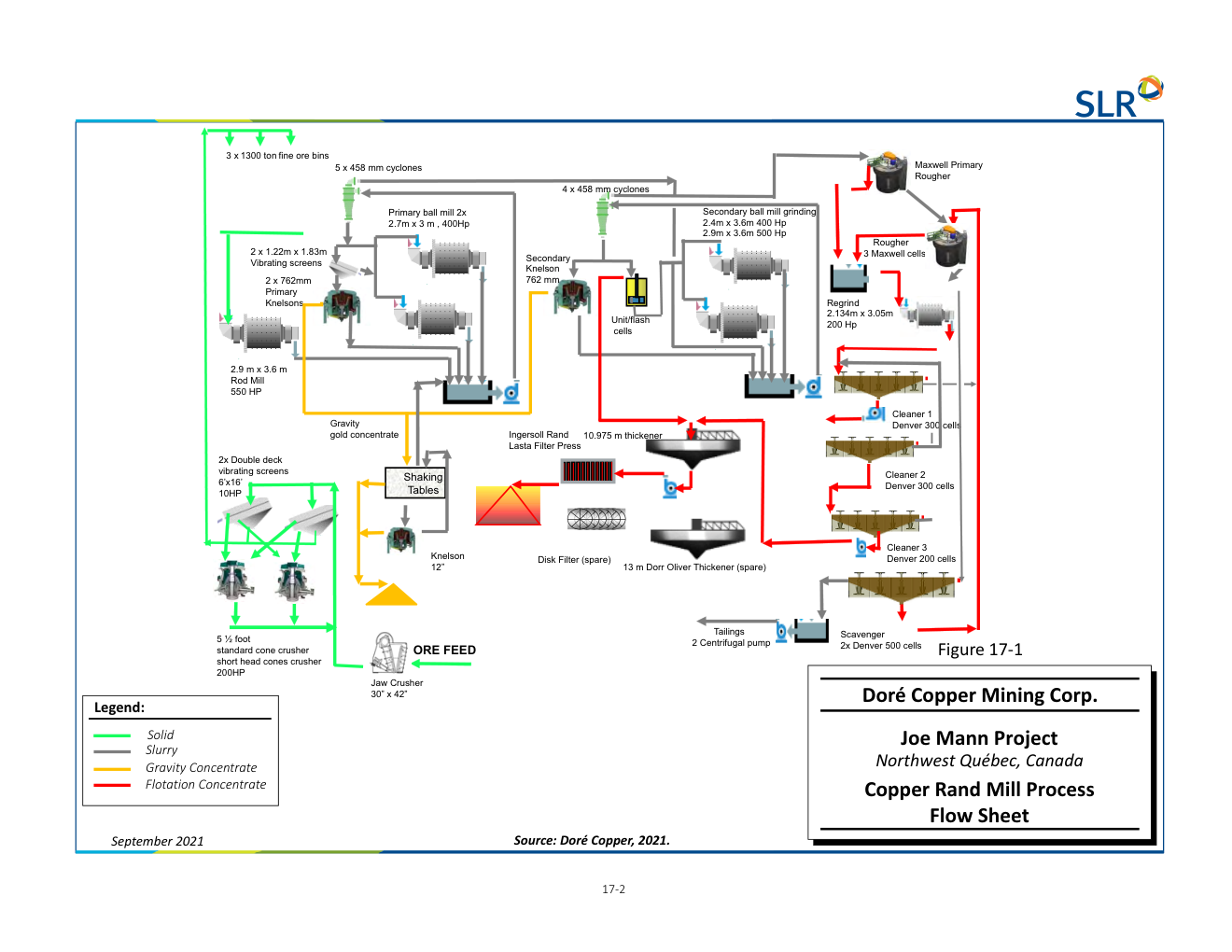
The Copper Rand Mill flowsheet, as described in the 2021 report, comprises crushing, primary and secondary grinding with gravity gold recovery, flotation, concentrate regrind and cleaning, thickening, and filtration.
Crushing and fine ore storage
Three stages of crushing are employed: a 30 in. × 42 in. jaw crusher as the primary, followed by a 5½ ft standard cone crusher and a 5½ ft short head cone crusher as secondary and tertiary units. Both cone crushers operate in closed circuit with two double-deck vibrating screens (72 in. × 192 in.). Screen undersize is conveyed to three fine ore bins, each of 1,300 st capacity (approximately 1,179 t per bin), for mill feed storage.
Primary grinding and gravity circuit
Crushed ore is fed to a 9½ ft × 12 ft rod mill operating in open circuit. Rod mill discharge is pumped to a primary grinding circuit consisting of two 9 ft × 10 ft ball mills in closed circuit with primary hydrocyclone classifiers (18 in. cyclones) and two 30 in. primary Knelson concentrators. The overflow from the primary hydrocyclones reports to secondary hydrocyclones.
Secondary grinding and gravity circuit
Underflow from the secondary hydrocyclones feeds an 8 m³ flash flotation cell and a 30 in. secondary Knelson concentrator. Concentrate from both stages of Knelson gravity separation is directed to a 4 ft × 8 ft shaking table for final gold and silver concentrate production, which is then melted in a furnace. Flash flotation concentrate is sent directly to the concentrate thickener, while flash flotation tailings are pumped to the secondary ball mill grinding circuit. The secondary grinding stage uses two ball mills: one 8 ft × 12 ft (400 hp) and one 9½ ft × 12 ft (500 hp).
Flotation circuit
Feed to flotation comes from the overflow of the secondary hydrocyclones. The flotation circuit comprises:
- Four Maxwell rougher tanks (one 32 m³ and three 20 m³)
- Two Denver 500 scavenger banks
- Three Denver cleaner banks (200 ft³, 200 ft³, 300 ft³, and 500 ft³ units)
Rougher concentrate is sent to a 7 ft × 10 ft regrind ball mill and then cleaned through three stages of cleaner cells before being pumped to the concentrate thickener. Tailings or middlings from the cleaning circuit can be returned either to the first cleaner or to the rougher circuit. Scavenger concentrate is recycled to rougher flotation; scavenger tailings proceed to the tailings pond.
Thickening and filtration
Thickened concentrate from a 36 ft × 10 ft Dorr-Oliver thickener is pumped to a Lasta filter press (1500 × 28 × 22 mm), then washed, dried, discharged, and stored. An 8 ft × 6 ft disc filter is also listed in the circuit.
Key reported parameters
| Parameter | Value | Basis |
|---|---|---|
| Ore transport distance (Joe Mann to Copper Rand Mill) | ~60 km | Historical operation (2005–2007) |
| Crushing stages | Three-stage (jaw, standard cone, short head cone) | Installed equipment, idle since 2008 |
| Fine ore bin capacity (each) | 1,300 st (approx. 1,179 t) | Installed; three bins total |
| Rod mill | 9½ ft × 12 ft, 550 hp | Installed, open circuit |
| Primary ball mills (two) | 9 ft × 10 ft, 400 hp each | Installed, closed circuit with hydrocyclones |
| Primary Knelson concentrators (two) | 30 in., 15 hp each | Installed |
| Secondary ball mills (two) | 8 ft × 12 ft (400 hp) and 9½ ft × 12 ft (500 hp) | Installed |
| Secondary Knelson concentrator | 30 in., 15 hp | Installed |
| Flash flotation cell | 8 m³ | Installed |
| Rougher flotation cells (Maxwell) | One 32 m³ (10.5 hp); three 20 m³ (10 hp each) | Installed |
| Regrind ball mill | 7 ft × 10 ft, 200 hp | Installed |
| Cleaner flotation cells (Denver) | 200 ft³ (20 hp), 200 ft³ (20 hp), 300 ft³ (30 hp), 500 ft³ (40 hp) | Installed |
| Concentrate thickener (Dorr-Oliver) | 36 ft × 10 ft | Installed |
| Filter press (Lasta) | 1500 × 28 × 22 mm | Installed |
| Historical gold recovery (2005–2007) | Reported in Table 13-1 of source | Actual mill performance; values not extracted from OCR-ambiguous table |
| Historical copper recovery (2005–2007) | Reported in Table 13-1 of source | Actual mill performance; values not extracted from OCR-ambiguous table |
| Historical silver recovery (2005–2007) | Reported in Table 13-1 of source | Actual mill performance; values not extracted from OCR-ambiguous table |
Technical qualifications
This profile is a snapshot of the 2021 technical report. The Copper Rand Mill has been idle since 2008; all equipment described is installed but non-operational. The report explicitly states that prior to restart, each component must be evaluated and any repairs or replacements completed. No metallurgical testing had been initiated by Doré Copper for the Joe Mann project at the time of reporting. The historical recovery data (2005–2007) are presented in the report as a summary table but specific numerical values are not reproduced here due to OCR ambiguity in the source markdown. The report notes that information regarding the specific mineralized zones extracted from the Joe Mann deposit during that period is unknown. The flowsheet description and equipment list show the configuration at the time of the mill’s closure; no design or proposed modifications are presented in the cited sections.
Source: Technical Report on the Joe Mann Project, Northwest Québec, Canada, prepared for Doré Copper Mining Corp. by SLR Consulting (Canada) Ltd. (SLR Project No: 233.03410.R0000). Effective date July 21, 2021; signature date September 10, 2021. Sections 13.0 (Mineral Processing and Metallurgical Testing) and 17.0 (Recovery Methods).
