

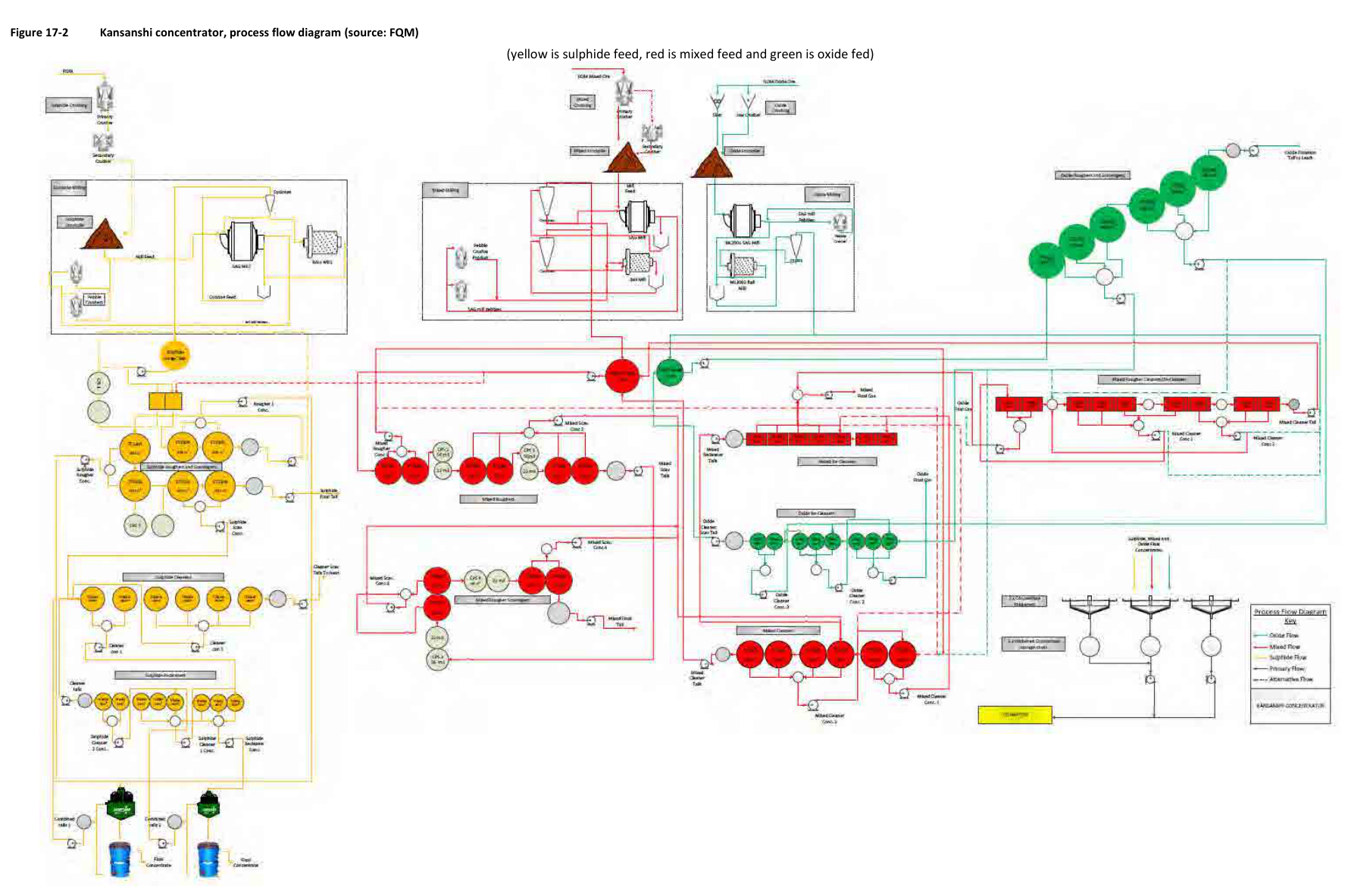
The Kansanshi processing facility comprises three ore-specific flotation circuits, hydrometallurgical leaching and SX/EW capacity, a smelting complex, and an expansion project (S3) under construction for additional sulphide ore treatment.
Report context
This article summarises processing information from the July 2024 NI 43-101 Technical Report for Kansanshi Operations. The report describes current facilities, historical production for 2019 to 2023, and proposed expansions. Material is drawn from Item 17, Recovery Methods.
Processing route
Current processing circuits
The Kansanshi processing facilities comprise three main circuits. The oxide circuit has an approximate capacity of 7 Mtpa, the mixed ore circuit 8 Mtpa, and the S2 sulphide circuit 13 Mtpa. All ore types are treated in separate circuits via crushing, milling and flotation to produce copper in concentrate. Oxide ore and a portion of mixed ore flotation tailings are leached, subject to solid-liquid separation, then treated by solvent extraction (SX) and electrowinning (EW) to produce copper cathode.
Crushing and ore storage
Direct mined ore is hauled to a run-of-mine (ROM) pad north of the processing plant. Feed from direct mine sources and surface stockpiles is tipped into one of three primary crusher dump pockets. The sulphide and mixed ore crushing circuits comprise primary gyratory and open circuit secondary cone crushers. The oxide crushing circuit comprises a primary jaw crusher, a secondary sizer and a semi-mobile jaw crusher. Crushed products are conveyed to dedicated coarse ore stockpiles.
Grinding circuits
Grinding circuits are SABC configurations, each comprising a SAG mill, ball mill and pebble crusher. Each mill is equipped with hydrocyclones. Cyclone overflow gravitates to rougher flotation. Underflow from SAG and ball mill cyclones is directed to the ball mill. Coarse SAG mill discharge screen material is conveyed to a pebble crusher and returned to the SAG mill feed conveyor.
Gravity gold recovery uses centrifugal concentrators in each milling circuit, treating a bleed stream from cyclone underflow. Gravity concentrates are upgraded on rougher and cleaner shaking tables, acid treated, washed, dried and smelted in an induction furnace to produce doré bars.
Flotation
Each circuit includes rougher, rougher-scavenger, cleaner and recleaner flotation sections. Sulphide circuit concentrates are treated in primary and secondary Jameson flotation cells and upgraded in columns. The oxide and mixed ore circuits use controlled potential sulphidisation (CPS) and NaHS to improve recovery of secondary and partially oxidised minerals. CPS has also been incorporated into the sulphide flotation circuit.
A new cleaner flotation circuit commissioned in early 2022 treats sulphide concentrates. This includes six 150 m³ cells as first cleaners and cleaner scavengers. First cleaner concentrates are re-cleaned in the existing cleaner circuit. Final concentrates are upgraded in two new flotation columns.
Concentrate handling
Final concentrates are dewatered in existing concentrate thickeners and pumped to the smelter. The current arrangement includes two existing agitated stock tanks with two additional tanks proposed. Three sets of concentrate transfer pumps are provided. Concentrate slurry is filtered using Larox filters adjacent to the smelter.
Smelter
The Kansanshi copper smelter (KCS) began operation in March 2015. The smelter features a single Isasmelt furnace, a 6-in-line electric furnace for matte settling and slag cleaning, four Pierce-Smith converters (PSCs) and two rotary anode furnaces. A 1,450 t/day oxygen plant and a 4,000 t/day sulphuric acid plant are integral to the smelting operations.
The smelter has achieved nameplate capacity of 1.2 Mtpa of copper concentrate. It operates consistently at about 1.38 Mtpa through an Isasmelt furnace feed rate of 170 to 180 dry t/h. Plant concentrates are delivered by slurry pipeline to a filter plant, then blended with Sentinel concentrate. The blended concentrate is fed to the Isasmelt furnace with silica, limestone, slag and reverts.
Off-gases are cooled in a vertical water tube boiler and hot electrostatic precipitator, then delivered to the acid plant gas cleaning system. Matte and slag are tapped from the furnace to an electric furnace for separation. Matte is transferred by ladles to the converters. Blister copper undergoes final refining in anode furnaces, with anodes cast using two 18-mould casting wheels at up to 110 t/h. Sulphuric acid from the off-gas treatment is delivered back to the plant for oxide ore leaching.
Smelter expansion proposals
Future concentrate production from the S3 circuit, increases at Sentinel, and other sources will result in up to 1.6 Mtpa of concentrate. The increased production will be handled by expanding smelter throughput to 1.6 Mtpa, treating 0.2 Mtpa of concentrate through the HPL circuit, and marketing some concentrate to other Zambian smelters.
The smelter expansion has been partially achieved by the addition of an Isoconvert furnace. The existing Isasmelt furnace requires an upgrade to the gas handling system to treat additional off-gas from increased concentrate throughputs. This includes increased capacity for the Induced Draft Fan, Intermediate Blower, and Air-Cooled Condenser in the Waste Heat Recovery Boiler.
Additional oxygen will be required for the smelter and HPL circuit. Increased concentrate treatment will produce more sulphur dioxide off-gases, requiring additional gas handling and an additional acid plant. One of the mothballed sulphur burning acid plants will be modified to handle the additional off-gas stream.
Concentrates from Kansanshi and Sentinel contain significant carbon levels of 1.5 to 2.5% by weight. Carbon contributes to the smelter heat load, consumes oxygen and generates additional off-gases. Flotation circuit modifications, including additional cleaner capacity and flotation columns, are aimed at reducing carbon levels. Reagent trials and process optimisation are continuing to address high carbon and pyrite in flotation concentrates.
The current HPL circuit comprises two autoclaves. Capacity is limited by oxygen availability to about 100,000 tpa of concentrate. Increased oxygen availability will increase capacity to approximately 200,000 tpa before the volumetric limit of the autoclaves is reached. Additional PLS generated from the HPL circuit can be handled in the current SX and EW circuits, which are running below capacity.
S3 expansion project
The S3 Project is an expansion to the existing sulphide processing facilities. It includes construction of a stand-alone copper concentrator capable of treating an additional 27.5 Mtpa of sulphide ore, and an overland conveyor from a near-mine surface transfer bin. The S3 design is based on the Sentinel concentrator design, with improvements from operating experience at Sentinel, Kansanshi and Cobre Panama incorporated.
The S3 plant design includes flotation circuit updates based on recent operating experience, including CPS and additional concentrate cleaning capacity to handle higher levels of carbon and pyrite in the ore feed. The project is under construction, with first ore expected in Q2 2025.
S3 process design criteria
The S3 plant has a revised throughput of 27.5 Mtpa based on 8,000 operating hours per year, equivalent to 3,438 tph. At a nominal head grade of 0.58% Cu and 90.7% recovery, this equates to approximately 145,000 tpa copper production at 24 to 26% concentrate grade. Crushing plant availability is 75% (6,570 h/annum) with concentrator availability of 91.3% (8,000 h/annum).
Primary crushing will use two gyratory crushers, one installed initially. Crusher operation is nominally 18 hours per day with an average feed rate of 3,805 tph. The crushed ore stockpile will have 13 hours live capacity, about 40,000 tonnes. Ore will be recovered by four variable speed apron feeders.
Grinding will use a 28 MW SAG mill, 12.2 m diameter with 8.2 m effective grinding length, and a single 22 MW ball mill, 8.5 m diameter with 13.3 m effective grinding length. The SAG mill discharge screen oversize returns to the SAG mill feed conveyor. Future crushing of the oversize is allowed for.
S3 concentrate handling
Concentrate from S3 will be handled in existing concentrate thickeners, which are adequate for future production. All six underflow pumps will be upgraded. Two new concentrate tanks will be added to supplement the existing two agitated stock tanks. Three sets of concentrate transfer pumps will pump concentrate to the smelter.
Concentrate slurry will be filtered using four Larox filters, one new filter added to supplement the existing three. Filtered concentrate reports to the smelter feed conveyor or to a storage shed conveyor.
S3 flotation
Two banks of flotation cells will be used for rougher/scavenger duty. Each bank will be headed by a single 600 m³ tank cell followed by four 300 m³ cells arranged as two stages of CPS. CPS enhancement is included to improve recoveries of partially oxidised sulphides and secondary sulphide minerals.
First rougher concentrates will be upgraded in two Jameson cells, then cleaned in columns. Scavenger concentrates will be upgraded in a bank of mechanical cells, followed by two Concorde cells and two columns to produce final concentrates for smelter feed.
Tailings disposal
Tailings from the rougher/scavenger flotation banks gravitate to two 50 m diameter tails thickeners. An agitated tails surge tank provides surge capacity between the thickeners and final tailings pumps. Main plant tailings at 30 Mtpa will be added to S3 tailings at 27.5 Mtpa in the tails surge tank, with combined tailings at 55 Mtpa pumped to TSF2.
Two duty tails lines, each with three stages of centrifugal pumps plus a booster stage, are provided for tailings pumping. A third line of pumps is provided as common standby.
Tailings storage facilities include TSF1, a cross-valley dam covering approximately 6.5 km², with deposition up to December 2023 of 245 million tonnes. TSF2, commissioned in 2012, had received 172 million tonnes by end of 2023. A third TSF is under consideration to improve operational flexibility.
Process water
Main sources of processing water are from the Main Pit dewatering shaft, the Kansanshi Dam, the Solwezi River, and return water from the tailings dam, sedimentation ponds and the smelter. Potable water comes from a dedicated borefield. Total make-up water requirements are 3,450 m³/h, or 82,800 m³/day.
Key reported parameters
| Parameter | Value | Basis |
|---|---|---|
| Oxide circuit capacity | ~7 Mtpa | Approximate |
| Mixed circuit capacity | 8 Mtpa | Nominal |
| S2 sulphide circuit capacity | 13 Mtpa | Nominal |
| S3 design throughput | 25 Mtpa (revised to 27.5 Mtpa) | Design |
| S3 mill feed rate | 3,438 tph | Design |
| S3 copper head grade (nominal) | 0.58% | Design |
| S3 copper recovery (nominal) | 90.7% | Design |
| S3 concentrate grade (nominal) | 24 to 26% | Design |
| S3 annual copper production | ~145,000 tpa | Design |
| S3 concentrate make (at 24% Cu) | 548,000 dtpa (603,000 dtpa) | Design |
| Crushing plant availability | 6,570 h/annum (75%) | Design |
| Concentrator availability | 8,000 h/annum (91.3%) | Design |
| Primary crusher feed rate | 3,805 dtph | Design |
| SAG mill power | 28 MW | Design |
| SAG mill dimensions | 12.2 m dia. x 8.2 m EGL | Design |
| Ball mill power | 22 MW | Design |
| Ball mill dimensions | 8.5 m dia. x 13.3 m EGL | Design |
| Smelter feed rate | 170 to 180 dry t/h | Actual |
| Smelter nameplate | 1.2 Mtpa concentrate | Design |
| Smelter throughput | ~1.38 Mtpa | Actual |
| HPL autoclaves | 2 | Existing |
| HPL capacity (current) | ~100,000 tpa concentrate | Oxygen limited |
| HPL capacity (potential) | ~200,000 tpa concentrate | Oxygen increased |
| Process water demand | 118 ML/day (post-S3) | Design |
| Fresh water dam capacity | 3.3 million m³ | Constructed |
| Tailings deposition TSF1 | 245 Mt (to Dec 2023) | Actual |
| Tailings deposition TSF2 | 172 Mt (to end 2023) | Actual |
Project website: https://www.first-quantum.com/operations/kansanshi/
Technical qualifications
The report includes several specific limitations and design-stage qualifications. The S3 mechanical design is based on the Sentinel concentrator, with improvements from Cobre Panama operating experience incorporated. The S3 metallurgical design is based on the existing Kansanshi sulphide circuit. Sulphide ore samples from the South East Dome deposit, yet unmined, appear geologically and mineralogically similar to carbonaceous phyllite ores from the Main Pit.
The S3 flotation circuit design has been updated based on recent operating experience to handle higher levels of carbon and pyrite. Circuit changes include additional concentrate cleaning capacity and CPS. The original cleaner circuit installed in 2008 will be decommissioned.
Smelter expansion proposals note that additional oxygen, gas handling, and acid plant capacity are required. The smelter expansion has been partially achieved. Mothballed sulphur burning acid plant capacity will be modified. Excess Sentinel concentrate not offloaded is redirected to other Copperbelt smelters.
The future smelter feed rate of 1.6 Mtpa includes concentrate from sources additional to the Mineral Reserve inventory. Whether the smelter can be filled with lower-carbon concentrates affects throughput. Acid plant production is related to smelter operations, and acid is consumed in the leaching circuits.
TSF1 and TSF2 have adequate combined capacity for future tailings. A third TSF will reduce rates of rise and improve operational flexibility. Sites are being evaluated.
Gravity gold recovery, flotation, and smelter carbon management are each described with reference to ongoing optimisation work. The report states that process optimisation and reagent trials are continuing for carbon and pyrite reduction but does not quantify outcomes.
Source: Kansanshi Operations, NI 43-101 Technical Report, July 2024, Item 17 Recovery Methods, Sections 17.1, 17.1.4, 17.1.5, 17.1.6, 17.1.7, 17.1.8, 17.1.9, 17.2.4, 17.2.5, 17.2.6, 17.2.7, 17.2.8, 17.2.9, 17.3, 17.3.1.
