

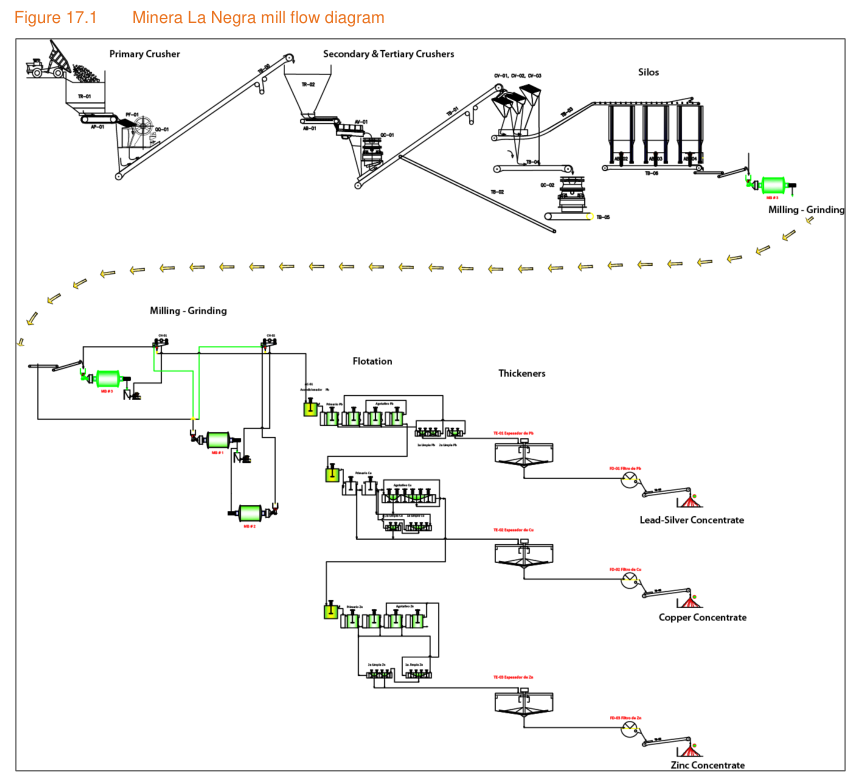
This report describes the conventional crushing, grinding and differential flotation processing route at the Minera La Negra concentrator.
Report context
This technical report, dated within the original source material, addresses the processing facilities at Minera La Negra. The concentrator has an operating capacity of 3,000 tonnes per day based on a conventional crushing, grinding and differential flotation process to produce lead-silver, copper-silver, and zinc concentrates, in that order. The present technical study assumes the processing plant will treat 2,500 tonnes per day, or 842,500 tonnes per annum. The report notes that Minera La Negra is not declaring any reserves; the mine plan is based on Indicated and Inferred Resources, and the term "ore" is used in a generic descriptive sense.
Processing route
Crushing and screening
Mineralized material is delivered to the plant site in 23 tonne trucks operated by a community-based contractor. After blending to control for grade and arsenic content, material is tipped into a 60 tonne coarse ore hopper with a 25" x 25" grate; oversize material is broken with a BT200 hydraulic breaker. A new breaker has been included in the start-up capital estimate.
Primary crushing: Material is fed into a Gator 30" x 42" primary jaw crusher with a 150 hp motor that produces a product with P80 of -4 inches. The primary crusher has an availability of 88% and is projected to operate 3,334 hours per annum and crush at a rate of 220 tonnes per hour.
Screening area: Product from the primary crusher is fed by a series of belts to a 25 hp grizzly in closed circuit that produces material ranging from 5/16" to 4". Material greater than 4" and less than 7" is fed to a 400 tonne coarse ore bin, while material less than 5/16" goes to a 100-tonne capacity fine ore hopper.
Secondary crushing: The secondary crusher consists of a 5½ ft Symons standard head cone crusher with a 200 hp motor that has a historical availability of 86% and is projected to operate at an average of 4,350 hours per annum. The crushing is estimated at a rate of 300-340 tonnes per hour to produce a product with P80 of 1½ inches. Crushed material is fed to two parallel 6' x 12' vibrating grizzlies, with material greater than 5/16" fed to the tertiary crusher and material finer than 5/16" fed to the fine ore bin.
Tertiary crushing: The tertiary crusher consists of a 300 hp 5½ ft Symons short head cone crusher which produces a product with P80 of 3/8" that has an availability of 86% and is projected to operate 4,349 hours per annum and crush at a rate of 150-190 tonnes per hour.
Mobile crusher: The processing section also features a 200 tph, 150 hp 30" x 42" mobile jaw crusher for bespoke jobs, including batch processing for certain material types as required by the geology team, and producing construction material, including crushed rock for the tailings storage facility (TSF) buttress. The product of this crusher ranges between 4" and 7" but also produces finer material that is fed to an Allis Chalmers vibrating grizzly that produces material less than 1" and greater than 3/8".
Ore storage
Crushed material is stored in three fine material silos each with a capacity of 450 tonnes.
Grinding circuit
Mineralized material is fed from the fine ore bins to the milling circuit. The grinding circuit consists of two parallel ball milling lines each in closed-circuit with a bank of hydrocyclones to deliver a P80 of approximately 75 µm.
The first line includes a Marcy 10' x 10' ball mill with an 800 hp motor and 46 tph capacity in a single grinding stage arrangement in closed circuit with two D20 hydrocyclones.
The second line includes two ball mills: an Allis Chalmers 9' x 11' mill with 36 tph capacity and a Taylor 7½' x 11' regrind mill with 22 tph capacity in a two-stage milling arrangement, with motors of 500 hp and 450 hp, respectively. The ground material is fed to a bank of six D10 hydrocyclones. The overflow from both ball milling circuits passes to the differential flotation circuit.
Zinc sulfate and sodium cyanide are added at a 2:1 ratio as conditioners during the milling stage to activate lead and to depress zinc, copper, pyrite, arsenic and iron.
Flotation circuit
The flotation circuit consists of three stages of flotation to recover lead, copper, and zinc concentrates, in that order. A variety of conventional reagents are added throughout the process to maximize recovery of the targeted metal while suppressing unwanted materials such as iron and arsenic.
Lead recovery: The lead recovery circuit consists of a 12' x 12' conditioning tank with a retention time of 12 minutes; Aero 404 is added as a promoter and the pulp fed to four 350 ft³ Outotec BC-10 flotation cells with CC-1064 as a frother in the first lead flotation cell. Four Denver 50 ft³ flotation cells are used for two stages of cleaning.
Copper recovery: Tails from the lead flotation circuit are fed to a 10' x 10' conditioning tank ahead of the copper flotation circuit. Retention time is 10 minutes and ammonium bisulfite is added as a pH modifier and to depress zinc and iron. S-7583 is added as a promoter to activate copper. The copper recovery circuit consists of two Wemco 300 ft³ flotation cells and the product of primary flotation can be sent to the concentrate thickener or, at the operator's discretion, to secondary flotation. The scavenger flotation consists of ten Denver 160 ft³ flotation cells followed by three stages of cleaning in Denver 50 ft³ cells, which can be used to deliver final product or used to recirculate material.
Zinc recovery: Tails of the copper circuit are fed to a 12' x 12' conditioning tank; milk of lime is added to increase the pH to 9.0-10.0 and as an iron depressant. Copper sulfate is also added to activate zinc. The zinc recovery circuit consists of four Denver 160 ft³ cells followed by three stages of cleaning in Denver 50 ft³ cells. The report provides a reagent consumption table (Table 17.2) that forms the basis for inputs into the cost model, based on historic consumption rates and operating experience.
Concentrate thickening and filtration
Each of the three concentrate streams is pumped to a thickener.
Lead concentrate: The lead thickener consists of an 18' x 6' thickener which increases the concentrate to 30-40% solids. The pulp is dosed with flocculant (Zetag 4125) depending on the level of sedimentation. The material is fed to two (one operating, one standby) PIPSA 5' x 4' disc filters that operate in a vacuum to produce material with a humidity range of 18-20%. Subsequent aeration reduces the moisture content to a nominal 10.8%.
Copper concentrate: The copper thickener consists of a 30' x 10' thickener which increases the concentrate to 65-70% solids; Zetag flocculant is added to aid in sedimentation. The pulp is fed to a Clever 1000 x 1000 plate filter which produces material with a humidity of 15-20%, with a nominal humidity of 10.9% after aeration and rehandling.
Zinc concentrate: The zinc concentrate is fed to a 12' x 12' thickener. Zetag 4125 is added as a flocculant and the material is fed to two PIPSA 6' x 5' disc filters that increase the material to 80-82% solids, with a nominal humidity of 10% after aeration.
Each concentrate is stored in a compartmentalized shed awaiting shipment by truck to the concentrate offtaker. Concentrates were historically shipped in 35 tonne trucks to the port of Manzanillo on the Pacific Coast by a local contractor. It is assumed that concentrate from La Negra will be shipped to Manzanillo once the mine is restarted.
Tailings
The report references Section 18.5 for the status of existing tailings impoundment facilities and the preferred alternative for tailings disposal following a restart.
Onsite laboratory
Minera La Negra has an onsite laboratory used to assay samples from exploration sampling and drilling, definition drilling, mill samples, and to verify concentrate specifications. Although owned by MLN, for operational purposes it is treated the same as an offsite lab and is required to meet the same standards as an independent certified facility. The lab follows procedures requiring the use of blanks, reference material and duplicates.
Sample preparation: Samples are received, logged, and ordered for preparation. Samples are weighed with an Ohaus Adventurer Pro scale and dried in a GRIEVA SB-550 oven. Dried samples are crushed in a Terminator jaw crusher and split in a Jones riffle splitter to produce a ~600 g sample, which is then ground in an ESSA (FLSmidth) pulverizer. Ground material is quartered with a spatula and passed through a 200-mesh sieve. All equipment is cleaned between each sample. The final particle size fraction is determined in a Ro-Tap® sieve shaker.
Analytical methods: For AA or ICP analysis, samples undergo acid digestion: a 0.5 g sample is combined with 2.5 ml of nitric acid, heated for 15 minutes at 150°C ±5°C, then 7.5 ml of hydrochloric acid is added and heated for an additional 30 minutes, after which an additional 10 ml of HCl is added. The laboratory can conduct both atomic absorption and ICP analyses with one Agilent atomic absorption spectrometer (AA240FS) and one Varian atomic absorption spectrometer (AA240). The inductively coupled plasma machine is an Agilent 4210 MP-AES atomic emission spectrometer.
Fire assay: The lab can conduct traditional fire assays for Au and Ag. A 30 g sample is weighed with a Mettler Toledo XS104 analytical balance and combined with 120 g of flux in a crucible, placed in a muffle furnace for 45 minutes at 1050°C. Metals are separated from slag and placed in a cupel, then heated at 920°C in the muffle furnace for 45 to 60 minutes.
Key reported parameters
| Parameter | Unit | Value | Basis |
|---|---|---|---|
| Concentrator operating capacity | tonnes per day | 3,000 | Historical design |
| Plant throughput (study assumption) | tonnes per day | 2,500 | Design |
| Plant throughput (study assumption) | tonnes per annum | 842,500 | Design |
| Operating schedule (historical) | shifts per day / days per year | 3 shifts, 336 days | Historical |
| Operating schedule (reopening plan) | shifts per day / days per year | 3 shifts, 337 days | Design |
| Primary crusher rate | tonnes per hour | 220 | Design |
| Primary crusher product size | P80 inches | -4 | Design |
| Primary crusher availability | % | 88 | Design |
| Secondary crusher rate | tonnes per hour | 300-340 | Design |
| Secondary crusher product size | P80 inches | 1½ | Design |
| Secondary crusher availability | % | 86 | Historical |
| Tertiary crusher rate | tonnes per hour | 150-190 | Design |
| Tertiary crusher product size | P80 inches | 3/8 | Design |
| Tertiary crusher availability | % | 86 | Design |
| Grinding product size | P80 µm | ~75 | Design |
| Ball mill line 1 capacity | tonnes per hour | 46 | Design |
| Ball mill line 2 capacity (mill 1) | tonnes per hour | 36 | Design |
| Ball mill line 2 capacity (mill 2, regrind) | tonnes per hour | 22 | Design |
| Lead conditioning retention time | minutes | 12 | Design |
| Copper conditioning retention time | minutes | 10 | Design |
| Zinc flotation pH | pH | 9.0-10.0 | Design |
| Lead thickener feed % solids | % | 30-40 | Design |
| Lead filter product humidity (after aeration) | % nominal | 10.8 | Design |
| Copper thickener % solids | % | 65-70 | Design |
| Copper filter product humidity (after aeration) | % nominal | 10.9 | Design |
| Zinc thickener product % solids | % | 80-82 | Design |
| Zinc filter product humidity | % nominal | 10 | Design |
| Coarse ore bin capacity | tonnes | 400 | Design |
| Fine ore hopper capacity | tonnes | 100 | Design |
| Fine material silos (each) | tonnes | 450 | Design |
| Mobile crusher capacity | tonnes per hour | 200 | Design |
Project website: https://aurcana.com/operations/la-negra/overview/
Technical qualifications
This technical study is based on the assumption that the processing plant will treat 2,500 tonnes per day, not the historical operating capacity of 3,000 tonnes per day. The report states that Minera La Negra is not declaring any reserves and the mine plan is based on Indicated and Inferred Resources. Therefore, the term "ore" as applied in the report is being used in a generic or descriptive sense consistent with industry terminology. Reagent consumption figures forming the basis for inputs into the cost model are based on historic consumption rates and operating experience. The report does not contain specific metallurgical performance data such as recoveries, concentrate grades, or mass balances. No flowsheet details beyond those described in this section are included in the provided source material.
—
Source: Minera La Negra , Technical Report, Section 17: Recovery Methods
