

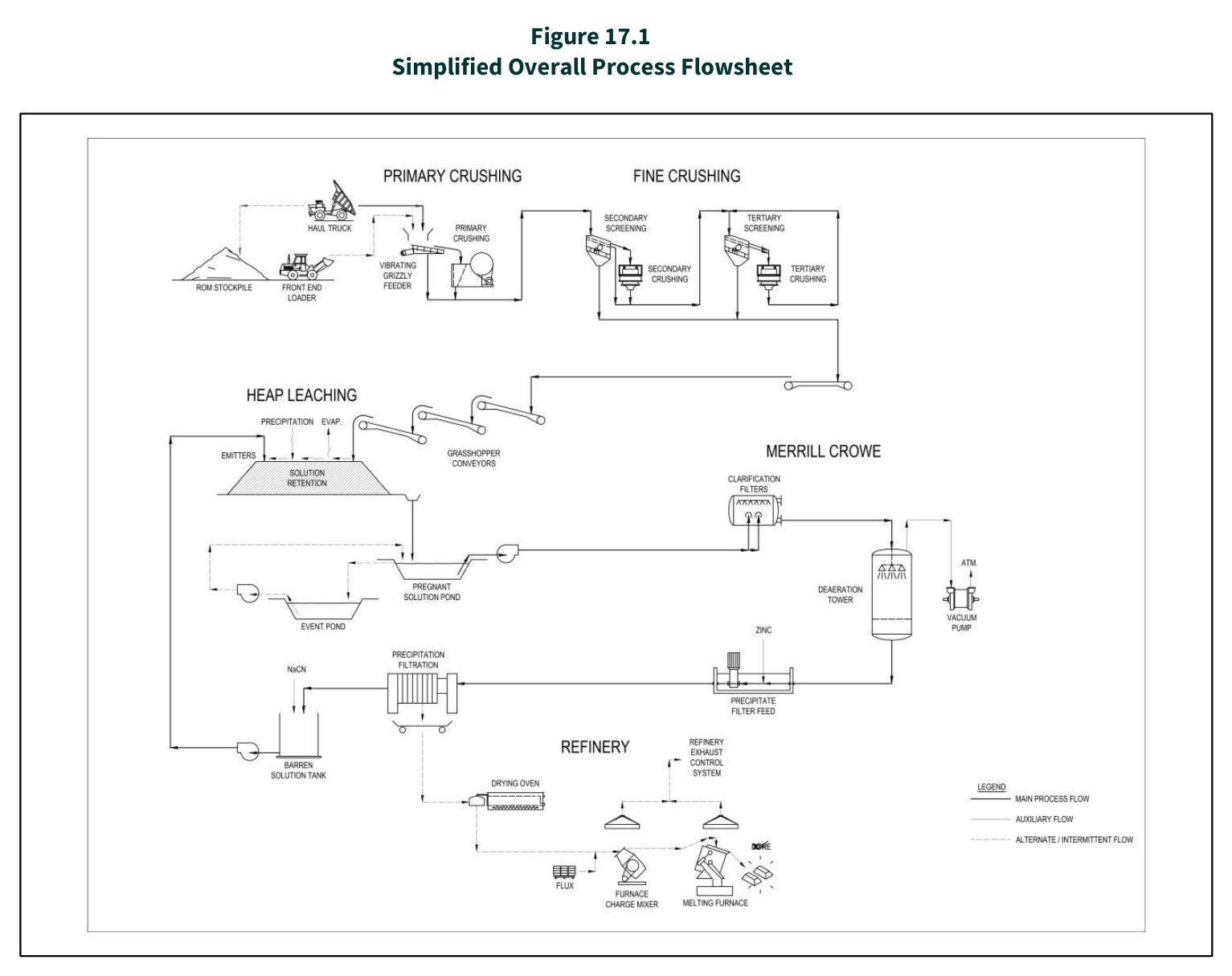
The Moss Mine in Mohave County, Arizona, processes gold and silver ore through a three-stage crushing circuit, valley-fill heap leaching, and a Merrill-Crowe precipitation plant. Mako Mining Corp. is targeting a throughput rate of 10,000 stpd as part of a production plan extending to 2040, with an expansion target of 14,000 stpd under consideration.
The Moss Mine is an operating gold and silver operation located in the Oatman Mining District of Mohave County, Arizona. The property is owned by Mako Mining Corp. The mine is currently in operation, with a production plan extending to 2040. The site uses conventional valley-fill heap leaching with a Merrill-Crowe plant to produce gold-silver doré bars. The original design capacity of the crushing plant is 5,500 short tons per day.
Critical Data
| Parameter | Value | Unit | Notes |
|---|---|---|---|
| Crushing plant design capacity | 5,500 | stpd | Original design |
| Target throughput | 10,000 | stpd | Mako Mining team target; circuit has achieved this rate at times |
| Expansion target | 14,000 | stpd | Future expansion target |
| Crushed product size | 3/8 (9.5) | in (mm) | P90 passing |
| Leach pad irrigation rate | 0.0049 | gpm/ft² | 2026 average |
| Mean gold recovery from PLS | 88.7 | % | January-June 2026, calculated |
| Mean silver recovery from PLS | 94.5 | % | January-June 2026, calculated |
| PLS mean flow | 2,593 | gpm | January-June 2026 |
| Merrill-Crowe plant availability | 98 | % | January-June 2026 |
| Primary crusher availability | 70.8 | % | January-June 2026 |
| Primary crusher utilization | 87.2 | % | January-June 2026 |
| Primary crusher run time | 61.7 | % | January-June 2026 |
| Primary crusher mean throughput | 6,194 | stpd | 173 operating days, January-June 2026 |
| Total dry tons crushed | 1,071,592 | st | January-June 2026 |
| Total PLS processed | 2,811,149 | st | January-June 2026 |
| Total gold recovered | 7,307 | oz | January-June 2026, calculated |
| Total silver recovered | 36,247 | oz | January-June 2026, calculated |
| Lime consumption | 1.15 | kg/st | Average reagent consumption |
| Sodium cyanide consumption | 0.10 | kg/st | Average reagent consumption |
| Zinc dust consumption | 0.17 | kg/st | Average reagent consumption |
| Diatomaceous earth consumption | 0.04 | kg/st | Average reagent consumption |
| Antiscalant consumption | 0.02 | kg/st | Scaletrol brand |
| Fluxes | 0.12 | $/st | Unit is dollars per short ton |
Overview
The recovery methods at the Moss Mine have been reviewed by Richard Gowans, P.Eng., a Principal Metallurgist with Micon International and a Qualified Person. The process involves crushing to 90% passing 3/8 inch (9.5 mm) and conventional valley-fill heap leaching. Gold and silver are extracted from pregnant solution using a Merrill-Crowe plant, which uses zinc cementation to produce a precipitate. That precipitate is dried, mixed with fluxes, and fed to a furnace to produce gold-silver doré bars.
The facility operates as a conventional cyanide heap leach. Ore is stacked on two leach pads, designated Pad 2 and Pad 3A. Pregnant leach solution is collected from four locations: the North Sump, the West Sump, the Pad 3A Sump, and the pregnant solution pond (PLS Pond). Solution is then pumped to the Merrill-Crowe plant.
Pad 2 was constructed in four sequential phases: Phase 1, 2A, 2B, and 2C. Phase 1, which served as the site's initial pilot facility, drains primarily to the PLS Pond, with a minor portion reporting to the West Sump. Phase 2A drains to both the PLS Pond and the West Sump. Phase 2B drains principally to the North Sump, and the majority of Phase 2C drains to the PLS Pond.
Pad 3A was developed in two phases. Pad 3A Phase 1, completed in 2021, was the preferred destination for the majority of new ore placed during 2022 and 2023. Pad 3A Phase 2, completed in late 2023, is the current preferred destination for newly stacked ore. Pad 3A did not require a dedicated PLS pond. Pregnant solution from this pad is collected in a small sump and transferred to the PLS Pond adjacent to the Merrill-Crowe plant, where it is combined with solution from the other pads. A stormwater pond was installed in conjunction with Pad 3A and is reserved exclusively for emergency water-control purposes.
Key Process Stages
Run-of-mine ore is excavated from the pit following blasting and hauled to a ROM stockpile located adjacent to the crushing plant. From the stockpile, ore is fed to the primary crusher and conveyed through secondary and tertiary crushing stages, which operate in closed circuit with vibrating screens to produce a crushed product with a nominal P90 of 3/8 inch. The crushed ore is blended with lime and discharged onto a series of portable grasshopper conveyors, which stack the ore directly onto the leach pad. Where required, a dozer distributes the ore across the pad to maintain uniform lift heights and the design slopes.
At the PLS Pond, pregnant solution is pumped to the Merrill-Crowe gold and silver recovery circuit. The solution is fed to one of two Veolia clarifiers, followed by a deaeration vacuum tower, a feed tank, and two filter presses. Diatomaceous earth, lead nitrate, and zinc are added to the clarified, deaerated solution in the feed tank prior to the filter presses. Gold and silver are recovered from solution as a precipitate by zinc cementation. The precious-metal-bearing precipitate captured in the filter presses is drained, dried, fluxed, and charged to a melting furnace, then poured to produce doré bars. These bars represent the final product of the operation and are secured on site and prepared for shipment off-site for further refining.
Barren solution exiting the Merrill-Crowe filter presses is returned to the barren solution tank, where it is re-fortified with sodium cyanide and pH-adjusted with lime as required to restore the target leach chemistry. The reconstituted barren solution is then pumped back to the leach pads and reapplied to the ore via the irrigation system, closing the leach circuit. Make-up water and reagents are added as necessary to maintain the solution balance and account for losses to evaporation, moisture retention within the ore, and metal recovery.
Additional Interesting Data and Summary
Over the first half of 2026 (January-June), the primary crusher processed approximately 1.07 million dry short tons, averaging 6,194 tons per operating day. Daily throughput ranged from a tenth percentile of 2,960 to a ninetieth percentile of 8,772 tons, indicating substantial day-to-day variability. Mechanical availability averaged 70.8% of scheduled hours, showing 1,252 hours of maintenance and breakdown downtime. Utilization of the available time was 87.2%, giving an overall asset use of 61.7% of scheduled hours. The results identify mechanical availability, not feed availability or utilization, as the primary opportunity for improving crusher performance and sustained throughput.
During the first half of 2026, the Merrill-Crowe plant operated continuously, processing pregnant leach solution on every calendar day (approximately 100% operating-day availability) for a total of approximately 2.81 million tons of solution. Daily throughput averaged 15,531 tons, equivalent to a mean solution flow of 2,593 gpm, and was notably stable, with a tenth-to-ninetieth percentile range of 13,960 to 16,524 tons showing low day-to-day variability.
Metal recovery from pregnant leach solution in the Merrill-Crowe circuit was consistently high over the first half of 2026, with gold recovery averaging 88.7% and silver recovery averaging 94.5%. Silver recovery ran approximately six percentage points above gold and within a tighter band, indicating both higher and more stable silver performance, as is typical for zinc-precipitation recovery from clarified solution.
Mako Mining has prepared a production plan extending to 2040. Under this plan, gold production is forecast to increase year-on-year through 2031, reaching approximately 260% of the projected 2026 figure of 18,000 oz. Meeting this target will require stacking more than double the current run-of-mine tonnage on the leach pads, which in turn necessitates more than doubling crushing capacity to over 5 million tons per annum by 2031.
To achieve the higher production rate, Mako Mining is considering an upgrade to the crushing plant through the addition of a secondary cone crusher and associated screen, targeting a throughput of 14,000 short tons per day over a 20-hour operating window. This constitutes a significant capital improvement program and should be independently reviewed and verified to confirm that the crushing circuit, as a whole, can support the proposed production expansion. The proposed 14,000 STPD over a 20-hour window implies a sustained rate of approximately 700 STPH. While additional crushing and screening capacity addresses the nameplate requirement, the achievability of this target is equally dependent on mechanical availability. The QP recommends that the review of the crushing circuit should include system reliability, maintenance strategy, and the realistic operating-hour basis underpinning the expansion.
The second significant implication of the planned increase in gold production concerns the capacity of the Merrill-Crowe plant, which will require detailed review and potential expansion. The plant currently comprises two Veolia clarifiers (model 66 AJ-2020F-WCD) which already appear to be operating at or above design capacity. Additional units, together with associated ancillary equipment, will likely be required to satisfy the expansion's design flow rate.
The current deaeration column also appears to be operating at or above design loading rate of around 30 gpm/ft². Accommodating the future production plan may therefore require the installation of an additional deaeration tower. As deaeration efficiency directly governs dissolved-oxygen removal ahead of zinc precipitation, sustained operation above the design loading rate represents a metallurgical risk to recovery, not merely a hydraulic one. This is particularly relevant given that any capacity expansion will further reduce solution residence time in the tower.
The QP recommends that all equipment within the Merrill-Crowe plant should be assessed in detail to ensure the plant does not become a bottleneck to achieving the planned increase in gold production. A similar exercise should also be undertaken for the leach-pad infrastructure, including sumps, ponds, pumps, piping, and the drainage system.
Key Processes
- Three-stage crushing (primary, secondary, tertiary) in closed circuit with vibrating screens to produce a P90 of 3/8 inch
- Valley-fill heap leaching on two pads (Pad 2 and Pad 3A) with cyanide solution
- Pregnant solution collection from four locations: North Sump, West Sump, Pad 3A Sump, and PLS Pond
- Merrill-Crowe zinc cementation circuit using two Veolia clarifiers, a deaeration tower, and two filter presses
- Doré bar production through drying, fluxing, and furnace melting of the precipitate
- Barren solution re-fortification with sodium cyanide and lime recirculation to the leach pads
Source: NI 43-101 Technical Report for the Mineral Resources, Mineral Reserves and Mine Plan for the Moss Mine, Oatman Mining District, Mohave County, Arizona, August 17, 2026. Project website: Moss Mine
2021 operating record
The following source records the earlier Arizona operation. Its historical throughput and recoveries are not current performance figures.
| Company | Not Specified |
| Mine | Moss Mine |
| Date | 2021 |
| Region | Not Specified |
| Commodities | Gold, Silver |
| Throughput | 11,000 tpd (LOM Plan) |
Executive Summary
The Moss Mine utilizes a heap leaching recovery method to extract gold and silver from ore. Mined ore is crushed to a target P80 of 3/8 inch and stacked on leach pads where it is irrigated with dilute sodium cyanide solution. The pregnant solution is collected and processed through a Merrill-Crowe plant to precipitate precious metals using zinc powder, which are then smelted into doré bars.
Production statistics from January 2018 to July 2021 indicate a cumulative recovery of approximately 102,694 ounces of gold and 768,248 ounces of silver. The operation targets metallurgical recoveries of 75-77% for gold and 40-43% for silver, with current cumulative recoveries tracking at 70% for gold and 34% for silver. The process includes a three-stage crushing circuit, lime addition for pH control, and a Merrill-Crowe precipitation circuit followed by smelting.
Reagent consumption includes lime, sodium cyanide, antiscalant, diatomaceous earth, and zinc dust. The operation has demonstrated consistent metal reconciliation within 1% of forecasted production. Ongoing metallurgical test work continues to optimize recovery rates and understand mineralization responses.
Key Statistics
Website: https://www.makominingcorp.com/projects/usa/production/moss-mine/
Report Date: 2021
Region: Not Specified
Project Status:
Commodity: Gold, Silver
Throughput: 11,000 tpd (LOM Plan)
Mine Life:
Mine Type:
Ore type:
