

This report describes four distinct mining and processing methods used for alluvial gold recovery at the Nechí property.
Report context
This technical report, dated September 15, 2021, covers the Nechí Alluvial Property operated by Mineros S.A. The report documents the recovery methods for alluvial gold processing, including bucket line dredges, Brazilian suction dredges, the Llanuras production unit, and terrace mining operations, each with associated processing plants.
Processing route
Bucket Line Dredge Alluvial Processing
Mineral beneficiation from the bucket line dredge consists of gravity concentration and gravity gold treatment on board the dredge. The overall metallurgical recovery estimated for the remaining reserves averages approximately 80%.
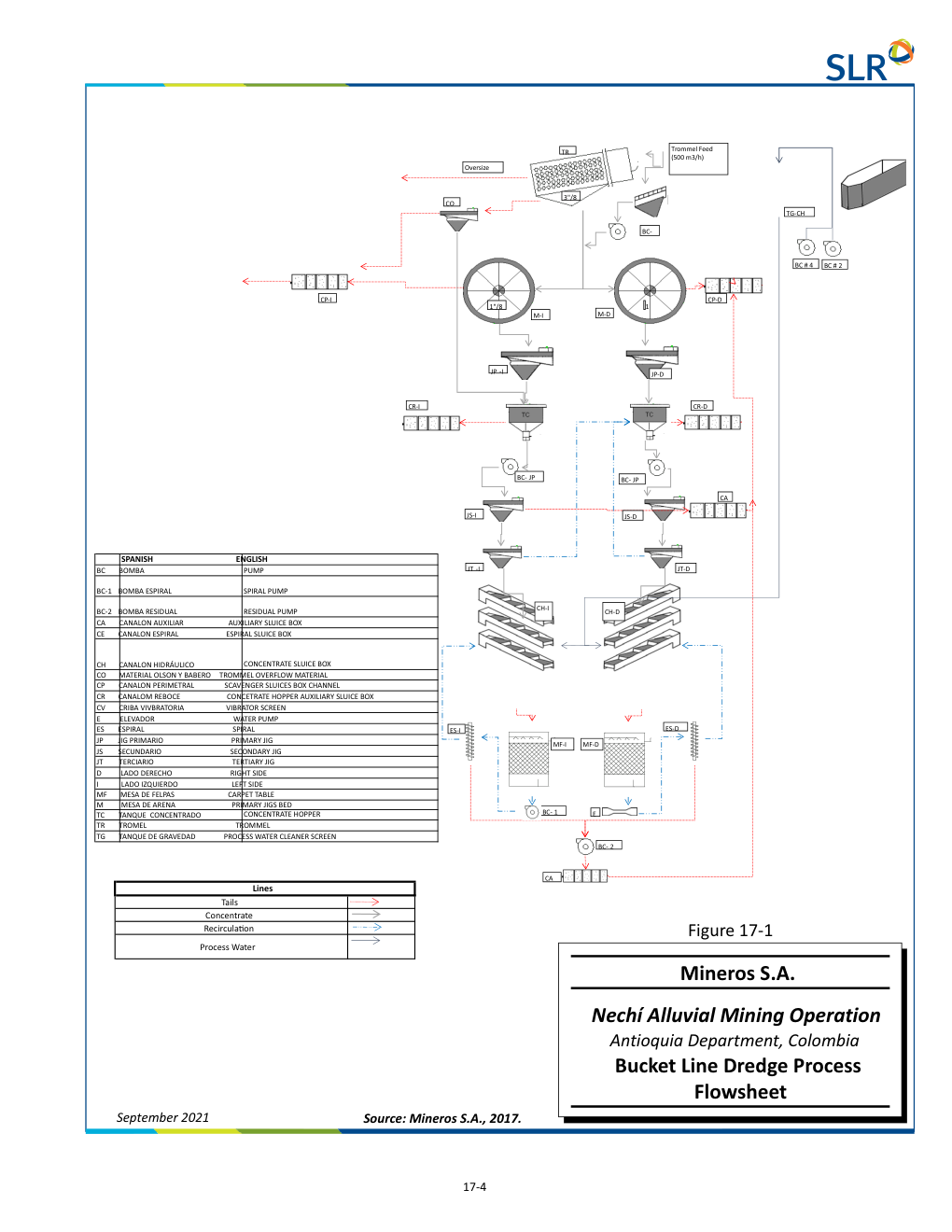
Screening: The bucket line arm excavates gravel at approximately 500 m³/h and delivers it to a main hopper feeding a rotating trommel with screen at 9.5 mm mesh (⅜ in.). Oversize material is discharged by a conveyor belt behind the bucket line dredge to form backfill (tailings), with a portion dumped near the anchor to strengthen the anchor base. Ten percent of the material spills at the hopper and is caught by a screening device that discharges coarse material directly into the water, with undersize returned to the process stream. The screening stage reduces material flow to 320 m³/h.
Gravity Concentration: The smaller size material from the trommel and fine material from the catching device are conveyed to a distributing tank feeding three gravity concentration stages. Primary concentration uses jigs processing material smaller than 9.5 mm at a concentration ratio of 10:1, reducing flow to 20 m³/h. Secondary concentration processes concentrates at a ratio of 6:1, reducing flow to 3.5 m³/h. Tertiary concentration processes concentrates at a ratio of 6:1, reducing flow to 0.6 m³/h. Concentrate proceeds to gold recovery; tails from primary and secondary stages are sent to a scavenger sluice box and dumped behind the dredge; tertiary tails return to the secondary stage.
Dredge Final Gold Recovery: By 2014, mercury amalgamation was discontinued and replaced by sluice boxes, carpet tables, and spirals for gold recovery from the jig circuit. Concentrate from the third stage of jigs is sent to a series of sluice boxes. Tails pass over a carpet table, then continue to spirals and a final sluice box for scavenger gold recovery. Three bucket line dredges have satellite final scavenger felt-lined sluices on barges attached to the hull. Sluice boxes are cleaned daily, producing approximately 20 kg to 25 kg of concentrate, sent by helicopter to the El Bagre metallurgical plant.
Suction Dredge Processing
The floating processing plant is fed by material from dredge No. 21, working with overburden suction dredge No. 20. The process uses screens and hydrocyclones for classification and dewatering, Gekko IPJ for primary gold separation (roughing), a Cleveland 12 pack jig for secondary separation (scavenging), IPJs for cleaning and a Cleveland jig for recleaning, automatic and manual sluice boxes and spirals for final concentrate gold recovery, and a manual sluice box with magnetic separator before shipping in 20 kg containers to El Bagre.
Brazilian Dredge Processing
The on-board processing plant uses a grizzly and Brazilian mat sluices. Classification of 160 m³/h of suctioned material by discharge to a 1-inch grizzly separates the -25 mm gold bearing fraction. Gravimetric concentration of 70% of the gold bearing heavy mineral sands uses 12 one-metre wide sluices lined with Brazilian mats. Grizzly oversize and sluice tailings constitute 99.7% of mined material and are discarded. Clean-up occurs after every 20 hours of operation, with concentrate shipped in 20 kg containers.
Terrace/Old Tailings Processing Plant
The processing plant at the Cargueros site is fed with material from the underflow of a rotating trommel screen capable of processing up to 120 m³/h, fed by an excavator backhoe operating 24 hours a day. The floating plant has a primary material receiving hopper, with material passing through a trommel dispersed with high pressure water. Material is filtered through trommel perforations and passes through recovery and discharge gutters. Trommel oversize is removed by conveyor belt. Material from the trommel is sent to a secondary process area utilizing sluice boxes and felt gold blankets for gold recovery.
El Bagre Metallurgical Plant
Gold concentrate from the dredges is flown by helicopter daily to the metallurgical plant at the El Bagre complex. Concentrate is deposited on a vibrating screen splitting feed using +/- 20 mesh. The +20 mesh material goes to a sluice box for gold recovery. The -20 mesh material goes to two stages of angular rotating tables, with recovered gold concentrate going to drying and magnetic separation, then smelting. Tails from angular rotating tables go to a three stage gold recovery circuit with gravity concentrators, spirals, and a sluice box. Concentrate from gravity concentrators and spirals returns to the primary angular rotating table. Tails from the final circuit go to flotation for final gold scavenging. Gold mixed with borax and sodium nitrate is fed into a preheated furnace at 1,000°C. Melted gold is poured into a mould, cooled, cleaned, sampled, and analyzed by fire assay. Bars weigh approximately 19 kg with composition of 90% Au, 9% Ag, 1% Fe, and traces of platinum.
Key reported parameters
| Parameter | Value | Basis |
|---|---|---|
| Bucket line dredge excavation rate | 500 m³/h | Design/operating |
| Trommel screen mesh size | 9.5 mm (⅜ in.) | Design |
| Material flow after screening | 320 m³/h | Operating |
| Primary concentration ratio | 10:1 | Design |
| Primary concentrate flow | 20 m³/h | Operating |
| Secondary concentration ratio | 6:1 | Design |
| Secondary concentrate flow | 3.5 m³/h | Operating |
| Tertiary concentration ratio | 6:1 | Design |
| Tertiary concentrate flow | 0.6 m³/h | Operating |
| Overall metallurgical recovery (bucket line dredge) | ~80% | Estimate for remaining reserves |
| Daily concentrate from bucket line dredge sluice boxes | 20 kg to 25 kg | Operating |
| Brazilian dredge suction rate | 160 m³/h | Design |
| Terrace trommel capacity | 120 m³/h | Design |
| Furnace temperature | 1,000°C | Design |
| Gold bar weight | ~19 kg | Operating |
| Gold bar composition | 90% Au, 9% Ag, 1% Fe, traces Pt | Testwork |
Project website: https://www.mineros.com.co/operations/colombia
Technical qualifications
The recoveries have been estimated by Mineros and the QP considers them to be reasonable. The report contains a Figure 17-1 showing a detailed schematic of the present beneficiation process on board the bucket line dredge. Figure 17-2 shows the Llanuras Process Plant flowsheet. Figure 17-3 shows the Brazilian suction dredge process. Figure 17-4 shows the El Bagre metallurgical plant process flowsheet.
Source: Mineros S.A., Nechí Alluvial Property, SLR Project No: 233.03444.R0000, NI 43-101 Technical Report, September 15, 2021, Section 17.0 Recovery Methods.
