

This feasibility study presents a proposed 1,000 t/d underground gold mine and flotation concentrator at the New Polaris Project in British Columbia, Canada.
Report context
This technical report and feasibility study was prepared for Canagold Resources Ltd with an effective date of July 21, 2025 and a report date of September 2, 2025. The proposed project is an underground gold mine with an anticipated production rate of approximately 1,000 tonnes per day, operating year-round, processing on average approximately 365,000 tonnes per year of ore. The mine life will be 8.1 years. The project is located near the confluence of the Taku and Tulsequah Rivers, in a remote area of northwest British Columbia, Canada.
Processing route
Proposed process plant design
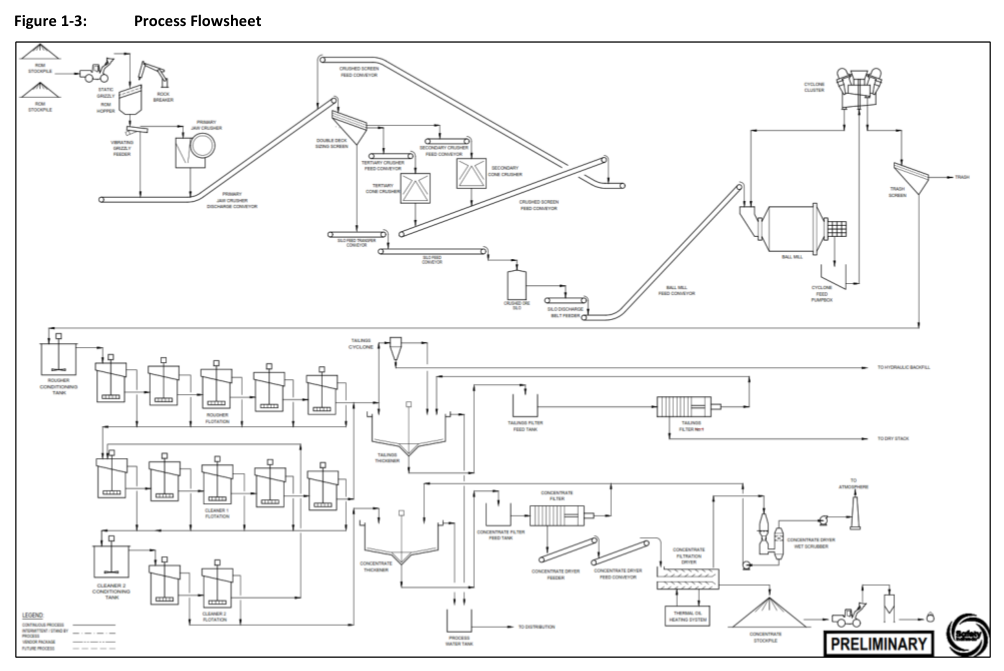
The proposed process plant will have a throughput of 1,000 t/d and produce a gold concentrate from material sourced from the underground mine. The design utilizes three stages of crushing, a ball mill and cyclone in closed circuit, flotation, and concentrate dewatering.
The crushing circuit consists of a primary jaw crusher followed by a secondary and a tertiary cone crusher. Crushed ore will be stored in a silo.
The flotation circuit will include rougher flotation and two stages of cleaning. Tailings from the rougher flotation cells will be sent to the tailings area and the concentrate will be refined in the cleaners. Tailings from the first cleaner will combine with the rougher tailings and sent to the tailings area. Concentrate from the first cleaner will be further cleaned in the second cleaner. Tailings from the second cleaner will be sent back to the first cleaner for another pass.
Concentrate from the second cleaner will be dewatered using a thickener followed by a horizontal filter press. The filter cake will then be dried in a dryer to bring down the moisture content to a suitable level for bagging and air freight.
The tailings area will consist of a tailings thickener and filter press and tailings cyclone. Tailings from flotation will report to either the tailings thickener or tailings cyclone depending on whether the backfill plant is running. If the backfill plant is active, the tailings cyclone will send coarse underflow to the plant and the overflow fines will report to the tailings thickener. When the backfill plant is not active the tailings will directly go to the thickener. Thickened underflow tailings will be further dewatered in the tailings filter press prior to dry stacking.
The summary of the design process operating availabilities are as follows:
- Primary, secondary, and tertiary crushing availability of 66%
- Grinding, flotation, and thickening availability of 92%
- Filtration availability of 85%
Metallurgical testwork
Metallurgical testwork was conducted at multiple laboratories. ALS Metallurgy (2022) completed pilot plant work, and Metso BIOX™ plant work was conducted in 2023. Base Metallurgical Laboratories Ltd. completed testwork in 2023. Forte Analytical LLC completed work in 2024. FLSmidth Inc completed work in 2024.
Recovery models
Recovery models were developed for concentrate mass recovery, gold concentrate grade, and arsenic and antimony concentrate grade. Metallurgical recovery assumed in the mineral reserve estimate is 89.75%, with payable assumed to be 90%.
Concentrate marketing
There are several potential customers for New Polaris concentrate, including gold roasters in China, traders, copper and lead smelters, and pressure oxidation (POX) plants. The base case for this study is selling to metal traders for blending, with delivery to China. The concentrate is expected to be flown from the mine to Juneau, Alaska, then transported by barge to Tacoma, Washington, for ocean shipment to the final destination. No transportation or off-take contracts for the concentrates are currently in place.
Key reported parameters
| Parameter | Units | Design Value | Testwork Basis |
|---|---|---|---|
| Plant throughput | t/d | 1,000 | Design |
| Mine life | years | 8.1 | Design |
| Metallurgical recovery (Au) | % | 89.75 | Assumed for reserve estimate |
| Payable gold | % | 90 | Assumed for reserve estimate |
| Crushing availability | % | 66 | Design |
| Grinding, flotation, thickening availability | % | 92 | Design |
| Filtration availability | % | 85 | Design |
| Gold price (reserve cut-off) | US$/oz | 2,245 | Assumption |
| Gold price (economic analysis base case) | US$/oz | 2,500 | Assumption |
| Exchange rate (reserve cut-off) | C$/US$ | 1.39 | Assumption |
| Exchange rate (economic analysis) | USD/CAD | 0.72 | Assumption |
Project website: https://canagoldresources.com/project/new-polaris/snapshot/
Project website: https://canarc.net/projects/new-polaris/
Technical qualifications
The Qualified Person responsible for mineral processing sections is Tommaso Roberto Raponi, P. Eng., who has not visited the project site. Kevin Murray, P. Eng., is the Qualified Person responsible for recovery methods sections and also has not visited the project site. The Qualified Persons responsible for the mineral reserve estimate and mining methods are Dino Pilotto, P. Eng., and Michael Levy, P. Eng., who visited the project site on June 3, 2025. The capital cost estimate conforms to Class 3 guidelines for an FS-level estimate with ±15% accuracy according to AACE International. No allowance has been made for exchange rate fluctuations and no escalation has been added to the estimate.
Source: New Polaris Gold Project, NI 43-101 Technical Report & Feasibility Study, British Columbia, Canada, effective date July 21, 2025, report date September 2, 2025, Sections 1.8, 1.12, 2.1, 2.3, 13.2, 13.3, 13.6, 1.14, 1.16.1.
