This report details the processing facilities and metallurgical performance for the Ying silver-lead-zinc property in Henan Province, China.
Report context
This technical report update for the Ying Ag-Pb-Zn Property in Henan Province, People's Republic of China, dated 2022, provides information on the processing operations for Silvercorp Metals Inc. The report covers two operating processing plants (Plant 1 and Plant 2) and a third plant under construction, with production data generally referenced from FY2019 through Q3 of FY2022 (1 April 2018 to 31 December 2021).
Processing route
Plant 1 (Xiayu Plant)
Plant 1, also known as the No.1 Mill or Xiayu Plant, has been in operation since March 2007. The plant was designed with a capacity of 600 tpd, later expanded to 800 tpd, based on lab tests completed by HNMRI in 2005. The plant currently operates at an actual capacity of 700 tpd with 330 days per year plant availability.
The flowsheet includes a crusher circuit with closed-circuit two-stage crusher-screen operation (jaw crusher, one cone crusher, vibrating screen, dust collectors, and two ore storage bins). Crushing is operated with a primary jaw crusher (Model: PEF 500 x 750) having a closed-side setting of 80 mm. Discharge is conveyed to a 15 mm aperture vibrating screen, with oversize material conveyed to a secondary cone crusher (Model: PYH-2X cone crusher) with a 15 mm closed-side setting. Product undersize feeds fine-ore bins with 100 t live storage capacity.
The milling classification circuit consists of two trains, each with a grate-discharge ball mill (Model: MQCG 2100 x 3600) and a screw classifier (Model: FG-200). The ball charge uses Mn-steel balls with diameters from 60 mm to 120 mm. The target grind size is 61% to 63% passing 200 mesh, with overflow density maintained at 40% solids w/w.
Plant 1 was upgraded by adding a gravity separation circuit following metallurgical testing by Changchun Gold Research Institute (CCGRI) in 2021. This circuit includes a set of hydrocyclones to replace the spiral classifier, a Knelson concentrator to recover coarse gold, a linear screen to screen coarse particles greater than 2 mm, and a shaking table for cleaning the Knelson concentrate.
The lead flotation circuit consists of one train with conventional Pb flotation arrangement capable of processing 800 tpd. The flotation bank includes one stage of roughing, two stages of scavenging (BF-4 type cells), and three stages of cleaning (BF-1.2 type cells). The zinc flotation circuit exists but is not currently in operation due to low zinc in the feed ore to Plant 1.
The following minor changes were made to the original Plant 1 design: addition of one cone crusher to increase ball mill capacity from 600 to 800 tpd; coarsening of the original ball mill grinding size target from 70% to 60% (-200 mesh), later adjusted to 61% to 63% (-200 mesh) in 2014 resulting in increased Pb recovery of 0.41% and Ag recovery of 2.16 g/t; addition of gravity separation circuit; and replacement of lime slurry by NaOH/Na2CO3 for pH control.
Plant 2 (Zhuangtou Plant)
Plant 2, also known as the No.2 Mill or Zhuangtou Plant, is located 2 km west of Plant 1. Phase I (1,000 tpd design) has been in production since December 2009, and Phase II (also 1,000 tpd design) has been in production since October 2011. The plant currently operates at an actual capacity of 1,800 tpd with 330 days per year plant availability.
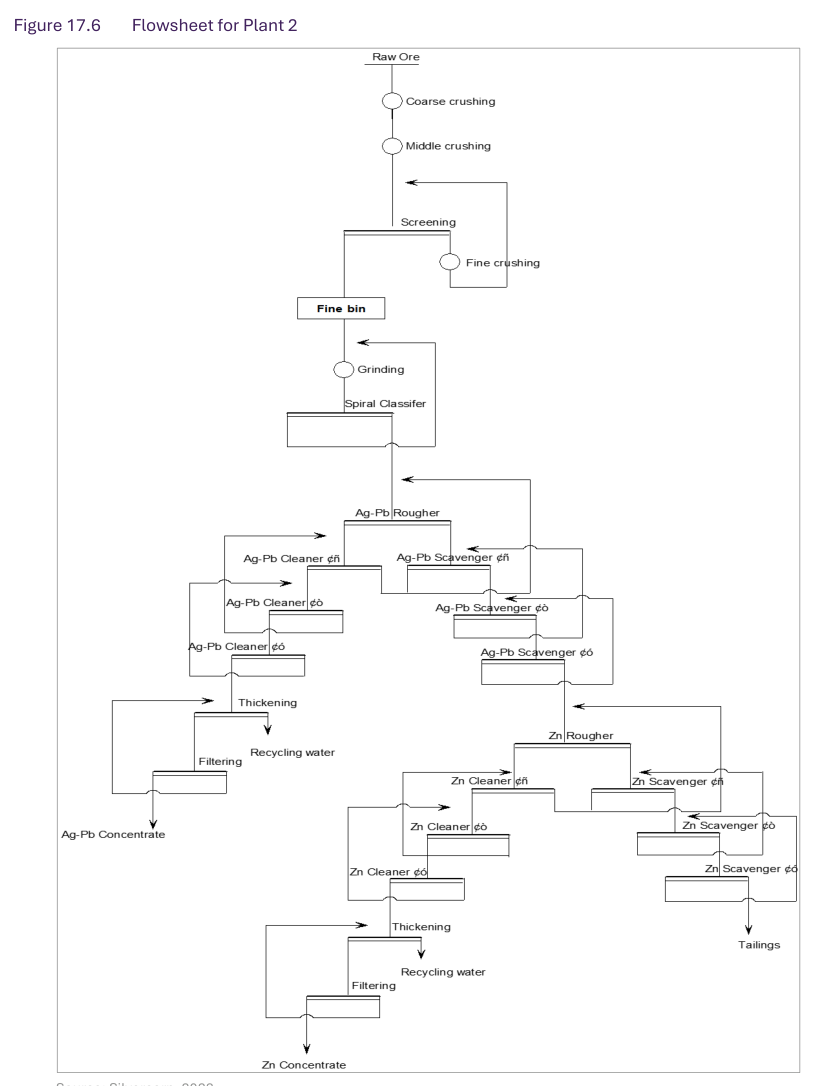
The flowsheet includes a crusher circuit with three-stage crushing-screening (one jaw crusher, two cone crushers, vibration screen, dust collectors, ore storage bins) as one train. The primary jaw crusher (Model: PEF 800 x 1000) has a closed-side setting of 80 mm. Discharge is conveyed to a secondary cone (Model: PYHD-3CC) with 15 mm closed-side setting, then to a 15 mm aperture vibrating screen. Oversize material is conveyed to a tertiary cone crusher (Model: PYH-3CC) with 15 mm closed-side setting. Undersize product feeds ore bins with 1,000 t live capacity.
The milling classification circuit consists of two trains, each with a grate-discharge ball mill (Model: MQG 2.7 m dia. x 4.0) and 15" hydrocyclone/spiral classifiers (Model: 2FG2.4).
The flotation circuit includes lead sulphide flotation and zinc sulphide flotation with rougher-scavenger-cleaner cells and chemical reagent preparation tanks, configured as two trains of 1,000 tpd each. There is no copper flotation. The flotation cells are larger than those in Plant 1 (BF-16 and BF-4).
Plant 3 (Under Construction)
Plant 3, with a design capacity of 3,000 tpd, is currently under construction and scheduled to be operating by mid-2024. The plant is planned to replace Plant 1 and Plant 2. A third tailings management facility is also being built to accommodate tailings from Plant 3.
Plant 3 is designed by Changchun Gold Design Institute (CGDI) according to the results of their metallurgical testing and operating experience at Ying. The flowsheet is similar to that of Plant 2 but with larger equipment, greater processing capacity, more advanced technology, and more flexible operation. It can handle silver-lead-zinc ore, silver-lead ore, copper-lead ore, and gold ore.
The flowsheet includes a crusher circuit (one train, 200 tph), grinding with semi-autogenous grinding (SAG) milling (6.0 m dia. x 3.0 m SAG mill), ball milling (4.5 m dia. x 6.4 m ball mill), and hydrocyclone classification (one set of 500 mm dia. hydrocyclones) arranged as one circuit with 3,000 tpd capacity. Gravity concentration includes a Knelson concentrator, a vertical mill for regrinding Knelson gold concentrate, and a concentrate shaking table. The flotation circuit includes lead flotation, zinc flotation, and copper/lead separation flotation.
Ore Supply and Handling
Ore from the Ying mines is shipped via truck to processing Plants 1 and 2. SGX/HPG lumps (rich, large-size galena lumps with characteristic specular, silver-grey appearance) may be hand-sorted at the mine sites, crushed, and shipped by dedicated trucks to Plant 1. These lumps are milled in a dedicated facility and sold directly or mixed with flotation PbS concentrate for sale, bypassing the flotation circuit. No hand-sorting was done between January 2020 and December 2021.
An ore transportation tunnel from SGX to HPG has been constructed and the haul road from HPG to the plants has been upgraded. A transportation tunnel from TLP to DCG was completed in October 2020 to haul ore from DCG via TLP to the plants by truck.
Concentrate Handling
Lead concentrate from Plant 1 and Plant 2 are blended to optimize profitability. High grade lead concentrate (55% to 65% Pb) from Plant 2 is blended with medium grade lead concentrate (40% to 50% Pb) from Plant 1 before shipping blended concentrate to clients.
Process Control
An ore crushing control centre in Plant 2 controls and monitors the crushing and screening equipment. In 2019, a PCL system was installed in the crushing building in Plant 2 to allow automatic control of the entire crushing system. Ore feed to the ball mill is controlled via an electronic scale. Chemical reagent dosages are controlled via a localized PLC system, adjusted based on assay feedback (each half hour). The central monitoring room in the grinding-flotation building allows monitoring of key points via TV imaging.
Plant 3 is to be equipped with advanced industry-standard monitoring and process control instruments and systems, including a central control room and video monitoring system for the whole plant.
Key reported parameters
| Parameter | Plant 1 | Plant 2 (Phase I) | Plant 2 (Phase II) | Plants 1+2 |
|---|---|---|---|---|
| First year in operation | Mar 2007 | Dec 2009 | Oct 2011 | – |
| Design capacity (tpd) | 800 | 1,000 | 1,000 | 2,800 |
| Actual capacity (tpd) | 700 | 900 | 900 | 2,500 |
| Plant availability (day/yr) | 330 | 330 | 330 | 330 |
| Major ore feed | LM/TLP/HZG | All | All | All |
| Tailings pond | P1-Zhuangtou | P2-Shiwagou | P2-Shiwagou | P1+P2 |
Project website: https://silvercorpmetals.com/silvercorp-announces-filing-of-updated-technical-reports-for-the-ying-mining-district/
| Design metallurgical performance | Pb recovery (%) | Zn recovery (%) | Ag recovery (%) |
|---|---|---|---|
| Plant 1 design (600 tpd basis) | 90.00 | 85.00 | – |
| Plant 2 design (1,000 tpd per phase) | 93.00 | 81.50 | – |
| Average actual (FY2019-FY2022Q3) | 95.80 | 59.87 | 95.28 |
| Design target | 90 | 85 | 90 |
| Concentrate quality (design vs actual average) | Pb (%) | Zn (%) | Ag (g/t) |
|---|---|---|---|
| Pb concentrate design | 60 | 1.95 | – |
| Pb concentrate actual average | 53.35 | 3.54 | 3,655 |
| Zn concentrate design | 0.95 | 45 | – |
| Zn concentrate actual average | 0.75 | 52.10 | 284 |
| Mill power consumption | Plant 1 | Plant 2 | Plant 3 (planned) |
|---|---|---|---|
| Total installed power (kW) | 3,124 | 9,260 | 12,391 |
| Crushing and milling power (kW) | 963 | 3,260 | 5,411 |
| Average mill power consumption (kWh/t) | 32.1 | 38.9 | 48.06 |
| 2021 average (kWh/t) | 29.4 | 40.95 | – |
| Ore supply by mine (FY2019-FY2022Q3 totals) | Tonnes | Contribution (%) |
|---|---|---|
| SGX | 942,794 | 39 |
| HZG | 198,815 | 8 |
| HPG | 226,658 | 9 |
| TLP | 634,043 | 26 |
| LME | 178,299 | 7 |
| LMW | 244,712 | 10 |
| Total | 2,425,320 | 100 |
Technical qualifications
The following limitations are noted from the report:
- Plant 1 is averaging 480 tpd which is less than the current stated capacity of 700 tpd and is run only in campaigns depending on ore supply. Plant 2 is operating at 1,500 tpd which is below the current stated capacity of 1,800 tpd.
- Lead and silver recovery targets are being met; however, zinc recovery is lower than design, attributed to lower than planned zinc feed grades.
- The average Pb grade in lead concentrate is still lower than the design value of 60%.
- With the proportion of SGX ore decreasing, the challenge is to maintain similar metallurgical performance on lower grade feedstock.
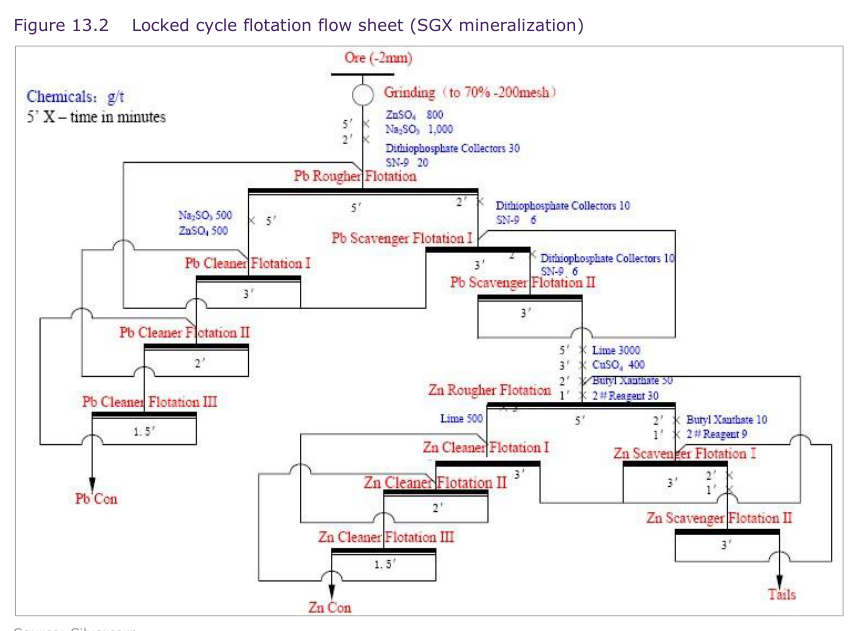
- The design of Plant 3 is based on locked-cycle flotation test results for different ore types, and the actual metallurgical performance will be determined after commissioning.
- Water usage data for Plant 3 is projected, not actual.
- The zinc flotation circuit in Plant 1 is not currently in operation due to low Zn in the feed ore.
Source: NI 43-101 Technical Report Update on the Ying Ag-Pb-Zn Property in Henan Province, People's Republic of China, Silvercorp Metals Inc., 2022, Section 17 Recovery methods.
Consolidated report summaries
The following former standalone pages about this operation were consolidated here on October 25, 2026. They are retained for source traceability; dates and figures reflect each report’s own effective date and may be superseded by the current information above.
Ying Property — 2012 Technical Report
This report details the processing route and recovery methods for the Gaocheng Ag-Zn-Pb project, based on design, testwork, and operating data.
Report context
This technical report update on the Gaocheng Ag-Zn-Pb Project in Guangdong Province, People’s Republic of China, for Silvercorp Metals Inc., is dated 2012. The report describes recovery methods for the Ying Property, incorporating metallurgical testwork outcomes, trial operations that commenced in 2013, and commercial production that began in 2015 at the Gaocheng mill.
Processing route
Introduction to recovery methods
Prior to operations, the silver mineralogy indicated an opportunity to increase silver recovery from all species, including sphalerite and pyrite, to the lead concentrate, within constraints of minimum % Pb specifications, with implications for lead cleaner circuit and filtration capacity. No comminution testwork was available to serve as a basis for the crushing and grinding circuit design. The flotation testwork culminating in the closed-circuit test provided an adequate basis for the flotation process design.
Circuit options investigated included copper-lead separation and tin recovery. Although both were included in the GMADI Design Instructions, neither had been included in financial modelling. AMC considered the copper-lead separation not to be viable and of limited materiality. AMC believed that a tin recovery circuit had potential merit and was considered an opportunity and a material circuit option, although the base case for operations did not include it.
Since the start of trial operations in 2013 and commercial production in 2015, lead and zinc concentrates have been produced in commercial quantities at the Gaocheng mill. Some small amounts of tin concentrate and sulphur have also been produced, but these quantities have not been material to mine economics.
Process flowsheet
The process flowsheet is shown schematically in Figure 17.1 of the report, being very similar to the process adopted in the closed-circuit flotation tests. No significant alterations have been made to the plant since completion of commissioning, and it has processed approximately the same amount of ore each year (around 260 ktpa).
Process description summary
The overall process consists of crushing, grinding, sequential flotation of lead, zinc, and pyrite concentrates, and concentrate dewatering by disc filtration. An experimental tin recovery gravity separation circuit is installed on pyrite flotation tails.
Crushing
Two-stage crushing is carried out, with the second stage in closed circuit. Run of mine ore at -350 mm is reduced to crusher product at -10 mm. The crushing circuit consists of a run-of-mine ore bin from which ore is drawn by a vibratory feeder into the primary jaw crusher. The jaw crusher product is screened on a vibrating screen, with -10 mm fines conveyed forwards to the fine ore bin while +10 mm material feeds the secondary cone crusher via a buffer storage bin to maintain choke feeding. The fine ore bin has a capacity of 1,600 t.
Grinding
Two-stage grinding in ball mills achieves a product size of 80% passing 75 µm (P80 of 75 µm). The two-stage grinding circuit is sized for 1,600 tpd. Given that 1,600 tpd could be the ultimate throughput, four mills with 400 kW motors have been installed. Typical of Chinese practice and conforming to the design used at Silvercorp's Ying mine, the grinding circuit consists of a grate-discharge ball mill in closed circuit with screw classifier, followed by an overflow ball mill in closed circuit with hydrocyclones. The circuit is configured in two parallel trains, each of 800 tpd capacity.
Flotation
The flotation process consists of a standard flotation of lead, with three-stage cleaning of the lead concentrate, then flotation of zinc concentrate with three-stage cleaning, leaving pyrite tailings as sulphur concentrate. Following on from the grinding circuit, the flotation circuit is similarly configured in two parallel trains. Flotation cell sizing is adequate for 1,600 tpd, with rougher residence time designed to be a minimum of 15 minutes plus scavenger time of 15 minutes. Conditioning times of approximately five minutes apply. The general layout makes use of gravity and the sloping site terrain.
Concentrate handling
The respective concentrates are thickened and then filtered on ceramic disc filters. The filters are sized at 9 m², 15 m², and 30 m² for the lead, zinc, and pyrite concentrates respectively. The filters are positioned above the concentrate storage shed for direct discharge, from which concentrates are loaded by front-end loader into trucks for transport to smelter customers.
Tin recovery circuit
The experimental tin recovery circuit treats pyrite flotation tailings. After an initial pre-concentration stage on eight sets of four-start spiral concentrators, the stream is cycloned to split at 75 µm. The +75 µm size fraction is fed over 25 coarse shaking tables, and the -75 µm material is fed over 51 fine shaking tables. The final step is a batch flotation stage to remove residual sulphides, which takes place in a small unit in the main flotation building. Tin quantities produced to date are not material to overall mine economics.
Process control and automation
Process control and automation consists of a central control room in the grinding-flotation building with TV imaging of key operating points, centralized monitoring of equipment run status, on/off interlocking of main crushing and grinding system flows, and measurement and control of key parameters including ball mill feed tonnage, critical bin and tank levels, critical densities, flotation cell pulp levels, and reagent dosage. Automatic sampling of key metallurgical accounting streams is also employed.
Key reported parameters
| Parameter | Unit | Design/Proposed | Historical Operating | Testwork Basis |
|---|---|---|---|---|
| Overall throughput base case | tpd | 1,000 | approximately 800 | , |
| Potential expansion throughput | tpd | 1,600 | , | , |
| Annual throughput | tpa | , | 264,000 | , |
| Operating days per year | days | 330 | 330 | , |
| Crushing operating hours | hrs/day | 18 | , | , |
| Grinding-flotation operating hours | hrs/day | 24 | , | , |
| Feed rate | tph | , | 42 | , |
| Daily utilization of time | % | , | 80 | , |
| Crushing product size | mm | -10 | , | , |
| Grinding product size (P80) | µm | 75 | 75 | , |
| Flotation rougher residence time | mins | 15 minimum | , | 15 minimum |
| Flotation scavenger residence time | mins | 15 | , | 15 |
| Conditioning time | mins | approximately 5 | , | approximately 5 |
| Fine ore bin capacity | t | 1,600 | , | , |
| Installed power (total) | kW | 5,043 | , | , |
| Actual power drawn | kW | , | approximately 3,657 | , |
| Annual power consumption | kWh | , | 28,963,000 | , |
| Total water demand (including recycle) | L/day | , | approximately 3,200,000 | , |
| Water demand per tonne ore | m³/t | , | 4 | , |
| Fresh water requirement | m³/t feed | , | approximately 0.4 | , |
| Water demand at 1,600 tpd | L/day | 6,000,000 | , | , |
| Lime consumption | kg/t | , | 8 | , |
| Lead concentrate filter area | m² | 9 | , | , |
| Zinc concentrate filter area | m² | 15 | , | , |
| Pyrite concentrate filter area | m² | 30 | , | , |
| Number of primary mill trains | , | 2 | 2 | , |
| Capacity per train | tpd | 800 | , | , |
| Mill motor power (each) | kW | 400 | , | , |
Project website: https://silvercorpmetals.com/ying-mining-district/
Technical qualifications
The following specific limitations apply to the recovery methods information in this report:
- There was no comminution testwork to serve as a basis for the crushing and grinding circuit design.
- The flotation testwork culminating in the closed-circuit test provided an adequate basis for the flotation process design.
- Copper-lead separation was considered not viable by AMC, with only limited copper resource data to support any copper recovery process.
- The tin recovery circuit is experimental, and tin quantities produced to date are not material to overall mine economics.
- The report states that the recovery methods used are appropriate for the ore characteristics, and that the flowsheet has demonstrated ability to achieve targeted recoveries and concentrate grades.
Source: NI 43-101 Technical Report Update on the Gaocheng Ag-Zn-Pb Project in Guangdong Province, People's Republic of China, Silvercorp Metals Inc., 2012, Section 17 Recovery Methods.
Ying Mining District Processes 1.0 Mt in FY2025 as Three-Plant Expansion Takes Shape
Silvercorp Metals Inc. operates two processing plants in Henan Province, China, with a third scheduled to start up in 2027. The Ying property is an operating silver-lead-zinc-gold mining district about 240 km west-southwest of Zhengzhou. Silvercorp holds an effective interest of 77.5% in most mines through wholly owned subsidiaries. Combined design capacity across the two existing plants is 4,300 tpd, with actual demonstrated capacity at 4,000 tpd.
Critical Data
| Parameter | Value | Unit | Notes |
|---|---|---|---|
| Plant 1 design capacity | 800 | tpd | Xiayu Plant; since March 2007 |
| Plant 1 actual capacity | 700 | tpd | FY2025 average 676 tpd (97% of stated capacity) |
| Plant 2 design capacity | 3,500 | tpd | Zhuangtou Plant; after Phase III completed November 2024 |
| Plant 2 actual capacity | 4,000 | tpd | Combined Plants 1 and 2 demonstrated capacity |
| Plant 2 FY2025 average throughput | 2,245 | tpd | 64% of stated 3,500 tpd capacity |
| Plant 3 design capacity | 3,000 | tpd | Planned operation in 2027 |
| Combined design capacity (Plants 1+2) | 4,300 | tpd | After Phase III (November 2024) |
| Combined design capacity (Plants 2+3) | 6,500 | tpd | After Plant 3 startup |
| Plant availability | 330 | day/yr | Both plants |
| FY2025 total ore processed | 1,013,659 | t | Wet tonnes; all mines combined |
| SGX contribution to FY2025 feed | 33 | % | Largest mine contributor |
| TLP contribution to FY2025 feed | 28 | % | Second largest contributor |
| FY2025 Pb recovery (weighted average) | 93.63 | % | Design target: 90% |
| FY2025 Ag recovery (weighted average) | 95.88 | % | Design target: 90% |
| FY2025 Zn recovery (weighted average) | 69.74 | % | Design target: 85% |
| FY2025 Au recovery (weighted average) | 79.21 | % | Design target: 80% |
| FY2025 Pb grade in Pb concentrate | 48.38 | % | Design value: 60% |
| FY2025 Zn grade in Zn concentrate | 49.21 | % | Design value: 45% |
| Plant 1 total installed power | 3,317 | kW | Includes standby |
| Plant 2 total installed power | 10,696 | kW | Includes standby |
| Plant 1 average power consumption | 34.43 | kWh/t | FY2025 |
| Plant 2 average power consumption | 41.51 | kWh/t | FY2025 |
| TSF1 storage capacity | 2.83 | million m³ | Valley type; closure initiated |
| TSF1 dam height | 70 | m | Final elevation 650 mRL |
| Overall water usage | 3.0 to 3.5 | m³/t ore | |
| Net freshwater usage | 0.1 | m³/t ore | After recycling |
Overview
Silvercorp runs two processing plants for the Ying operations. Plant 1, called the Xiayu Plant or No. 1 Mill, has operated since March 2007. Plant 2, called the Zhuangtou Plant or No. 2 Mill, came online in phases starting December 2009. The two plants sit within 2 km of each other. Both were designed based on laboratory testing completed by HNMRI in 2005.
Plant 1 started at 600 tpd design capacity and was later expanded to 800 tpd. Plant 2 Phase I added 1,000 tpd in December 2009. Phase II added another 1,000 tpd in October 2011 with a parallel flotation bank. Phase III added 1,500 tpd in November 2024 with a third flotation line, bringing Plant 2 to 3,500 tpd design. Combined design capacity for both plants is 4,300 tpd. The actual demonstrated capacity is 4,000 tpd.
A third processing plant called No. 3 Mill or Plant 3 is planned to begin operation in 2027. It is in the final design and construction planning stages. Design capacity will be 3,000 tpd. The preliminary design was done by Changchun Gold Design Institute. Construction is expected to start in March 2026 once the land use application is approved. Plant 3 will process Ag-Pb-Zn ore and Ag-Pb ore. After Plant 3 starts, the company intends to operate the newer larger lines and close Plant 1 when its capacity is no longer required.
Tailings from the two plants have been directed to two tailings storage facilities called TSF1 and TSF2. A third facility called TSF3 or Shimengou TSF was built and put into pilot operation in November 2024. With some upgrading, TSF3 was permitted by the provincial government to start formal operation in December 2025. TSF1 closure was initiated in 2023. Tailings discharge from Plant 1 to TSF1 stopped in February 2025. Since then Plant 1 tailings have been pumped to TSF2 through pipelines.
Ore from the Ying mines is shipped by truck to the plants. An ore transportation tunnel from SGX to HPG was built, and the haul road from HPG to the plants was upgraded. A transportation tunnel from TLP to DCG was completed in October 2020. The KP mine is under construction with no fixed plans for milling its future production yet. Metallurgical testing on KP ore has been initiated for flowsheet development.
Key Process Stages
The process at both plants includes crushing, grinding, gravity separation for gold recovery, flotation, and product dewatering. Plant 1 operates one processing train at 800 tpd design. Plant 2 operates three parallel trains totaling 3,500 tpd design. Plant 3 will have one train at 3,000 tpd design using a SAG mill and ball mill circuit.
Crushing at Plant 1 uses a closed circuit with a primary jaw crusher and one secondary cone crusher with a vibrating screen. The jaw crusher has an 80 mm closed-side setting. Screen aperture is 15 mm. Live storage capacity in fine-ore bins is 100 t. Dust is collected under vacuum in a baghouse filter and the slurry goes to flotation.
Crushing at Plant 2 uses three-stage crushing in closed circuit. A primary jaw crusher with 80 mm setting feeds a secondary cone crusher with 15 mm setting. Product goes to a 15 mm vibrating screen. Oversize reports to a tertiary cone crusher also set at 15 mm. Undersize feeds crushed ore storage bins with 1,000 t live capacity.
In parallel with the 2024 extension of Plant 2, Silvercorp trialed and moved to full-scale production with XRT intelligent ore sorting. The system sits next to the ROM ore yard at Plant 2. Primary ores processed through ore sorting come from TLP, SGX, and DCG mines. About 8% of waste rock is separated and rejected before crushing and grinding.
Grinding at Plant 1 uses two ball mill trains. Each train has a grate-discharge ball mill. One uses a screw classifier, the other uses hydrocyclones. The target grind size is 61% to 63% passing 75 µm. Overflow density is maintained at 40% solids for flotation feed.
Grinding at Plant 2 uses three parallel ball mill trains. Train 1 and Train 2 use 2.7 m diameter by 4.0 m length mills. Train 3 uses a 3.6 m diameter by 4.5 m length mill. Classifiers are 10.5-inch hydrocyclones or spiral classifiers.
Gravity separation at Plant 1 was added following metallurgical testing by Changchun Gold Research Institute in 2021. A Knelson concentrator recovers coarse gold from ball mill discharge. A linear screen ahead of the Knelson removes particles larger than 2 mm. Concentrate from the Knelson is cleaned on a shaking table. Tailings are classified by cyclone with coarse material going back to the ball mill and fines entering flotation.
Gravity separation at Plant 2 was added to the third processing line. A Knelson concentrator recovers coarse gold from ball mill discharge. A linear sieve screens out particles larger than 2 mm.
Flotation at Plant 1 produces lead concentrate only. The zinc circuit is not in use because zinc feed grades are low. The bank has one stage of roughing, two stages of scavenging using BF-4 type cells, and three stages of cleaning using BF-1.2 type cells. Knelson tailings report to lead flotation feed.
Flotation at Plant 2 uses differential flotation to produce lead sulphide concentrate first, then zinc sulphide concentrate. Each of the three trains has rougher, scavenger, and cleaner cells. Train 1 and Train 2 use BF-16 and BF-4 cells. Train 3 uses XCF/KYF-30, XCF/KYF-16, and XCF/KYF-8 cells. No copper flotation equipment has been installed.
Concentrate dewatering at Plant 1 uses a concrete settling structure followed by a ceramic filter. Filter cake moisture runs 7% to 10%. Product goes to Plant 2 for blending. Plant 2 uses larger thickeners and ceramic disc filters for both lead and zinc concentrates. High-grade lead concentrate from Plant 2 at 55% to 65% Pb is blended with medium-grade from Plant 1 at 40% to 50% Pb before shipping to customers.
Additional Interesting Data and Summary
In FY2025, Plant 1 averaged 676 tpd, which is 97% of its current stated operating capacity of 700 tpd. Plant 2 averaged 2,245 tpd, which is 64% of its stated capacity of 3,500 tpd. The lower rate for Plant 2 was because the third processing line only started in November 2024.
From FY2020 to FY2025, lead and silver recovery averaged 95.21% and 95.48% respectively. Both are above the design target of 90%. Zinc recovery averaged 64.80% over the same period, well below the target of 85%. The QP attributes this to lower than anticipated zinc content in the ore feed. Pb grade in lead concentrate averaged 48.38% in FY2025, below the design value of 60%. Zn grade in zinc concentrate averaged 49.21%, above the design value of 45%.
For FY2025 across all mines, lead recovery ranged from 73.81% to 96.44% with weighted average 93.63%. Silver recovery ranged from 81.37% to 98.16% with weighted average 95.88%. Gold recovery averaged 79.21%. Zinc recoveries were 65.98% for HPG, 70.13% for SGX, and 37.14% for LME. No mines achieved zinc recovery design value of 85%.
The proportion of SGX ore in the feed is decreasing. The QP notes that recoveries appear to be maintained on lower grade feedstock based on recent performance. Pb recovery met or exceeded 90% for SGX, HPG, TLP, and LMW. Ag recovery exceeded 90% for SGX, HZG, TLP, LME, and LMW.
Water management uses reclaimed water from tailings ponds and in-plant recycle. Overall water usage is 3.0 to 3.5 m³ per tonne of ore processed. Net freshwater usage is about 0.1 m³ per tonne. Recycled water from tailings ponds provides about 65% of total water demand. In-plant recycled water provides about 10%.
Power consumption in FY2025 was 34.43 kWh/t at Plant 1 and 41.51 kWh/t at Plant 2. Plant 1 has 3,317 kW installed including standby. Plant 2 has 10,696 kW installed including standby.
Process control uses a PLC system installed in 2019 for the Plant 2 crushing operation. Ore feed to ball mills is controlled by electronic scale. Water addition is manually adjusted based on density measurement. Chemical reagent dosage uses a localized PLC system with adjustments based on assay feedback every half hour. A central monitoring room uses TV imaging to watch key points.
The site laboratory does sample preparation, fire assay, wet chemistry, and photometric analysis. Silvercorp QA/QC includes inserting standards in sample batches and sending duplicate pulps to an external lab.
Reagents used across both plants include sodium sulphide, zinc sulphate, sodium sulphite, and copper sulphate as depressants or modifiers. Collectors include di-ethyl dithiocarbamate, ammonium dibutyl dithiophosphate, and butyl xanthate. No. 2 oil is used as frother and is added directly.
After Plant 3 starts, tailings from Plant 1 and some from Plant 2 will go to TSF2. Part of Plant 2 tailings and all of Plant 3 tailings will go to TSF3. In later years both Plant 2 and Plant 3 tailings will discharge to TSF3 depending on production and TSF operations.
Key Processes
- Crushing in closed circuit (two-stage at Plant 1; three-stage at Plant 2; jaw and cone crushers with vibrating screens)
- Grinding in ball mills (two trains at Plant 1; three trains at Plant 2) to 61% to 63% passing 75 µm
- Gravity gold recovery using Knelson concentrators with shaking table cleaning and linear screens ahead of concentrators
- Differential flotation producing lead sulphide concentrate then zinc sulphide concentrate (zinc circuit not operating at Plant 1)
- Concentrate dewatering using ceramic filters (concrete settling at Plant 1, ceramic disc at Plant 2)
- XRT intelligent ore sorting at Plant 2 rejecting about 8% waste rock before crushing
- Concentrate blending between plants for product grade optimization
- Water recycling from tailings storage ponds and in-plant recycle
Source: NI 43-101 Technical Report Update on the Ying Ag-Pb-Zn-Au Property in Henan Province, People’s Republic of China, 12 June 2026. Project website: Ying Ag-Pb-Zn-Au Property
Additional process diagram from the technical report