

A conventional copper concentrator with crushing, grinding and flotation is proposed to treat 8 Mtpa of ore from the Homestead, Cupuzeiro and Silica Cap deposits.
Report context
This NI 43-101 technical report for the Planalto project, dated 14 November 2025, presents a preliminary economic assessment based on a conventional concentrator flowsheet. The basis of design assumes a processing rate of 8 Mtpa, of which 70% will be sourced from Homestead and the majority of the remainder from Cupuzeiro, with a relatively small input from Silica Cap. The concentrator is designed to produce a copper concentrate grading 28% Cu with a copper recovery of 90.8% and a gold recovery of 51% for the first six years of operation.
Processing route
Flowsheet development
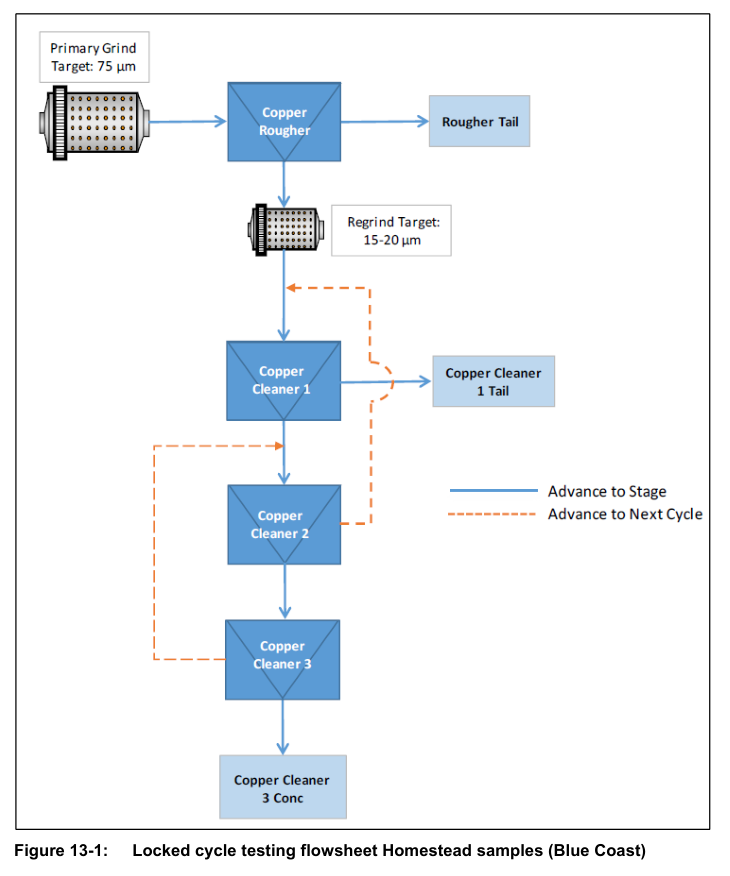
Consensum Engenharia used the results of metallurgical testwork carried out by Blue Coast Metallurgy & Research to develop the plant flowsheet and mass balance. The findings were presented in a final report dated 9 April 2025. A steady-state process simulation software (USIM PAC), designed specifically for modelling and optimising complex mineral processing flowsheets, was used to develop the flowsheet and generate the mass balance from which mineral processing equipment was selected.
A 70:30 blend of Homestead to Cupuzeiro ores has been assumed for the first six years of production at an average head grade of 0.5% Cu. Consensum noted that the Cupuzeiro metallurgical testwork was carried out at a coarser grind than the Homestead testwork and that the Cupuzeiro copper recoveries were lower than those achieved with the Homestead samples. Assuming that the finer grind would be selected for the plant design, results from the Homestead testwork were used as inputs to the simulation.
ONIX Engenharia e Consultoria Ltda. used the resulting mass balance and equipment sizing to develop preliminary plant engineering and an equipment list for the Planalto Concentrator.
Crushing and grinding
After drilling and blasting in the pit, run-of-mine material will be delivered to a primary crusher at the concentrator by large mine trucks where it can be dumped directly into the crusher hopper or stockpiled on the ROM pad and later fed by front-end loader. The primary crusher will crush the rock to a size less than 250 mm and is selected to operate 70% of the time to allow for maintenance.
Crushed material from the primary crusher is conveyed to a stockpile which forms a buffer between the primary crusher and the concentrator. The stockpile is designed at 11 hours capacity, which is undersized compared to typical crushed ore stockpiles having 48 to 72 hours live capacity. The report notes that as there is minimal cost in the size of the stockpile, this modification will have minimal impact on plant capital expenditure and operating costs and should be updated in future engineering exercises.
Crushed ore is withdrawn from the stockpile by apron feeders onto the plant feed conveyor belt and fed to the grinding circuit, which consists of a SAG mill followed by two parallel ball mills in a standard configuration. The SAG mill is in closed circuit with a pebble crusher that crushes oversize rocks in the mill discharge and returns them to the SAG mill feed. Fine material from the SAG mill with a P80 of 1.7 mm feeds both ball mills, each of which is in closed circuit with a bank of hydrocyclones. The hydrocyclones classify the ball mill product to control the feed to the flotation circuit at a target grind size of 75 µm. Oversize coarse material from the hydrocyclones returns to the ball mill feed.
Ore characterisation testwork carried out by Blue Coast did not include uniaxial compressive strength, drop weight testing or crushability index. Without specific breakage energy results, assumptions for these characteristics have been made for sizing the crusher and SAG mill. In the absence of testwork on Planalto samples, the specific breakage energy used in the design of a nearby large copper mining operation was assumed for this PEA. The values assumed were a specific crushing energy of 1.4 kWh/t and a rated specific power at pinion of 8.1 kWh/t.
Based on these assumptions, the equipment supplier recommendations were a 42 x 65 primary gyratory crusher, a dual pinion SAG mill of 38 feet diameter by 22 feet long with 2 x 9 MW motors, and MP800 cone crushers for pebble crushing duty. The average value of five Bond work index test results from the Blue Coast testwork was provided to the original equipment manufacturers to size the ball mills, with recommended equipment being two 24 feet diameter by 37 feet long ball mills, each with two 6 MW motors providing 12 MW of installed power per mill.
Flotation
The overflow from the hydrocyclones associated with each ball mill feeds into a dedicated line of rougher flotation cells. The two banks of rougher cells, one associated with each ball mill, produce initial concentrates equal to approximately 10% of the mass feed to the roughers. These concentrates are reground to a P80 of 15 to 20 µm in concentrate regrind mills dedicated to each rougher line. The re-grind size was determined in the metallurgical testwork.
The finely ground concentrate from each regrind mill is combined and fed to a common cleaner circuit where it is upgraded in two stages of flotation to make a saleable concentrate. The first stage of cleaner cells is followed by a bank of cleaner-scavengers which recover any partially liberated chalcopyrite and return it to the concentrate regrind mill for additional grinding.
The flotation circuit configuration comprises two parallel rows of six 160 m³ rougher cells each, with each row having a dedicated concentrate regrind vertical mill and hydrocyclone cluster. Rougher tailings pass to the tailings thickener. Rougher concentrate is reground before passing to the cleaner circuit. Rougher banks are configured so that froth from the cells at the head of the bank can be diverted directly to the final cleaner without regrinding when high grade is achieved.
A common bank of three 30 m³ cleaner cells is followed by 30 m³ cleaner-scavenger cells. Froth from the cleaner cells passes to the re-cleaner stage. Froth from the cleaner scavenger cells returns to the re-grind circuit. Cleaner-scavenger tailings pass to the tailings thickener, or, when processing high pyrite tailings, to a dedicated pyrite tailings thickener. A common bank of two 30 m³ re-cleaner cells produces the final copper concentrate, with tailings from the re-cleaner cells re-circulated to the first cleaner cells.
Tailings and water management
When processing low pyrite ores, rougher flotation tailings and cleaner-scavenger flotation tailings are combined in a tailings thickener where they are thickened before being pumped to the tailings dam. Tailings thickener overflow is returned to the concentrator as process water. When processing higher pyrite ores, the cleaner-scavenger tailings, which will be high in pyrite, are thickened separately and pumped to a pyrite tailings storage facility. A separate cleaner-scavenger tailings thickener has been included in the capital expenditure for this purpose.
A different methodology is proposed for later years, where tailings slurry is thickened to a homogeneous state using a deep cone type thickener for a central thickened discharge system.
A water treatment plant has been included in the flowsheet to account for processing of potentially acidic return water from the pyrite tailings dam and any run-off from the ROM and low grade stockpiles. A peak wet season flowrate from the pyrite tailings dam and the ROM and coarse ore stockpiles has been calculated at 200 m³/h. The plant design includes a cascade of four conditioning tanks providing a total residence time of 24 hours, along with a 15 m diameter clarifier to separate treated water for release to the natural environment. Underflow from the clarifier will be pumped to the tailings thickener for disposal in the main tailings dam.
Concentrate dewatering
Final copper-gold concentrate from the last cleaner stage is thickened before final dewatering in a pressure filter to a filter cake with a moisture content of 8% for transport off site. No dewatering testwork has been carried out, which is noted as not unusual at this stage of a project. The concentrate thickener design is 15 m diameter. A single 1,500 mm x 1,500 mm filter press will dewater the final copper concentrate, a fully automated membrane type filter press with 40 chambers sized to allow for two hours of downtime per day for maintenance.
Equipment selection and sourcing
ONIX developed short specifications for the process technology equipment which were sent to reputable original equipment manufacturers to provide budgetary quotations for specific equipment either manufactured or assembled in Brazil on a delivered and tax inclusive basis, or sourced from international suppliers paid for at local port of manufacturer excluding costs associated with shipping to Brazil and importation taxes.
Equipment selection was made in conjunction with Metso Corporation for milling and crushing, FLSmidth for flotation and thickening, Andritz AG for concentrate filter presses, Weir Pumps Ltd for pumps, Brazilian suppliers known to ONIX, or from ONIX’s internal database of equipment.
Where testwork is yet to be carried out, reasonable assumptions have been made on equipment sizes using nearby operations, other Brazilian projects or industry standards for equipment capacity.
Key reported parameters
| Parameter | Value | Basis |
|---|---|---|
| Plant throughput | 8 Mtpa | Design basis for PEA |
| Feed blend (first six years) | 70% Homestead, 30% Cupuzeiro | Assumed mining sequence |
| Average head grade | 0.5% Cu | First six years average |
| Concentrate grade | 28.0% Cu | USIM PAC simulation |
| Copper recovery | 90.8% | USIM PAC simulation |
| Gold recovery | 51% | USIM PAC simulation |
| Primary crusher product size | Less than 250 mm | Design specification |
| SAG mill product size (P80) | 1.7 mm | Design specification |
| Flotation feed grind size (P80) | 75 µm | Target specification |
| Regrind product size (P80) | 15 to 20 µm | From metallurgical testwork |
| Concentrate moisture content | 8% | Filter press specification |
| Crushed ore stockpile capacity | 11 hours | Current design (noted as undersized) |
| Specific crushing energy assumed | 1.4 kWh/t | From nearby operation |
| Rated specific power at pinion assumed | 8.1 kWh/t | From nearby operation |
| Primary gyratory crusher | 42 x 65 | OEM recommendation |
| SAG mill | 38 ft diameter x 22 ft long, 2 x 9 MW motors | OEM recommendation |
| Ball mills | Two units, 24 ft diameter x 37 ft long, each with 2 x 6 MW motors | OEM recommendation |
| Pebble crushers | MP800 cone crushers | OEM recommendation |
| Rougher flotation | Two parallel rows, six 160 m³ cells each | Design specification |
| Cleaner flotation | Three 30 m³ cells | Design specification |
| Cleaner-scavenger flotation | Three 30 m³ cells | Design specification |
| Re-cleaner flotation | Two 30 m³ cells | Design specification |
| Concentrate thickener | 15 m diameter | Design specification |
| Concentrate filter press | 1,500 mm x 1,500 mm, 40 chambers | Design specification |
| Tailings thickener | 50 m diameter | Design specification |
| Pyrite tailings thickener | 15 m diameter high rate | Preliminary sizing estimate |
| Water treatment plant capacity | 200 m³/h peak wet season | SRK calculation |
| Water treatment residence time | 24 hours | Design specification |
| Water treatment clarifier | 15 m diameter | Design specification |
Project website: https://www.planalto.gov.br/
Technical qualifications
The testwork undertaken to date does not cover all aspects of the flowsheet and some assumptions have been made in the sizing of the equipment, reducing the accuracy of the capital expenditure and operating costs estimates, but the accuracy remains within the normal boundaries for this level of study.
Specific limitations identified in the report include:
- Ore characterisation testwork did not include uniaxial compressive strength, drop weight testing or crushability index. Without specific breakage energy results, assumptions for these characteristics have been made for sizing the crusher and SAG mill, reducing confidence in the estimates.
- In the absence of testwork on Planalto samples, the specific breakage energy used in the design of a nearby large copper mining operation was assumed for the PEA.
- The Consensum mass balance assumes the plant feed will show simultaneous mining of Homestead at 70% and Cupuzeiro at 30% over the first six years of production.
- Locked cycle tests for the two main mining areas were carried out at different grind sizes, and the report highlights that making an average of the concentrate grade and recovery numbers may not show the performance of the plant which will be achieving the finer grind size. An elevated recovery for Cupuzeiro at the finer grind could be considered but requires confirmation by additional testing.
- The plant simulation copper recovery of 90.88% is slightly higher than achieved in the locked cycle testing, and the concentrate grade of 28.02% Cu is slightly lower than achieved in locked cycle testing.
- No dewatering testwork on concentrate has been carried out.
- In some minor areas of the plant, equipment sizes have been selected based on experience and previous projects, considered a low risk approach.
Source: Planalto , 2025 NI 43-101 Technical Report, 14 November 2025, Item 17 Recovery Methods.
