

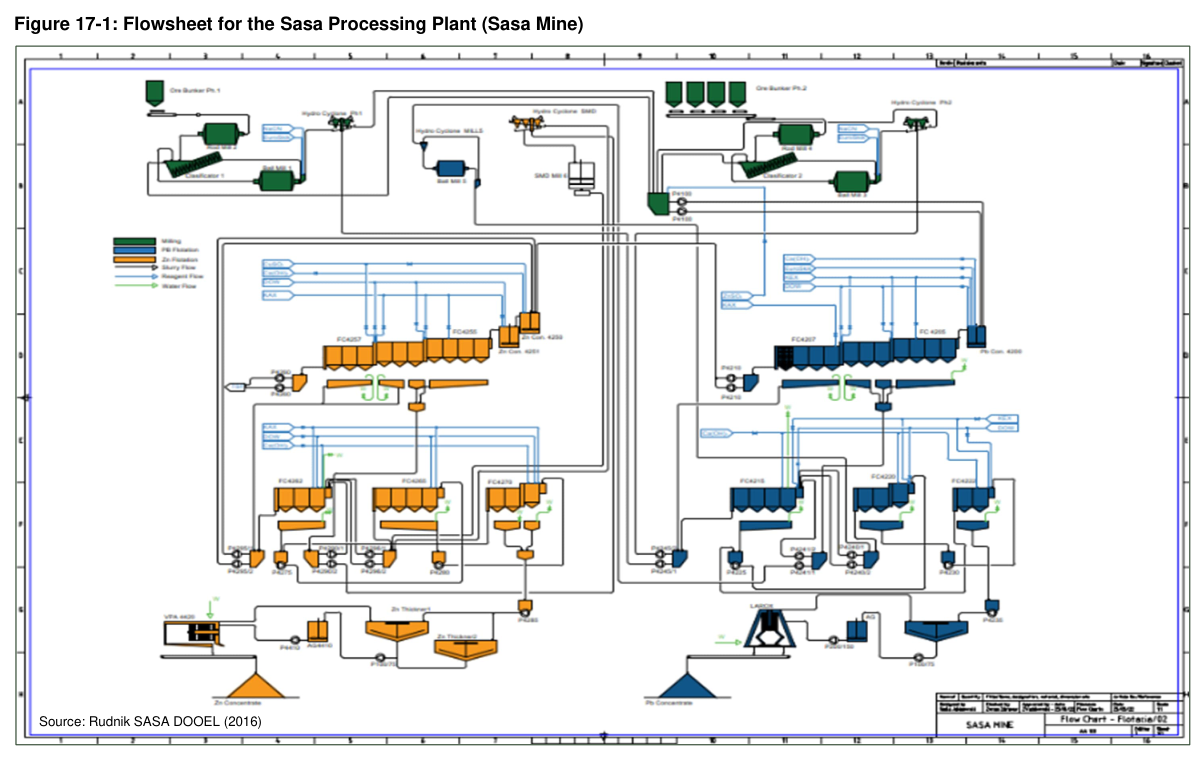
The Sasa processing plant in North Macedonia uses a conventional three-stage crushing circuit, rod and ball mill grinding, and selective lead-zinc flotation to produce lead and zinc concentrates for truck shipment.
The Sasa Mine is an operating lead-zinc-silver mine located in northeast North Macedonia, 10 km north of Makedonska Kamenica and 150 km east of Skopje. It is owned by Rudnik SASA DOOEL, a subsidiary of Central Asia Metals plc. The mine has an Exploitation Concession valid until September 28, 2030, with the current life of mine plan running until 2034. The processing plant was commissioned in 2006 and upgraded in 2007.
Critical Data
| Parameter | Value | Unit | Notes |
|---|---|---|---|
| Plant commissioning | 2006 | Not applicable | Original design: 650 ktpa |
| Nameplate capacity | 850 | ktpa | After 2007 upgrade |
| Recent throughput | ~800 | ktpa | Matched to mine production rate |
| Crushing circuit design throughput | 150 | tph | At 67% design utilisation |
| Grinding circuit design capacity | 109 | tph | At 92% design utilisation |
| Final grind size | 70–75 | % minus 75 microns | Feed to flotation |
| Lead recovery forecast (2026–2034) | 94 | % | LOM plan value |
| Zinc recovery forecast (2026–2034) | 86 | % | LOM plan value |
| Silver recovery forecast (2026–2034) | 75 | % | LOM plan value |
| Lead concentrate moisture | 6–7 | % w/w | Typical |
| Zinc concentrate moisture | 9–10 | % w/w | Typical |
| LOM average throughput | 830 | ktpa | Period 2027–2033 |
| Total LOM tonnes treated | 7.327 | Mt | At 3.48% Pb, 2.50% Zn, 26 g/t Ag |
| Processing plant personnel | 72 | Not applicable | Crushing: 18, Grinding/flotation: 41, Tailings: 13 |
Overview
The Sasa processing plant uses a three-stage crushing circuit and conventional grinding, classification, and selective flotation circuits. It produces lead and zinc concentrates that are thickened and filtered for shipment by truck. A paste backfill plant was commissioned in 2023, and a dry stack plant was commissioned in 2025. For 2026, the planned tailings distribution is approximately 31% dry stacked, 36% used for paste backfill, and 33% stored in the existing TSF-4. Paste backfill is the priority method for tailings disposal. An additional Stirred Media Detritor (SMD) regrind mill was installed in the zinc circuit in 2017.
The crushing circuit operates 24 hours per day, 7 days per week on a three-shift basis. The three-stage crushing circuit was installed in 2006 using new Metso crushers and screens, incorporating refurbished feeders and conveyors from the original Russian-designed plant.
Key Process Stages
Primary Crushing. Run of mine ore at nominally minus 350 mm is fed via conveyor to a vibrating screen ahead of the Nordberg C106 jaw crusher. Screen undersize and jaw crusher product at minus 100 mm are conveyed to the secondary crushing circuit. Tramp iron is removed by an overhead magnet, with secondary protection from a metal detector.
Secondary Crushing. A Nordberg GP220 cone crusher operating in closed circuit with a vibrating screen handles secondary crushing. Primary crushed ore is screened at 30 mm, with the plus 30 mm oversize crushed in the Nordberg GP220 cone crusher operating in open circuit. Screened and secondary crushed ore is conveyed to the tertiary crushing circuit.
Tertiary Crushing. Secondary crushed ore goes to the tertiary vibrating screen, where final crushed ore at minus 20 mm reports to the grinding circuit feed bins. Screen oversize is crushed in the HP200 tertiary crusher operating in closed circuit with the screen. A bifurcated chute with a manual diverter flap routes the final crushed product to either the 1,500 t bin for single-phase milling or the four 500 t bins for two-phase milling. A tripper conveyor distributes material to the four 500 t bins.
Grinding. Two parallel grinding lines operate independently. Line 1 has a single 1,500 t crushed ore feed bin, while Line 2 has four 500 t feed bins fed via a tripper conveyor. Each line has an open circuit rod mill, a twin spiral classifier, and a ball mill operating in closed circuit with hydrocyclone classifiers. All four mills are 2.7 m diameter by 3.6 m long, each with 380 kW motors, and are of original ex-Soviet manufacture. Steel liners are used for the rod mills and rubber liners for the ball mills. The rod mills use 85 mm diameter steel rods, and the ball mills use 60 mm diameter steel balls. Sodium cyanide, used as a zinc and pyrite depressant, and EuroSkik, a specific lead collector, are added to the ball mill feed. Water addition is automatically controlled.
Lead Flotation Circuit. Lead conditioning occurs in a single agitated conditioning tank after zinc sulphate is added as a zinc depressant. Additional reagents include lime for pH control, EuroSkik and Potassium Ethyl Xanthate (KEX) collectors, and Dowfroth frother. The circuit has lead rougher and scavenger flotation and three stages of lead concentrate cleaning. Initial flotation uses seven Metso RCS20 Rougher flotation cells (each 20 m³) for 15 minutes residence time. Rougher tails go to four Metso RCS20 Rougher Scavenger cells (20 m³ each) for 15 minutes. Rougher Scavenger concentrate is pumped back to the grinding circuit. Rougher concentrate goes to a regrind circuit with a 1.8 m diameter by 2.4 m long ball mill (110 kW) in closed circuit with hydrocyclones. Three stages of cleaning use Metso RCS5 cells (5 m³ each). Cleaner 1 uses five cells for 20 minutes; Cleaner 2 uses three cells for 20 minutes; Cleaner 3 uses two cells for 20 minutes. Final lead concentrate is sampled, thickened in one thickener, and filtered with an automated Larox filter to a typical moisture content of 6 to 7% w/w. Thickener overflow recirculates to the lead flotation circuit.
Zinc Flotation Circuit. Zinc conditioning uses two tanks. Copper sulphate (zinc activator) and lime are added to the first tank, with KAX and Dowfroth added to the second. The circuit has zinc rougher and scavenger flotation and three stages of zinc concentrate cleaning. Initial flotation uses seven Metso RCS20 Rougher cells (20 m³ each) for 15 minutes. Rougher tails go to three Metso RCS20 Rougher Scavenger cells (20 m³ each) for 15 minutes. Rougher Scavenger tails are pumped as final tails to the three tailings disposal circuits. Rougher concentrate (first five cells) goes to the regrind circuit, consisting of an SMD mill operating in closed circuit with hydrocyclones. Cyclone overflow at approximately 85% minus 38 microns goes to cleaning. Three stages of cleaning use Metso RCS cells: Cleaner 1 uses three RCS10 cells (10 m³ each) for 20 minutes; Cleaner 2 uses four RCS5 cells (5 m³ each) for 20 minutes; Cleaner 3 uses three RCS5 cells (5 m³ each) for 20 minutes. Final zinc concentrate is sampled, thickened in two parallel thickeners, and filtered with an automated Metso VPA filter to a typical moisture content of 9 to 10% w/w. Thickener overflow recirculates to the zinc flotation circuit.
Reagents and Consumables. Lime is used for pH control. Sodium cyanide is the zinc and pyrite depressant. Potassium ethyl xanthate and EuroSKIK are the lead collectors. Potassium amyl xanthate is the zinc collector. Zinc sulphate is the zinc depressant in the lead circuit, and copper sulphate is the zinc activator in the zinc circuit. Nasfroth 240 is the frother throughout. No flocculants are used in the concentrate dewatering circuits. Reagents are stored and mixed in a reagent building annexed to the concentrator. Sodium cyanide is stored in a separate locked area. Lime is received as bulk hydrated lime powder, stored in a silo, and mixed to slurry.
Additional Interesting Data and Summary
The plant historically processed an average of 794.8 ktpa from 2008 to 2016. For that period, average lead grade was 4.13% Pb with 94.1% recovery to a 74.16% Pb concentrate, and average zinc grade was 3.63% Zn with 85.5% recovery to a 50.1% Zn concentrate. Despite declining head grades in recent years, metals recoveries and concentrate grades have remained at design levels.
The life of mine plan from 2026 to 2034 uses metallurgical recoveries of 94% for lead, 86% for zinc, and 75% for silver. Silver recovery to the lead concentrate is based on 75% recovery at a grade of 254 g/t Ag. Average throughput is 830 ktpa for 2027 to 2033, with 815 ktpa in 2026 and 705 ktpa in 2034. Total LOM tonnes treated are 7.327 Mt at 3.48% Pb, 2.50% Zn, and 26 g/t Ag.
The processing department employs 72 personnel: 18 in crushing, 41 in the main grinding and flotation plant, and 13 in tailings. The plant operates an 8-hour shift pattern. The Qualified Persons consider the Sasa Mine has sufficient supply of energy and water for forecast throughputs, and sourcing of process consumables is well established with recognised suppliers and logistics.
Key Processes
- Three-stage crushing circuit: primary jaw crusher (Nordberg C106), secondary cone crusher (Nordberg GP220), and tertiary cone crusher (HP200) with vibrating screens
- Two-line grinding circuit: open circuit rod mills and ball mills in closed circuit with hydrocyclones
- Lead flotation circuit with rougher, scavenger, three stages of cleaning, regrind ball mill, thickening, and Larox pressure filtration
- Zinc flotation circuit with rougher, scavenger, three stages of cleaning, SMD regrind mill, thickening, and Metso VPA pressure filtration
- Paste backfill plant (commissioned 2023) and dry stack plant (commissioned 2025) for tailings management
- Reagent mixing and distribution system for lime, sodium cyanide, xanthates, EuroSKIK, copper sulphate, zinc sulphate, and frother
Source: NI 43-101 Technical Report on the Sasa Mine, North Macedonia, December 31, 2025. Project website: Sasa Mine
