

This technical report describes the processing facilities at the Tanami Operations in the Northern Territory, including design upgrades, historical operating data, and testwork results.
Report context
This NI 43-101 technical report for Tanami Operations, Northern Territory, is dated March 2019. The report covers recovery methods at The Granites processing plant, including process flowsheet, plant design history, crushing and ore handling, grinding, gravity separation, leach and adsorption, deslime and filtration, gold recovery, process control, gravity circuit optimization, diagnostic leach testing, and historical recovery performance.
Processing route
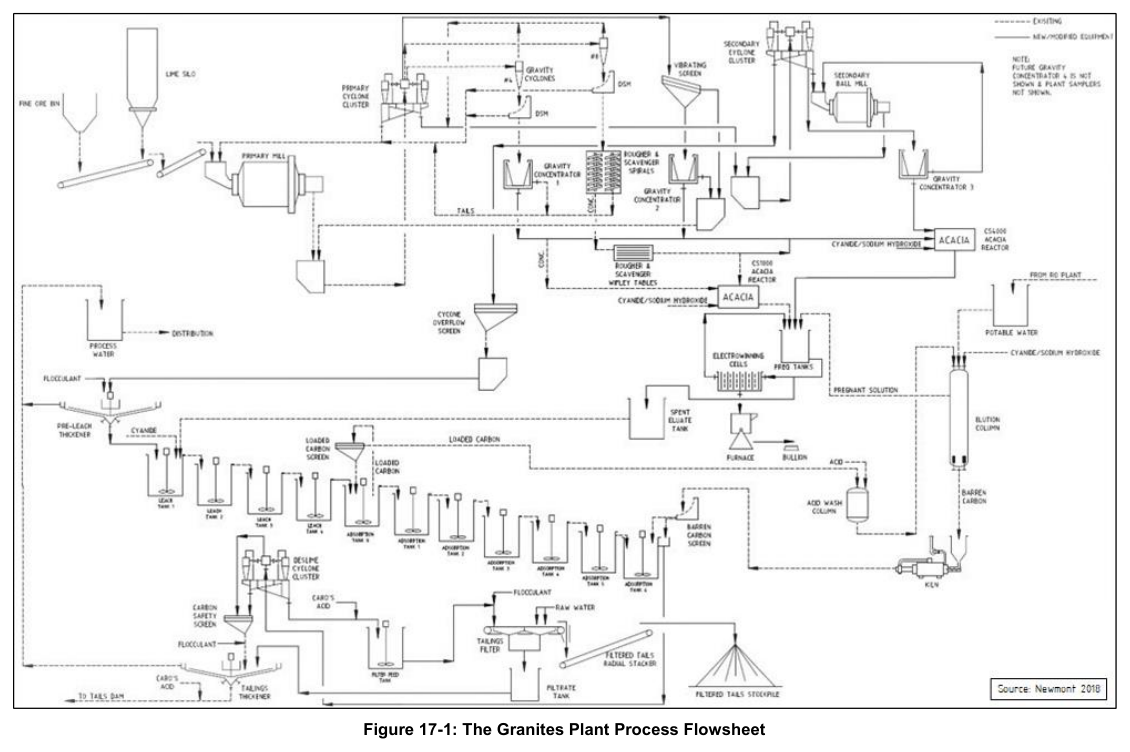
Process flow sheet
The plant circuit includes gravity concentration, leach, carbon-in-pulp (CIP) and gold recovery circuits.
Plant design history
The initial process plant was constructed in June 1986 with an initial throughput of 0.36 Mtpa, consisting of a crushing circuit and one ball mill feeding a CIP plant. This plant was upgraded in September 1989 via the addition of a low-aspect semi-autogenous grind (SAG) mill to maintain gold production as mill feed head grades declined. In the upgrade, a SAG primary mill was installed ahead of the ball mill and an additional 2,400 m³ of leach capacity was installed together with the replacement of cyclones, pumps and screens. A mill scat handling and crushing system was installed in late 1990 which increased mill capacity to around 1 Mtpa. A third mill was installed in 1998, and the processing plant ran in this configuration (SAG mill and two ball mills) until November 2003 when all three mills were decommissioned and a single 5.5 m x 9.3 m, 4,700 kW Outokumpu ball mill was installed. This mill is currently operating today, fed by a 3-stage contract crushing facility.
Throughput expansion project (TEP)
Various improvements to the plant were designed, constructed and then commissioned in Q3 2017 as part of the Tanami Expansion Project (TEP). These included: a second ball mill to allow annual average throughput to be increased from 2.3 Mtpa up to 2.6-2.8 Mtpa; classification and efficiency improvements due to the installation of a pre-leach thickener; wet plant upgrades such as sampling stations, a tailings deslime circuit for the paste filter plant feed preparation and a tailings filter plant installation; and an upgraded gravity concentration circuit to maximize gravity gold recovery.
Crushing and ore handling
Underground ore is transported 44 km by trucks to The Granites processing plant site and stockpiled on a ROM pad adjacent to the crushing plant. The ROM ore is crushed in a 3-stage crushing circuit to an approximately P₈₀ of 12 mm. Equipment includes a primary jaw crusher (Vicker Reiwoldt 42 x 30 inch double toggle), secondary cone crusher (Symonds 7 foot SXHD), and tertiary cone crusher (Symonds 7 foot SXHD). The primary jaw crusher is fed ROM ore smaller than 800 mm. The tertiary crushers operate in closed circuit with double and triple deck vibrating screens to produce coarse ore (less than 30 mm) and fine ore (less than 14 mm) product. The undersize is conveyed into a large ore holding bin with 3,500 t capacity.
Grinding
Crushed ore is recovered from the ore bin via two apron feeders and ground in a primary overflow ball mill (4,700 kW installed power) operated in closed circuit with a hydrocyclone distributor consisting of ten 400CVXFB Weir Warman Cavex Flat Bottom cyclones. Quicklime is added to the mill feed conveyor. The primary ball mill circuit cyclone overflow is fed to a secondary grate discharge ball mill (2,700 kW installed power) in closed circuit with ten 400CVX10 Weir Warman cyclones. The targeted liberation grind size from the grinding circuit is within a P₈₀ range of 50 µm to 80 µm when both ball mills are operating.
Gravity separation
Gravity recoverable gold is recovered from the grinding circuit in four distinct circuits. The primary milling gravity circuit comprises Dutch State Mines (DSM) screening of two primary cyclone underflow streams, with the DSM screen undersize reporting to two distinct gravity separation circuits. One circuit consists of rougher and cleaner spirals and Wilfley tables, and the other circuit uses a 30 inch Knelson concentrator. A second primary milling gravity circuit was installed as part of the TEP, however pumping issues meant this system was not operating as of December 2018 and was expected to be fully commissioned and operating in 2019. The secondary grinding gravity circuit comprises a split of the secondary cyclone underflow fed to a single 48 inch Knelson concentrator.
The Acacia reactor is operated on a cycle of one (up to two) batches per day. Electrowinning of the Acacia pregnant solution is carried out in a dedicated 18-cathode electrowinning cell. The proportion of feed to the gravity section increased from about 9% of circulating load to about 25% and is expected to increase further up to 40% once the new primary gravity circuit is fully commissioned.
Leach and adsorption
Cyclone overflow from the grinding circuit gravitates over a vibrating trash screen then reports to the pre-leach thickener ahead of the leach circuit. The pre-leach thickener allows the milling circuit to operate at more traditional operating densities with cyclone overflows of 35% solids increased to 50% solids for feed to the leach tanks. The leach circuit consists of three 1,500 m³ tanks and one 600 m³ tank. Cyanide is added to the head of the circuit with a top up to the third leach tank. A cyanide level of 140 to 150 g/m³ is maintained within the first and third tanks. Oxygen is produced on site from two pressure swing adsorption plants via two tpd and three tpd units. The total leach and adsorption residence time at a throughput rate of 295 tph and slurry density of 50% solids is about 22 hours. The CIP circuit consists of seven 600 m³ adsorption tanks.
Deslime and filtration
As part of the TEP, a deslime section and filter plant were installed. The deslime section consists of a cluster of 14 x 250 CV20XV Weir Warman Cavex cyclones. The filter plant consists of a 158 m² Jord vacuum filter belt. Filtercake is discharged onto a conveyor belt feeding a radial stacker which discharges onto a 10,800 t capacity stockpile. Both the deslime section and filter plant generated material as per the design criteria of 20% passing 20 µm at 130 tph, however ongoing investigations are underway to optimise specification.
Gold recovery
Final loaded carbon is removed from the head of the adsorption circuit at a normal rate of two 3.4 t batches per day. Elution is carried out via an Anglo American Research Laboratories (AARL) process at 135 °C and pressure of 330 kPa. Electrowinning is carried out in an 18-cathode electrowinning cell. Eluted carbon is regenerated in an Ansac horizontal rotary kiln operating continuously.
Gravity circuit optimization testwork
A study into Gravity Recoverable Gold (GRG) found that the feed to the processing plant had a high GRG content of 80% and that the 45% recovery by the gravity circuit being achieved in 2002 could be improved significantly. Circuit improvements and optimization increased gravity gold recovery up to 66%. In 2007, further improvements increased gravity recovery to 70%.
In March 2012 an extensive gravity and milling circuit plant survey was undertaken by Curtin University Gold Technology Group as part of the AMIRA P420D project. At the time of the survey the processing plant was treating 100% ore from the underground Callie orebody. The GRG performance of the spirals was found to be excellent with 95% of rougher spiral feed GRG reporting to cleaner concentrate. The recovery of fine gold on the spirals (less than 53 µm) was lower at 50%. The Knelson concentrator GRG recovery was unexpectedly low at 22%, with highest recovery in the finer size classes. Overall, the two gravity recovery devices worked synergistically, leading to high overall recovery for the circuit. The Wilfley table yielded 97.8% recovery to concentrate.
Diagnostic leach testing
The effectiveness of process plant gold recovery and extraction is determined using diagnostic testing of the final tails. This provides quantitative measurement of free milling gold available for cyanide leaching and gold locked up in various mineralogical species. Since the TEP, the grind size achieved has been significantly lower than the P₈₀ of 125 µm expected during design, with P₈₀ of 50 to 70 µm over extended periods. Silicate locked and extended leachable gold are similar at 34% and 32% of gold in tailings solids respectively, with gold locked in carbonates and sulfides at 16% and 18% respectively.
Gold recovery historical performance
A review of monthly reconciled data from 2008 to 2018 shows: feed gold grade increased from mid-2010 to the end of 2013/start of 2014, after which it varied but overall did not increase further; since the TEP, recovery increased by approximately 1.7%; gravity recovery improved with the TEP expansion. For October 2018, the reconciled feed grade was 9.90 g/t Au with recovery of 97.9%. An inverse relationship exists between gravity and leach recoveries.
Key reported parameters
| Parameter | Value | Basis |
|---|---|---|
| Initial plant capacity (1986) | 0.36 Mtpa | Design |
| Pre-TEP modelled capacity | 2.3 Mtpa (230 tph) | Design/model |
| TEP design annual throughput | 2.6-2.8 Mtpa | Design |
| TEP design feed rate | 333 tph | Design |
| Achieved feed rates (2015-2017) | Exceeding 300 tph (weekly averages) | Historical operating data |
| Achieved feed rates (post-TEP to end 2018) | 380-390 tph | Historical operating data |
| Current mining forecasts feed rate | 300-350 tph | Forecast |
| Primary ball mill power | 4,700 kW | Design |
| Secondary ball mill power | 2,700 kW | Design |
| Crushing product size (P₈₀) | 12 mm | Design |
| Target grind size (P₈₀ range) | 50-80 µm | Design |
| Leach and CIP residence time | ~22 hours at 295 tph and 50% solids | Design |
| Leach tank volumes | 3 x 1,500 m³ + 1 x 600 m³ | Design |
| CIP adsorption tanks | 7 x 600 m³ | Design |
| Pre-leach thickener feed density | 35% to 50% solids | Design |
| Cyanide level (first and third leach tanks) | 140-150 g/m³ | Operating target |
| Tailings cyanide | Less than 45 g/m³ | Operating target |
| Deslime/filter plant design | 20% passing 20 µm at 130 tph | Design |
| Elution temperature | 135 °C | Design |
| Elution pressure | 330 kPa | Design |
| Ore bin capacity | 3,500 t | Design |
| Filter cake stockpile capacity | 10,800 t | Design |
| Gravity circuit GRG content (study) | 80% | Testwork |
| Gravity recovery (2002) | 45% | Historical operating data |
| Gravity recovery (after initial improvements) | 66% | Historical operating data |
| Gravity recovery (after 2007 improvements) | 70% | Historical operating data |
| Spiral GRG recovery (2012 survey) | 95% of rougher feed to cleaner concentrate | Testwork |
| Knelson GRG recovery (2012 survey) | 22% | Testwork |
| Wilfley table recovery (2012 survey) | 97.8% | Testwork |
| Gold recovery increase post-TEP | ~1.7% | Historical operating data |
| Feed grade (October 2018) | 9.90 g/t Au | Historical operating data |
| Recovery (October 2018) | 97.9% | Historical operating data |
| Power consumption | ~30 kWh/t | Historical operating data |
| Grinding balls consumption (2018) | 0.441 kg/t | Historical operating data |
| Sodium cyanide consumption | 0.298 kg/t | Historical operating data |
| Lime consumption | 0.637 kg/t | Historical operating data |
| Raw water supply | 60 L/s maximum | Design |
Project website: https://operations.newmont.com/australia/tanami
Technical qualifications
In the opinion of the qualified person, the mill throughput, process and associated recovery factors are considered appropriate to support Mineral Resource and Mineral Reserves estimation, and mine planning requirements for the current and future expanded operations.
Source: Tanami Operations, Northern Territory, NI 43-101 Technical Report, March 2019, Section 17.0 Recovery Methods.
