

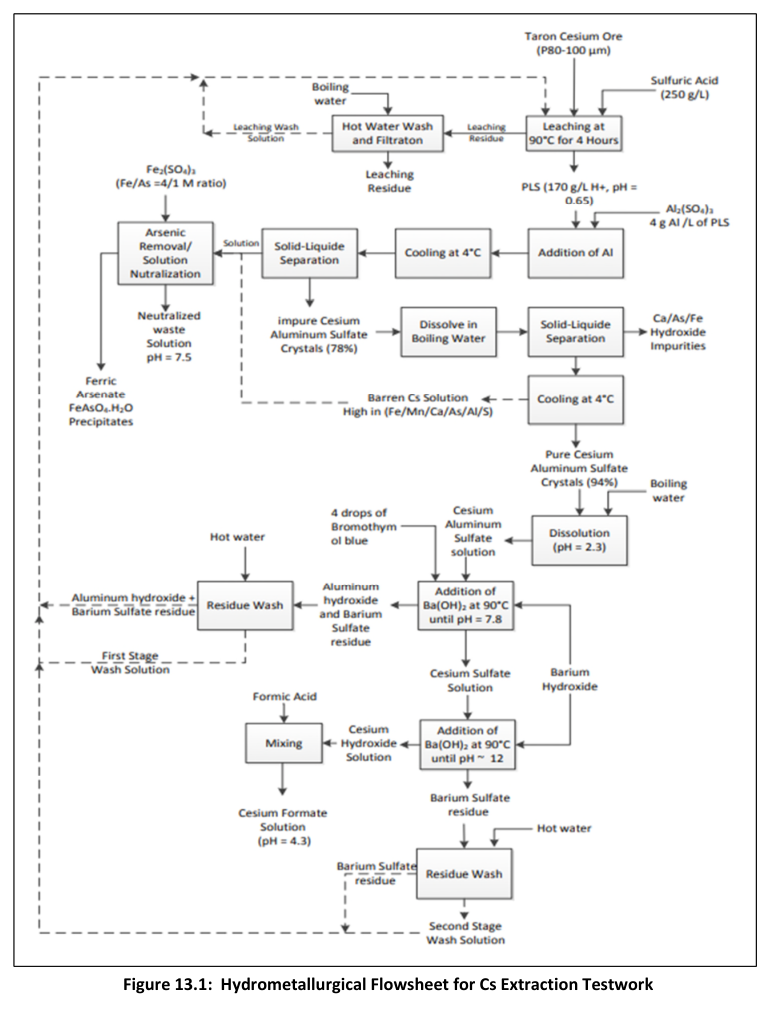
Project Overview
Location: Salta Province, Argentina
Process Type: Atmospheric or HPAL Leaching (under evaluation)
Annual Production: 1.75 million tonnes (5,000 tpd)
Feed Grade: 0.2144% Cs
Recovery Rate: Not specified
Final Product: 80% Cesium Formate Brine
Project Stage: PEA Trade-off Study
Detailed Process Description
Processing Options
The project is evaluating two main processing routes: atmospheric leaching and High-Pressure Acid Leaching (HPAL). The HPAL option presents higher capital costs but offers advantages in reduced acid and limestone consumption, potentially leading to lower operating costs. The facility is designed to process 1.75 million tonnes annually over a 14-year mine life.
Atmospheric Leaching Circuit
The atmospheric leaching process begins with ROM ore feeding to a rotary breaker for size reduction. Material undergoes ball milling in closed circuit with hydrocyclones to achieve a P80 of 44 microns at 30% solids density. The slurry feeds two atmospheric agitated leach tanks with a 1.5-hour residence time, using sulfuric acid addition at 400kg/t for cesium extraction. Post-leaching, the slurry undergoes thickening and filtration, with solids reporting to a dry stack facility.
HPAL Alternative
The HPAL option maintains similar front-end processing but replaces atmospheric leach tanks with two parallel autoclave circuits operating at high temperature and pressure. This redundancy in autoclave systems provides operational flexibility and maintenance advantages. The process aims to optimize acid consumption while maintaining high cesium recovery rates.
Downstream Processing
Both process options share a common downstream circuit where aluminum sulfate is added to the leach solution before cooling to promote cesium alum formation. The process includes multiple dissolution and crystallization steps, followed by treatment with barium hydroxide to remove impurities. The final product is cesium hydroxide, which is converted to cesium formate using formic acid to produce an 80% cesium formate brine for market sale.
Technical report and processing history
The following archived source profiles have been consolidated here to preserve the project’s processing history and study context.
Taron Cesium Project — 2024 Preliminary Economic Assessment
Taron Cesium Project — 2024 Preliminary Economic Assessment
| Company | Cascadero Copper Corporation |
| Date | April 2024 |
| Region | Salta, Argentina |
| Commodities | Cesium |
| Mine Type | Open Pit |
| Throughput | 1.75 Mtpa (5,000 tpd) |
| Mine Life | 14 years |
| Status | Exploration/Development |
Executive Summary
This Technical Report presents a Preliminary Economic Assessment (PEA) for the Taron Cesium Project located in the Salta Province of Argentina. The project focuses on the extraction of Cesium from a sedimentary deposit hosted in sandstone and conglomerate units within the Ochaqui Basin. The assessment utilizes Inferred Mineral Resources and assumes an open pit mining method with a Life of Mine (LOM) of 14 years. The primary product is an 80% cesium formate brine intended for the oil and gas drilling market.
Metallurgical trade-off studies compared Atmospheric Leaching against High-Pressure Acid Leaching (HPAL). Although atmospheric leaching required less capital, the high acid consumption resulted in unsustainable operational costs. HPAL was selected for the PEA due to lower reagent consumption compensating for higher capital expenditure, offering better economic viability. The processing circuit involves crushing, ball milling, autoclave leaching, alum formation, and purification to produce the final brine.
The economic analysis indicates a positive project viability with a Net Present Value (NPV) of US$79 million at a 10% discount rate and an Internal Rate of Return (IRR) of 14%. The payback period is estimated at five years. The project is currently in the exploration and development stage, with recommendations to advance to a Pre-Feasibility Study (PFS) to define Mineral Reserves and refine cost estimates.
Processing Profile
Reports
Website: https://cascadero.com/properties/argentina/taron-group/
Report Date: April 2024
Region: Salta, Argentina
Project Status: Exploration/Development
Commodity: Cesium
Throughput: 1.75 Mtpa (5,000 tpd)
Mine Life: 14 years
Mine Type: Open Pit
Ore type:
