

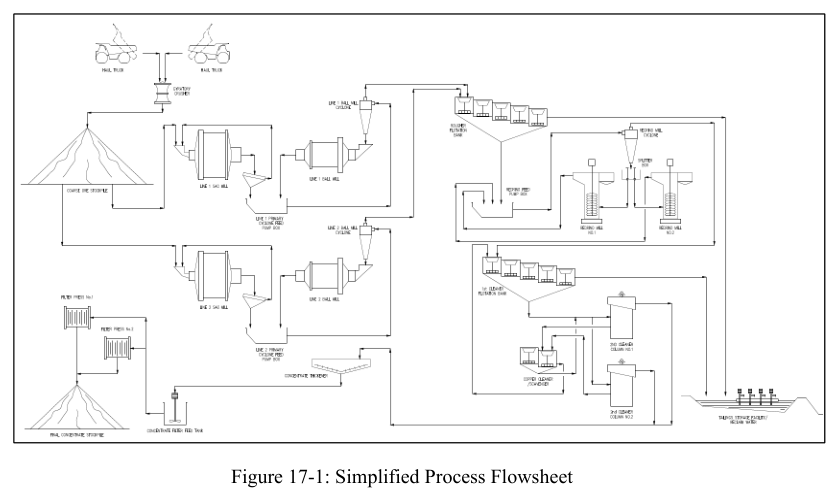
The Yellowhead Project sulphide concentrator is designed to process 90,000 tonnes per day of ore through three stages of comminution, three stages of flotation, and concentrate dewatering.
Report context
This July 2025 technical report for the Yellowhead Project presents the proposed design for a sulphide concentrator to produce a marketable copper concentrate containing payable amounts of gold and silver. Process design and equipment sizing were informed by results from the 2011/2012 G&T and 2020/2021 SGS metallurgical test programs discussed in Section 13 of the report.
Processing route
Crushing and conveying
The concentrator will receive run-of-mine ore from the open pit via a single gyratory crusher located near the ultimate pit rim. The crusher facility includes a double-sided dump pocket for mine haulage trucks and is designed to process ROM ore at a design rate of 7,500 tonnes per hour, representing approximately 45 percent excess capacity relative to concentrator throughput. The P80 product size at crusher discharge is expected to range between 160 mm and 250 mm depending on crusher gap setting. Crushed ore discharges into a surge bin sized to hold approximately two truckloads, then passes via apron feeder onto an overland conveyor system to a coarse ore stockpile with 45,000 tonnes live storage capacity.
Primary grinding
Two parallel SAG mill and ball mill circuits form the primary grinding stage. Each circuit includes variable speed, dual pinion driven SAG and ball mills powered by low-speed induction motors. SAG mill discharge passes over vibrating double-deck screens with spray bars; screen oversize is recirculated to the SAG mill feed via pebble conveying system. The design allows for future installation of a pebble crusher. Screen undersize combines with ball mill discharge in a common primary cyclone feed pump box, feeding hydrocyclone clusters. Cyclone underflow returns to ball mills while overflow flows by gravity to rougher flotation. Ball mills are designed for a circulating load of 350 percent and produce a P80 product size of 165 μm.
Rougher flotation
Ground ore from both grinding lines combines and feeds a single bank of six forced air flotation tank cells. Flotation reagents include lime as pH regulator, a dual collector system based on mercaptan and thionocarbamate chemistry, and a frother based on alcohol and glycol ether chemistry. Rougher concentrate is pumped to the regrind circuit; rougher tailings flow by gravity to the tailings storage facility.
Regrind circuit
Rougher concentrate is pumped to a cluster of regrind cyclones with underflow split to two parallel vertical stirred mills. Mill discharge returns to the regrind cyclone feed pump box by gravity. The regrind hydrocyclone and pumping system is designed for a circulating load of 250 percent. Lime is added to maintain slurry pH targets for downstream cleaner flotation. The regrind circuit targets a P80 product size of 25 μm.
Cleaner flotation
The cleaner circuit comprises an open circuit first cleaner flotation stage and a closed circuit second cleaner stage. Reground rougher concentrate feeds a bank of six forced air flotation tank cells for first cleaning. First cleaner tailings flow by gravity to the TSF through a dedicated pipeline. First cleaner concentrate is pumped to the second cleaner stage consisting of two parallel flotation columns equipped with external hydrodynamic sparging systems. Column concentrate becomes the final copper concentrate. Column tailings feed a second cleaner scavenger stage of two forced air tank flotation cells; scavenger concentrate recycles to second cleaner column feed while scavenger tailings return to first cleaner feed.
Concentrate dewatering
Final concentrate is dewatered in a high rate thickener followed by pressure filtration to approximately 8 percent moisture. Flocculent is added to the thickener to aid settling. Thickener underflow at 55 to 65 percent solids density is pumped to a concentrate stock tank then to vertical plate pressure filters. Filtered concentrate is conveyed to a stockpile prior to truck transport to an off-site concentrate handling facility in Vavenby. Filtrate returns to the concentrate thickener as dilution water; thickener overflow is sent to the TSF and reclaimed back to the process water pond.
Tailings and water reclaim
Rougher and first cleaner flotation tailings are transported separately via gravity to the TSF located south of the concentrator. Process water is reclaimed from drained tailings and recycled via a pump-back system to the process water pond. The pond has 26,000 m³ storage capacity, approximately three hours of nominal plant water demand. A reclaim barge with six vertical turbine pumps feeds the process water pond, supplemented by water from pit dewatering and site collection ponds.
Key reported parameters
| Parameter | Unit | Design/Actual/Testwork Basis | Value |
|---|---|---|---|
| Daily throughput | tpd | Design | 90,000 |
| Annual throughput | tpa | Design | 32,850,000 |
| Design processing rate | tph | Design | 4,076 |
| Design process plant copper recovery | % | Design | 90 |
| Design final concentrate grade | % Cu | Design | 26 |
| Crusher utilization | % | Design | 60 |
| Grinding and flotation availability | % | Design | 92 |
| Ore specific gravity | t/m³ | Testwork | 2.8 |
| Crusher work index | kWh/t | Testwork | 6.6 |
| Bond rod mill work index | kWh/t | Testwork | 11.8 |
| Bond ball mill work index | kWh/t | Testwork | 13.2 |
| A*b | , | Testwork | 50.8 |
| Primary crushing rate, dry | tph | Design | 7,500 |
| Grinding and flotation process rate, dry | tph | Design | 4,076 |
| Ball mill P80 product size | µm | Design | 165 |
| Regrind P80 product size | µm | Benchmark from pilot plant | 25 |
| Primary grinding average load | kW | Design | 62,000 |
| Primary grinding consumption | MWh/yr | Design | 540,000 |
| Total concentrator average load | kW | Design | 83,000 |
| Total concentrator consumption | MWh/yr | Design | 730,000 |
Project website: https://yellowheadinstitute.org/
Project website: https://www.tasekomines.com/properties/yellowhead-project/
Project website: http://inspection.canada.ca/en/animal-health/aquatic-animals/diseases/reportable-diseases/yellow-head-disease/fact-sheet
Technical qualifications
The specific energy requirements for the regrind circuit were benchmarked from a pilot plant campaign conducted on an ore sample of comparable ore hardness with a similar target regrind product size, rather than from the specific Yellowhead ore body testwork. Flotation cells were sized based on estimated slurry flow rates and flotation retention time requirements informed by the 2020/2021 metallurgical test program, with typical scale-up factors applied and a minimum number of cells applied based on experience to avoid short circuiting. The SAG and ball mills were sized based on energy calculations using ore hardness results from SMC grindability and Bond work index testing described in Section 13. The design includes consideration for future installation of a pebble crusher, which is not currently included in the base design.
—
*Source: Yellowhead Technical Report, July 2025, Section 17: Recovery Method*
