

Source: OceanaGold Corporation (2026)
Website: https://oceanagold.com/operations/haile
Critical Data
| Parameter | Value | Unit | Notes |
|---|---|---|---|
| Throughput | 3.0 | Mt/yr | Scheduled mill rate over life of mine; peak monthly rates of 479 t/h achieved (equivalent to ~3.8 Mt/yr) |
| Mill Power | Not specified | ||
| Target Grind Size | 75 | μm (P80) | Primary grinding circuit product size; regrind target P80 of 13 μm for flotation concentrate |
| Head Grade | 1.7 | g/t | Typical fresh ore gold feed grade used in recovery model; average sulfur feed grade 0.4% with max monthly 2.1% |
| Recovery % | Not specified | % | Overall gold recovery tracked well with site model; flotation sulfur recovery 70-90% |
| Processing Capacity | 3,000,000 | t/yr | Nominal capacity after debottlenecking; design basis for regrind circuit 4 Mt/yr at 5% sulfur |
| Energy Consumption | Not specified | kWh/t | |
| Water Consumption | Not specified | m³/t | Main water requirements satisfied by internal recycle from thickeners and TSF decant |
| Operating Hours | 24 | hours/day | Continuous operation; SAG mill utilization 84%-89% historically, targeting 92% |
Overview
OceanaGold operates the Haile Gold Mine in Lancaster County, South Carolina, using a conventional flotation and cyanide leaching (CIL) flowsheet that commenced commercial operation in 2017. The plant originally had a nameplate capacity of 2,300,000 tonnes per year (t/yr) and has been systematically debottlenecked to treat up to 3,800,000 t/yr depending on ore competency. The facility processes a blend of fresh and oxidized sulfide ores from open pit and underground sources, achieving scheduled mill rates of 3.0 million tonnes per annum (Mt/yr) over the life of mine. Gold recovery methods at Haile rely on a SAG-ball mill-pebble crusher (SABC) circuit for primary grinding to a target P80 of 75 microns, followed by flash and rougher flotation to recover sulfide minerals. The flotation concentrate undergoes two-stage fine grinding in a tower mill and an IsaMill to a P80 of 13 microns before cyanide leaching. Flotation tailings are also leached to recover soluble gold. Overall gold recovery has tracked well with the site model, with leach performance primarily influenced by concentrate regrind size and carbon activity. The plant produces gold-silver doré bars as final product and includes a contact water treatment plant to manage environmental discharge. A major upgrade to separate concentrate leaching with a Carbon-in-Pulp (CIP) circuit and extend residence time to 96 hours is planned for 2028, adding approximately 63,000 ounces of gold recovery.
Key Process Stages
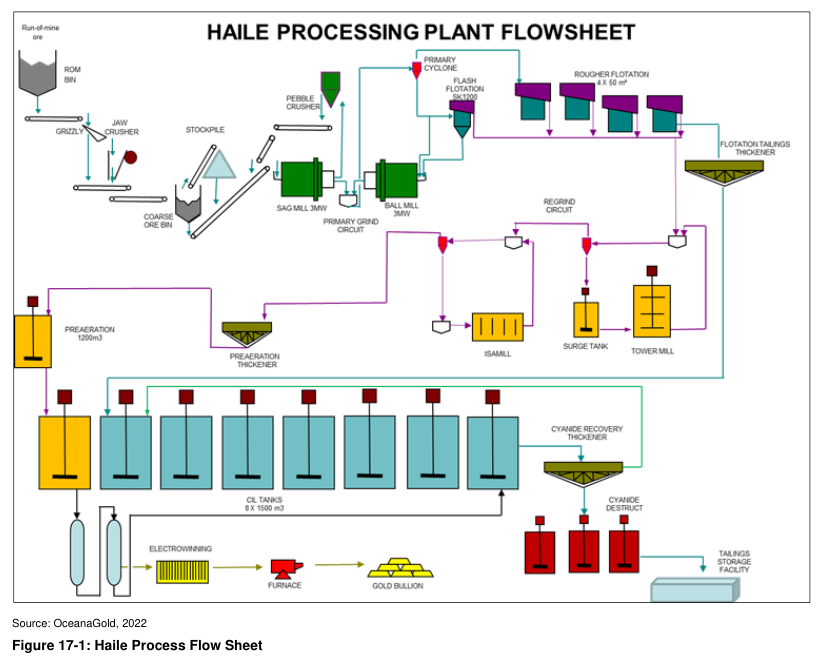
- Stage 1: Crushing and Conveying — Run-of-mine ore is fed via apron feeder to a vibrating grizzly, with oversize crushed by a primary jaw crusher to minus 100 mm. Crushed ore and grizzly fines are conveyed to a coarse ore surge bin or an emergency stockpile for reclaim.
- Stage 2: Grinding and Classification — A SAG-ball mill-pebble crusher (SABC) circuit grinds ore in closed circuit with vibrating screens and hydrocyclones. The target primary grind size is P80 of 75 microns. Pebble crusher (Sandvik CH-440) and SAG mill grate redesign improve handling of competent ore.
- Stage 3: Flotation — Flotation reagents (SIBX and frother) are added in the grinding circuit. A flash flotation cell recovers a portion of sulfides from the ball mill circulating load, followed by bulk rougher flotation to recover the balance. Combined concentrate reports to the regrind circuit.
- Stage 4: Concentrate Regrinding — Flotation concentrate is reground in two stages: first, an ETM-1500 tower mill (1.2 MW) in closed circuit with cyclones to P80 <40 microns; second, an M10000 IsaMill (3 MW) in closed circuit with cyclones to a target P80 of 13 microns.
- Stage 5: Cyanide Leaching and Gold Recovery — Reground concentrate is thickened, pre-aerated, and leached in a CIL circuit with activated carbon. Gold and silver are stripped from loaded carbon by hot caustic-cyanide solution, recovered by electrowinning, and smelted into doré bars. CIL tailings are thickened, detoxified, and pumped to a lined tailings storage facility.
Additional Interesting Data and Summary
The Haile Gold Mine processing facility has undergone continuous optimization since commissioning in 2017, including installation of a pebble crusher, two-stage fine grinding circuit upgrades (1.2 MW tower mill and 3 MW IsaMill), and replacement of thickener internals. The contact water treatment plant (CWTP) treats mine contact water via pH adjustment, clarification, microfiltration, and a newly added reverse osmosis stage (2025) to meet Whole Effluent Toxicity limits, increasing treatment capacity from 1,100 gpm to 2,640 gpm. Brine from RO is pumped to the tailings dam, with Minetek evaporators being recommissioned for pool control. A major USD 45 million concentrate leach circuit upgrade is planned, adding four 750 m³ leach tanks and a Kemix Carousel CIP system to extend concentrate residence time to 96 hours, targeting an additional 63,000 ounces of gold recovery. The upgrade will be completed by Q1 2028 ahead of Ledbetter Underground ore processing. Operating costs are budgeted at US$23.28 per tonne milled, including US$2.13 for water treatment, with inflationary pressures on reagents, labor, and electricity. Key consumable rates include 0.664 kg NaCN/tonne, 1.45 kg lime/tonne, and 0.441 kg flocculant/tonne. The plant processes 2.8–3.0 Mt/yr of ore from open pit (Ledbetter, Snake, Haile phases) and underground sources, targeting 200–220 koz gold production annually from 2028. Future sustainability initiatives include engineering rectifications to improve mill utilization above 90% and implementation of the Andritz expert system for SAG mill, ball mill, cyclone, thickener, and cyanide destruction control. The site-specific comminution model developed from SMC and Bond work index testing has enabled accurate throughput forecasting for deeper, more competent ores, with geometallurgical testing using Geopyora on 72 core intercepts supporting the reduced throughput expectation in the life-of-mine plan.
Key Processes: Flotation, CIP/CIL, Cyanidation, SAG Mill, Ball Mill, Crushing
Target Commodities: Gold, Silver
Technical report and processing history
The following archived source profiles have been consolidated here to preserve the project’s processing history and study context.
Haile Gold Mine Open Pit and Underground Update — 2024 Technical Report
Haile Gold Mine Open Pit and Underground Update — 2024 Technical Report
| Company | OceanaGold |
| Date | 2024 |
| Region | South Carolina, USA |
| Commodities | Gold, Silver |
| Mine Type | Open Pit, Underground |
| Throughput | 3,800,000 tpa |
| Status | Operating |
Executive Summary
The Haile Gold Mine processing plant has been successfully operating since 2017, achieving targeted throughput rates and gold production. Originally designed with a nameplate capacity of 2,300,000 tpa, the facility underwent progressive debottlenecking to reach a current capacity of up to 3,800,000 tpa. The plant utilizes a conventional flotation and cyanide leaching flowsheet, with key upgrades including the installation of a pebble crusher, tower mill, and Isamill to optimize grinding and recovery. Operational results indicate mill throughput has exceeded initial predictions, with specific energy requirements lower than forecast, although challenges with ore competency and moisture levels have required ongoing management strategies.
Gold recovery performance has improved relative to the feasibility model following the rectification of several key issues, including CIL tank short-circuiting and regrind circuit upgrades. The plant now achieves gold recovery rates consistent with an adjusted model, with fresh sulfide ore feed yielding higher recoveries than oxide or transitional material. Process unit costs are budgeted at an average of US$15.10 per tonne of ore milled, with ongoing improvements focused on expert system control, reagent optimization, and water treatment capacity expansion to support the increased throughput and environmental compliance.
The facility manages a blend of oxidized and sulfide ore, with feed strategies adjusted to minimize recovery impacts from oxide material. Water treatment plant capacity was expanded in 2023 to 2,640 gpm to handle contact water from mining areas, ensuring compliance with environmental discharge standards. Continuous monitoring and improvement projects, such as the implementation of expert system control for cyanide concentration and froth cameras for flotation, aim to maintain operating knowledge and predict unit costs based on first principles.
Website: https://oceanagold.com/operations/haile
Report Date: 2024
Region: South Carolina, USA
Project Status: Operating
Commodity: Gold, Silver
Throughput: 3,800,000 tpa
Mine Life:
Mine Type: Open Pit, Underground
Ore type:
Haile Gold Mine Feasibility Study Update (2021)
Haile Gold Mine Feasibility Study Update (2021)
| Company | OceanaGold |
| Mine | Haile Gold Mine |
| Date | 2022 |
| Region | United States |
| Commodities | Gold, Silver |
| Status | Operating |
Executive Summary
The Haile Gold Mine processing plant has been successfully operating since 2017, achieving targeted throughput rates and gold production following a progressive ramp-up. Originally commissioned with a nameplate capacity of 2,300,000 tpa, debottlenecking activities have upgraded the facility to a current capacity of up to 3,800,000 tpa depending on ore competency. The plant utilizes a conventional flotation and cyanide leaching flowsheet, with ongoing improvement projects focused on maintaining recovery and developing a first principles cost model.
Key operational upgrades included the installation of a pebble crusher, Nippon Eirich ETM-1500 tower mill, and M10000 Isamill to enhance grinding efficiency. Mill throughput has exceeded initial predictions, with specific energy requirements lower than forecast. Operational challenges related to ore blending and regrind capacity have been addressed, leading to improved flotation recovery and overall gold recovery trends that now meet or exceed the adjusted feasibility model.
Process unit costs are budgeted at an average of US$11.570/tonne of ore milled over the Life of Mine at the 3.8 Mtpa rate. The facility includes comprehensive water treatment and tailings management systems, with capacity expansions planned to support increased throughput. Continuous monitoring and expert system controls are implemented to maximize throughput and minimize reagent consumption.
Website: https://oceanagold.com/operations/haile
Report Date: 2022
Region: United States
Project Status: Operating
Commodity: Gold, Silver
Throughput:
Mine Life:
Mine Type:
Ore type:
Haile Gold Mine — 2020 Technical Report
Haile Gold Mine — 2020 Technical Report
| Company | OceanaGold |
| Date | 2020 |
Executive Summary
Section 17 details the recovery methods and operational performance of the Haile Gold Mine processing plant. The facility utilizes a conventional flotation and cyanide leaching flowsheet, having ramped up from a nameplate capacity of 2,300,000 t/a to a current capacity of 4,000,000 t/a through progressive debottlenecking and upgrades completed around 2018-2020. Key upgrades included the installation of a pebble crusher, tower mills, and Isamills, alongside improvements to thickening and cyanide destruction circuits.
Operational results indicate that mill throughput has exceeded initial predictions, with a budget throughput rate of 485 t/h achieved in Q1 2020. While flotation performance was initially constrained by regrind circuit bottlenecks, recovery rates improved significantly following upgrades in 2019. Gold recovery has trended near feasibility model predictions after addressing issues such as CIL short-circuiting, carbon regeneration efficiency, and feed blending strategies for oxide ore.
The process plant manages reagent consumption and water treatment actively, with unit costs budgeted at approximately $9.98/tonne of ore milled over the Life of Mine. Ongoing process improvement projects focus on expert system control, carbon management, and mineralogical analysis to further optimize recovery and reduce reagent usage.
Reports
Website: https://oceanagold.com/operations/haile
Report Date: 2020
Region:
Project Status:
Commodity:
Throughput:
Mine Life:
Mine Type:
Ore type:
Haile Gold Mine Project — 2014 Technical Report
Haile Gold Mine Project — 2014 Technical Report
| Company | M3 |
| Date | 2014 |
| Region | Not Specified |
| Commodities | Gold, Silver |
| Mine Type | Not Specified |
| Throughput | 7,000 tpd |
| Mine Life | Not Specified |
| Annual Production | Not Specified |
| Status | Development |
Executive Summary
This technical report outlines the recovery methods designed for the Haile Gold Mine Project, focusing on the extraction of gold and silver from the ore. The plant was designed to process 7,000 tons per day (TPD) of ore. The process flow begins with size reduction using a primary jaw crusher, followed by stockpiling and reclamation. The ore is then ground in a SAG mill and ball mill circuit prior to processing in a flotation circuit.
The flotation circuit includes rougher flotation and a flash flotation cell, with concentrate undergoing regrinding to a finer size. The reground concentrate is thickened and subjected to cyanide leaching in agitated leach tanks. The leach discharge is processed in a carbon in leach (CIL) circuit to dissolve and adsorb gold and silver. The loaded carbon is treated by acid washing, stripping, and thermal reactivation. Precious metals are recovered via electrowinning, and the resulting sludge is melted to produce gold-silver doré bars.
The report also details options for future expansion, including a 30% increase in throughput through incremental changes to the crushing and grinding circuits, or a major expansion by doubling throughput with a mirrored second processing line. Water management and reagent storage are also covered, ensuring efficient recycling and detoxification of tailings prior to disposal.
Operational Details
Processing Profile
Website: https://m3eng.com/portfolio/haile-gold-laboratory-building/
Report Date: 2014
Region: Not Specified
Project Status: Development
Commodity: Gold, Silver
Throughput: 7,000 tpd
Mine Life: Not Specified
Mine Type: Not Specified
Ore type:
