

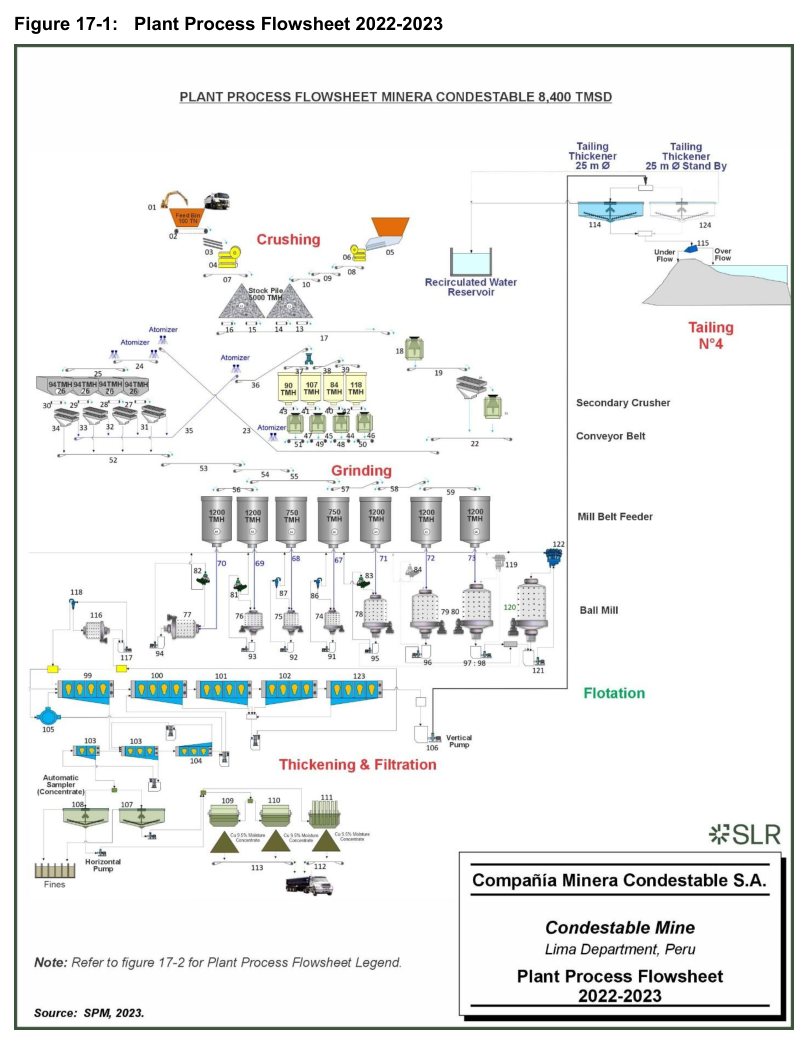
This NI 43-101 Technical Report describes the recovery methods at the Condestable Mine's 8,400 tonne per day flotation concentrator, operated by Ariana Management Corporation S.A.C.
The Condestable concentrator is situated on a steep hillside above the administration offices and warehouse facilities. Ore is sourced from the Condestable and Raúl underground mines and trucked approximately three kilometres to the plant. The facility operates a conventional four-stage crushing, grinding, and flotation circuit configured to produce a filtered copper concentrate for sale on the open market.
With assistance from Holland & Holland Consultants, the operator expanded the concentrator's design capacity from 7,000 tonnes per day (tpd) to 8,400 tpd. The Expansion Project involved modifications to equipment in crushing, milling, flotation, tailings pumping, and tailings thickening. In addition, a new tailings thickener was installed, and existing tailings pumps were replaced with larger capacity horizontal units. The expansion also included installation of a new ball mill and associated hydrocyclone nest.
Crushing occurs in several stages. Ore from the underground mines feeds one of two primary jaw crushers, discharging at a nominal 200 mm size to one of two coarse ore stockpiles. Material is recovered from the stockpiles using belt feeders and transferred to a secondary HP500 standard cone crusher, which reduces it to a nominal 70 mm. A tertiary HP500 standard cone crusher, which replaced an earlier HP400 unit as part of the Expansion Project, further reduces the ore to approximately 35 mm. The tertiary product reports to the screening plant where ore is separated into fine ore at a nominal 3.5 mm size; oversize material passes to quaternary crusher bins. Four HP400 short head crushers operate in closed circuit with four 2.44 m by 6.10 m screens to reduce oversize material to a nominal 3.5 mm for milling feed.
Fine ore from the crushing plant is stored in six bins with a combined capacity of 6,500 t. Each bin feeds one of six primary grinding ball mills. The primary grinding mills operate with cyclones and Derrick screens to produce a flotation feed of 80% passing 200 µm. A total of nine mills are described in the report, including a regrind mill completed in October 2017 and a new mill installed as part of the Expansion Project. Number 6 mill operates in open circuit with its discharge delivered to the pump box of the new mill, eliminating classification with a high-frequency sieve. The regrind mill is configured with 25.4 cm cyclones, and all products are combined to form flotation feed.
Flotation feed at approximately 32% solids enters the copper rougher-scavenger circuit, comprising 16 cells arranged in four banks of four OK 38 cells, each of 38 m³ volume. The first four cells operate as a high-grade rougher while the remainder functions as a three-stage scavenger circuit. Concentrate from the first four-cell scavenger bank passes to the cleaner scavenger for upgrading before recycling to cleaner feed. The final two scavenger banks produce a scavenger concentrate that feeds the regrind circuit, which recycles to flotation feed. A new bank of four OK 38 cells was installed as a fourth stage scavenger as part of the Expansion Project. An OK 20 cell was added to process regrind overflow and reduce iron recirculation in the circuit, promoting flotation time in the rougher stage and improving copper recovery. Automatic samplers collect feed, concentrate, and tailings streams for analysis, while an Outotec Courier on-line analyzer provides on-stream analysis of copper, iron, and percent solids at the mill feed, concentrate, and final tailings.
Concentrate from the cleaner circuit reports to one of two 7.62 m diameter thickeners, with overflow water recycled to the plant. Underflow at 60% solids feeds two 2.44 m by 2.44 m Dorr Oliver drum filters and one Fima disc filter, producing concentrate at a final moisture content of approximately 9.5%. Filter product discharges by gravity to a storage hopper and is loaded onto trucks. The process concludes with tailings disposal in a dam, with decant water pumped back to the plant as recycle process water.
Critical Data
| Parameter | Value | Unit | Notes |
|---|---|---|---|
| Design capacity | 8,400 | tpd | Expanded from 7,000 tpd |
| Crushing feed size | 200 | mm | Nominal primary discharge |
| Tertiary product | 35 | mm | Nominal |
| Screen aperture | 3.5 | mm | Nominal fine ore |
| Fine ore storage | 6,500 | t | Six bins |
| Grind size | 80% passing 200 | µm | Flotation feed |
| Grinding solids | 32 | % | Flotation feed |
| Concentrate thickener diameter | 7.62 | m | Two units |
| Filter underflow solids | 60 | % | |
| Final concentrate moisture | 9.5 | % | Approximate |
| Regrind mill installation | October 2017 | , | Number 8 ball mill |
| New tailings thickener diameter | 25 | m | Part of Expansion Project |
Overview
The Condestable concentrator is an operating copper flotation plant in Peru. The ore is sourced from the Condestable and Raúl underground mines, with material trucked roughly three kilometres to the plant. The facility was designed with assistance from Holland & Holland Consultants, which supported its expansion from 7,000 tpd to 8,400 tpd. The expansion involved changes to crushing, milling, flotation, tailings pumping, and tailings thickening. The plant produces a filtered copper concentrate for open-market sale.
Key Process Stages
The flow sheet follows four major stages. Crushing is conducted in multiple stages from primary jaw crushing down to a nominal 3.5 mm using screens and short head crushers in closed circuit. Grinding uses a series of ball mills with cyclones and Derrick screens to achieve a flotation feed of 80% passing 200 µm, with a dedicated regrind mill added for flexibility when encountering harder ore. Flotation comprises a rougher-scavenger stage using 16 OK 38 cells, a regrind circuit, and a cleaner stage with an additional OK 20 cell to reduce iron recirculation. Dewatering is accomplished with thickeners and filters, producing a concentrate at approximately 9.5% moisture.
Additional Interesting Data and Summary
The report details a number of operational changes made during the Expansion Project. A new regrind ball mill was installed with a nest of eight hydrocyclones and two horizontal pumps, along with minor electrical supply system modifications. Number 6 mill placement into open circuit eliminated the need for high-frequency sieving. The addition of an OK 20 cell in the regrind circuit was intended to reduce iron recirculation and increase flotation time in the rougher stage. These changes combined to provide increased process flexibility and additional regrind capacity. The plant is supported by a dedicated wet chemical assay laboratory operating 24 hours per day and a fully equipped metallurgical laboratory on site.
Key Processes
- Crushing: Jaw crushers, HP500 and HP400 cone crushers in four-stage circuit
- Grinding: Multiple ball mills including regrind mill, cyclones and Derrick screens
- Flotation: OK 38 cells for rougher/scavenger, OK 20 cell for regrind overflow
- Dewatering: Thickeners, Dorr Oliver drum filters, Fima disc filter
- Tailings: Thickener and dam with water recycle
Source: Condestable Mine , 2024 Technical Report, 2024-04-12. Project website: Rio2
Project website: Condestable Mine, 2024 Technical Report
