

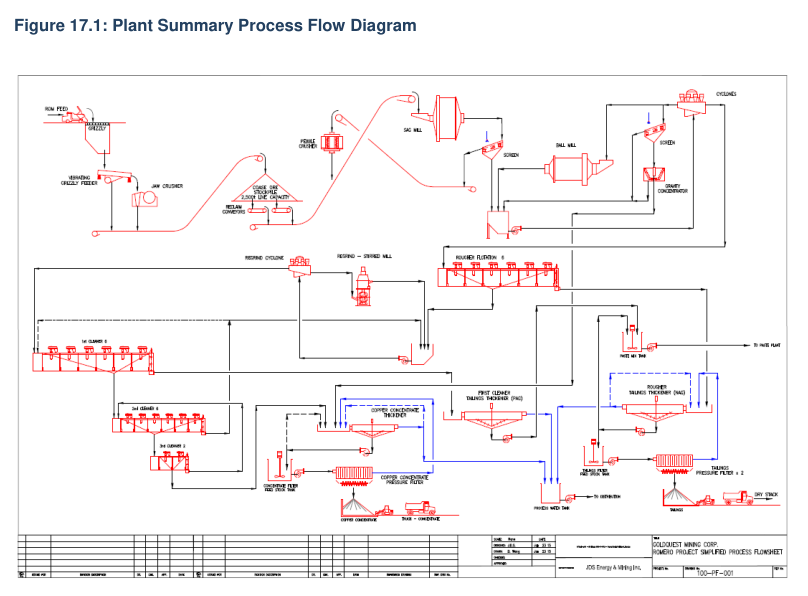
This report presents the conceptual processing design for the Romero project, based on metallurgical testwork, with a flowsheet comprising crushing, grinding, flotation, and on-site bacterial oxidation to produce copper concentrate and pyrite concentrate feed for off-site gold recovery.
Report context
The Romero Project Preliminary Economic Assessment Technical Report is a dated technical report that describes a proposed processing facility designed to treat 4,000 t/d (1,400,000 t/y) of mineralized material. The report date is identified by the report title and the processing description presented in Section 17 (Recovery Methods). The proposed plant is designed for 350 operating days per year and includes comminution, flotation, dewatering, and bacterial oxidation circuits. The report is based on the Romero and Romero South mineral resources and uses inputs from metallurgical testwork programs described in Section 13 of the source report.
Processing route
The proposed processing facility is designed around a conceptual flowsheet that produces two marketable products: a copper flotation concentrate and a pyrite concentrate from which gold is recovered after on-site bacterial oxidation. The design basis distinguishes actual metallurgical testwork data from design parameters that rely on industry experience.
Crushing and grinding
The crushing circuit uses a single-stage jaw crusher to reduce run-of-mine material to a nominal product size of 150 mm (80% passing). The crushed material is stored in a coarse ore bin with a design live storage capacity of 4,000 t. The grinding circuit is a semi-autogenous grinding (SAG) mill and ball mill configuration with a pebble crusher, operating in closed circuit with hydrocyclone classifiers. The target grind size for the grinding circuit product is 190 μm (P80), which was selected based on the liberation requirements for the copper and gold bearing minerals.
Copper flotation
The grinding circuit product feeds a copper flotation circuit comprising a conditioner, a rougher bank, a regrind mill, and two stages of flotation cleaners. The regrind circuit is designed for a product size of 30 μm (P80). The copper flotation concentrate is thickened in a high rate thickener and dewatered using continuous pressure filters to reduce moisture to less than 10%. The filter cake is stored on site in 1-tonne bags and loaded into containerized trucks for delivery to a port facility and off-shore smelting.
The secondary cleaner tailings are recycled to the primary copper cleaners, and the primary copper cleaner tailings report to the pyrite cleaner circuit. Copper rougher tailings feed the pyrite flotation circuit.
Pyrite flotation
The pyrite flotation circuit consists of a conditioner, a rougher bank, a regrind mill, and two stages of flotation cleaners. The regrind circuit is designed for a product size of 48 μm (P80). The secondary cleaner tailings are recycled to the primary pyrite cleaners, while the primary pyrite cleaner tailings are combined with the pyrite rougher tailings and feed the tailings dewatering circuit.
The final pyrite concentrate feeds the bacterial oxidation circuit at a design rate of 480 dry t/d, equivalent to a 12% weight recovery from plant feed. The concentrate is diluted to 20% solids by weight before oxidation.
Bacterial oxidation
The bacterial oxidation circuit operates in two stages: the first stage includes three tanks in series providing two days of reaction time, and the second stage includes five tanks providing three additional days of retention, for a total of five days. Oxygen is injected as air using dedicated blowers, and cooling water is circulated through cooling pipes installed in the tank baffle systems. A facility to remove iron from the circuit after the first oxidation stage is included in the design, although actual requirements will require future development testwork.
The oxidation product feeds a three-stage counter current decantation (CCD) circuit with a wash water ratio of 8 m³ of water per tonne of solids. The solids from the third CCD thickener are pumped to a thickener and filter press, with filtered solids packaged in 1-tonne bulk bags and transported off-site for gold recovery as doré. The CCD overflow feeds the neutralization and residue dewatering circuit.
Neutralization and tailings disposal
Neutralization of the leach solution occurs in two reaction tanks providing six hours of total reaction time. Ground limestone and hydrated lime are added to both tanks, and compressed air is injected to promote the reaction. The neutralization product feeds the tailings thickener.
Tailings from pyrite flotation and residue from the neutralization circuit are thickened at the plant site and pumped to a filtration system at the tailings disposal site. Filtrate is returned to the process plant as process water, and filtered tailings are stacked at the disposal site. Thickened tailings can also be directed underground to the backfill system when required.
Effluent treatment
An effluent treatment plant is included in the PEA to treat excess process water. The treatment process is designed to remove sulphate and metals through a series of precipitation processes, including oxidation, lime addition, precipitation, secondary sulphate precipitation, clarification, and neutralization. The design feed capacity is 70 m³/h, which will require confirmation in the next development phase. It is assumed that effluent treatment will only be required for nine months of the year.
Water systems
Fresh water is used for reagent make-up, gland service, fire water, potable water, and cooling water for the bacterial oxidation reactors. Mine site fresh water is pumped from a local river system. Two main process water systems are included: one services the grinding and flotation circuits, and a separate system feeds the bacterial oxidation circuit. Thickener overflow streams are collected and distributed as circuit dilution, spray water, and hose water, with fresh water make-up covering any deficit.
Consumables and reagents
The estimated annual consumption of process reagents and consumables is reported separately for Romero and Romero South mineralization. Key consumables include SAG mill grinding balls (863.5 t/y for Romero), ball mill grinding balls (883.4 t/y), quick lime to flotation (2,044 t/y for Romero), and quick lime to the bacterial oxidation circuit (10,200 t/y for both).
Most consumables will be imported and transported from the port to site by road. Suitable limestone required to neutralize the bacterial oxidation residue is assumed to be sourced locally. Specific reagent consumption values for the copper and pyrite circuits are summarized in the table below.
Key reported parameters
| Parameter | Unit | Value | Basis |
|---|---|---|---|
| Nominal ore processing rate | t/y | 1,400,000 | Design |
| Average plant daily ore throughput | t/d | 4,000 | Design |
| Operating regime | d/y | 350 | Design |
| Design utilization (crushing plant) | % | 65 | Design |
| Design utilization (remainder of plant) | % | 90 | Design |
| Crushing stages | – | 1 | Design |
| Crusher product size (P80) | mm | 150 | Design |
| Grinding stages | – | 2 | Design |
| Primary grind (SAG mill) product size | μm | 1,200 | Design |
| Secondary grind (ball mill) product size | μm | 190 | Design |
| Bond ball mill work index (metric) | kWh/t | 15.33 | Testwork |
| Copper flotation concentrate grade | % Cu | 20 | Design |
| Copper circuit regrind product size (P80) | μm | 30 | Design |
| Pyrite circuit regrind product size (P80) | μm | 48 | Design |
| Copper recovery to copper concentrate (Romero) | % | 88.9 | Testwork |
| Copper recovery to copper concentrate (Romero South) | % | 78.5 | Testwork |
| Gold recovery to copper concentrate (Romero) | % | 49.4 | Testwork |
| Gold recovery to copper concentrate (Romero South) | % | 40.3 | Testwork |
| Gold recovery to pyrite concentrate (Romero) | % | 31.4 | Testwork |
| Gold recovery to pyrite concentrate (Romero South) | % | 33.6 | Testwork |
| Design concentrate production | dry t/d | 122 | Design |
| Design copper in concentrate production | Mlb/y | 18.9 | Design |
| Copper concentrate filter cake moisture | wt % | 8 | Design |
| Pyrite concentrate filter cake moisture | wt % | 10 | Design |
| Bacterial oxidation feed rate | dry t/d | 480 | Design |
| Oxidation retention time | d | 5 | Design |
| Oxidation tank pulp density | wt % | 20 | Design |
| Oxidation stages | – | 2 | Design |
| CCD wash ratio | m³/t solids | 8 | Design |
| Gold recovery to final solids product | % | 98 | Design |
| CCD wash water to tailings thickener | t/h | 1,658 | Design |
| Effluent treatment design capacity | m³/h | 70 | Design |
| Quick lime to bacterial oxidation (Romero) | t/y | 10,200 | Design |
| Limestone to bacterial oxidation (Romero) | t/y | 126,000 | Design |
| Nutrients to bacterial oxidation (Romero) | t/y | 285.6 | Design |
| Flocculant to bacterial oxidation (Romero) | t/y | 10.1 | Design |
Technical qualifications
The recovery methods described in this report are based on metallurgical testwork described in Section 13 of the source report. However, several specific limitations apply to the data presented.
For the bacterial oxidation circuit, the report states that due to lack of actual available testwork data, the design basis relies on Micon's experience and typical industry design parameters. This applies to the oxidation circuit design, including retention times, staging, and oxygen requirements.
The effluent treatment plant design feed capacity of 70 m³/h is identified as requiring confirmation during the next phase of project development. The assumption that effluent treatment will only be required for nine months of the year is also noted as a design assumption.
The bacterial oxidation circuit design assumes no pyrite dewatering prior to the oxidation circuit. The preliminary process material balance indicates that no pyrite concentrate dewatering is included in the design, and the pyrite concentrate reports directly to dilution and oxidation feed.
Iron removal from the bacterial oxidation circuit following the first stage of oxidation is included in the design, but the actual requirements will need to be determined by future development testwork.
The water balance presented in the report excludes reagents, gland service water, and effluent treatment plant flows. The design also assumes that suitable limestone required for neutralization will be sourced locally.
—
Source: Romero Project Preliminary Economic Assessment Technical Report, Section 17 (Recovery Methods), Tables 17.1, 17.2, and 17.3.
