

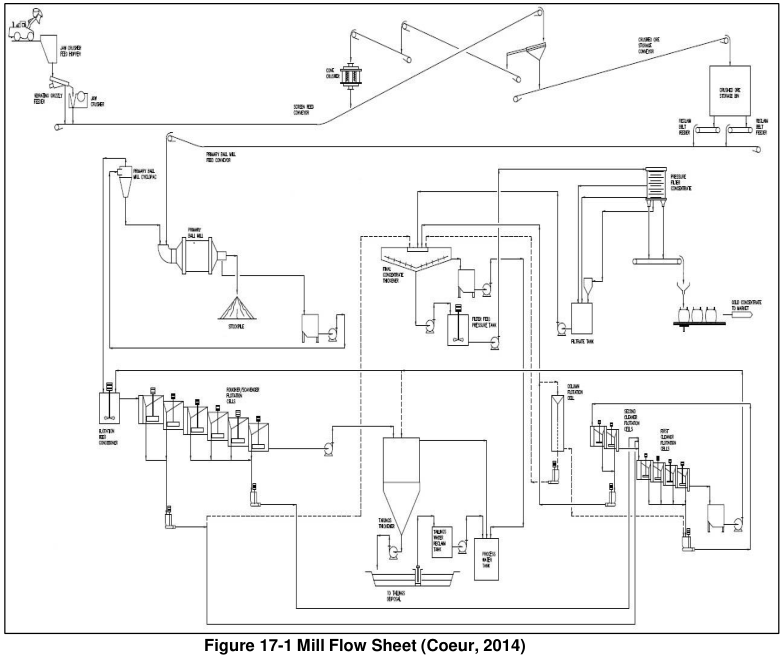
This report describes the flotation mill processing route used at the Kensington Mine in Southeast Alaska to recover gold from sulfide-bearing ore.
Report context
The Kensington Mine NI 43-101 Technical Report – Updated Project Study is dated April 25, 2018, and covers the Kensington Mine located in Southeast Alaska, U.S.A. The report presents the recovery methods, infrastructure, and processing facilities that support operations at the mine.
Processing route
Crushing
After blending based on grade, ore is fed to the crushing plant using a vibratory feeder. First stage crushing is achieved using a jaw crusher to reduce ore size to minus 4 inches. The primary crusher product is fed to a vibrating double deck screen. Until mid-2012, the lower screen deck separated material at minus 0.375 inch. In mid-2012, the lower screen deck was changed to 0.75-inch opening, and then a mixture of 1-inch and 1.5-inch openings since 2014. This allows higher throughput by reducing circulating load in the crushing circuit. The oversize screen product is conveyed to a cone crusher, set at 0.75 inch. The secondary crusher product returns to the screen deck. Undersize screen product is fed to the mill. Mill feed is stored in a 1,100-ton capacity fine ore bin.
Grinding
Ore from the fine ore bin is fed to the primary ball mill by a conveyor belt. Grinding is accomplished using a 19.8-feet-long × 11.1-feet diameter ball mill equipped with a 1,250 HP motor. Ball mill discharge is fed to one of two 20-inch cyclones. The cyclone overflow, P80 of 210 µm, is fed to the flotation circuit, while the underflow is returned to the ball mill.
Flotation
Primary flotation is conducted in a circuit comprised of two rougher cells and four scavenger cells. Until late 2011, all the concentrate produced in the primary circuit was sent to an 11.5-feet-long × 7.2-feet diameter regrind mill, targeting a grind size P80 of 38 µm, before being introduced to the cleaning circuit. This secondary grinding step was eliminated to prevent losses due to overgrinding and sliming of target minerals. Rougher flotation product is either sent directly to the concentrate thickener or to the cleaner circuit. Scavenger product is sent directly to the cleaner circuit, which consists of four primary cleaner cells and two secondary re-cleaner cells.
The processing arrangement is a modified rougher/scavenger and cleaner/re-cleaner configuration. Reagent addition points were altered to give the telluride mineral (calaverite) priority in rougher flotation, and then allow for flotation of the bulk sulfides – a selective flotation strategy. The discrete calaverite particles can be floated first, followed by those existing as rinds and inclusions with pyrite.
Dewatering
Final cleaner concentrates report to a concentrate thickener, the underflow of which supplies a filter feed tank. The concentrate thickener overflow returns to the process water system. The filter feed tank contents are pumped to a Larox filter press for dewatering. Dried filter cake from the Larox is weighed into 2-ton FIBCs for shipment to smelters. Filtrate water returns to the process water system.
Tailings
Tailings from the scavenger cells are mixed with flocculent and sent to a 29.5-feet diameter high rate thickener. The underflow is then sent to either the tailings impound dam, or underground to the paste backfill plant. The overflow returns to the process water system. Stage 2 of the TTF dam was completed in 2012. Total available tailings storage for Stage 2 is approximately 60,000,000 ft³. As of December 2017, it is estimated that approximately 55,300,000 ft³ had been placed. Stage 3 construction of the TTF dam will begin in the spring of 2018 and will be complete by the end of 2018. The ultimate tailings storage capacity is 125,000,000 ft³.
Ore Sorting
In late September 2015, Kensington commissioned a TOMRA COM Tertiary XRT 1200 ore sorter. This device uses XRT to identify pockets of high density mineral (pyrite in this case) on, or in the bulk of, the lower density quartz and diorite being fed to it across the sorter conveyor belt. The software identifies, targets, and tracks the rocks containing mineral, then uses one or more jets of air to alter an individual rock's trajectory at the discharge of the sorter's conveyor belt. Waste goes onto a conveyor belt to be stockpiled separately and the ore onto another conveyor belt to be recycled back to the process. Ore pebbles are fed back through the milling process at an average grade of 0.247 opt Au (24% higher than LOM feed grade). Through 2017, 167,612 tons of pebbles had been sorted, yielding 13,607 tons of ore containing 3,374 ounces of gold. During normal operation, the average processing rate is 52 tons per hour. Test work for incorporation of ore sorting technology into the crushing circuit is in progress.
Product/Materials Handling
Flotation concentrates are thickened and filtered to approximately 10% moisture. Concentrate is loaded into FIBCs; 12 FIBCs are loaded into each 20-foot sea container. Storage space at the mill is limited, so tractor trailer trucks are used to haul sea containers of concentrate product to a staging area at the Kensington port. The containers are staged until the desired lot size is achieved, at which time, a barge takes the lot to Seattle, and a container ship delivers the product to the overseas smelter.
Tailings are pumped 3.5 miles to the tailings impoundment or are pumped underground to the paste plant to create backfill. The paste plant uses a disc filter to decrease the moisture to 20% before the filter cake is mixed with binder and the resulting slurry is pumped to the appropriate stope. Water removed by the disc filter is sent back to the mill as recycled water.
Supernatant water at the tailings impoundment is sent to the Tailings Treatment Facility (TTF) for processing. Ferric chloride and flocculent are added to water to remove fine suspended solids particles. Flocculated solids are settled using a sand ballasted clarifier; settled solids are filter pressed and returned underground. Potassium permanganate is added to oxidize the soluble divalent manganese to insoluble tetravalent manganese. This oxidation is aided using a pyrolusite filter media, which catalyzes the reaction and eliminates any residual permanganate. Final polishing filtration is done using granular activated carbon. The plant discharges into Slate Creek via pipeline.
Key reported parameters
| Parameter | Value | Basis |
|---|---|---|
| Original design capacity | 1,250 tpd (52 tph) | Design |
| Mill throughput (2012) | 69 tph (maximum) | Historical operating data |
| Mill throughput (post-modifications) | 84 tph | Historical operating data |
| Mill throughput (average achieved) | 149% of design | Historical operating data |
| Mill throughput (peak achieved) | 160% above design | Historical operating data |
| Ball mill dimensions | 19.8 ft × 11.1 ft diameter | Design |
| Ball mill motor | 1,250 HP | Design |
| Cyclone overflow P80 | 210 µm | Design |
| Regrind mill target (historical) | P80 of 38 µm | Historical operating data (discontinued late 2011) |
| Regrind mill dimensions (historical) | 11.5 ft × 7.2 ft diameter | Historical operating data (discontinued late 2011) |
| Flotation recovery | Approximately 96% | Testwork / operating data |
| Overall recovery | 95% | Testwork / operating data |
| Concentrate moisture (after filtration) | Approximately 10% | Design |
| Fine ore bin capacity | 1,100 tons | Design |
| High rate thickener diameter | 29.5 ft | Design |
| Mill power requirement | 1.5 to 2.0 MW | Operating data |
| Mill total water requirement | Approximately 1,600 gpm | Operating data |
| Fresh water available for mill use | Up to 520 gpm | Permit limitation |
| Ore sorter average processing rate | 52 tph | Operating data |
| Ore sorter pebble feed grade | 0.247 opt Au | Operating data |
| Ore sorter throughput (2012-2017) | 167,612 tons pebbles sorted; 13,607 tons ore produced | Historical operating data |
| Gold recovered via ore sorting (2012-2017) | 3,374 ounces | Historical operating data |
| Tailings storage – Stage 2 capacity | 60,000,000 ft³ | Design |
| Tailings storage – Stage 2 fill (Dec 2017) | 55,300,000 ft³ | Historical operating data |
| Tailings storage – ultimate capacity | 125,000,000 ft³ | Design |
Project website: https://www.coeur.com/operations-projects/kensington-ak/default.aspx
Technical qualifications
The report states that the Qualified Person reviewed the information provided by Kensington and considers that there are no data or assumptions in the Life of Mine (LOM) plan that are significantly different from previous plant operating experience, previous production throughputs and recoveries, or the Project background history. The report notes that the mill requires approximately 1.5 to 2.0 MW of power to operate at full capacity and that there is no expectation for this power demand to increase. The report also indicates that the QP considers the current process facilities appropriate to the mineralization types provided from the mine, and that the flow sheet, equipment, and infrastructure are expected to support the current LOM plan.
Source: Kensington Mine, Southeast Alaska, U.S.A., NI 43-101 Technical Report, April 25, 2018.
