

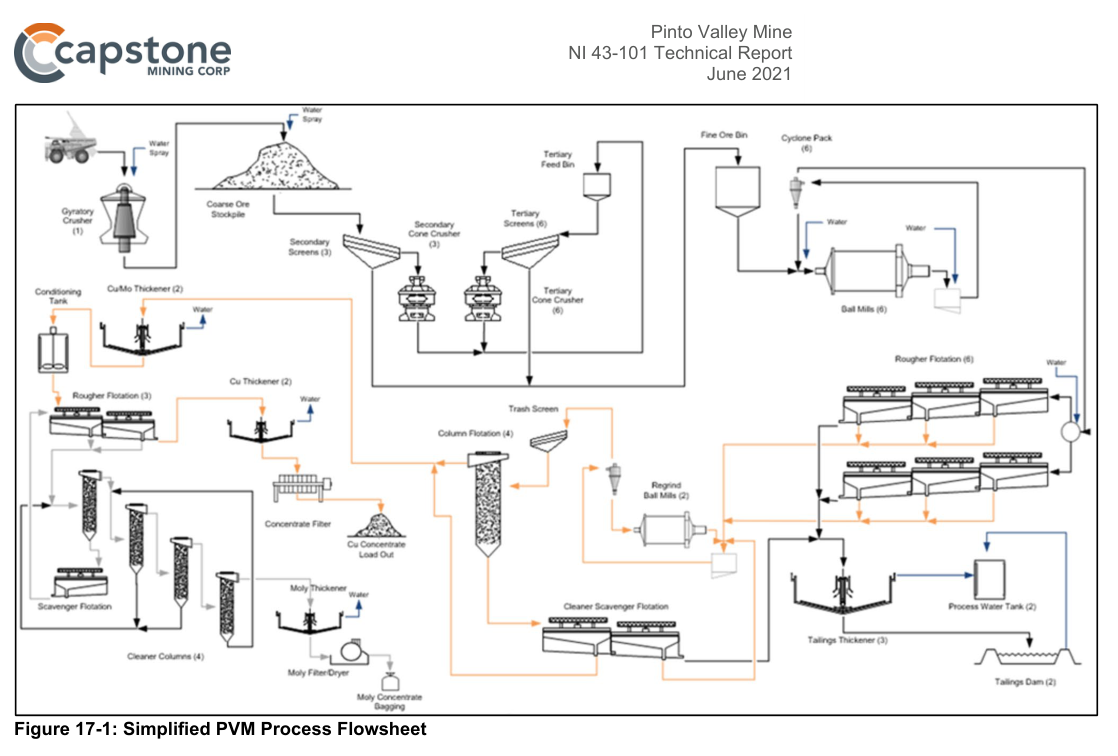
This report presents the process design criteria, operating history, and proposed upgrades for the Pinto Valley Mine concentrator, which has a current base case capacity of 56,000 tonnes per day.
Report context
The Pinto Valley Mine (PVM) NI 43-101 Technical Report is dated June 2021. The concentrator was originally built in 1973 with a nameplate capacity of 36,287 tonnes per day (40,000 short tons per day). Through continuous improvements, the plant achieved a 56,000 tonnes per day base case capacity at the time of reporting. The plant is designed to treat porphyry copper ore with minor molybdenum, targeting chalcopyrite and molybdenite as the main minerals of interest, with by-product precious metals including gold and silver.
Processing route
Crushing
Run-of-mine ore is delivered by haul truck to a Fuller Traylor 60 inch by 89 inch gyratory primary crusher. The crushed ore is withdrawn from a surge pocket by an apron feeder and transported to the coarse ore stockpile, which has a nominal live capacity of 27,215 tonnes (30,000 tons). Based on digital size analysis, the P80 of the primary crusher discharge is approximately 88.9 mm, with 32% passing 12 mm.
Fine crushing uses secondary and tertiary crushers. Ore is reclaimed from the coarse ore stockpile by six apron feeders feeding three coarse ore reclaim belts. Each belt discharges onto an 8 by 20 ft Ludowici double-deck vibrating screen. Oversize from two screens reports to two secondary 7 ft Nordberg standard cone crushers, and one screen feeds a new Raptor 900 standard cone crusher (a proposed upgrade in progress at the time of reporting, with completion expected in 2021). The secondary crushers operate in open circuit. Tertiary crushing uses six 7 ft Nordberg shorthead cone crushers in closed circuit. At the current plant throughput, the P80 of the fine crushing plant product is approximately 11 mm.
Grinding
Fine ore from the fine ore bin is fed to six 18 ft by 21 ft, 2,983 kW (4,000 hp) Allis-Chalmers overflow ball mills. Each mill operates as an independent circuit with a discharge sump, pump, and cyclone cluster of three 838 mm inclined cyclones. The ball mills operate in closed circuit with cyclones, with a circulating load estimated at 400%. Xanthate (SIPX), dithiophosphate (DAP), diesel, and lime are added in the grinding circuit to prepare the slurry for flotation at a pH target of 10.
Flotation
The flotation circuit operates as a bulk copper and molybdenum flotation process, followed by differential flotation to produce separate concentrates. The rougher flotation circuit consists of 65 28.3 m³ (1,000 ft³) Wemco cells configured into three banks. Rougher tailings report directly to final tailings. Rougher concentrate is delivered to the regrind circuit, which consists of two 11 by 15 ft regrind ball mills driven by 373 kW (500 hp) synchronous motors. The target product for regrind cyclone overflow is P80 of 50 μm.
The cleaner circuit uses four 2.4 m diameter by 12.2 m tall column flotation cells operated in parallel. The column cell concentrate, the final copper-molybdenum bulk concentrate, contains 24% to 29% Cu and 0.35% to 0.7% Mo. Column cell tails are sent to a cleaner scavenger bank of 15 8.5 m³ (300 ft³) Wemco flotation cells.
The molybdenum plant comprises four banks of Agitair rougher cells of six 1.4 m³ (50 ft³) cells each and four stages of cleaning using column cells. Sodium hydrosulfide is added for depression of copper and iron sulfides, and diesel is added as a molybdenum promoter.
Concentrate dewatering
The molybdenum rougher tailing becomes the final copper concentrate, reporting to one of two 27.4 m (90 ft) copper thickeners. The final copper concentrate is thickened to 60% solids and filtered in an Eimco plate and frame pressure filter. The final molybdenum product is thickened in a 7.9 m (26 ft) molybdenum thickener, filtered on a disk filter, dried in a rotary dryer, and bagged for shipment.
Tailings thickening and disposal
Tailings from the three rougher banks and the cleaner scavenger bank are combined and feed three 106 m diameter (350 ft) tailings thickeners. TSF4 is the primary tailings storage facility, with TSF3 used only for initial start-up and emergencies.
Process water
Water sources include the Cottonwood Reservoir, the Mine Reservoir, and the Peak Well system. Supplemental process water is pumped from BHP Copper's Copper Cities Unit Diamond H pit under a Water Supply Agreement effective until October 2025. The report states that PVM maintains a site water balance indicating that existing water sources will be sufficient to execute the life-of-mine plan, though periods of severe drought could limit processing at planned throughput rates.
SX-EW plant
The SX-EW plant was built and commissioned in 1981 to process solutions from leach grade material on run-of-mine leach dumps north of the pit. Through 1998, approximately 450 million tonnes of 0.13% Cu material had been placed on the leach dumps, resulting in peak production of 10 to 15 million pounds of cathode copper per year in the early 2000s. Over the last few years before the report, the SX-EW produced in the range of 3 to 5 million pounds of cathode per year. A moderate quantity of fresh material was placed on the leach pad in 2020.
Proposed plant optimization
The report describes improvements implemented since Capstone acquired PVM, including minor expansions to both the copper and molybdenum flotation circuits and a new filter plant installed in 2006. The most recent major upgrades (2020) focused on the fine crushing plant and include: replacement of a secondary 7 ft diameter Symons crusher with a Raptor 9000 (in progress with completion expected in 2021), representing a change in installed power from 373 kW to 671 kW; replacement of 7 by 16 ft Simplicity double deck screens to 8 by 20 ft Ludowici Banana Double Deck Screens for secondary crushers; replacement of 8 by 20 ft Simplicity double deck screens to 8 by 20 ft Ludowici Banana Double Deck Screens for tertiary crushers; and ball mill shell replacements, with one shell replacement completed in 2020 and a second scheduled for 2021.
Other improvements include improved blast fragmentation, flotation level control upgrades, operator training, and flotation circuit adjustments including flowsheet and reagent optimization. The report notes that the molybdenum circuit was being optimized with a new reagent suite to potentially eliminate the use of NaHS.
Testwork and studies
The report references several studies and testwork programs. Pilot plant testing of coarse particle flotation technology by Eriez Flotation Division suggested a 6 to 8% increase to overall copper recovery is achievable (Capstone, 2021), with investigation continuing into other possible benefits such as lower grinding costs and reductions to specific water and specific energy use. A review of potential opportunities to enhance dump leach performance was underway, with proof of concept demonstrated in a test application of patented catalytic technology from Jetti Resources to an existing dump leach. An investigation into recovering additional minerals from copper circuit cleaner tailings (Pyrite Agglomeration) was initiated, with the material to be leached in conjunction with dump leach material.
Recommendations
The report includes recommendations for plant upgrades: upgrade the level control system for the rougher flotation circuit (estimated cost $200,000, six months); upgrade the reagent dosing system (estimated cost $150,000, three months); upgrade the rougher concentrate pumps (estimated cost $250,000, six to nine months); and upgrade the tailings thickeners to more efficient units (estimated cost $5 to $7 million, completion expected July 2021).
Key reported parameters
| Parameter | Value | Basis |
|---|---|---|
| Concentrator throughput (base case) | 56,000 tpd | Design |
| Original nameplate capacity | 36,287 tpd (40,000 stpd) | Historical design |
| Primary crusher availability (2020 average) | 86% | Historical operating data |
| Primary crusher feed rate | Up to 4,300 tph | Operating data |
| Primary crusher product P80 | 61.9 mm | Typical operating data |
| Secondary/tertiary crusher availability (2020 average) | 83% | Historical operating data |
| Secondary/tertiary crusher feed rate | Up to 2,900 tph | Operating data |
| Fine crushing plant product P80 | 10.9 mm | Typical operating data |
| Grinding circuit availability (2020 average) | 93% | Historical operating data |
| Work index | 14.5 kWh/t | Nominal |
| Cyclone overflow P80 | 330 μm | Typical operating data |
| Cyclone overflow density | 37% solids | Target |
| Rougher flotation feed density | 35% solids | Target |
| Rougher flotation residence time | 17 minutes | Nominal |
| Rougher mass pull | 5-8% | Target |
| Rougher concentrate grade | 4-6% Cu | Typical operating data |
| Rougher recovery | 88-90% | Typical operating data |
| Cleaner concentrate grade (2020 average) | 25% Cu | Historical operating data |
| Final copper recovery (2020 average) | 85% | Historical operating data |
| Copper concentrate filtration availability (2020 average) | 93% | Historical operating data |
| Copper concentrate filtration throughput (2020 average) | 580 tpd dry concentrate | Historical operating data |
| Copper concentrate moisture | Less than 10% | Typical operating data |
| Final tailings thickening throughput (2020 average) | 2,400 tpd | Historical operating data |
| Tailings thickener underflow solids (2020 average) | 55% solids | Historical operating data |
| Overall water recovery | 60% | Operating data |
| Water reuse | 93% | Operating data |
| Coarse ore stockpile live capacity | 27,215 tonnes (30,000 tons) | Design |
| Fine ore bin live capacity | 40,000 tonnes (44,000 tons) | Design |
| Ball mill installed power (each) | 2,983 kW (4,000 hp) | Design |
| Ball mill dimensions (each) | 18 ft x 21 ft | Design |
| Number of ball mills | 6 | Design |
| Regrind mill installed power (each) | 373 kW (500 hp) | Design |
| Regrind cyclone overflow target P80 | 50 μm | Target |
| Regrind circuit configuration | Reverse configuration | Design |
| Bulk cleaner concentrate grade | 24-29% Cu, 0.35-0.7% Mo | Typical operating data |
| SX-EW cathode production (recent years) | 3-5 M lb/year | Historical operating data |
| SX-EW peak production (early 2000s) | 10-15 M lb/year | Historical operating data |
| Leach dump material placed through 1998 | ~450 M tonnes at 0.13% Cu | Historical |
Project website: https://capstonecopper.com/operations/pinto-valley/
Technical qualifications
The report identifies key risks to plant operation, including that the plant was originally built in 1973 and much of the original equipment remains in service. Although a systematic program of replacements and upgrades has been undertaken, unforeseen failures may occur given the age of equipment. The report also notes that insufficient water supply for prolonged periods could affect processing capability, and future water sources may not be available at suitable cost. The water supply agreement with BHP Copper is effective only until October 2025 and is subject to water availability and BHP Copper's own requirements.
Source: Pinto Valley Mine NI 43-101 Technical Report, June 2021, Sections 17 Recovery Methods.
