

Kinross's March 2026 technical report on the Paracatu mine in Minas Gerais, Brazil, effective December 31, 2025, describes Plant I (1987), Plant II (2008), and tailings reprocessing since 2015.
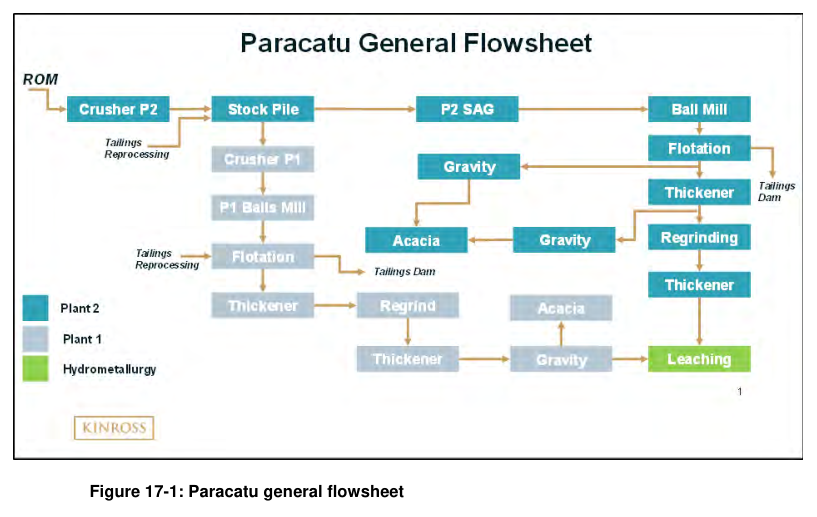
The Paracatu Mine, State of Minas Gerais, Brazil, NI 43-101 Technical Report was prepared by Kinross Gold Corporation with an effective date of December 31, 2025 and a report date of March 26, 2026. Paracatu has two main processing plants, Plant I since 1987 and Plant II since 2008, and a hydrometallurgical facility that recovers gold from their flotation and gravity concentrates. Tailings have also been reprocessed through the PSAT and PET projects since 2015. The combined flowsheet runs crushing, grinding, classification, flotation, gravity concentration, cyanidation by carbon-in-leach (CIL), elution and electrowinning.
Critical Data
| Parameter | Value | Unit | Notes |
|---|---|---|---|
| Report effective date | December 31, 2025 | Not applicable | Kinross Gold Corporation; report date March 26, 2026 |
| In-pit crusher | MMD 1300 twin-shaft sizer | Not applicable | 1,300 mm feed to nominal 350 mm |
| Overland conveyor | 1.8 | km | To the covered stockpile |
| Stockpile | 45,000 t live, up to 282,000 t | Not applicable | Six variable-speed reclaim feeders |
| Plant I grind | P80 below 160 | µm | Four 15 x 19 ft primary ball mills (3,500 kW each) |
| Plant II design rate | 5,100 | t/h | 92% availability |
| Plant II SAG mill | 11.6 x 6.7 m, 20,000 kW | Not applicable | Trommel and vibrating screen |
| Plant II ball mills | 2 x 7.3 x 12.2 m and 2 x 7.9 x 12.8 m | Not applicable | Overflow P80 190 µm |
| Concentrate regrind | About 90% passing 45 | µm | Vertical mill |
| Hydromet leach | Two 707 m³ pre-aeration tanks, seven CIL tanks | Not applicable | Concentrate at 45 to 52% solids |
Overview
The primary crusher sits in the open pit. Trucks tip into a 480 t dump hopper, and an apron feeder feeds an MMD twin-shaft sizer that crushes rock from up to 1,300 mm to a nominal 350 mm. A sacrificial conveyor transfers it to the 1.8 km overland conveyor, which ends at a covered A-frame stockpile holding 45,000 t live, or up to 282,000 t when dozers push ore to its edges.
Both plants grind and float the ore and recover part of the gold by gravity. Their concentrates go to hydrometallurgy for leaching, carbon adsorption, elution and electrowinning.
Key Process Stages
Plant I crushing. Four parallel lines, normally three running and one in maintenance, are loaded from the Plant II stockpile. Each line has a primary screen, an impact crusher, a secondary screen and a cone crusher, producing P80 below 10 mm. The lines also crush pebbles from Plant II's SAG mill.
Plant I grinding and flotation. Crushed ore is blended in silos and fed to four 15 by 19 ft primary ball mills of 3,500 kW, closed with hydrocyclones, giving overflow at P80 below 160 µm and 32 to 37% solids. A secondary 15 by 19 ft ball mill takes about 35% of the primary underflow, and 13% of its cyclone underflow goes to gravity. A 1,000 kW rod mill handles mill oversize. Rougher flotation runs at 30 to 35% solids and pH 6.0 to 8.0, one circuit per grinding line. Cleaner flotation runs at 20 to 25% solids, and its concentrate goes to the Hydro II plant.
Plant II grinding. A 20 MW SAG mill (11.6 by 6.7 m) produces slurry at 70 to 74% solids, with pebbles returned to the SAG mill or sent to Plant I crushing. Four ball mills grind it to P80 190 µm at 35% solids: two 7.3 by 12.2 m mills and two 7.9 by 12.8 m mills, added in 2011 and 2012. About 13% of the ball mill circulating load feeds four Knelson QS70 concentrators.
Plant II flotation and gravity. Four rougher lines of six cells each produce the rougher concentrate. The first rougher bank's concentrate goes to three Knelson QS48 concentrators, and the rest goes to two cleaner lines of five cells each. Rougher tails go to the tailings storage facility.
Concentrate thickening and regrind. A dewatering thickener removes flotation reagent solution. A vertical mill then regrinds the concentrate to about 90% passing 45 µm, closed with a ten-cyclone cluster whose underflow passes a Knelson concentrator. Cyclone overflow goes to the final concentrate thickener.
Hydrometallurgy. Concentrate at 45 to 52% solids, with less than 10% retained on 45 µm, is sampled every 20 minutes. It passes two 707 m³ pre-aeration tanks: oxygen at about pH 8 in the first to oxidize sulphides, then lime and oxygen at pH 9.8 to 10.5 in the second to prevent hydrogen cyanide formation and oxidize cyanide consumers such as iron, copper, zinc, lead and sulphur. Seven CIL tanks follow, then elution and electrowinning.
Additional Interesting Data and Summary
Plant II, built in the Paracatu Expansion III project, started with the in-pit sizer, the overland conveyor, the covered stockpile, the 20 MW SAG mill and two 13 MW ball mills. A third 15 MW ball mill was added in June 2011 and a fourth in August 2012. The grinding bay has a 100 t overhead crane with a 25 t auxiliary hoist.
In summary, Paracatu is a very large, low-grade operation that grinds coarse (P80 160 to 190 µm), concentrates the gold by flotation and gravity, then regrinds and leaches only the concentrate, using two plants of very different vintage and a common CIL facility.
Key Processes
- In-pit twin-shaft sizer and 1.8 km overland conveyor
- Plant I: impact and cone crushing, ball milling, rougher and cleaner flotation
- Plant II: 20 MW SAG and four ball mills to P80 190 µm
- Knelson gravity concentration on mill circulating load and rougher concentrate
- Rougher and cleaner flotation
- Concentrate thickening and vertical-mill regrind to 45 µm
- Oxygen pre-aeration and CIL of concentrate
- Elution and electrowinning
Source: Paracatu Mine, State of Minas Gerais, Brazil, NI 43-101 Technical Report, Kinross Gold Corporation, effective date December 31, 2025.
Consolidated report summaries
The following former standalone pages about this operation were consolidated here on October 25, 2026. They are retained for source traceability; dates and figures reflect each report’s own effective date and may be superseded by the current information above.
Paracatu Project — 2020 Technical Report
The Paracatu Project operates two processing plants and tailings reprocessing circuits, with infrastructure designed to support a 61 Mt/a operation in Brazil.
Report context
This technical report for the Paracatu Project, dated 2020, describes the processing facilities and recovery methods at the operation in Brazil. The site includes Plant I, operating continuously since 1987, and Plant II, in operation since 2008. Tailings reprocessing commenced in 2015.
Processing route
Plant I
Plant I has operated continuously since 1987 with expansion upgrades in 1997 and 1999. In 2018, the plant processed 8.25 Mt at a Bond Work Index (BWI) of approximately 13.9 kWh/t.
Crushing. The crushing circuit consists of four independent parallel operating lines (A, B, C and D). Each line comprises a primary screen (Metso 8 ft x 20 ft), a primary crusher (APSM Hazemag), a secondary screen (Metso 6 ft x 16 ft) and a secondary crusher (HP300). The lines are fed with front end loaders using material from the Plant II stockpile and pebbles from Plant II. The crushing circuit product has a P80 of 12 mm.
Grinding. The grinding circuit consists of four primary ball mills (4.5 m diameter by 5.7 m long effective grinding length, 1.8 MW gearless drives), one secondary ball mill (5 m diameter by 7.6 m long EGL, 3 MW drive) and one rod mill used to regrind the primary ball mill oversize. The ball mills operate in closed circuit with hydrocyclones (GMAX20). The grinding circuit is operated to produce a product with a particle size distribution with a P80 of 150 microns.
Flotation and regrind. The grinding circuit product (cyclone overflow) feeds the rougher flotation circuit consisting of Wemco cells (10 cells of 42.5 m³ each), Outokumpu cells (4 cells of 16.5 m³ each) and Smartcells (4 cells of 127 m³ each). A portion of the rougher concentrate is fed to a Knelson Concentrator (QS48). The cleaner flotation circuit (Outokumpu cells, 5 cells of 16.5 m³ in operation) receives concentrate from the rougher circuit. Cleaner tails are refed to the rougher flotation feed, while rougher tailings are discharged to the tailings dam.
Cleaner concentrate feeds a dewatering thickener, which subsequently feeds a regrinding circuit consisting of two ball mills (220 kW and 130 kW) operated in closed circuit with hydrocyclones. A portion of the cyclone underflow is treated by a Knelson concentrator (XD30). The regrinding circuit product at a P90 of 45 µm is directed to a dewatering thickener. Dewatered slurry is directed to the Hydro (CIL) circuit for further processing. Concentrates from the Knelson concentrator are processed in an Acacia intensive leaching system. Thickener overflow water returns to the Plant I grinding circuit.
Plant II
Plant II was developed as part of the Paracatu Expansion III Project. The plant consists of one in-pit crusher (MMD toothed roll type), a 1.8 km conveyor to a covered stockpile area, one 20 MW semi-autogenous grinding (SAG) mill and two 13 MW ball mills. A third ball mill (15 MW) was installed in June 2011, and a fourth ball mill (15 MW) was installed in August 2012. In 2018, the plant processed 35.4 Mt of run-of-mine material at a BWI of approximately 13.9 kWh/t.
Crushing and stockpile. The primary crusher is located in the open pit. ROM ore is delivered by haul trucks to the 480 t crusher dump hopper. An apron feeder withdraws ROM ore from the dump hopper and feeds an MMD 1300 Series Twin Shaft Sizer. The MMD sizer crushes rock from a maximum size of 1,300 mm to a nominal size of 350 mm and discharges onto a sacrificial conveyor, which in turn discharges onto the 1.8 km overland conveyor. A stationary hydraulic rock breaker at the MMD sizer feed chamber breaks oversize rock. The MMD sizer can be removed to a maintenance position using a winch and slide rails.
Crushed ore is sent to a covered ore stockpile with a rectangular A frame. Ore is delivered to the stockpile by a tripper conveyor. The stockpile provides 45,000 t of live volume, and the volume can reach 282,000 t when dozers push ore to its borders. The reclaim tunnel has six variable speed belt feeders, a bag house, dust collector and escape tunnel.
Grinding. The Plant II grinding circuit consists of one SAG mill (11.6 m diameter by 6.7 m long EGL, 20 MW gearless drive), two ball mills (7.3 m diameter by 12.0 m long EGL, 13 MW drive) and two ball mills (8 m diameter by 12.8 m long EGL, 15 MW drive). The ball mills are equipped with dual pinion gear drives. The SAG mill operates in open/closed circuit with a trommel screen and vibrating screen. Pebbles have the option to be fed to Plant I (open circuit) or back to the SAG (closed circuit). Oversize rejects from the SAG mill are transferred to the SAG mill feed conveyor by three pebble conveyors in series when operated in closed circuit. When operating in open circuit, the oversize rejects are transferred by conveyor to the Plant I crushing circuit.
SAG mill discharge screen undersize and trommel screen undersize flow to a pump box, from which they are pumped to the ball mill circuits. Each ball mill operates in closed circuit with a set of hydrocyclones. The grinding circuit is operated to obtain a nominal flotation feed particle size distribution with a P80 of 150 µm. Cyclone overflow reports to the flotation circuit, while underflow reports back to the ball mill.
Flotation, gravity and regrinding. The flotation rougher circuit receives fresh feed plus circulating load from cleaner flotation cells. The rougher circuit consists of 24 rougher flotation cells arranged in four rows of six cells each, fed by cyclone overflow from the grinding circuit. The cells are 160 m³ tanks fitted with self-aspirating mechanisms. Reagents (collectors and frother) are supplied from reagent tanks to head tanks in the grinding circuit, with metering pumps adding reagents to the grinding hydrocyclone overflow launder.
First rougher concentrate is processed by three Knelson concentrators (QS48). The rougher concentrate is treated in a cleaner circuit consisting of two rows of five self-aspirated 60 m³ tank cells. Cleaner tailings flow to a pump box and are pumped to the rougher flotation feed distribution box. Cleaner concentrate is collected in a single pump box and pumped to the dewatering thickener. Water from thickener overflow returns to the ball mill discharge boxes. Dewatered concentrate is fed to a vertimill (13.5 m high, 931 kW vertical stirred type) where it is ground to 90% passing 45 microns. The mill operates in closed circuit with ten 254 mm diameter hydrocyclones (GMAX26). A Knelson concentrator (Model XD40) treats the circulating load (underflow) of the vertimill. The vertimill product (hydrocyclone overflow) reports to the dewatering thickener. Dewatered slurry is directed to the Hydro circuit for further processing. Gravity concentrates are transported to the Hydro (CIL) Plant for further processing in an Acacia reactor.
Hydro (CIL) circuit
Hydro receives flotation concentrate from Plant I and Plant II. The typical concentrate gold grade is 10-15 g/t and total sulfur content is 20-25%. The concentrate is fed to an agitated pre-aeration tank where lime is added to adjust pH to approximately 10.5. Pre-aeration residence time is approximately four hours, and CIL residence time is 30-40 hours. The CIL circuit consists of eight tanks with a volume of 750 m³ each.
Oxygen is injected into the pre-aeration tank using a fillblast system to increase the dissolved oxygen concentration to approximately 9-10 mg/L. The slurry flows by gravity through an eight-stage CIL circuit. Cyanide is added into the first CIL tank and adjusted to a concentration of approximately 700-750 mg/L NaCN. The cyanide concentration decreases down the CIL circuit, reaching 150-200 mg/L NaCN in the final tank. The leached slurry passes from CIL 8 into two cyanide treatment tanks (250 m³ each). Tailings slurry is treated for cyanide destruction in an agitated tank using ammonium bisulfite and oxygen.
Carbon elution and regeneration. Loaded carbon is transferred out of CIL twice daily. The loaded carbon is screened and flows by gravity to an acid washing column. Carbon is treated with 5% hydrochloric acid for four hours to remove calcium carbonate deposits and other inorganic contaminants. Spent acid is neutralized with sodium hydroxide before discarding to the tails pump box. From the acid wash vessel (1 column, 14 t capacity, 36 m³), carbon is pumped to the elution columns (2 columns, 14 t capacity, 36 m³). The elution cycle operates with a 0.2% sodium cyanide and 2-3% sodium hydroxide solution at 140°C and 300 kPa for approximately eight hours. After elution, carbon is pumped to the regeneration kilns. Two electrically powered kilns with 600 kg/h capacity each regenerate carbon at 700°C. Regenerated carbon is screened to remove fines before being reintroduced to the CIL circuit.
Intensive cyanidation. Gravity concentrates from the Plant I and Plant II gravity circuits are treated by intensive cyanidation. Plant I gravity concentrate is treated in an Acacia CS2000, while Plant II concentrate is treated in an Acacia CS8000. The pregnant leach solution from the Acacia systems is pumped to the electrowinning circuit. The solids residue from the Acacia system is sampled and pumped to the CIL circuit.
Electrowinning and refining. Pregnant solution from elution is combined with solution from the gravity circuit and is pumped to four electrowinning cells (Summit Valley Model 125 EC33, 3.5 m³ each, sludging cathode type). Periodically, cathodes are cleaned using a high-pressure washer, and gold-bearing sludge is recovered by a filter press. The resulting filter cake is dried, mixed with fluxes (borax, soda ash and occasionally sodium nitrate) and fed to electric induction furnaces. Doré metal and slag separate in the furnace, and the slag is poured off into slag pots. The doré metal is then poured into bars.
Tailings reprocessing (PSAT and PET projects)
In August 2015, Paracatu began the PSAT project, and in mid-2017, the Eustáquio Tailings (PET) project commenced. These projects target gold that has segregated naturally in the tailings basins. Coarser material from PSAT and PET is excavated and hauled by truck to the Plant II stockpile, where the tailings are comingled with ROM to feed the SAG mill. Finer material from PSAT is hydraulically mined using a high-pressure water jet and pumped to the Plant I flotation circuit.
Key reported parameters
| Parameter | Unit | Value | Basis |
|---|---|---|---|
| Site design capacity | Mt/a | 61 | Infrastructure design |
| Plant I 2018 throughput | Mt | 8.25 | Historical operating data |
| Plant II 2018 throughput | Mt | 35.4 | Historical operating data |
| Plant I Bond Work Index | kWh/t | ~13.9 | Historical operating data |
| Plant II Bond Work Index | kWh/t | ~13.9 | Historical operating data |
| Plant I crushing product P80 | mm | 12 | Design specification |
| Plant I grinding product P80 | µm | 150 | Design specification |
| Plant II grinding product P80 | µm | 150 | Design specification |
| Concentrate gold grade | g/t | 10-15 | Typical reported range |
| Concentrate total sulfur | % | 20-25 | Typical reported range |
| CIL residence time | hours | 30-40 | Design specification |
| Pre-aeration residence time | hours | ~4 | Design specification |
| CIL tank volume (each) | m³ | 750 | Design specification |
| NaCN concentration (first CIL tank) | mg/L | 700-750 | Design specification |
| NaCN concentration (final CIL tank) | mg/L | 150-200 | Design specification |
| PSAT cumulative production (2015-2019) | |||
| – Feed | t | 35,958 | Historical operating data |
| – Grade | g/t | 0.344 | Historical operating data |
| – Recovery | % | 66.01 | Historical operating data |
| – Ounces | oz | 268,371 | Historical operating data |
| PET cumulative production (2015-2017) | |||
| – Feed | t | 5,668 | Historical operating data |
| – Grade | g/t | 0.438 | Historical operating data |
| – Recovery | % | Not available | Historical operating data |
| – Ounces | oz | Not available | Historical operating data |
Project website: https://www.kinross.com/news-and-investors/news-releases/press-release-details/2020/Kinross-files-new-Paracatu-technical-report/default.aspx
Technical qualifications
This article is based solely on the original technical report. The report does not provide information on capital or operating costs, economic analysis, mineral resource or reserve estimates, current ownership structure, or project status beyond the reported date. PET recovery and ounce data from 2018 onward are not reported separately and are counted towards overall circuit recovery.
Gold Recovery Methods at Kinross Paracatu Mine, Brazil
Gold Recovery Methods at Kinross Paracatu Mine, Brazil
Source: Kinross Gold Corporation (2026)
Website: https://www.kinross.com/operations/default.aspx
Critical Data
| Parameter | Value | Unit | Notes |
|---|---|---|---|
| Throughput | 5100 | tph | Plant II design capacity at 92% availability |
| Mill Power | 20000 | kW | SAG mill power |
| Target Grind Size | 190 | μm (P80) | Plant II secondary grinding target |
| Head Grade | Not provided in Section 17 | ||
| Recovery % | % | Not specified in Section 17 | |
| Processing Capacity | 5100 | tph | Plant II nominal throughput |
| Energy Consumption | kWh/t | Not provided in Section 17 | |
| Water Consumption | m³/t | Not provided in Section 17 | |
| Operating Hours | 24 | hours/day | Continuous operation with scheduled maintenance; 92% availability implies ~22 hr/day effective |
Overview
Kinross Gold Corporation operates the Paracatu Mine in Brazil, employing a sophisticated combination of two processing plants (Plant I since 1987 and Plant II since 2008) along with a hydrometallurgical facility for gold recovery. The operation also reprocesses tailings through the PSAT and PET projects initiated in 2015. Located in the state of Minas Gerais, Paracatu is one of the largest gold mines in South America. The significance of this operation lies in its ability to process refractory gold ore through an integrated flowsheet that includes crushing, grinding, classification, flotation, gravity concentration, and carbon-in-leach (CIL) cyanidation. The process begins with primary crushing using an MMD toothed sizer that reduces ROM ore from 1,300 mm to 350 mm, followed by stockpiling. Plant I uses conventional ball mills and flotation, while Plant II features a large 20 MW SAG mill and four ball mills totaling 28 MW. Gold recovery is enhanced by gravity concentration using Knelson concentrators and intensive leaching. The hydrometallurgical plant treats flotation concentrates through pre-aeration, CIL leaching with a residence time of 25 hours, and carbon elution at 140°C. Final gold recovery is achieved via electrowinning and smelting into doré bars. Environmental management includes ISO 14001 and 45001 certifications and compliance with the International Cyanide Management Code.
Key Process Stages
- Stage 1: ROM Crushing and Stockpiling – Ore from the open pit is dumped into a 480 t hopper and fed to an MMD 1300 Series Twin Shaft Sizer that reduces rock from 1,300 mm to 350 mm. Crushed ore is conveyed to a covered stockpile with 45,000 t live capacity (expandable to 282,000 t using dozers). Six variable-speed belt feeders reclaim ore from the tunnel.
- Stage 2: Grinding Circuit – Plant II uses a 11.6 m × 6.7 m SAG mill (20 MW) in closed circuit with trommel and vibrating screens to produce slurry at 70-74% solids. Pebbles are recycled or sent to Plant I. Secondary grinding uses four ball mills (two 7.3 m × 12.2 m at 2×6,500 kW and two 7.9 m × 12.8 m at 2×7,500 kW) in closed circuit with hydrocyclones targeting a P80 of 190 µm. Plant I uses six mills (four primary ball mills at 3,500 kW each, one secondary ball mill at 3,500 kW, and one rod mill at 1,000 kW) achieving P80 < 160 µm.
- Stage 3: Flotation and Gravity Concentration – Rougher flotation in four lines (six cells each) produces a gold-bearing concentrate. The first rougher concentrate feeds gravity concentration via Knelson concentrators (three QS48 units in Plant II). Cleaner flotation (two lines, five cells each) upgrades the concentrate, which is then thickened and reground in a vertical mill to 90% passing 45 µm. Gravity tailings return to the ball mill discharge or flotation feed.
- Stage 4: Hydrometallurgy – CIL Leaching – Flotation concentrate is pre-aerated in two tanks (707 m³ each) with oxygen and lime to adjust pH to 9.8-10.5. Seven CIL tanks (750 m³ each, 10 m diameter) operate with a total of 200 t of activated carbon and a residence time of approximately 25 hours. Cyanide concentration starts at 500-800 ppm and drops to 100-150 ppm in the last tank. Loaded carbon is recovered via interstage screens and transferred to acid wash and elution.
- Stage 5: Elution, Electrowinning, and Refining – Loaded carbon undergoes acid washing (3% HCl for 3 hours) then elution (0.2% NaCN, 2-3% NaOH at 140°C, 300 kPa for 10-12 hours) in two 36 m³ columns. The rich solution feeds electrowinning cells (four stainless-steel cathodes at 80-90°C). Gold sludge is calcined at 700°C for 12 hours, then smelted with fluxes at 1,200°C in an induction furnace to produce doré bars. Carbon is regenerated in two 600 kg/h rotary kilns at 700°C. Cyanide destruction via SO₂/O₂ (detox) ensures tailings discharge meets environmental limits.
Additional Interesting Data and Summary
The Paracatu Mine’s gold recovery methods integrate multiple unit operations tailored to the refractory nature of the ore. Plant I, operational since 1987, uses conventional ball milling and flotation with a target grind P80 of 160 µm, while Plant II, added in 2008 and expanded with two additional ball mills in 2011–2012, processes higher throughput with a SAG mill–ball mill configuration. The gravity circuit in Plant II processes approximately 13% of the ball mill circulating load using four Knelson QS70 concentrators, with additional Knelson QS48 units treating first-rougher concentrate. The hydrometallurgical plant handles both flotation and gravity concentrates via the Acacia reactors (CS2000 and CS8000, with capacities of 8 t/d and 32 t/d respectively) for intensive leaching prior to CIL. Key process parameters include pre-aeration pH of 9.8–10.5, CIL cyanide concentration from 500 to 150 ppm, and elution temperature of 140°C. The detox circuit uses the SO₂/O₂ method to destroy free and WAD cyanide before tailings disposal. Environmental stewardship is a priority: the site holds ISO 14001, ISO 45001, and International Cyanide Management Code certifications. Water quality management is critical due to naturally occurring arsenic and sulphides; the operation implements a Basic Intervention Plan that has reduced metal concentrations in local streams. Human Health Risk Assessments guide remediation efforts. The mine’s tailings reprocessing projects (PSAT and PET) since 2015 further enhance recovery and reduce environmental footprint. With a total installed grinding power exceeding 48 MW across both plants, Paracatu continues to optimize energy efficiency and gold recovery. Future outlook focuses on sustaining production through brownfield expansions, improving water recirculation, and maintaining regulatory compliance. The facility’s significance lies in its ability to consistently recover gold from low-grade, refractory ore, making it a benchmark for large-scale gold mining in South America.
Key Processes: Flotation, CIP/CIL, Cyanidation, Gravity Separation, SAG Mill, Ball Mill, Crushing
Target Commodities: Gold
