

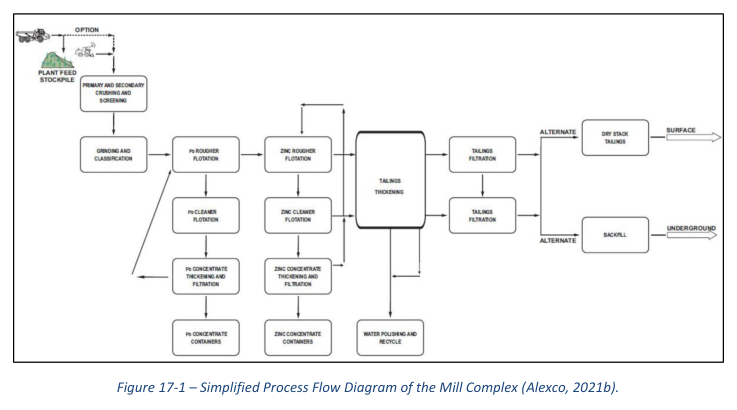
The 2024 technical report describes the Keno Hill Mine in Yukon, Canada, detailing a conventional sequential flotation process for a silver-lead-zinc orebody with a life-of-mine average throughput of 500 tpd.
Report context
This NI 43-101 technical report on the Keno Hill Mine, Yukon, Canada, covers the processing operations as described in the recovery methods section. The report presents current operating data, planned design criteria, and projections based on the approximately 11-year mine plan supporting the processing operations detailed for the Keno Hill District Mill.
Processing route
Mineralization and ore characteristics
The Keno Hill deposit is polymetallic silver-lead-zinc vein-type mineralization. Silver predominantly occurs in argentiferous galena and argentiferous tetrahedrite, with lesser native silver, and the silver-bearing minerals polybasite, stephanite, and pyrargyrite. Lead occurs in galena and zinc in sphalerite, either iron-rich or iron-poor varieties. Other sulfides identified include pyrite, pyrrhotite, arsenopyrite, and chalcopyrite. Common gangue minerals include siderite, quartz, and calcite in decreasing order of abundance.
Crushing and ore storage
The crushing system operates up to 12 hours per day at a process rate of 50 t/h. Run of mine ore is crushed in a two-stage crushing circuit closed with a vibrating screen, producing a final crushed product P80 of 12 mm. A stationary grizzly with 450 mm aperture opening prevents oversized ore from entering the primary jaw crusher. The crushed material is conveyed to a fine ore stockpile with 550 t live capacity, with reclaim achieved via a draw-down pocket.
Grinding circuit
Crushed ore is reclaimed onto the ball mill feed conveyor at a nominal rate of 18.1 t per operating hour. The primary grinding circuit consists of two-stage ball milling producing a ground material with P80 of 100 to 120 µm. The primary No.1 ball mill is a tire-driven type, 1,800 mm diameter and 3,600 mm long, with 150 kW installed power. The secondary ball mill was added to increase capacity. The Bond rod mill work index was found to be 12.4 kWh/t, while the Bond ball mill work index was measured as 10.20 kWh/t, both noticeably higher than the 2009 design of 8.7 kWh/t (RWi) and 9.5 kWh/t (BWi).
The two-stage ball mill grinding circuit is estimated to achieve 600 tpd based on a feed size F80 of 10 mm and an overall Bond Work index of 11.0 kWh/t. The ground product contains 80% passing 100 to 120 µm.
Lead flotation circuit
The lead flotation circuit produces a final silver concentrate through rougher flotation, rougher scavenger flotation, concentrate regrinding, followed by three stages of cleaner flotation. The regrind circuit uses a ball mill 1,050 mm in diameter and 1,400 mm long, powered by an 18-kW motor, operated in closed circuit with two 100 mm cyclones. The regrind particle size target is P80 of about 30 µm.
The 1st cleaner flotation stage consists of three 3 m³ conventional flotation cells with a total maximum residence time of 18 minutes. The 2nd cleaner flotation train has a total maximum residence time of 15 minutes. Blower air is injected into each cell mechanism.
Zinc flotation circuit
Zinc flotation processes the lead flotation tailings through rougher flotation, rougher scavenger flotation, rougher concentrate regrinding, followed by three stages of cleaner flotation. Prior to zinc flotation, the feed is conditioned with copper sulfide to activate depressed zinc minerals, and lime to suppress pyrite if required.
The zinc rougher feed slurry at 29% solids flows into the first of four 8 m³ rougher flotation tank cells with a total residence time of 40 minutes. Test work has indicated a maximum residence time of 30 minutes is adequate for zinc sulfide flotation. The zinc rougher concentrate is reground in a ball mill 1,050 mm in diameter and 1,400 mm long with 18 kW power, operated in closed circuit with two 100 mm cyclones, with a P80 target of around 30 µm.
Dewatering
The silver concentrate thickener is a 3.05 m diameter high-rate unit producing underflow at 60% solids. The silver concentrate is dewatered using a 1,000 mm by 1,000 mm pressure filter with 9 plates, achieving a moisture level of 8%. The dewatered silver concentrate is discharged to a covered stockpile with seven days storage capacity.
The zinc concentrate is dewatered using a pressure filter with 9 plates, achieving a moisture level of 8%. The filter is a 1,000 mm by 1,000 mm pressure filter unit. The dewatered zinc concentrate is stored in a covered stockpile with approximately seven days storage capacity.
Tailings management
The zinc 1st cleaner scavenger tailings feed the No.2 tailings thickener, a 3.05 m diameter high-rate type, producing underflow at 58% solids. Thickener underflow is pumped to a tailings storage tank then to No.2 tailings filter presses. The final tailings filter press was replaced with a larger unit to increase capacity.
The zinc rougher scavenger tailings feed the No. 1 tailings thickener, a 6.1 m diameter high-rate type, producing underflow at 58% solids. Both tailings filter products have greater than 88% solids content, suitable for disposal by truck to either underground as cemented tailings backfill once the CRF plant is operating, or to the dry stack tailings facility.
Reagents
Key reagents specified for the process plant include:
| Reagent | Preparation Method | Use |
|---|---|---|
| Flocculant | Powder in 25 kg bags; mixed to 0.3% storing strength; diluted to 0.03% dosing strength | Flocculation in thickeners |
| Copper Sulfide | Powder in 25 kg bags; mixed to 10% strength | Regulator for zinc sulfide minerals in flotation |
| MIBC | Liquid in 200 L drums; dosed undiluted | Froth promotion and stabilization in flotation cells |
| SIBX | Powder in 25 kg bags; mixed to 10% strength | Collector for sulfide minerals into froth phase |
| 3418A | Liquid in 200 L drums; dosed undiluted | Additional collector for lead and silver sulfide minerals |
| Zinc Sulfide | Powder in 25 kg bags; mixed to 10% strength | Regulator of lead sulfide minerals |
| Lime | Powder in 1 t bags; mixed to 20% strength | pH control and pyrite depressant |
| Carbon Dioxide | Compressed gas in 240 L cylinders | pH control to prevent sphalerite activation in lead flotation |
Project website: https://www.hecla.com/operations/hecla-keno-hill-yukon-territory-canada
Key reported parameters
Design criteria from the 2024 technical report:
| Description | Unit | Value |
|---|---|---|
| Daily Processing Rate (design) | tpd | 400 (ramping to 550 in year 5) |
| Annual Operating Days | d/y | 365 |
| Crushing Availability | % | 75 |
| Grinding/Flotation Availability | % | 92 |
| Feed Size F80 | mm | 12,000 |
| Grinding Product P80 | µm | 100 to 120 |
| Lead Regrind P80 | µm | 30 |
| Zinc Regrind P80 | µm | 30 |
| Head Grade Ag (LOM) | g/t | 912 |
| Head Grade Pb (LOM) | % | 2.81 |
| Head Grade Zn (LOM) | % | 2.53 |
| Bond Ball Mill Work Index | kWh/t | 10.5 |
LOM projected concentrate production from the mine plan includes:
| Product | Unit | Total |
|---|---|---|
| Silver Concentrate Production | wmt/a | 11,000 |
| Zinc Concentrate Production | wmt/a | 7,000 |
| Silver Concentrate Grade (Ag) | g/t | 15,269 |
| Silver Concentrate Grade (Pb) | % | 45.0 |
| Zinc Concentrate Grade (Zn) | % | 47 |
| Zinc Concentrate Grade (Ag) | g/t | 997 |
| Recovery to Ag-Pb Concentrate (Ag) | % | 92.0 |
| Recovery to Ag-Pb Concentrate (Pb) | % | 88.0 |
| Recovery to Ag-Pb Concentrate (Zn) | % | 4.0 |
Annual projected feed grades by year for the LOM period:
| Year | Feed (t) | Ag (g/t) | Pb (%) | Zn (%) |
|---|---|---|---|---|
| 2024 | 127,307 | 912 | 2.81 | 2.53 |
| 2025 | 139,259 | 944 | 2.11 | 1.34 |
| 2026 | 146,136 | 941 | 2.05 | 1.58 |
| 2027 | 176,937 | 974 | 2.00 | 1.99 |
| 2028 | 200,803 | 855 | 2.22 | 3.23 |
| 2029 | 200,879 | 849 | 3.47 | 3.22 |
| 2030 | 200,917 | 944 | 3.25 | 3.33 |
| 2031 | 199,076 | 990 | 3.43 | 3.30 |
| 2032 | 200,234 | 998 | 3.63 | 2.74 |
| 2033 | 200,443 | 835 | 2.70 | 2.34 |
| 2034 | 85,365 | 808 | 2.81 | 2.08 |
LOM projected concentrate production includes total recovered metals of 50.66 Moz Ag, 46,440 t Pb, and 32,311 t Zn in the Ag-Pb concentrate.
Technical qualifications
The report identifies several limitations and recommendations regarding the metallurgical predictions and testing:
- Further locked cycle tests are recommended for samples representing the Flame and Moth deposit and different blends according to the LOM production plan.
- There may be opportunity to improve concentrate grades with further testing, particularly for the zinc concentrate.
- Additional metallurgical testing at different head grades would support the approach to capping recoveries, particularly for the comportment of lead to concentrates at lower head grade mill feed.
- Further hardness tests are recommended on samples to verify potential grindability variations for future mill feeds.
- Testing of the increased plant throughput above 400 tpd should be done in the first year of operation to identify potential bottlenecks and confirm requirements for mill modifications to achieve 550 tpd throughput.
- A series of debottlenecking exercises and productivity tests on the mill is recommended prior to expected throughput increases to de-risk the production profile.
The report also notes that the locked cycle testing completed in 2017 and 2018 was analyzed for penalty elements including As, Bi, Sb, Hg, F, SiO2, Mn, Fe, Cd, and Zn (in Pb). Based on initial smelter terms discussions, the silver concentrate only showed slightly elevated As, Bi, and Sb, while the zinc concentrate only showed slightly elevated As and Cd. No penalties were applied to the payable metals in this technical report based on the predicted metallurgical performance.
Source: Hecla, 2024, NI 43-101 Technical Report on the Keno Hill Mine, Yukon, Canada.
