

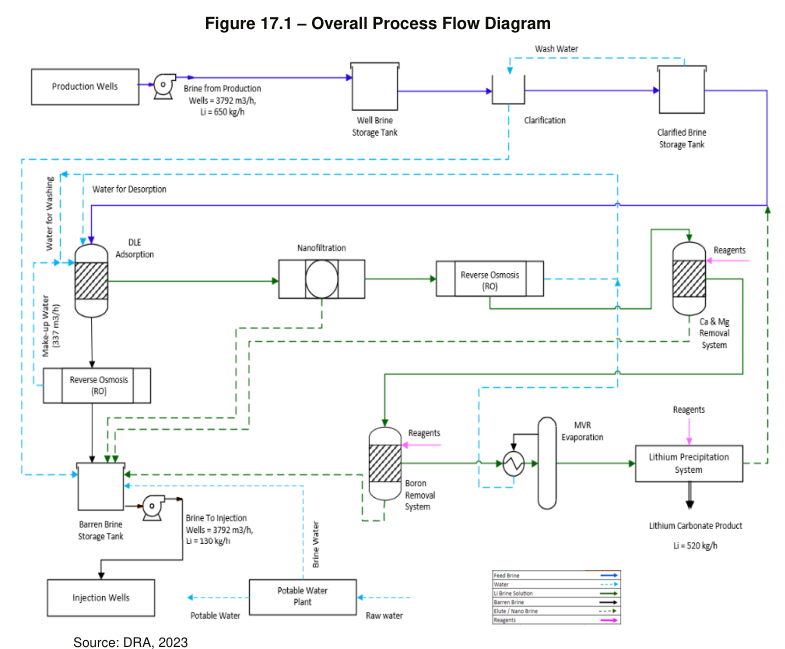
This Preliminary Economic Assessment describes a proposed processing facility to produce 20,000 tonnes per annum of lithium carbonate from salar brine using direct lithium extraction, membrane separation, ion exchange, mechanical vapour recompression, and carbonate precipitation.
Report context
The NI 43-101 Technical Report for the Kuska Project, dated February 2024, was prepared for the project located in the Region of Antofagasta, Chile. The document presents a Preliminary Economic Assessment (PEA) and is identified by document number G7919-0000-STU-REP-0001. The process description and associated data constitute proposed design parameters and testwork-based assumptions for a project that has not yet been constructed.
Processing route
Brine extraction and clarification
Extraction wells are located in three different locations, each provided with one brine transfer tank. Salar brine from the wells is pumped into the respective transfer tanks before being pumped into a large feed storage tank adjacent to the process plant, which has a four-hour residence time. A small quantity of ultra-fine suspended solids is anticipated to be present in the extracted brine, requiring clarification to mitigate the impact of these solids on downstream adsorption of lithium. Separated solids are backwashed using clarified solution and directed to the barren solution storage tank before being transferred back into injection wells.
Direct lithium extraction and membrane separation
Direct Lithium Extraction (DLE) employs resin to selectively extract lithium from clarified brine. The DLE adsorption stage consists of several resin adsorption columns. Water recovered from downstream reverse osmosis (RO) and condensate from the mechanical vapour recompression (MVR) evaporator is used to wash and desorb lithium from the sorbent. The loaded resin is washed and then eluted with water to produce a lithium-rich eluate containing some impurities.
This enriched solution is subjected to a membrane separation step comprising nano-filtration (NF) followed by reverse osmosis. NF selectively purifies the eluate by reducing calcium and magnesium concentration; most dissolved Mg and Ca is rejected into a brine stream sent to the barren solution tank for reinjection. The NF permeate passes through an RO plant to concentrate lithium in the brine solution. RO permeate is directed to the recovered water tank for use in washing and desorption during the DLE adsorption stage.
Ion exchange and final concentration
The partially concentrated and purified solution from RO is subjected to two ion exchange (IX) polishing steps: first to remove calcium and magnesium, followed by a separate step to remove boron. Eluate streams generated from elution and regeneration of the resin are sent to the barren solution tank.
The purified solution is then sent to a mechanical vapour recompression (MVR) evaporator for final concentration prior to the carbonation step. This final concentration step ensures a high recovery of lithium during carbonate precipitation. Condensate from the evaporation step is sent to the recovered water tank for use in the DLE adsorption stage.
Lithium carbonate precipitation and product handling
The concentrated lithium chloride solution from MVR evaporation is sent to a conventional lithium carbonate (Li₂CO₃) precipitation circuit. The feed solution is heated in heat exchangers prior to being fed into continuously stirred tank reactors where it is mixed with sodium carbonate precipitant solution. The pH during precipitation is monitored and adjusted with the addition of sodium hydroxide. Most of the dissolved lithium precipitates as insoluble Li₂CO₃, with a residual amount remaining in solution due to saturation limits. The resulting precipitate slurry is subjected to solid-liquid separation to recover Li₂CO₃ and to allow washing of the precipitate with hot RO water to remove entrained soluble species. Depleted lithium solution is recycled back to the DLE adsorption step to recover remaining soluble lithium.
Wet precipitate is sent to the final product handling circuit, which comprises a dryer, micronizer, and packaging system. Final packaged product is stored ready for dispatch.
Barren brine handling
An additional RO circuit is considered to process a portion of the barren brine (tail brine) from the DLE adsorption stage to generate make-up water requirements. The RO brine and remaining barren brine from DLE adsorption are collected in a barren brine storage tank adjacent to the process plant. The barren brine is pumped from the barren storage tank into the respective injection well field transfer tanks and then into the injection wells.
Reagent services
Sodium carbonate (soda ash) is utilized to precipitate Li₂CO₃ from the lithium chloride-rich solution. The reagent is received as a dry solid, stored on site, and dissolved in an agitated tank using heated washate and demineralized water to maintain a saturated solution at operating temperature.
Sodium hydroxide is used to regenerate IX resin and for pH control in the carbonate precipitation circuit. It is delivered as lye, stored in a tank, pumped to a caustic make-up tank where it is diluted with demineralized water to the appropriate concentration, then transferred to a storage tank for distribution.
Hydrochloric acid (35% w/w solution) is delivered by tanker truck, transferred into a storage tank, and diluted with demineralized water before being used for elution of the polishing IX resin.
Water services
The primary source of fresh make-up water is from the additional RO plant located in the barren brine area. Make-up water is used for the DLE adsorption stage, reagent make-up, IX wash, and Li₂CO₃ precipitate wash. Raw water obtained from separate freshwater wells supplies water for fire suppression and for producing potable water.
Steam and air services
Steam is generated in fuel-fired boilers and used for evaporation, soda ash make-up, heating of the lithium-rich solution, feeding of the carbonation area, and heating of RO water used for washing the Li₂CO₃ product. The process facilities include air compressors, air dryers, air filters, and air receivers to provide instrumentation and plant air.
Key reported parameters
| Parameter | Units | Value | Basis |
|---|---|---|---|
| Annual lithium carbonate production | tpa | 20,000 | Proposed design |
| Well field and plant availability | % | 82 | Proposed design |
| Operating hours | h/a | 7,200 | Proposed design |
| Feed brine flowrate | L/s | 1,056 | Proposed design |
| Feed brine lithium concentration | mg/L | 172 | Proposed design |
| Lithium yield | % | 80 | Proposed design |
| Salar brine flowrate | m³/h | 3,792 | Proposed design stream |
| DLE eluate flowrate | m³/h | 823 | Proposed design stream |
| Membrane separation flowrate | m³/h | 94 | Proposed design stream |
| Polished Li solution flowrate | m³/h | 94 | Proposed design stream |
| MVR Li rich solution flowrate | m³/h | 22 | Proposed design stream |
| Barren brine flowrate | m³/h | 3,792 | Proposed design stream |
| Lithium mass flowrate in salar brine | kg/h | 650 | Proposed design stream |
| Lithium mass flowrate in DLE eluate | kg/h | 576 | Proposed design stream |
| Lithium mass flowrate after membrane separation | kg/h | 565 | Proposed design stream |
| Lithium mass flowrate in polished Li solution | kg/h | 554 | Proposed design stream |
| Lithium mass flowrate in MVR Li rich solution | kg/h | 554 | Proposed design stream |
| Lithium mass flowrate in barren brine | kg/h | 130 | Proposed design stream |
Project website: https://wealthminerals.com/projects/kuska/
Technical qualifications
The processing route and associated data presented in this report are based on proposed design parameters and process flow modelling. No historical operating data from the Kuska Project are reported. The process description relies on testwork-derived assumptions, including the anticipated presence of ultra-fine suspended solids requiring clarification and the use of DLE resin for selective lithium extraction. The overall process flow diagram is attributed to DRA (2023). The report constitutes a Preliminary Economic Assessment and does not represent a feasibility study. Economic performance, project ownership, current development status, and links to operating facilities are not addressed in the recovery methods section.
Source: NI 43-101 Technical Report, Preliminary Economic Assessment, Kuska Project, Region of Antofagasta, Chile, Document # G7919-0000-STU-REP-0001, February 2024, Section 17 Recovery Methods.
