

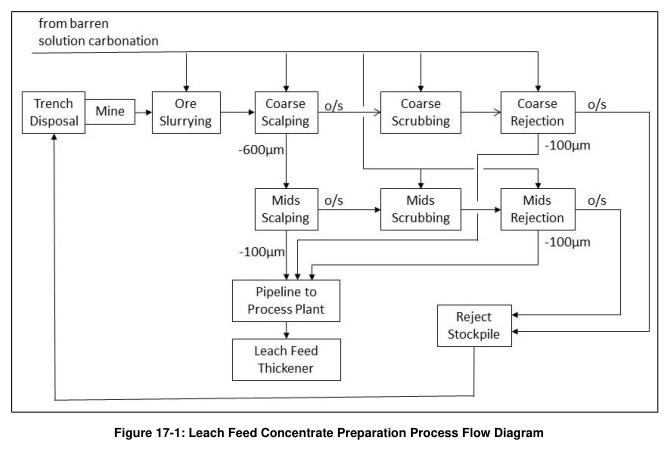
This report describes the proposed alkaline carbonate leach processing route for the Ivana uranium-vanadium deposit, including leach feed concentrate preparation and downstream recovery of U₃O₈ and V₂O₅.
Report context
This technical report presents a preliminary economic assessment update for the Ivana Uranium-Vanadium Deposit, part of the Amarillo Grande Project in Rio Negro Province, Argentina. The report is effective December 31, 2024. The Ivana Operation is a proposed uranium-vanadium mine and process plant. Over its 11-year operating life, the conceptual process plant is designed to process 23.5 Mt of uranium-vanadium process plant feed, grading on average 0.038% U₃O₈ (319 ppm U) and 0.019% V₂O₅ (107 ppm V). Process design criteria will be refined in the future based on the results of ongoing exploration and process testing.
Processing route
Process Selection
Uranium leaching may be either acidic (normally sulphuric acid) or alkaline (normally with a combination of sodium carbonate and sodium bicarbonate). Alkaline carbonate leaching was selected for the Ivana leach process because of the relatively high concentration of acid-consuming minerals in the leach feed. The processing route selected for the Ivana operation uses processes commonly used in alkaline carbonate leach plants globally, while including some innovative processes to optimize plant performance.
Leach Feed Concentrate Preparation Plant
The first stage of processing is leach feed concentrate production. Virtually all of the uranium and vanadium mineralization in the mined material occurs in particle sizes less than 100 µm. The Leach Feed Concentrate Preparation Plant is a semi-mobile screening and scrubbing facility, located near the proposed mining site.
Mineralized material reclaimed from the mine stockpiles is slurried and passed over a 600 µm scalping screen. The 600 µm oversize is the coarse fraction. The coarse fraction is scrubbed in a series of attrition scrubbers. The scrubbed coarse material is rejected by screening at 100 µm. The mids fraction is scalped over a 100 µm screen. The mids fraction is scrubbed in a second series of attrition scrubbers. The scrubbed mids material is rejected by screening at 100 µm.
Separating the coarse fraction and the mids fraction at 600 µm gives two +100 µm fractions of approximately equal mass, simplifying the design and operation of the scrubbing and rejection unit operations. The rejected coarse fraction and mids fraction resemble a clean coarse sand and are sent to a reject stockpile for onsite disposal. The U grade of each of the rejected coarse fraction and the rejected mids fraction is less than 0.03% U.
In the leach feed concentrate preparation process the mass recovery from mined material to leach feed concentrate averages approximately 23%. The leach feed preparation process recovers 89% of the uranium and vanadium mineralization from the mined material. Thus, the leach feed concentrate preparation process increases the leach feed grade approximately fourfold relative to the mined material.
Process Plant
The slurry containing the -100 µm fraction of the mined material is pipelined to the leach feed thickener in the process plant.
Leach feed thickener overflow is pumped to the lime thickener feed well. Leach feed thickener underflow is pumped to slurry carbonation, where flue gas from the site steam boilers is mixed into the slurry to dissolve carbon dioxide from the flue gas.
The carbonated slurry feeds the alkaline carbonate leach circuit where uranium and vanadium are dissolved from the leach feed minerals. The alkaline carbonate leach runs at 95°C and is heated by steam injection. No oxidant is required. Tests using oxygen as oxidant did not increase uranium leach recovery, and decreased vanadium leach recovery.
The slurry feed to the alkaline carbonate leach circuit will pass through a pipe-in-pipe heat exchanger to recover heat from the slurry exiting the alkaline carbonate leach circuit.
The alkaline carbonate leach circuit product slurry feeds tailings filtration. The filter cake is pumped to the tailings thickener. Filtrate is pumped to membrane filtration. The membrane permeate, essentially clean water, is used as the secondary wash for tailings filtration. The membrane retentate, a relatively low flow rate and a more concentrated pregnant solution, is pumped to liming.
In the liming circuit, lime slurry is added to reduce bicarbonate ion concentration and to precipitate impurities such as sulphate ion, molybdenum, iron, thorium, and radium. The resulting slurry is pumped to the lime thickener.
Lime thickener underflow is pumped to the leach feed thickener to recover any uranium unintentionally precipitated in the lime circuit. Lime thickener overflow solution is polished in sand filters, from which it enters the U-V separation circuit.
In the U-V separation circuit, uranium and vanadium are separated by selective chemical precipitation. The uranium solution from the U-V separation circuit passes to the uranium peroxide precipitation stage, where dissolved uranium is precipitated with hydrogen peroxide. The uranium precipitate, uranium peroxide, is UO₄·2H₂O. The uranium precipitate solids are filtered from the barren solution using process water as cake wash, then calcined to U₃O₈ or UO₃, packaged in steel drums and shipped to market.
The vanadium solution from the U-V separation circuit passes to the ammonium metavanadate (AMV) precipitation stage, where dissolved vanadium is precipitated with ammonium hydroxide. The vanadium precipitate, ammonium metavanadate, is NH₄VO₃. The vanadium precipitate solids are filtered from the barren solution using process water as cake wash, then calcined to vanadium pentoxide (V₂O₅), packaged in steel drums and shipped to market.
The combined barren solution undergoes carbonation, where flue gas from the site steam boilers is mixed into the solution to dissolve carbon dioxide from the flue gas. The carbonated barren solution is pumped to the leach feed concentrate preparation plant, and to tailings filtration as the primary cake wash.
Tailings thickener underflow is pumped into the starter tailings management facility (TMF). In the starter TMF the tailings slurry settles and consolidates, releasing entrained water. This released water is reclaimed and pumped to the water treatment circuit in the process plant. In this circuit the water is treated first to precipitate dissolved radium, then to precipitate any remaining dissolved sulphate ion, molybdenum, iron, and thorium. Finally, the solution pH is adjusted to 7.0 (neutral). The resulting low-density slurry is pumped to the tailings thickener, in which the water treatment precipitate solids settle for pumping into the TMF, along with and mixed into the alkaline carbonate leach tailings. Tailings thickener overflow is pumped to the process water tank, in which the pH is adjusted to 7.0.
Key reported parameters
| Parameter | Value | Basis |
|---|---|---|
| Process plant life | 11 years | Conceptual design |
| Total process plant feed | 23.5 Mt | Conceptual design |
| Average feed grade U₃O₈ | 0.038% (319 ppm U) | Conceptual design |
| Average feed grade V₂O₅ | 0.019% (107 ppm V) | Conceptual design |
| Plant design feed rate | 2.17 Mtpa | Conceptual design |
| Average annual U₃O₈ production | 1.5 Mlb | Conceptual design |
| Total U₃O₈ production | 16.5 Mlb | Conceptual design |
| Average annual V₂O₅ production | 0.5 Mlb | Conceptual design |
| Total V₂O₅ production | 5.2 Mlb | Conceptual design |
| Overall U recovery | 85% | Derived from 89% leach feed concentrate recovery and 95% subsequent process recovery |
| Overall V recovery | 53% | Derived from 89% leach feed concentrate recovery and 59% subsequent process recovery |
| Mass recovery to leach feed concentrate | Approximately 23% | Conceptual design |
| U and V recovery in leach feed preparation | 89% | Conceptual design |
| Grade increase from mined material to leach feed | Approximately fourfold | Conceptual design |
| Alkaline carbonate leach temperature | 95°C | Design |
| Oxidant requirement | None | Testwork indicated oxygen did not increase U leach recovery and decreased V recovery |
| Rejected coarse and mids fraction U grade | <0.03% U | Conceptual design |
Project website: https://blueskyuranium.com/projects/neuquen-basin/amarillo-grande-project/ivana-property/
Technical qualifications
The processing route described in this report is for a conceptual process plant. Process design criteria will be refined in the future based on the results of ongoing exploration and process testing. The conceptual process plant design can accommodate fluctuations in feed grade which are expected over the project life.
Source: Preliminary Economic Assessment Update for the Ivana Uranium-Vanadium Deposit, Amarillo Grande Project, NI 43-101 Technical Report, effective December 31, 2024, Section 17 Recovery Methods.
