

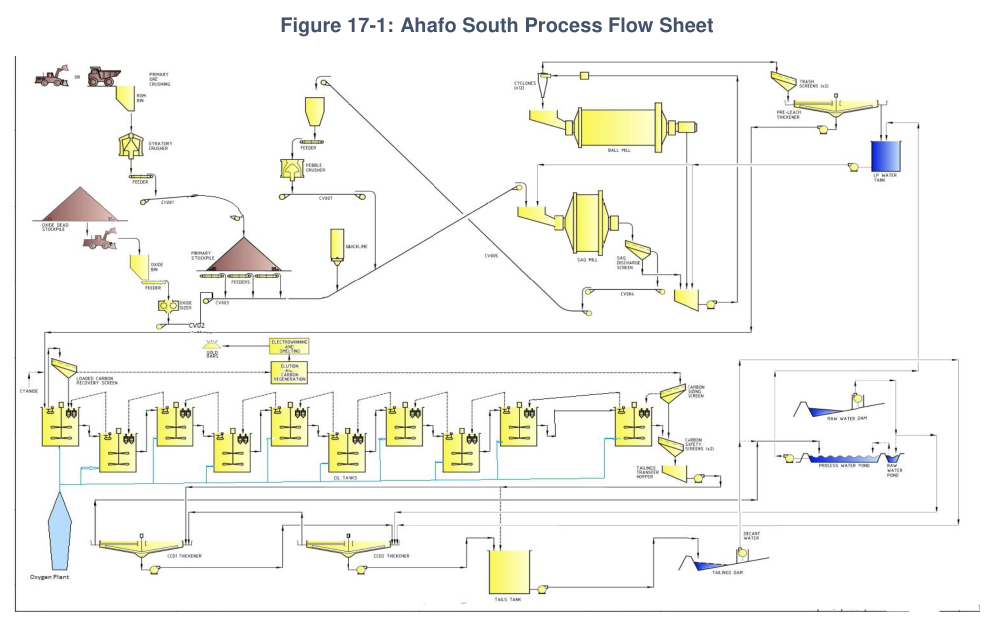
Newmont’s Ahafo South operation in Ghana runs a conventional gold processing plant with a counter-current decantation circuit for cyanide recovery and a planned expansion to add an independent milling line.
The Ahafo South process plant in the Republic of Ghana, operated by Newmont, is designed around conventional equipment and technology for treating a blend of fresh rock and saprolite. The flowsheet was established using testwork results, previous study designs, and industry standard practices. Actual throughput for the remaining life of mine is projected to vary from 7.3 to 10.6 Mt/a (904 to 1,336 t/hr), depending on the ore blend from open pit and underground operations. The process route begins with single-stage primary crushing, followed by semi-autogenous grinding, ball milling, leaching, carbon-in-pulp recovery, electrowinning, and smelting to produce doré. A counter-current decantation circuit, commissioned in 2008, recovers cyanide from CIL tailings prior to discharge to the tailings storage facility. A scalable mill expansion project, referred to as AME, is planned to expand the existing plant by 3.5 Mt/a with a new independent comminution circuit.
Critical Data
| Parameter | Value | Unit | Notes |
|---|---|---|---|
| Plant capacity (Saprolite) | 2.0 | Mt/a | Design criterion |
| Plant capacity (Primary) | 5.5 | Mt/a | Design criterion |
| Actual throughput | 7.3–10.6 | Mt/a | Remaining LOM projection (904–1,336 t/hr) |
| Head grade (Saprolite, design) | 1.99 | Au g/t | Design criterion |
| Head grade (Primary, design) | 2.46 | Au g/t | Design criterion |
| Design gold recovery (Saprolite) | 98 | % | Design criterion |
| Design gold recovery (Primary) | 92 | % | Design criterion |
| Crushing plant availability (Saprolite) | 92 | % | Design criterion |
| Crushing plant availability (Primary) | 75 | % | Design criterion |
| Mill/CIL availability | 92 | % | Design criterion |
| Bond abrasion index (Saprolite) | 0.341 | Not stated | Design criterion |
| Bond abrasion index (Primary) | 0.225 | Not stated | Design criterion |
| Bond ball mill work index (Saprolite) | 9.8 | kWh/t | Design criterion |
| Bond ball mill work index (Primary) | 19.4 | kWh/t | Design criterion |
| Grind size (P80) | 106 | μm | Design criterion |
| Installed mill power (SAG + ball) | 26,000 | kW | Design criterion |
| Number of CIL tanks | 10 | Not applicable | Design criterion |
| Total CIL volume | 3,250 | m3 | Design criterion |
| Elution strips | 6.0 | strips/week | Design criterion |
Overview
The Ahafo South plant uses conventional technology and has no significant elements of technological innovation in its comminution and recovery processes. The process plant was designed to handle combinations of fresh rock and saprolite based on testwork results and standard industry practice. The AME project is not considered by Newmont to be a material increase to current production. The project will expand the existing plant through installation of a new primary gyratory crusher, single-stage SAG mill, and additional leach tanks. The Line 2 comminution circuit will be independent of the existing Line 1 crushing and grinding circuit.
Key Process Stages
Primary crushed material is discharged from the crusher into a surge hopper directly underneath. From the surge hopper, the material is withdrawn to a reclaim stockpile via an apron feeder, conveyors, and a transfer station. The milling configuration allows for utilization of spare ball mill capacity when feed is mostly SAG-mill limiting. The cyclone overflow reports to a pre-leach thickener via trash screens, with the thickener overflow recycled to the milling circuit as process water. The thickener underflow advances to the leaching circuit.
The leaching circuit consists of CIL tanks with a total volume of 3,250 m3. Pregnant solution advances to electrowinning, which uses stainless-steel cathodes. Gold sludge collected from the cathodes is washed, dried, and smelted in a furnace to produce doré. A counter-current decantation circuit, commissioned in 2008, recovers cyanide from CIL tailings prior to discharge. The International Cyanide Management Institute certified the Ahafo Operation as fully compliant with the International Cyanide Code in July 2008.
Additional Interesting Data and Summary
Line 1 installations require approximately 30 MW of power to operate at full capacity. Line 2 is expected to draw about 15 MW of power when operational. Potable water is sourced from boreholes. The scalable mill expansion project will expand the existing plant by 3.2–3.5 Mt/a through the installation of a new primary gyratory crusher, single-stage SAG mill, two additional leach tanks, and two additional tailings disposal units. The reduction in overall process operating cost from the AME project is anticipated to be 3–5% over the life of mine.
Key Processes
- Single-stage primary crushing with direct truck dump or front-end loader feed
- SAG milling with pebble crushing and recycle
- Ball milling with cyclone classification
- Pre-leach thickening with trash screening
- Carbon-in-leach (CIL) with 10 tanks
- Counter-current decantation for cyanide recovery
- Electrowinning using stainless-steel cathodes
- Smelting in a furnace to produce doré
- International Cyanide Code compliant operation
Source: Ahafo South Operations , 2019 Technical Report, 2019.
Project website: Ahafo South Operations, 2019 Technical Report
