

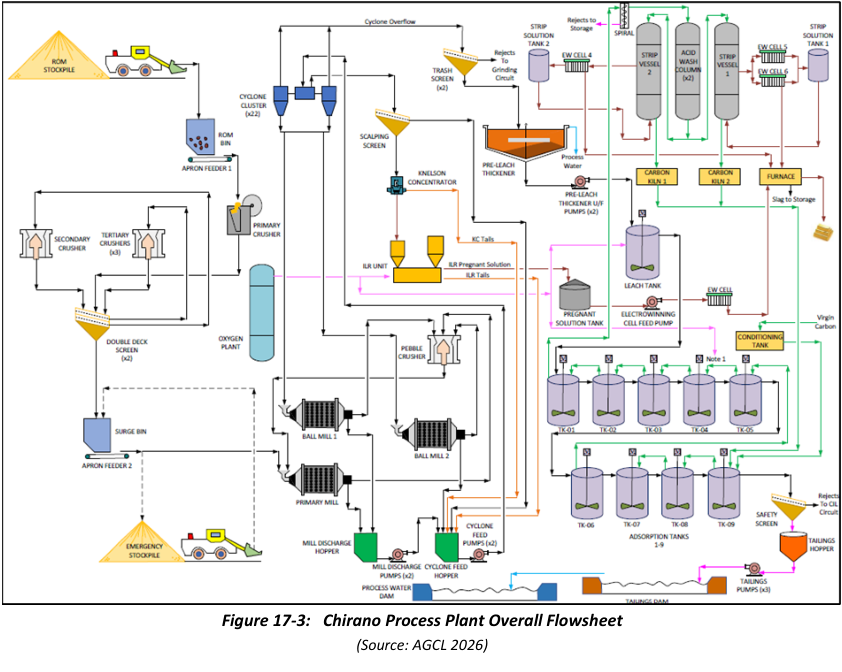
Asante Gold Corporation's Chirano Gold Project in Ghana has implemented a series of plant modifications between 2023 and 2025 designed to increase throughput capacity from the 3.6 Mtpa design rate toward 4.0 Mtpa, with additional upgrades scheduled through 2026.
The Chirano Gold Project is an operating gold mine located in Ghana, West Africa, owned by Asante Gold Corporation. The processing facility at Chirano treats ore from multiple underground mines, including Akwaaba, Suraw, Akoti, Tano, and Obra, as well as open pit sources including Mamnao, Sariehu, and Aboduabo. The plant uses a standard carbon-in-leach (CIL) process for gold extraction. The technical report covering the project carries an effective date of 31 December 2025.
Critical Data
| Parameter | Value | Unit | Notes |
|---|---|---|---|
| Plant design throughput capacity | 3.6 | Mtpa | Nameplate capacity |
| Target throughput after modifications | 4.0 | Mtpa | Objective of plant modifications |
| Average milled ore 2024 | 3.3 | Mt | Total for production year |
| Total milled ore 2025 (11 months) | 3.2 | Mt | Year-to-date at time of reporting |
| Average crusher throughput rate 2023 | 484 | tph | Annual average |
| Average crusher throughput rate 2024 | 503 | tph | Annual average |
| Average crusher throughput rate 2025 | 559 | tph | Annual average |
| Average mill throughput rate 2023 | 424 | tph | Annual average |
| Average mill throughput rate 2024 | 448 | tph | Annual average |
| Average mill throughput rate 2025 | 475 | tph | Annual average |
| Average mill work index 2024 | 16.6 | kWh/t | Blended mill feed |
| Average mill work index 2025 | 16.1 | kWh/t | Blended mill feed |
| Average gold recovery 2023 | 85.52 | % | From Table 17-1 |
| Average gold recovery 2024 | 86.20 | % | From Table 17-1 |
| Average gold recovery Q4 2025 | 82.98 | % | From Table 17-1 |
| Average head grade 2023 | 1.50 | g/t | From Table 17-1 |
| Average head grade 2024 | 1.40 | g/t | From Table 17-1 |
| Average head grade Q4 2025 | 1.11 | g/t | From Table 17-1 |
| Crusher effective utilisation (3-year average) | 73.3 | % | Exceeds industry standard of 70% |
| Mill effective utilisation (3-year average) | 86.9 | % | Below industry standard of 91.3% |
| Unscheduled mill downtime 2025 | 596 | hours | Equivalent to 24.8 milling days |
| Lost milled throughput from unscheduled downtime | 280,000 | tonnes | 2025 year-to-date |
| CIL pre-leach tank live volume | 3,200 | m3 | From equipment specifications |
| Individual CIL tank live volume | 1,300 | m3 | Nine tanks total |
| Oxygen generation capacity | 10 | tpd | From PSA plant |
| Pre-leach tank agitator power | 160 | kW | Replaced 130kW unit |
| CIL agitator power (upgraded) | 75 | kW | Three tanks, replaced 55kW units |
Overview
The Chirano process plant uses a comminution circuit with three-stage crushing and two-stage ball milling. A standard CIL process extracts gold from the ore. The plant treats a blended feedstock comprising roughly 95% fresh ore and 5% oxide ore. In 2024 the plant feed blend averaged 47% underground ore and 44% open pit ore. For 2025 those proportions shifted to 47% underground and 45% open pit, with oxide ore making up the balance.
Since Asante acquired the Chirano mine, the plant has not reached its 3.6 Mtpa nameplate capacity, averaging approximately 3.3 Mtpa. The planned total milled ore for the completed 2025 production year was 3.5 Mt. The plant modifications described in the technical report aim to close that gap and push throughput beyond the original design rate to 4.0 Mtpa.
Key Process Stages
Ore enters the primary jaw crusher, a Metso C150, in open circuit. Secondary crushing uses one Sandvik S660 CS660 Hydrocone. Two Sandvik H660 CH660 Hydrocone crushers served as tertiary crushers alongside a newer Sandvik CH865i Hydrocone installed in September 2024. Crusher screens are Sandvik XS144 double-deck units.
Mill feed goes to a surge bin with overflow to a dead stockpile for mechanical reclaim. The primary ball mill, a converted SAG mill with grate discharge measuring 6.0 metres diameter and 5.7 metres effective grinding length, runs at 2,900 kW. Two secondary ball mills operate in closed circuit with cyclone clusters. Secondary ball mill number one is an overflow discharge unit 4.88 metres in diameter with 6.83 metres effective grinding length at 2,500 kW. Secondary ball mill number two was converted from a SAG mill to overflow configuration, 6.10 metres diameter with 7.0 metres effective grinding length at 2,500 kW.
A centrifugal gravity concentrator, a Knelson QS48, draws a bleed stream from the secondary mill discharge with a scalping screen to remove oversize. An intensive leach reactor processes the gravity concentrate. Primary mill scats go through in-circuit crushing.
Cyclone overflow passes through trash screening and thickening before leaching. The pre-leach tank receives oxygen from a PSA plant generating 10 tonnes per day. An Aachen shear reactor installed in March 2024 operates on the 3,200 cubic metre pre-leach tank. Nine CIL tanks follow, each 12 metres diameter by 12 metres height with flat bottoms and 1,300 cubic metre live volumes. The pre-leach tank agitator was upgraded to a 160 kW dual hydrofoil impeller unit in August 2024. The first three CIL tanks received upgraded 75 kW dual hydrofoil impeller agitators at the same time.
Two Zadra elution circuits operate with dedicated acid wash columns and regeneration kilns. The gold room houses three elution eluate electrowinning cells plus a dedicated gravity electrowinning cell. Carbon screening of CIL tails precedes disposal of tailings to a clay-lined tailings storage facility.
Additional Interesting Data and Summary
The crusher plant averaged 73.3% effective utilisation across 2023, 2024, and 2025, exceeding the industry standard of 70% or 6,100 hours per annum. The milling plant's effective utilisation averaged 86.9% over the same period, below the industry standard of 91.3% or 8,000 hours per annum.
Total mill plant downtime for 2025 year-to-date was 860 hours. Scheduled plant maintenance accounted for 264 hours. Power outages caused 46 hours of downtime. Mill 1 motor electrical faults and mill oil lubrication faults totalled 89 hours. Commissioning of the new cyclone cluster required 55 hours. CV-02 feed conveyor repairs took 76 hours. Mechanical repairs to the thickener and operational issues contributed 38 hours. TSF water supply shortage caused 19 hours of downtime. Excluding scheduled maintenance, major downtimes totalled 323 hours. An additional 273 hours came from 35 unscheduled mill stoppages. Total unscheduled milling plant downtime reached 596 hours.
The average monthly milled tonnage increased from 275,000 tonnes per month in 2023 and 2024 to 295,000 tonnes per month in 2025. Average gold recovery for 2023 was 85.52% at an average head grade of 1.50 g/t. In 2024 recovery improved to 86.20% at 1.40 g/t head grade. For the fourth quarter of 2025, average recovery was 82.98% at 1.11 g/t head grade.
The mill feed grind size, measured at 106 micrometres, averaged 80.42% passing in 2023, 81.88% in 2024, and 83.87% in the fourth quarter of 2025. The operating work index averaged 16.62 kWh/t in 2024 and 16.30 kWh/t in the fourth quarter of 2025.
An average crushed throughput rate of 600 tonnes per hour was achieved in the last half of the 2025 production year. This figure excludes an additional 145,000 tonnes per month of crushed rock supplied to the rehandle stockpile from the remote ROC plant and from a mobile crusher at the plant site. At 75% effective utilisation and 600 tonnes per hour, the crusher plant capacity reaches 4.0 Mtpa with backup supply from remote crushers.
After the cyclone modification in the second quarter of 2025, the milling feed rate ramped to 500 tonnes per hour but was reduced to 475 tonnes per hour. Higher slurry flow rates at 500 tonnes per hour exposed a bottleneck in the CIL plant. At 89% effective utilisation and a milling throughput rate of 510 tonnes per hour, the milling circuit capacity is 4.0 Mtpa.
The 448 tonnes per hour average mill throughput for 2024 was 27 tonnes per hour lower than the 475 tonnes per hour average for 2025. The 2025 blended mill feed had a softer ore with an average mill work index of 16.1 kWh/t compared to 16.6 kWh/t for 2024. Higher milling rates of 501 tonnes per hour in the first quarter of 2025 and 478 tonnes per hour in the third quarter corresponded to softer work indices of 15.64 kWh/t and 15.84 kWh/t respectively.
Key Processes
- Three-stage crushing circuit with primary jaw crusher, secondary cone crusher, and tertiary cone crushers including a larger Sandvik CH865i Hydrocone installed September 2024
- Two-stage ball milling circuit with primary ball mill converted from SAG mill and two secondary ball mills
- Gravity concentration circuit with Knelson concentrator commissioned December 2023
- Intensive leach reactor for gravity concentrate gold extraction with dedicated electrowinning cell
- Pre-leach tank with Aachen shear reactor using oxygen from 10 tpd PSA plant
- Nine carbon-in-leach tanks with upgraded agitators and interstage pumping screens
- Two Zadra elution circuits with acid wash columns and regeneration kilns
- Gold room with three elution electrowinning cells and one gravity electrowinning cell
- Carbon screening of CIL tails with clay-lined tailings storage facility disposal
Future plant modifications include installation of a vibrating grizzly screen in the third quarter of 2026 to remove fine material from the jaw crusher feed. Upgrades to the remaining six of nine CIL tanks will continue through the first to fourth quarters of 2026, installing uprated agitators, new double interstage pump screens, larger inter-tank launders, and carbon transfer pumps to remove the 4.0 Mtpa flow rate bottleneck.
Source: NI 43-101 Technical Report and Updated Mineral Resource Estimate, Asante Gold Chirano Ltd., Ghana, West Africa, 31 December 2025. Project website: Chirano Gold Project
