

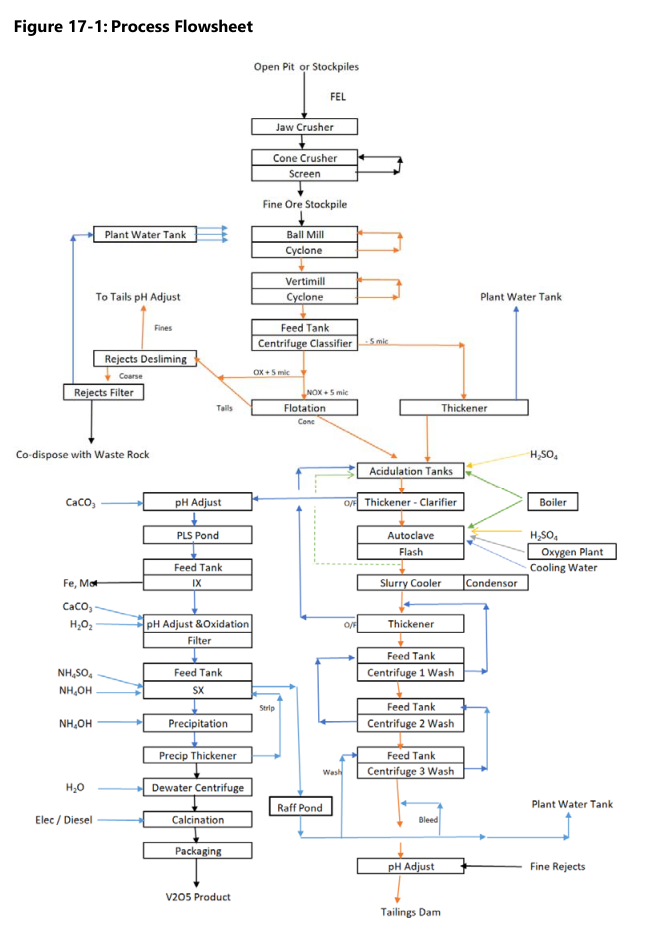
This technical report describes the proposed processing route for vanadium recovery at the Carlin Vanadium Project in Nevada, USA, based on a 2020 Preliminary Economic Assessment.
Report context
The Carlin Vanadium Project (the Project) is located in Nevada, USA. This NI 43-101 Technical Report on Preliminary Economic Assessment is dated June 2020. The report presents a process design for vanadium recovery from mudstone-hosted mineralization types, supported by testwork and historical operating data. The process design assumes mineralization supply from an active mining operation for the first 11 years (plus one year of pre-production), followed by five years of stockpile treatment, then a final four years of acid-plant only operation.
Processing route
Mineralization classification and front-end processing
For the purposes of the process plant design, the mudstone-hosted mineralization types are classified as being an oxide and a non-oxide type. The mineralization types have significantly different mineralogical and physical characteristics which results in differences to the front end of the flowsheet for the two mineralization types.
The oxide mineralization is friable, with the gangue being dominated by acid-consuming dolomite and K-feldspar, and is not significantly upgradable by conventional flotation or gravimetric methods. The non-oxide mineralization is competent, is also dominated by acid-consuming dolomite and K-feldspar, but generally contains a greater proportion of sulphide minerals. In addition, the non-oxide mineralization contains a high proportion of sulphur-bearing kerogen with which the vanadium is associated.
Testing showed that it is possible to upgrade the mineralization by cycloning. The cyclone underflow from the oxide mineralization type is rejected to upgrade tailings, thus removing a substantial quantity of acid-consuming gangue from downstream processes. The cyclone underflow from the non-oxide mineralization contains a large proportion of the vanadium-bearing kerogen, so the underflow advances to carbon flotation for kerogen recovery.
Stockpile and crushing
The higher-grade mill feed material will be processed during the initial years of the Project, while the lower-grade mineralization will be stockpiled close to the processing plant. The oxide and non-oxide mill feed material will be stockpiled separately. The final five years of operation will be fed exclusively from these lower-grade stockpiles.
Mill feed material will be either dumped directly into the plant feed hopper or withdrawn from the stockpile via a front-end loader to feed a primary jaw crusher. The jaw crusher discharge will be screened and the oversize will be fed to a secondary cone crusher in closed circuit with the sizing screen. The screen undersize will advance to the milling section.
Milling and classification
The oxide mineralization is friable, and testing has shown that the material breaks down to a slurry in an attrition scrubber. The fine vanadium minerals are liberated from the coarser gangue mineral which provides the opportunity to upgrade the vanadium minerals using particle size classification. Processing the mill feed material through a ball mill is potentially detrimental to recovery by particle size, due to overgrinding of the gangue minerals, so the oxide mineralization will bypass the primary ball mill and report directly to the secondary tower mill, which will be configured to do duty as an attrition scrubber.
The non-oxide mineralization is substantially more competent than the oxide mineralization. The crushed mineralization will feed into a ball mill in closed circuit with a hydrocyclone cluster, classifying the overflow to a P80 of 105 µm. The overflow will advance to a tower mill which will be configured as a secondary milling stage. The tower mill will operate in closed circuit with a hydrocyclone cluster, classifying the overflow to a P80 -50 µm. The overflow will advance to a fines classification circuit.
Limited comminution testwork is available at this time. A Bond mill work index of 13.7 kWh/t was used to size the comminution equipment.
Fines classification
The vanadium minerals are predominantly in the -5 µm fraction and can be concentrated by classifying at a cut point of approximately 8 µm. The gangue minerals, particularly the acid-consuming calcium and magnesium carbonates, are in the coarser fractions. Testing with hydrocyclones showed a vanadium grade improvement in the overflow and a significant reduction in the concentration of calcium and magnesium carbonate minerals. This factor is key to reducing sulphuric acid consumption in downstream acidulation and pressure leach processes.
The cyclones tested were commercially-available units of 1-inch diameter. Each cyclone is capable of processing between 0.68–1.14 m³/h. The cyclones are typically configured in clusters of 250 cyclones manifolded within a vessel, and are utilized in liquor desanding applications. There is no commercial reference using these cyclones for slurry classification in the minerals industry.
Centrifuges are commonly employed in dewatering and classifying applications and routinely do duty at 5–8 µm cut points in large industrial applications. Preliminary testing has demonstrated that centrifuges can be applied in the process as fines classifiers and have thus been used as the preferred classification equipment.
The centrifuges will be configured in open circuit, receiving a conditioned cyclone overflow from the tower mill. The coarse rejects will either be sent to the upgrade tailings circuit in the case of the oxide mill feed type, or carbon flotation in the case of the non-oxide mill feed type. The centrate containing the fines fraction will advance to acidulation.
Carbon flotation
Flotation testing has demonstrated that the kerogen can be recovered by a single bank of conventional mechanical flotation cells, using emulsified diesel as a collector and MIBC as a frother. The carbon flotation circuit will only be operated when the kerogen-containing non-oxide mill feed material is treated. When oxide mineralization is treated, the fines from the classification centrifuges will by-pass flotation and advance directly to the pre-acidulation thickener.
Acidulation
The centrifuge centrate and flotation concentrate will combine in the feed to the pre-acidulation thickener. The thickener underflow will be pumped to the acidulation circuit. The pre-acidulation thickener underflow will combine with the autoclave discharge thickener overflow solution. Energy recovery using flash and splash from the autoclave discharge will be used to heat the slurry fed to acidulation. As the full acid requirement in acidulation will be met by the residual acid in the autoclave discharge thickener overflow solution, additional acid dosing into acidulation will not be necessary. The acidulation tanks will overflow to the pressure leach feed thickener where flocculant will be added to the feed. The thickener overflow will advance to the pregnant leach solution (PLS) pond.
Pressure oxidation
The pressure oxidation feed thickener underflow will pass through a slurry–slurry heat exchanger to recover energy from the second-stage flash slurry discharge.
The autoclave will be a six-compartment vessel, sized at 14 ft internal diameter by 65 ft length, and will operate at 245ºF to a maximum pressure of 600 psi. Concentrated sulphuric acid will be added to the autoclave to maintain a residual acid concentration of 65 g/L in the discharge. Oxygen will be added to maintain a 102 psi oxygen over pressure. The oxygen will be an “over-the-fence” supply from a vendor-owned plant.
The operating conditions differ between the oxide and non-oxide mineralization types. The oxide mill feed requires super-heated steam to achieve the operating temperature and pressure, whereas the non-oxide mill feed allows for autothermal operation.
Testing has indicated that approximately 5% of the kerogen oxidizes in the autoclave, which alleviates initial concerns around the high organic carbon content in the autoclave and related safety aspects.
The autoclave discharge will be cooled using a conventional two-stage flash, with flash steam utilized to heat the acidulation feed slurry and maintain elevated temperature in the acidulation tanks. The slurry will pass through a slurry–slurry heat exchanger to recover residual energy to the autoclave feed slurry.
Thickening and counter-current washing
The leached slurry will advance to the pressure oxidation discharge thickener. The thickener underflow will be pumped through a three-stage decanting centrifuge circuit where the slurry will be washed counter-current with solvent extraction raffinate solution. The thickener overflow will return to acidulation to recover residual acid.
Ion exchange
The PLS will be pumped from the PLS pond through a NIMCIX ion exchange extraction circuit to target the extraction of uranium and molybdenum impurities. The vanadium will be in the V⁴⁺ state and will not be adsorbed onto the strong-base ion exchange resin. The ion exchange raffinate solution will be treated with hydrogen peroxide to oxidize the V⁴⁺ to V⁵⁺ ahead of solvent extraction.
Solvent extraction
The extraction circuit will consist of four reverse-flow mixer–settler stages in series. The stages will be operated organic continuous. The loaded organic will advance to a single scrub mixer–settler where the organic will be scrubbed with acidified demineralized water to reduce iron contamination. The scrubbed organic will advance to three-stage strip mixer–settlers. The third stage mixer–settler will receive recycled ammonium sulphate solution from the precipitation circuit for initial pH change. The second and first stages will have stepped pH adjustment using ammonium hydroxide solution to pH 6.5 in the first stage, stripping the vanadium as ammonium decavanadate.
The solvent extraction process flowsheet as designed deviates from the process flowsheet that was used as the basis for the testwork. The testwork flowsheet used sodium carbonate as a strip solution, forming a sodium vanadate strip liquor containing sodium sulphate. The ammonium sulphate strip and precipitation process was adopted during the process flowsheet development as it allows for process simplification and potential cost benefits.
Precipitation and calcination
The loaded strip liquor will be filtered through a carbon filter to remove entrained organic before being pumped to the ammonium metavanadate (AMV) precipitation tanks arranged in series. The precipitate slurry will overflow the final tank to the AMV thickener where the precipitate will settle out. The underflow will advance to a centrifuge to wash the precipitate, then to a filtration step to dewater the solids.
The filtered cake will be fed into a multi-hearth furnace which will dry and calcine the AMV under oxidizing conditions to produce vanadium pentoxide. The vanadium pentoxide will be crushed, and bagged in one-ton supersacks.
Tailings management
The plant tailings neutralisation tanks will receive tailings from fines classification tailings, flotation tailings, counter-current washing slurry, ion exchange eluate and regeneration solution, solvent extraction raffinate bleed and regeneration solution, and precipitation barren solution bleed. Calcium hydroxide slurry will be added to the neutralisation tanks to neutralise the slurry before being pumped to the tailings storage facility (TSF).
Energy, water and process materials
Power for the process is assumed to be supplied from a turbine-generator set which will use waste heat from the acid plant in parallel with a new distribution line to be constructed for the Project. The plant will draw an average of 8.7 MW while processing non-oxide feed, and 7.6 MW while processing oxide feed.
Raw water will be sourced from a well-field within the Project boundary. The raw water requirement is expected to be approximately 660 gpm.
Approximately 14 major reagents have been identified for the planned process.
Key reported parameters
| Parameter | Value | Basis |
|---|---|---|
| Plant design capacity – oxide mill feed material | 3,200 st/d | Design |
| Plant design capacity – non-oxide mill feed material | 2,500 st/d | Design |
| Bond mill work index | 13.7 kWh/t | Used for equipment sizing |
| Autoclave dimensions | 14 ft internal diameter x 65 ft length | Design |
| Autoclave operating temperature | 245ºF | Design |
| Autoclave maximum pressure | 600 psi | Design |
| Residual acid concentration in autoclave discharge | 65 g/L | Design |
| Oxygen over pressure | 102 psi | Design |
| Non-oxide mill feed P80 after primary milling | 105 µm | Design |
| Non-oxide mill feed P80 after secondary milling | -50 µm | Design |
| Average power draw – non-oxide feed processing | 8.7 MW | Design |
| Average power draw – oxide feed processing | 7.6 MW | Design |
| Raw water requirement | approximately 660 gpm | Design |
| Sulphuric acid plant capacity | 550 st/d | Design |
| Vanadium price forecast | US$10.65 per pound of V₂O₅ | Economic analysis |
| Low-grade stockpile storage capacity | 3.6 Mft³ (sufficient for 5.4 Mt) | Design |
| Waste rock storage facility capacity | about 51 Mst | Design |
| Estimated closure costs | US$30 million | Conceptual mine plan |
| Total disturbed area | 540 acres | Estimate |
| Bond mill | 2,500 HP; 15 ft x 19 ft | Design |
| Tower mill (Vertimill) | 800 HP | Design |
| Flotation cells | 3 x 250 ft³ | Design |
| Fines thickener diameter | 115 ft | Design |
| Leach thickener/clarifier diameter | 115 ft | Design |
| Counter-current decant thickener diameter | 115 ft | Design |
| PLS pond capacity | 36 hours | Design |
| Raffinate pond capacity | 20 hours | Design |
| Solvent extraction plant extraction mixer/settler area | 9 x 1,500 ft² | Design |
| Oxygen plant capacity | 300 st/d | Design |
| Ion exchange columns – adsorption | 11.3 ft diameter | Design |
| Ion exchange columns – elution | 5.5 ft diameter | Design |
Project website: https://firstvanadium.com/index_php/projects/carlin-vanadium/
Project website: https://www.phenomresources.com/portfolio/carlin-gold-vanadium/
Technical qualifications
Several aspects of the process design should be investigated as part of metallurgical testing ahead of subsequent study phases. Mineralization upgrade or gangue rejection using cyclones has been applied on projects in the past, albeit at a coarser grind. The ultra-fine grind and the use of centrifuges instead of cyclones in the talc industry is common. Sighting tests suggest that the process should work as intended. Further testing is necessary.
Solid–liquid separation of ultra-fine slurries carries risk in the ability to achieve meaningful thickener and centrifuge slurry densities, and the impact on the selection and sizing of equipment for solid liquid separation processes. Further testing is necessary.
The significant gangue acid consumption points to a high dissolved solids concentration and gypsum saturation, which would likely present challenges in the downstream processes.
Fluoride is present in the mineralization in low concentrations but could nevertheless influence the selected materials of construction considering the high temperature and high acid concentrations in sections of the process.
Limited comminution testwork is available at this time.
A processing facility of this configuration has not been used for recovery of vanadium. However, the individual unit processes selected are common to, and conventional in, the mining industry, each having multiple installations.
Source: Carlin Vanadium Project, Nevada, USA, NI 43-101 Technical Report on Preliminary Economic Assessment, June 2020, Sections 1.14, 1.15, 1.16, 1.17, and 17.0.
