

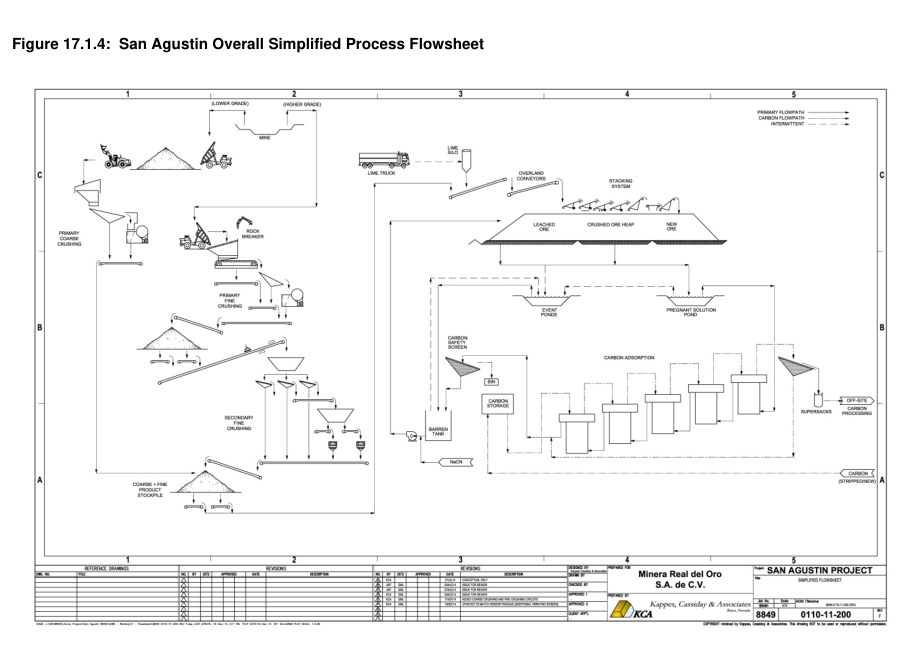
Source: Sonoro Gold Corp (2026)
Website: https://sonorogold.com/project/cerro-caliche
Critical Data
| Parameter | Value | Unit | Notes |
|---|---|---|---|
| Throughput | 16,000 | tpd | Nominal for Years 2-9; Year 1 at 12,000 tpd |
| Mill Power | 200 | kW | Primary jaw crusher installed power |
| Target Grind Size | 12.5 | mm | Crushing product P80 for heap leach feed |
| Head Grade | 0.36 | g/t | Gold head grade; silver head grade 3.7 g/t |
| Recovery % | 72 | % | Design gold recovery (discounted 2% from lab column tests of 74%) |
| Processing Capacity | 5,840,000 | tpa | Annual throughput Years 2-9 (16,000 tpd x 365 days, 360 operating days) |
| Energy Consumption | kWh/t | Not specified in Section 17 | |
| Water Consumption | m³/t | Not specified; water supplied from wells and runoff collection | |
| Operating Hours | 24 | hours/day | Two 12-hour shifts, 360 days per year |
Overview
Sonoro Gold Corp.’s Cerro Caliche Gold Project in Sonora, Mexico, employs a proven heap leach gold recovery process designed to treat low-grade gold-silver mineralized material. The Preliminary Economic Assessment (PEA) effective December 2025 outlines a robust flowsheet centered on conventional three-stage crushing, heap leaching, and carbon-in-column (CIC) adsorption to achieve a design gold recovery of 72% and silver recovery of 26.7%. Located near the town of Magdalena, the project benefits from existing infrastructure and a favorable climate for year-round operations. The process facility is designed for a nominal throughput of 12,000 tpd in Year 1, ramping to 16,000 tpd for Years 2 through 9, processing material with average head grades of 0.36 g/t Au and 3.7 g/t Ag. The recovery method leverages the ore’s soft but abrasive nature, with crushing indices supporting a product size of P80 12.5 mm. Run-of-mine material undergoes primary jaw crushing followed by secondary and tertiary cone crushing in closed circuit with screens. The crushed product is conveyed to lined heap leach pads where a drip irrigation system distributes cyanide solution. Pregnant solution reports to two trains of five-stage CIC tanks for gold and silver loading onto activated carbon. Loaded carbon is stripped, electrowon, and refined into doré bars. Water from onsite wells and seasonal runoff supports reagent mixing and pad irrigation. This heap leach gold recovery approach optimizes capital efficiency while delivering strong metal recoveries from the deposit’s disseminated mineralization. The design incorporates dust control, solution management, and a full metallurgical laboratory for process monitoring. Cerro Caliche exemplifies modern, scalable heap leach technology applied to a bulk-tonnage gold project in a mining-friendly jurisdiction.
Key Process Stages
- Stage 1: Primary Crushing – Run-of-mine material with a top size of 600 mm is fed via a vibrating grizzly into a Sandvik CJ815 jaw crusher (1,500 mm x 1,300 mm, 200 kW). Operating at a nominal 1,111 t/h (based on 60% utilization), the primary crusher reduces ore to a product suitable for conveying to a crushed mineralized material stockpile. A belt weightometer and magnet ensure feed control and tramp metal removal.
- Stage 2: Secondary and Tertiary Crushing – Crushed material from the stockpile is reclaimed via four variable-speed vibrating pan feeders and conveyed to a secondary double-deck linear screen. Oversize feeds two Sandvik CS660C cone crushers (315 kW each, 40 mm closed side setting). Tertiary circuit uses three Sandvik CS660F cone crushers (315 kW each, 18 mm closed side setting) in closed circuit with three inclined screens. The final product achieves P80 12.5 mm and is conveyed 1.45 km to the heap leach pads via grasshoppers and a TeleStacker.
- Stage 3: Heap Leach Pad System and Solution Distribution – The lined heap leach pads are built in three phases: Phase 1A covers 353,000 m² with 60 mm HDPE LLDPE liner, Phase 1B adds 276,000 m² in Year 2, and Phase 2 adds 244,000 m² in Year 4. Crushed ore is stacked by grasshoppers and leveled by a dozer. A drip-pipe system distributes cyanide leach solution at a design irrigation flow rate of 10.0 Lph/m². Pregnant solution (approx. 19,400 t/day, AuEq grade 0.22 g/t) is collected via the lined pad system.
- Stage 4: Carbon-in-Columns (CIC) Adsorption Circuit – Pregnant solution is pumped to two parallel CIC trains, each with five upflow tanks (3.6 m diameter x 3.8 m high) configured for countercurrent contact. Activated carbon (6×12 mesh) adsorbs gold and silver as solution flows upward. Carbon is advanced periodically, and barren solution drains to the barren pond for reagent addition and recirculation. Spillage control sumps are included.
- Stage 5: Carbon Stripping, Electrowinning, and Refinery – Loaded carbon is dewatered on a 28-mesh screen and transferred to stripping vessels. Gold and silver are stripped using heated caustic-cyanide solution, then recovered in electrowinning cells. The resulting sludge is smelted in an induction furnace to produce doré bars. A reactivation kiln regenerates stripped carbon for reuse. The refinery includes a fume hood, dust collector, and bullion molds, all in a secure area.
Additional Interesting Data and Summary
Beyond the core recovery flowsheet, the Cerro Caliche Project integrates comprehensive support systems and environmental controls. The water supply relies on nearby drilled wells and seasonal rain/runoff collection, with multiple high-head pumps feeding a freshwater tank for process make-up, reagent mixing, and emergency needs. The main process plant features a fully contained reagent mixing area handling hydrated lime (bulk dry), sodium cyanide (dry super sacs), caustic soda, activated carbon, and refinery slagging reagents. A dedicated metallurgical and assay laboratory, located adjacent to the plant, provides timely monitoring of process streams, daily production reporting, blast hole sampling, and exploration sample analysis. Dust control is addressed via dust collectors at each crushing stage, while the camp facilities offer accommodation for senior management and visitors, plus food preparation and worker amenities with septic systems. Instrument and process air supply is included for the CIC plant and control systems. The project’s sustainability and economic impact are underscored by its phased pad construction strategy, which defers capital while maintaining operational flexibility. The design accounts for a 60% utilization in the crushing circuit (allowing maintenance downtime) and 92% utilization in leaching and carbon adsorption. Key ore characteristics—specific gravity 2.65 g/cm³, bulk density 1.65 t/m³, moisture 2.0%, work index 16.0 kWh/t, and abrasion index 0.75 g—informed equipment selection. Water balance modeling (Figure 17.3) ensures effective management of solution inventory. The project is being advanced as a PEA, with additional metallurgical testing recommended to optimize crushing circuit design and cyanide consumption. The process design reflects a conservative 2% discount on gold recovery from lab column tests to account for field leaching inefficiencies and pad stacking effects, and a similar discount on cyanide consumption from 0.55 kg/t to 0.20 kg/t for operating costs. Looking ahead, the Cerro Caliche gold heap leach operation is positioned to become a significant low-cost producer in Sonora, leveraging established infrastructure, a skilled local workforce (via Fimsa for crusher packages), and a favorable regulatory environment. The combination of three-stage crushing, heap leaching, and carbon-in-column adsorption offers a technically sound, capital-efficient recovery method for this bulk-tonnage gold-silver deposit.
Key Processes: Heap Leaching, Cyanidation, Gravity Separation, Crushing
Target Commodities: Gold, Silver
Technical report and processing history
The following archived source profiles have been consolidated here to preserve the project’s processing history and study context.
Cerro Caliche Gold Project — 2023 Technical Report
Cerro Caliche Gold Project — 2023 Technical Report
| Company | Sonoro Gold Corp |
| Date | 2023 |
| Region | Sonora, Mexico |
| Commodities | Gold, Silver |
| Mine Type | Open Pit |
| Throughput | 4,000 t/d (Years 1-2), 12,000 t/d (Years 3-9) |
| Mine Life | 9 years |
| Status | Development |
Executive Summary
This Technical Report presents a Preliminary Economic Assessment (PEA) for the Cerro Caliche Gold Project, developed by Sonoro Gold Corp. The project design is based on a nominal throughput of 4,000 tonnes per day (tpd) for the first two years, ramping up to 12,000 tpd for years three through nine. The mineralized material features average grades of 0.43 g/t Au and 3.75 g/t Ag, with a specific gravity of 2.65 g/cm³ and bulk density of 1.65 t/m³. The design anticipates an overall gold recovery of 72% and silver recovery of 26.7%.
The process plant flowsheet utilizes a conventional three-stage crushing circuit followed by heap leaching. Run-of-mine material is reduced to a P80 of 12.5 mm and loaded onto lined heap pads. Pregnant solution is irrigated and collected, then pumped to two trains of carbon-in-column tanks for gold and silver adsorption. The facility includes carbon stripping, reactivation, electrowinning, and doré refining to produce bullion bars.
Supporting infrastructure includes surface water wells for reagent mixing and process make-up, a fully equipped metallurgical laboratory, and reagent storage for lime, sodium cyanide, and activated carbon. The plant operates on a two 12-hour shift schedule, 360 days per year, with specific utilization factors of 60% for the primary crusher and 92% for leaching and carbon adsorption circuits to account for maintenance downtime.
Reports
- reports/2023_SonoroGold_CerroCaliche
Website: https://sonorogold.com/project/cerro-caliche
Report Date: 2023
Region: Sonora, Mexico
Project Status: Development
Commodity: Gold, Silver
Throughput: 4,000 t/d (Years 1-2), 12,000 t/d (Years 3-9)
Mine Life: 9 years
Mine Type: Open Pit
Ore type: Gold-Silver Bearing
NI 43-101 Preliminary Economic Assessment Study for the Cerro Caliche Project
NI 43-101 Preliminary Economic Assessment Study for the Cerro Caliche Project
| Company | Sonoro Gold Corp. |
| Date | 2021 |
| Region | Sonora, Mexico |
| Commodities | Gold, Silver |
Executive Summary
The Cerro Caliche Project, located in Sonora, Mexico, is a development-stage mining project focused on the extraction of gold and silver. The Preliminary Economic Assessment Study outlines a process plant design capable of treating 15,000 tonnes per day of mineralized material with average grades of 0.41 g/t Au and 4.05 g/t Ag. The project utilizes a conventional crushing circuit followed by heap leaching and carbon adsorption for metal recovery.
The process flowsheet involves a three-stage crushing circuit reducing ROM material to a P80 of 12.5 mm for loading onto lined heap pads. Pregnant solution is collected and pumped to two trains of carbon in column tanks for gold and silver loading. The loaded carbon is bagged and shipped to North American refiners for stripping and recovery, as the plant does not currently include carbon stripping or electrowinning facilities.
Water supply is sourced from surface wells located approximately 3 km from the processing site. The plant is designed for a nominal throughput of 15,000 tpd with an anticipated overall gold recovery of 73.6% and silver recovery of 26.7%. The project remains in the development phase with no camp facility planned at this time.
Website: https://sonorogold.com/news/sonoro-files-updated-preliminary-economic-assessment-for-the-cerro-caliche-project
Report Date: 2021
Region: Sonora, Mexico
Project Status:
Commodity: Gold, Silver
Throughput:
Mine Life:
Mine Type:
Ore type:
Cerro Caliche Project — 2021 Technical Report
Cerro Caliche Project — 2021 Technical Report
| Company | Sonoro Gold Corp. |
| Date | 2021 |
| Region | Sonora, Mexico |
| Commodities | Gold, Silver |
Executive Summary
The Cerro Caliche Project, located in Sonora, Mexico, is currently in the development phase with a focus on gold and silver recovery through heap leaching. The process plant design is based on preliminary test work and supports a nominal throughput of 8,000 tpd in the initial years, ramping up to 15,000 tpd from Years 3 through 8. The ore is characterized by average grades of 0.41 g/t Au and 4.05 g/t Ag, with a specific gravity of 2.65 g/cm³ and bulk density of 1.65 t/m³.
The recovery circuit utilizes a three-stage conventional crushing system to reduce run-of-mine material to a P80 of 12.5 mm before loading onto lined heap pads. Pregnant solution is collected and pumped to two trains of carbon in column tanks for gold and silver adsorption. The project does not plan to operate carbon stripping or electrowinning facilities on-site; instead, loaded carbon will be shipped to North American refiners for metal recovery and carbon regeneration.
Water supply for the process is sourced from surface wells located approximately 3 km from the facility, supporting reagent mixing and heap irrigation. The plant is designed for 360 days of operation per year with specific utilization rates of 60% for the crushing circuit and 92% for leaching and carbon adsorption. Anticipated overall recoveries are 73.6% for gold and 26.7% for silver based on the design criteria.
Reports
Website: https://sonorogold.com/project/cerro-caliche
Report Date: 2021
Region: Sonora, Mexico
Project Status:
Commodity: Gold, Silver
Throughput:
Mine Life:
Mine Type:
Ore type:
