

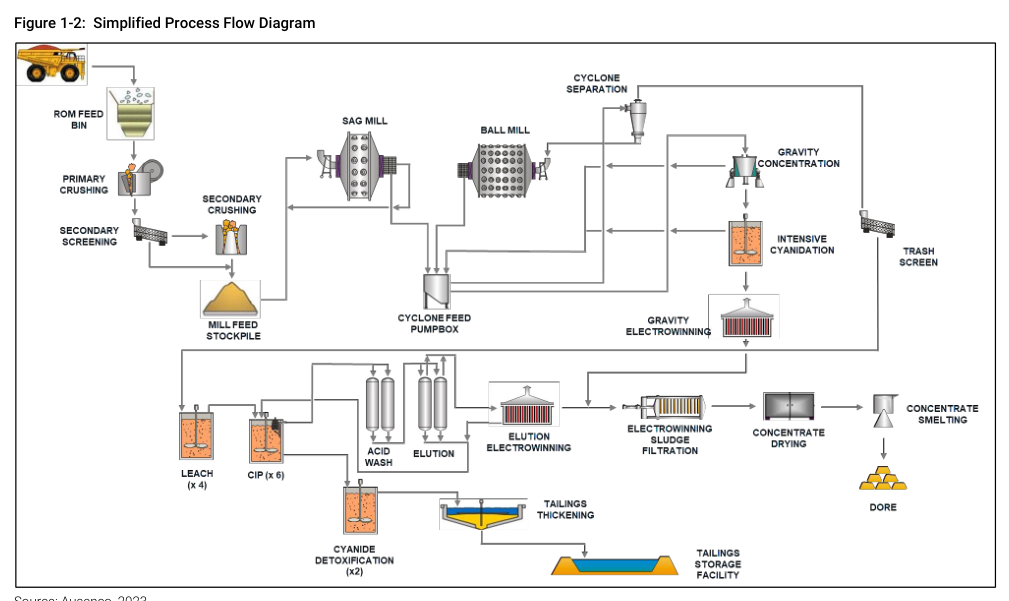
This NI 43-101 Technical Report and Preliminary Economic Assessment outlines the proposed process design for the Colomac Gold Project, where a conventional gold-processing flowsheet has been selected based on preliminary metallurgical testwork and economic modelling.
Article Body
The Colomac Gold Project is the subject of a 2023 NI 43-101 Technical Report and Preliminary Economic Assessment, which presents the proposed process design for the gold-processing plant. The flowsheet has been selected based on a review of preliminary metallurgical testwork results and subsequent economic modelling. The unit operations selected for the plant are described as standard technologies typically used in gold-processing plants. The proposed flowsheet uses conventional processes for crushing and grinding, leaching and carbon adsorption, carbon desorption with electrowinning and refining, plus cyanide destruction and tailings dewatering.
The plant design criteria have been established after a review of available metallurgical testwork and comparable industry benchmarks. The designs include a plant throughput of 6.10 Mt/a, or 16,715 t/d, with a gold head grade for design set at 1.80 g/t Au. The overall recovery for design purposes is 96.3%. Crushing plant availability is set at 65%, while mill availability is set at 92%. The process design criteria also specify a Bond Crusher Work Index of 18.7, a Bond Ball Mill Work Index of 16.0, and a Bond Abrasion Index of 0.47. The ROM specific gravity for design is given as 2.69, with a maximum size of 800 mm and moisture content of 3%.
The process plant design includes primary and secondary crushing of run-of-mine (ROM) material, a SAG mill and ball mill grinding circuit with hydrocyclone classification, a gravity circuit, an intensive leach reactor, a leach and carbon-in-pulp (CIP) circuit with carbon desorption, electrowinning and smelting to produce doré. The design also includes carbon regeneration, tailings cyanide destruction using the SO₂/air process, carbon safety screening, and tailings disposal, along with reagent storage and distribution.
Critical Data
| Parameter | Value | Unit | Notes |
|---|---|---|---|
| Plant Throughput, Design | 6.10 | Mt/a | |
| Plant Throughput, Design | 16,715 | t/d | |
| Gold Head Grade, Design | 1.80 | g/t Au | |
| Recovery for Design Purposes | 96.3 | % Au | |
| Crushing Plant Availability | 65 | % | |
| Mill Availability | 92 | % | |
| Bond Crusher Work Index (CWi), Design | 18.7 | metric | |
| Bond Ball Mill Work Index (BWi), Design | 16.0 | metric | |
| Bond Abrasion Index (Ai), Design | 0.47 | – | |
| ROM Specific Gravity, Design | 2.69 | – | |
| ROM Mineralized Material Maximum Size | 800 | mm | |
| ROM Mineralized Material Moisture | 3 | % | |
| Mill Feed Stockpile Live Capacity | 12 | h | |
| Grinding Circuit Feed Size, F80 | 36 | mm | |
| Grinding Circuit Product Size, P80 | 150 | μm | |
| Pebble Recycle Rate, Operating | 13 | % Fresh Feed | |
| Cyclone Underflow Pulp Density, Design | 72 | % Solids (w/w) | |
| Leach Cyanide Addition Rate, Design | 0.50 | kg/t | |
| Leach Hydrated Lime Addition Rate, Design | 0.1 | kg Ca(OH)₂/t | |
| Adsorption Number of Stages | 6 | – | |
| Adsorption Time Total, Design | 8 | h | |
| Carbon-in-Pulp Tail, Solution Concentration | <0.015 | mg/L Au | |
| Carbon Batch Size | 8.0 | t | |
| Type of Stripping System | – | – | Pressure Zadra |
| Number of Parallel Elution Circuits | 2 | – | |
| Number of Strips per Elution Column per Day | 1 | – | |
| Number of Acid Wash Columns | 2 | – | |
| Hydrochloric Acid Addition Rate, Design | 3.0 | % Concentrate w/v | |
| Number of Elution Columns | 2 | – | |
| Electrowinning Plating Time | 16 | h | |
| Barren Eluate Assay | <10 | mg/L Au | |
| Carbon Addition Rate, Design | 0.04 | kg/t | |
| Fuel Source for Elution Heater and Regeneration Kiln | – | – | Electric |
| Detoxification Feed CNWAD Concentration, Design | 100 | mg/L | |
| Detoxification Tanks | 2 | – | Parallel |
| Fresh Water Demand | 58 | m³/h | |
| Average Operating Power Draw | 20.8 | MW | 168 GWh/y |
Overview
The project's process plant has been designed to treat 16,715 t/d of ROM mineralized material, which corresponds to a nominal plant feed rate of 6.10 Mt/a. The process design criteria were set after a review of available metallurgical testwork and comparable industry benchmarks. The plant achieves a design recovery of 96.3% of the gold. The reagent consumption rates used for the design include 2,418 t/y of cyanide, 3,989 t/y of lime, 2,170 t/y of sulphur, 512 t/y of copper sulphate, 300 t/y of hydrochloric acid, 350 t/y of sodium hydroxide, 122 t/y of flocculant, and 244 t/y of carbon.
The process plant is expected to be a conventional gold-processing facility. The process will be supplied with low-pressure and high-pressure compressed air at 120 kPag and 750 kPag, respectively. Compressors will supply air for general process use, notably in leaching and detoxification, to a primary receiver. A portion of the air will be dried and filtered before being transferred to a dried air receiver for instrument use. The process will require an estimated 58 m³/h of fresh water. Make-up water will be reclaimed from consolidated tailings and other sources such as surface runoff and pit dewatering when available. The process plant is expected to consume 168 GWh of power per year, or an average operating power draw of 20.8 MW.
Key Process Stages
The crushing and stockpiling circuit will process run-of-mine production that is hauled from the mines and stockpiled or directly tipped into the ROM dump hopper. A primary jaw crusher with a modular rock breaker will manage very large rocks that may exceed the crusher cavity size. Major equipment in this area includes the primary jaw crusher, a secondary sizing screen, the secondary crusher, and associated material handling equipment.
The grinding circuit consists of a SAG mill in closed circuit with a ball mill and hydrocyclone cluster. The cyclone overflow gravitates over a trash screen where the oversize is collected and periodically removed. Major equipment in this area includes the SAG mill, ball mill, hydrocyclone cluster, cyclone feed pump, and gravity feed pump, along with other associated material handling equipment.
The gravity circuit includes one centrifugal concentrator with a feed scalping screen to protect the unit from oversize material. A gravity concentrator tailings return pump and other associated material handling infrastructure make up the balance of the circuit. The gravity concentrate is directed to the intensive leach reactor.
A separate intensive leach reactor circuit is used to treat the gravity gold concentrate. In the intensive leach reactor, the gold concentrate is leached into solution using sodium hydroxide, sodium cyanide, and a leach accelerant. Leach aid is used in this circuit to improve the free gold leaching process. The pregnant solution from the intensive leach reactor is directed to electrowinning.
The leach and CIP circuit treats the grinding circuit product. Hydrated lime slurry is added to maintain the operating pH at the desired set point of 10.5. The slurry is leached in a series of leach tanks and then through the CIP circuit. Major equipment in this area includes leach tanks, CIP tanks, carbon and slurry pumps, as well as associated retention screens and launders for material transfer. Carbon from the CIP circuit advances counter-currently, with loaded carbon passing over a carbon safety screen. Carbon retained on the safety screen is removed into bulk bags and shipped off-site for third-party processing.
Carbon desorption is performed using the pressure Zadra process. Screen undersize from the carbon safety screen is pumped back to the first CIP tank, while the oversize discharges to one of two acid wash columns. The acid-washed carbon is hydraulically transferred to one of two elution columns for gold stripping using a sodium cyanide and sodium hydroxide solution. Two cycles, one in each acid wash and elution column combination, can be carried out per day. After elution, the stripped carbon is dewatered by a screen over a feed hopper that feeds an electric rotary kiln via a screw feeder. The regenerated carbon is sized, with undersized carbon combined with CIP tailings into the detoxification process feed. Major equipment in this area includes the carbon dewatering screen, regeneration kiln, carbon sizing screen, and associated materials handling equipment.
Gold is recovered from the intensive leach reactor and elution pregnant solution by electrowinning, where an electrical current is applied across the cells, causing gold to deposit on the cathode surfaces. The resulting sludge is filtered, dried, mixed with fluxes, and smelted in an electric induction furnace to produce gold doré bars.
Cyanide detoxification is carried out using the SO₂/air process at a pH of 8.5, with copper sulphate used as a catalyst. Prilled sulphur is used as the source of SO₂ for cyanide detoxification. Process air is used as a source of oxygen for leaching and cyanide detoxification. Detoxification is carried out in two parallel tanks. Major equipment in this area includes the detoxification tanks, carbon safety screen, thickener, pumps, and associated slurry transfer equipment.
Additional Interesting Data and Summary
Reagent consumption rates for the plant are estimated annually at 2,418 t of cyanide, 3,989 t of lime, 2,170 t of sulphur, 512 t of copper sulphate, 300 t of hydrochloric acid, 350 t of sodium hydroxide, 122 t of flocculant, and 244 t of carbon. Wear part consumption rates include 3,068 t/y of grinding media. The reagent storage and distribution system will handle sodium hydroxide for use in the carbon elution and intensive leach reactor circuits. Process air will be used as a source of oxygen for leaching and cyanide detoxification. An antiscalant is used to reduce the formation of scale in the elution and electrowinning circuit equipment and on the activated carbon. A flux of silica, niter, and soda ash is used in gold smelting to produce slag and capture metal impurities.
Key Processes
- Crushing and stockpiling
- Grinding (SAG mill, ball mill, hydrocyclone)
- Gravity concentration
- Intensive leach reactor
- Leaching and carbon-in-pulp adsorption
- Carbon acid wash, elution, and regeneration
- Electrowinning and smelting
- Cyanide detoxification and tailings disposal
Source: Colomac Gold Project , 2023 Technical Report, 2023.
Project website: Colomac Gold Project, 2023 Technical Report
