

Overview
Nestled in the mineral-rich Department of Risaralda, Colombia, the Quinchía Gold Project represents a significant and advanced-stage development poised to become a major gold producer. Operated by Tiger Gold Corp., a Vancouver-based exploration and development company, the project is the focus of a comprehensive NI 43-101 Technical Report and Preliminary Economic Assessment dated September 2025. This detailed study, prepared by the renowned engineering firm Ausenco, outlines a robust plan to process 7.5 million tonnes of ore annually, equivalent to a daily throughput of 20,548 tonnes. The project is designed to leverage conventional yet optimized mineral processing technologies to efficiently recover gold from the Tesorito deposit and surrounding mineralized zones. The selection of a flowsheet featuring High-Pressure Grinding Rolls (HPGR) and Carbon-in-Pulp (CIP) reflects a modern approach focused on energy efficiency and high recovery rates. For the local economy and the global gold market, the Quinchía Gold Project stands as a testament to strategic mineral resource development, combining technical innovation with rigorous economic and environmental planning to unlock value from Colombia’s promising geology.
Key Process Stages
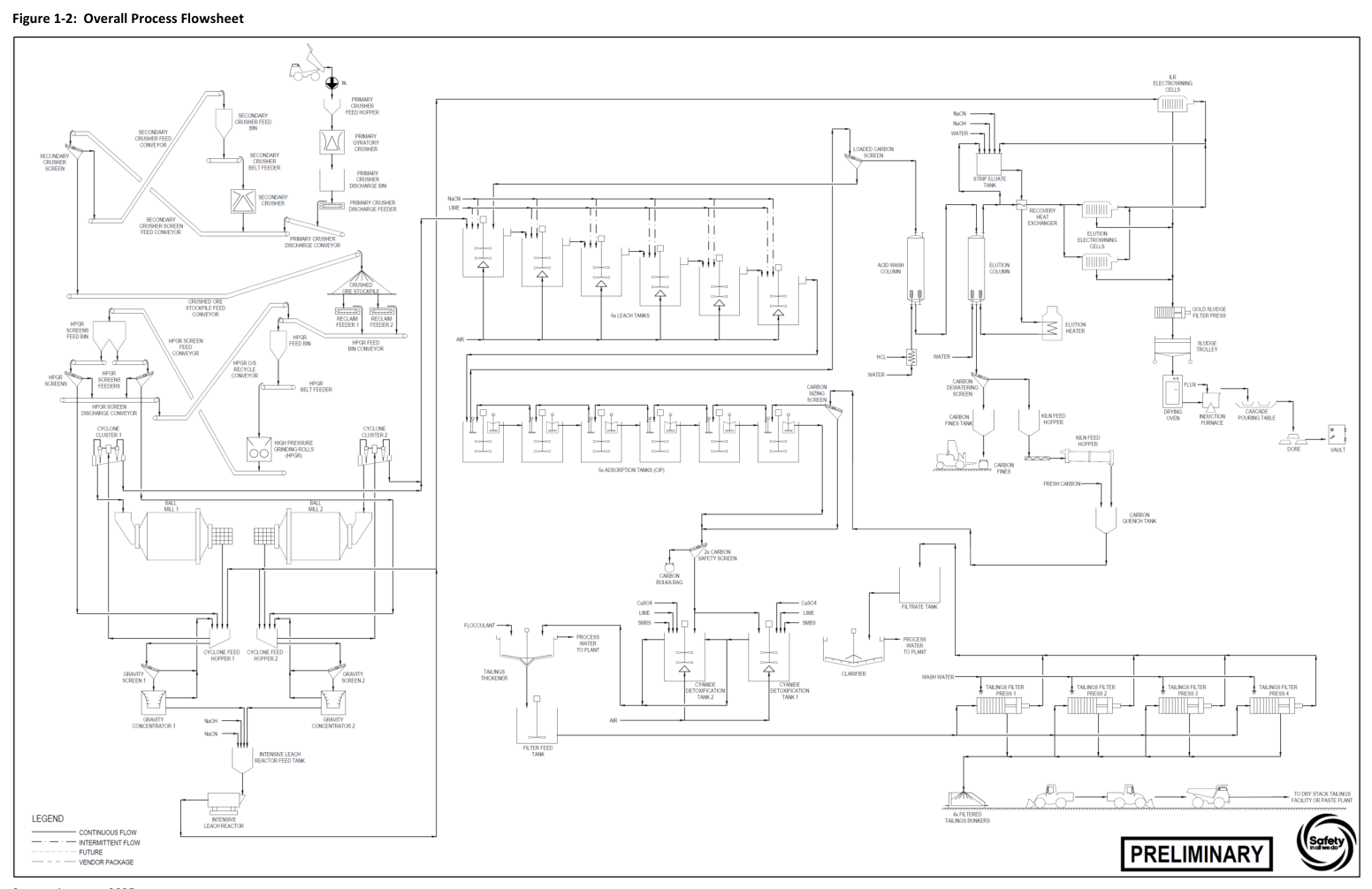
The Quinchía Gold Project employs a sophisticated and sequential mineral processing circuit designed to maximize gold recovery while optimizing energy and water usage. The circuit integrates crushing, grinding, gravity separation, leaching, adsorption, and advanced tailings management into a cohesive operation.
- Stage 1: Two-Stage Crushing Run-of-mine (ROM) ore is first reduced by a primary gyratory crusher (MK-III 4265) to a product size (k80) of 129 mm. The crushed material is then screened, with oversize fed to a secondary cone crusher (HP900) to achieve a final crushed product size of 59 mm (k80). This prepares the ore for efficient downstream grinding.
- Stage 2: HPGR & Ball Mill Grinding Circuit This innovative circuit begins with a High-Pressure Grinding Roll (Polysius 2.0m x 1.5m, 3,700 kW) in closed circuit with wet screens, reducing material to 3.25 mm (k80). The HPGR was selected over a traditional SAG mill for its lower power consumption given the ore hardness. The screened undersize feeds two parallel ball mills (7.32m x 10.67m EGL, 11,000 kW each) in closed circuit with hydrocyclones. The circuit targets a primary grind size of 75 µm (k80) at 42% solids, with a 350% circulating load.
- Stage 3: Gravity Recovery & Intensive Leaching A portion of slurry is diverted to a gravity recovery circuit using semi-batch centrifugal concentrators, designed to recover 30% of the coarse, free gold. The high-grade gravity concentrate is then treated in an Intensive Leaching Reactor (ILR) using a cyanide solution enhanced with LeachAid®. The gold-laden solution from the ILR is sent directly to a dedicated electrowinning cell.
- Stage 4: Leach, CIP Adsorption, and Elution The main stream of ground ore (cyclone overflow) enters a series of six leach tanks (18 hours residence time) where cyanide and lime dissolve the gold. The slurry then progresses through six Carbon-in-Pulp (CIP) adsorption tanks (6 hours residence time), where activated carbon granules adsorb the dissolved gold. Loaded carbon is acid-washed and stripped of gold in an AARL-type elution column using a hot caustic cyanide solution.
- Stage 5: Gold Room & Doré Production Pregnant solution from both the main elution circuit and the ILR circuit is processed in electrowinning cells. Gold plates onto steel wool cathodes, which are washed to produce a gold sludge. This sludge is dried, mixed with flux, and smelted in a furnace to produce final doré bars.
- Stage 6: Cyanide Destruction & Tailings Management A critical environmental step, CIP tailings undergo cyanide destruction using the SO2/Air process (using Sodium Metabisulphite) to reduce weak acid dissociable cyanide (CNwad) from 150 mg/L to below 2.5 mg/L. The detoxified tailings are thickened, then dewatered to ~15% moisture by four plate-and-frame filter presses for dry stacking, minimizing the environmental footprint and water consumption.
Critical Data
The following table summarizes the key operational and design parameters for the Quinchía Gold Project’s processing plant, as defined in the 2025 NI 43-101 Technical Report.
| Parameter | Value | Unit | Notes |
|---|---|---|---|
| Annual Throughput | 7.50 | Mt/y | Design capacity |
| Daily Throughput | 20,548 | t/d | Nominal operating rate |
| Mill Operating Availability | 92 | % | Grinding & downstream circuits |
| Target Primary Grind Size (P80/k80) | 75 | µm | Cyclone overflow target |
| Gravity Recovery (Design) | 30 | % | Of total gold recovered |
| Leach Extraction (Design) | 89 | % | Gold dissolution in leach tanks |
| Bond Ball Mill Work Index (BWi) | 19.1 | kWh/t | 75th percentile, indicates medium hardness |
| Installed Power Load | 43.5 | MW | For crushing and process plant |
| Operating Power Demand | 28.4 | MW | Nominal operating demand |
| Fresh Water Consumption | 138 | m³/h | For reagents, elution, potable use |
| Process Water Circulation | 1,752 | m³/h | Includes thickener overflow & filtrate recycle |
| Sodium Cyanide Consumption | 6,041 | t/y | Major leaching reagent |
Additional Interesting Data and Summary
Beyond the core process, the Quinchía design incorporates several noteworthy technical and sustainability features. The decision to employ an HPGR-based comminution circuit is a significant energy-saving choice, with the report citing over 300 industry installations mitigating technology risk. The circuit’s design recycle load of 100% at the HPGR and 350% at the ball mills highlights the focus on classification efficiency. From a reagent perspective, annual consumption is substantial, including 20,823 tonnes of hydrated lime for pH control and 8,062 tonnes of Sodium Metabisulphite (SMBS) for cyanide detoxification, underscoring the scale of the operation.
Environmental stewardship is a central pillar. The comprehensive water balance relies heavily on recycling, with thickener overflow and filter press filtrate constituting the bulk of the 1,752 m³/h process water circuit. The commitment to dry stack tailings management via filtration to 15% moisture represents modern best practice, drastically reducing the footprint and long-term liability associated with conventional slurry tailings dams. The SO2/Air cyanide destruction system is designed to meet stringent environmental compliance, targeting effluent levels well below international guidelines.
Economically, the plant’s high availability targets (92% for grinding, 85% for filtration) are crucial for achieving the projected throughput. The use of standard, proven equipment across most circuits is intended to ensure operational reliability and maintainability. For Tiger Gold Corp., the successful implementation of this flowsheet as detailed in the PEA is the critical path to transforming the Quinchía Gold Project from a detailed technical study into a financially robust, socially responsible, and environmentally sound gold mining operation in Colombia. The project exemplifies how contemporary mineral processing integrates cutting-edge efficiency with rigorous environmental controls to define the future of responsible mining.
Source: NI 43-101 Technical Report | Preliminary Economic | Project: Gold Project | Date: September 2025
Further Reading
- Tiger Gold Corp – Advancing the Quinchía Gold Project in …
- Quinchia Gold Project
- Quinchia Project – Tiger Gold
- Quinchia Gold Project
Technical report and processing history
The following archived source profiles have been consolidated here to preserve the project’s processing history and study context.
Quinchía Gold Project — 2025 Technical Report
Quinchía Gold Project — 2025 Technical Report
| Company | Not Specified |
| Date | 2025 |
| Commodities | Gold |
Executive Summary
The Quinchía Gold Project 2025 Technical Report outlines the proposed recovery methods for the project, selected based on historical metallurgical testwork and preliminary economic modelling. The process plant utilizes conventional technologies adapted for the specific mineralisation characteristics, featuring a two-stage crushing circuit followed by a comminution circuit that integrates a High-Pressure Grinding Roll (HPGR) with ball mills. This configuration was chosen to reduce power consumption compared to traditional SAG mill flowsheets, leveraging the hardness of the mineralised material identified in testwork.
The flowsheet includes gravity recovery of coarse gold using semi-batch centrifugal concentrators, followed by intensive cyanidation of the gravity concentrate. The main gold recovery circuit employs Carbon-in-Pulp (CIP) adsorption with six leach and six adsorption tanks. The process concludes with carbon regeneration, cyanide destruction using the SO2/air method, and tailings thickening and filtration for dry stacking. Key design criteria include a daily throughput of 20,548 tonnes and a design leach extraction of 89%.
Operational availability varies by circuit, with crushing at 65%, grinding at 92%, and tailings filtration at 85%. The plant is designed to operate 365 days per year. Reagent consumption includes significant quantities of hydrated lime and sodium cyanide, with specific requirements for elution and detoxification circuits. The overall design aims for economic favourability through reduced operating power and consumables costs associated with the HPGR technology.
Reports
Website: https://tigergoldco.com/quinchia-project/
Report Date: 2025
Region:
Project Status:
Commodity: Gold
Throughput:
Mine Life:
Mine Type:
Ore type:
Inside the Quinchía Gold Project: A Deep Dive into the 20,500 tpd HPGR-Ball Mill & CIP Processing Circuit
Overview
Nestled in the mineral-rich Department of Risaralda, Colombia, the Quinchía Gold Project represents a significant and strategically important development in the global gold mining landscape. Operated by Tiger Gold Corp., a Vancouver-based exploration and development company, this advanced-stage project is poised to become a major gold producer. The cornerstone of the project is a robust, modern mineral processing facility designed to treat 7.5 million tonnes of ore annually, equivalent to a daily throughput of 20,548 tonnes. The facility’s design, detailed in a comprehensive NI 43-101 Technical Report and Preliminary Economic Assessment (PEA) with an effective date of September 2025, leverages conventional yet optimized technologies to efficiently recover gold from the Tesorito deposit and surrounding mineralized zones. The selection of a High-Pressure Grinding Roll (HPGR) and ball mill comminution circuit, coupled with gravity recovery and Carbon-in-Pulp (CIP) leaching, underscores a commitment to energy efficiency and high recovery rates. This project is not only critical for Tiger Gold Corp.’s growth but also holds substantial economic promise for the local region, aiming to extract gold from ore with a design head grade of 0.87 g/t Au through a meticulously engineered flowsheet.
Key Process Stages
The Quinchía Gold Project employs a comprehensive and sequential mineral processing circuit designed for high throughput and optimal gold recovery. The flowsheet integrates size reduction, liberation, concentration, and extraction stages, culminating in the production of gold doré bars. Below is a detailed breakdown of each critical stage.
- Stage 1: Two-Stage Crushing Run-of-mine (ROM) ore is first reduced by a primary gyratory crusher (MK-III 4265) to a product size of 129 mm (k80). The crushed material is then screened, with oversize reporting to a secondary cone crusher (HP900) for further reduction to a final crushed product size of 59 mm (k80). This prepares the ore for efficient downstream grinding.
- Stage 2: HPGR & Ball Mill Grinding Circuit This energy-efficient comminution circuit begins with a High-Pressure Grinding Roll (Polysius 2.0m x 1.5m, 3,700 kW) in closed circuit with wet screens, reducing material to 3.25 mm (k80). The screen undersize feeds two parallel ball mills (7.32m x 10.67m EGL, 11,000 kW each) operating in closed circuit with hydrocyclones. The circuit is designed to achieve a primary grind size of 75 µm (k80) at 42% solids, which is optimal for gold liberation.
- Stage 3: Gravity Recovery & Intensive Leaching A portion of the cyclone feed slurry is diverted to a gravity recovery circuit featuring centrifugal concentrators preceded by scalping screens. This circuit is designed to recover 30% of the coarse, free-milling gold. The high-grade gravity concentrate is then treated in an Intensive Leaching Reactor (ILR) using a cyanide-based solution, with the gold-laden solution sent directly to a dedicated electrowinning cell.
- Stage 4: Leach, Adsorption (CIP), & Elution The main stream of ground ore undergoes cyanide leaching in a series of six agitated tanks with an 18-hour residence time. The gold in solution is then recovered via a six-stage Carbon-in-Pulp (CIP) adsorption circuit. Loaded carbon is acid-washed and stripped using an Anglo-American Research Laboratory (AARL) elution process to produce a rich, pregnant solution.
- Stage 5: Electrowinning, Smelting & Tailings Management Gold is plated onto cathodes from the elution and ILR solutions in electrowinning cells. The sludge is dried, mixed with flux, and smelted in a furnace to produce doré bars. Meanwhile, CIP tailings undergo cyanide destruction using the SO2/air process to meet environmental standards, are thickened, and finally dewatered to ~15% moisture via plate-and-frame filter presses for dry stack tailings disposal.
Critical Data
The operational and design parameters for the Quinchía processing plant are founded on extensive metallurgical testwork and engineering studies. The table below summarizes the key performance indicators and design criteria that define the circuit’s capacity and efficiency.
| Parameter | Value | Unit | Notes |
|---|---|---|---|
| Annual Throughput | 7.50 | Mt/y | Design capacity |
| Daily Throughput | 20,548 | t/d | Nominal operating rate |
| Operating Availability (Grinding) | 92 | % | Annual operating time basis |
| Target Primary Grind Size (P80) | 75 | µm | Cyclone overflow target |
| Design Gravity Recovery | 30 | % | Percentage of total gold recovered by gravity |
| Design Leach Extraction | 89 | % | Gold extraction in leach tanks |
| Installed Power Load | 43.5 | MW | For crushing and process plant |
| Nominal Operating Power Demand | 28.4 | MW | Estimated running demand |
| Fresh Water Consumption | 138 | m³/h | For reagents, elution, potable use, and makeup |
| Process Water Consumption | 1,752 | m³/h | Main circuit usage (largely recycled) |
| Sodium Cyanide Consumption | 6,041 | t/y | Major leaching reagent |
| Ball Mill Media Consumption | 8,513 | t/y | Estimated annual usage |
Additional Interesting Data and Summary
Beyond the core process stages, the Quinchía Gold Project’s design incorporates several noteworthy technical and sustainability features. The decision to employ an HPGR over a more traditional SAG mill was driven by a detailed economic analysis that considered the ore’s hardness (Bond Ball Mill Work Index of 19.1 kWh/t) and the technology’s superior energy efficiency. This choice is expected to result in lower operating power and consumable costs over the life of the mine. The circuit’s water management strategy is highly integrated, aiming to maximize recycling. The tailings thickener overflow and filtration plant filtrate are collected and reused as process water, significantly reducing the fresh water footprint to 138 m³/h. The commitment to environmental stewardship is further evidenced by the inclusion of a robust cyanide destruction circuit using the SO2/air process, designed to reduce Weak Acid Dissociable (WAD) cyanide levels from 150 mg/L to below 2.5 mg/L, aligning with international best practices for tailings management.
The project’s reagent consumption profile, detailed in the PEA, highlights the scale of operations, with major annual consumables including 20,823 tonnes of hydrated lime for pH control and 8,062 tonnes of sodium metabisulphite for cyanide detoxification. The dry stack tailings facility, enabled by the filter presses, represents a modern approach to tailings storage, reducing long-term environmental liability and water consumption compared to conventional slurry impoundments. With an estimated nominal operating power demand of 28.4 MW, the project’s energy intensity is a key focus. The selection of equipment and the flowsheet configuration directly address this, aiming for a cost-effective and sustainable operation. As outlined in the September 2025 NI 43-101 report, this processing plant forms the economic engine of the Quinchía Gold Project, designed to deliver strong recoveries and operational reliability while adhering to stringent environmental and safety standards, positioning Tiger Gold Corp. as a responsible future gold producer in Colombia.
Source: NI 43-101 Technical Report | Preliminary Economic | Project: Gold Project | Date: September 2025
