

This article describes the conceptual processing route and plant design criteria presented in the February 2016 NI 43-101 Preliminary Economic Assessment for the Constellation Project, incorporating the Los Helados Deposit, Chile, and the Josemaría Deposit, Argentina.
Report context
The Constellation Project technical report, dated February 2016, presents a preliminary economic assessment for the combined project incorporating the Los Helados deposit in Chile and the Josemaría deposit in Argentina. The report includes a conceptual process flow sheet and plant design for treating mill feed from both deposits over a mine life that begins with open pit mining at Josemaría, later blends feed from Los Helados underground operations, and concludes with only Los Helados underground feed.
Processing route
Comminution circuit selection
The metallurgical testwork programs reviewed two alternative comminution technologies: conventional semi-autogenous grind (SAG) milling and high pressure grinding rolls (HPGR). Based on the testwork completed, a decision was made to proceed with HPGR technology due to estimated significant life-of-mine operating cost savings. The report notes that this decision was based on early-stage metallurgical testwork results and a high-level financial analysis, and recommends that a more detailed techno-economic trade-off study on SAG versus HPGR should be conducted.
Primary crushing and conveying
For the Josemaría mill feed material, run-of-mine material will be trucked from inside the pit to two gyratory jaw crushers located just outside of the Josemaría open pit. The material will be primary crushed and then conveyed to a common primary crushed stockpile located at the plant via a conveying system consisting of three conveyors: JM1 (1.36 km), JM2 (1.57 km), and JM3 (1.99 km).
Run-of-mine material from Los Helados will be primary crushed underground in jaw gyratory crushers and conveyed to the surface via an underground conveying system. At surface, the mill feed will be transferred to surface conveyors and transported to the central primary crushed stockpile at the plant using a conveying system consisting of the LH1 (2.80 km), JM2, and JM3 conveyors.
Comminution circuit design
The base case comminution circuit design is a conventional HPGR crushing circuit followed by conventional ball mill grinding. Design was based on the more competent Los Helados material, since this is the primary mill feed source for the life of mine, and not on the less competent Josemaría material.
Primary crushed material from the primary crushed ore stockpile will be control-fed to conveyors and then to a conventional secondary screening circuit where the material will be combined with secondary cone crushed product. The combined new feed and secondary crushed product will then be fed to a storage bin and control-fed to six conventional vibrating screens. Screen undersize material will be conveyed to a storage bin feeding the HPGR crushers, whilst screen oversize material will be fed to the secondary crushing. The undersize material will be combined with screen oversize product from the HPGR crushers. This combined material will be control-fed individually to four separate HPGR crushers, with the product being conveyed to eight vibrating discharge screens located at the discharge of four ball mills (two screens per mill) operating in parallel. Ball mill discharge screen undersize material will flow into the ball mill discharge hopper where it will be pumped to a bank of hydro-cyclones for classification. Cyclone underflow will flow by gravity to a distribution box and be split evenly to the ball mills, whilst cyclone overflow will be directed to the copper sulphide flotation area.
Flotation circuit
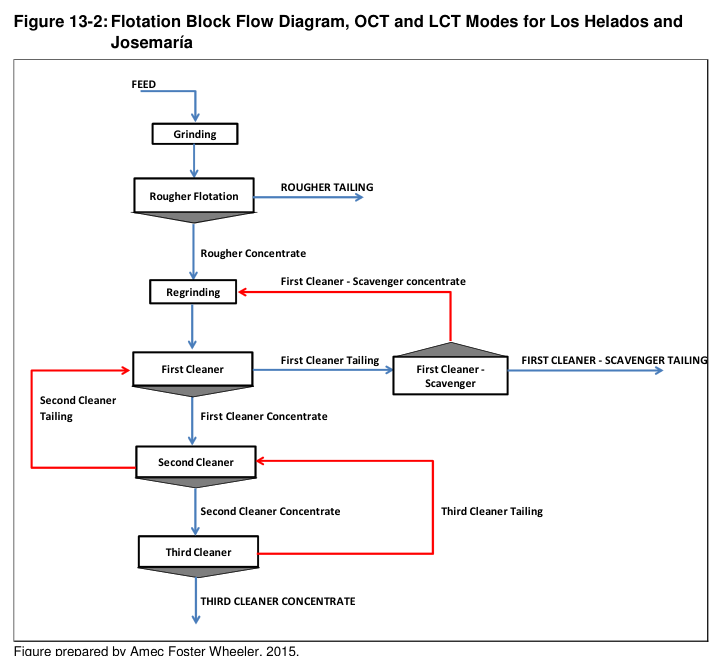
Conventional sulphide flotation will follow the comminution stage. The circuit will commence with a rougher flotation section. Rougher flotation concentrate will be produced and directed to a vertical mill regrind stage in closed circuit with hydrocyclones. Overflow pulp from the hydrocyclones will be directed to three sequential stages of conventional cleaning flotation. Cleaner scavenger flotation will be installed on the discharge from the first cleaning stage.
Tailings and water recovery
Tailings from the rougher flotation and cleaner scavenger flotation stages will be combined and will report to the final tails thickener, where 74% of the water will be recovered. The tails will go to the tailings storage facility where approximately 20% of the contained water in the tailings will be recovered and sent back to the process plant.
Copper concentrate from the third cleaner stage will be directed to the concentrate thickener and filtration stages. The water obtained from the concentrate thickener, tailings thickener, and concentrate filter will also be recovered and sent back to the process plant.
Reagent and consumables consumption
The reagent consumption estimate includes lime addition at 0.45 g/t new feed, collector SASCOL 95 at 25 g/t new feed, collector MATCOL TC-123 at 5 g/t new feed, frother MIBC at 10 g/t new feed, and tailings thickener flocculent dose rate at 3 g/t plant feed rate. Consumables estimates include ball mill media consumption of 691 g/t for Josemaría material and 864 g/t for Los Helados material, and regrind mill media consumption of 60 g/t for Josemaría and 108 g/t for Los Helados.
Key reported parameters
| Parameter | Unit | Design / Basis |
|---|---|---|
| Plant operation | d/a; h/d | 365 d/a; 24 h/d |
| Plant design capacity – Josemaría | dry t/d | 150,000 |
| Plant design capacity – Los Helados | dry t/d | 120,000 |
| Plant utilization | – | 0.94 |
| Specific gravity – Josemaría | – | 2.69 |
| Specific gravity – Los Helados | – | 2.74 |
| Bond ball mill work index – Josemaría | kWh/t | 15 |
| Bond ball mill work index – Los Helados | kWh/t | 19.3 |
| ROM F80 | mm | 143 |
| HPGR specific energy requirement – design | kWh/t | 13.1 |
| Target P80 – Los Helados | µm | 125 |
| Target P80 – Josemaría | µm | 160 |
| Average copper head grade – Both Deposits | % | 0.38 |
| Average gold head grade – Both Deposits | g/t | 0.17 |
| Final copper concentrate grade – LOM average | % | 29.1 |
| Stage copper recovery – Design (rougher) | % | 93.7 |
| Cleaning stages copper recovery – Design | % | 94.8 |
| Effective flotation residence time – Josemaría | min | 19 |
| Effective flotation residence time – Los Helados | min | 24 |
Project website: https://en.wikipedia.org/wiki/Constellation_program
Technical qualifications
The report notes several limitations and recommendations. The decision to use HPGR technology was based on early-stage metallurgical testwork results and a high-level financial analysis, and a more detailed techno-economic trade-off study on SAG versus HPGR should be conducted. Additional physical characterization and flotation optimization tests should be conducted on mineralization variability from both deposits, including further SAG mill competency and bench-scale HPGR testing, particularly with respect to the Josemaría deposit.
In this study, the plant is to be located in Argentina close to the Josemaría deposit, which impacts on the selected HPGR comminution route as unit energy costs are lower than in Chile, and it is assumed that a sufficient supply of fresh water with low salt content will be available for process make up. Available water supplies from the Josemaría region should be used for metallurgical testwork going forward.
Due to the aridness of the region, water recovery processes should be reviewed as part of more detailed studies. Areas to assess include consideration of tailings thickening to either paste or filtered tailings which would reduce the water requirement, thereby reducing pumping and pipeline capital and operating costs.
Source: Constellation Project incorporating the Los Helados Deposit, Chile and the Josemaría Deposit, Argentina, NI 43-101 Technical Report on Preliminary Economic Assessment, February 2016, Section 17.0 Recovery Methods.
