

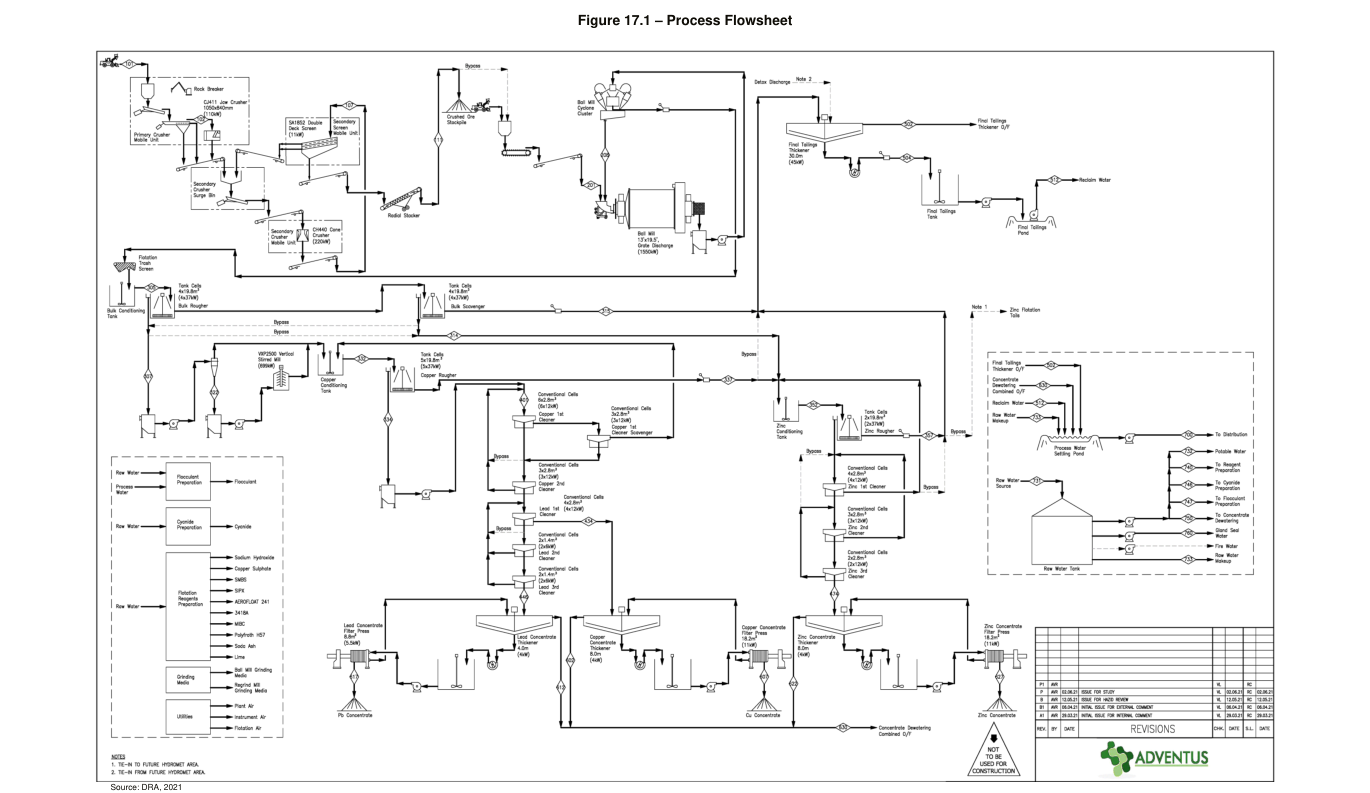
The processing plant is designed to handle ore from the Curipamba-El Domo polymetallic project, a planned open pit mine in the provinces of Bolivar and Los Rios, Ecuador. The project is 75 percent owned by Silvercorp Metals Inc., with Salazar Resources holding the remaining 25 percent. Facilities and infrastructure are under construction, with permits and licenses guaranteed. Construction and pre-production began in January 2026, with commercial operation expected to run for 11.5 years after roughly 1.5 years of construction. The processing plant has a nominal design capacity of 666,000 tonnes per year.
Critical Data
| Parameter | Value | Unit | Notes |
|---|---|---|---|
| Annual throughput (design) | 1,850 | tpd | Nominal design capacity |
| Annual throughput (design) | 666,000 | tpa | Nominal design capacity |
| Operation days per year | 330 | days | Plant operates continuously |
| Grinding and flotation operating hours per year | 7,920 | hours | 90.41% operating rate |
| Crushing operating hours per year | 3,960 | hours | 45.21% operating rate |
| Crushing circuit feed size, F100 | 500 | mm | Run-of-mine top size |
| Crushing circuit product size, P80 | 150 | mm | Jaw crusher product |
| Primary grinding fineness, P80 | 125 | μm | Design value |
| Regrinding product fineness, P80 | 15 | μm | Design value |
| SAG mill grinding density | 75 | % | Design value |
| Ball mill grinding density | 75 | % | Design value |
| Cyclone pulp density | 30 | % | Design value |
| Concentrate water content | 10 | % | Design value |
| Tailings pulp density | 50 | % | Design value |
| Ball mill circulating load | 250 | % | Design value |
| SAB feed rate | 77.08 | t/h | Design value |
| Copper concentrate grade (design) | 25.35 | % Cu | Design target for final product |
| Zinc concentrate grade (design) | 53.50 | % Zn | Design target for final product |
| Lead concentrate grade (design) | 20.65 | % Pb | Design target for final product |
| Process water demand, total | 10,636 | m³/d | Design value |
| Make-up fresh water | 241 | m³/d | 0.13 m³/t of ROM |
| Reclaimed water | 10,445 | m³/d | 98.2% reuse rate |
| Annual power consumption | 37.87 | million kWh/a | Design value |
| Specific power consumption | 62.04 | kWh/t of ROM | Design value |
Overview
The recovery methods section of the technical report on the Curipamba-El Domo project describes a processing plant designed by Yantai Oriental Metallurgical Engineering Co., Ltd. based on the December 2021 feasibility study prepared by DRA Global Ltd. The preliminary design was completed in February 2026. Metallurgical testwork was carried out by BML between 2019 and 2023, with additional analysis and verification tests in July 2025. In December 2025, GRINM was commissioned to conduct further testwork including process mineralogy studies and closed-circuit flotation tests for different flowsheet configurations.
The processing flowsheet was developed from multiple metallurgical testing programs and considered actual production flowsheets from similar concentrators already operating in Ecuador. The plant will operate 330 days per year with two 12-hour shifts daily. The crushing system operates two shifts per day at six hours per shift.
The designed final products are copper concentrate at 25.35 percent copper, zinc concentrate at 53.50 percent zinc, and lead concentrate at 20.65 percent lead. Gold and silver are concentrated among these three concentrates for overall recovery. Copper and zinc concentrates are considered saleable products with attractive gold and silver credits, though payability for gold and silver is less favourable in zinc concentrate. The lead concentrate has a relatively low lead grade and high copper content, which makes its marketing challenging. However, it carries significant gold and silver credits. Approximately 34 percent of gold and 26 percent of silver losses occur in the zinc rougher tailings.
Key Process Stages
The designed process consists of primary crushing, a SAB grinding circuit, partial preferential copper-lead flotation, copper-lead-zinc bulk flotation, regrinding of the bulk flotation concentrate, copper-zinc separation flotation, copper-lead separation flotation, zinc-sulfur separation flotation, and concentrate dewatering.
Run-of-mine ore is dumped by trucks into the coarse ore bin or hauled to the ROM stockpile for storage and later rehandling by wheel loader. A fixed grizzly with 500 by 500 millimeter openings sits on top of the bin. Oversize rock is broken by a mobile hydraulic rock breaker. Undersize ore feeds into the bin and is withdrawn by one GBZ1858 heavy-duty apron feeder to a C106 jaw crusher for primary crushing. The crushed product discharges at P80 of 150 millimeters and is conveyed to an intermediate stockpile.
Material from the intermediate stockpile is withdrawn by three GBZ12-6 apron feeders onto a belt conveyor that feeds one 5.03 meter by 2.8 meter semi-autogenous mill for grinding. SAG mill discharge is screened by one 2ZKR2052 linear vibrating screen with five millimeter apertures. Screen undersize is pumped to a cluster of FX500 by 6 hydrocyclones with four operating and two standby. Cyclone overflow passes through a ZKR2052 trash screen and flows by gravity to the flotation circuit. Cyclone underflow goes to one 3.6 meter by 6.5 meter overflow ball mill with ball mill discharge returning to the cyclone feed pump box. The primary grinding product has a fineness of P80 of 125 micrometers at a slurry density of 30 percent solids. Space is reserved in the grinding circuit for a Knelson centrifugal gravity concentrator.
The classified overflow goes to one CT-3 by 12 flotation column for first-stage copper-lead preferential rougher flotation. Column tailings flow by gravity to four XCF/KYF-30 air-inflation flotation cells for the second rougher stage. Second rougher tailings go to the copper-lead-zinc bulk flotation system. Combined concentrates from both rougher stages go to one CT-2 by 9 flotation column for cleaning. Cleaner tailings flow to one 2500 by 2500 millimeter agitated tank for reagent conditioning and then to two XCF/KYF-30 air-inflation cells for cleaner-scavenger flotation. Cleaner-scavenger tailings go to the bulk concentrate regrind circuit. Cleaner-scavenger concentrate together with cleaner concentrate forms copper-lead preferential 1 concentrate, which is pumped either to the copper-lead separation circuit or directly to the copper concentrate thickener.
Second rougher tailings from the partial preferential copper-lead flotation are conditioned with reagents and flow by gravity to three XCF/KYF-30 air-inflation flotation cells for bulk flotation roughing. Rougher tailings undergo two stages of scavenger flotation. When oxidized zinc minerals are present, copper sulfate is added to the second scavenger cells and the concentrate feeds the zinc-sulfur separation rougher stage. Otherwise, the final bulk flotation tailings go to a 20 meter high-efficiency tailings thickener. Bulk flotation rougher concentrate passes through a 3000 by 3000 millimeter agitation tank for defoaming and then goes to the bulk concentrate regrind circuit.
The bulk concentrate regrind circuit uses two-stage regrinding and classification. The first regrind stage uses one VGX-1000 vertical mill in closed circuit with a cluster of FX200 by 12 hydrocyclones, producing P80 of 25 micrometers. The first-stage regrind product is further classified by a cluster of FX100 by 18 hydrocyclones. Cyclone underflow goes to one SMD-355 stirred mill operating in open circuit. Stirred mill discharge and second-stage cyclone overflow go to the copper-zinc separation flotation circuit. Final regrind fineness is P80 of 15 micrometers.
The regrind product after reagent conditioning goes to one CT-5.5 by 12 flotation column for first-stage rougher flotation. Column tailings flow by gravity to four XCF/KYF-30 air-inflation cells for the second rougher stage. Second rougher tailings go to the zinc-sulfur separation system. Combined concentrates from both rougher stages go to one CT-3 by 9 flotation column for cleaning. Cleaner tailings go to a cluster of FX75 by 12 hydrocyclones for thickening. Cyclone underflow returns to the SMD-355 stirred mill, and overflow goes back to the rougher conditioning tank.
Concentrates from the preferential flotation and from the copper-zinc separation cleaning stage enter the copper-lead separation circuit. One-stage roughing followed by one-stage cleaning is used. Rougher tailings become the copper concentrate and go to a 20 meter copper concentrate high-efficiency thickener. Cleaner concentrate becomes the lead concentrate and goes to a 3.6 meter lead concentrate thickener.
Scavenger tailings from the copper-zinc separation circuit together with second scavenger concentrate from the copper-lead-zinc bulk flotation enter the zinc-sulfur separation circuit. Two-stage roughing, one-stage cleaning, and one-stage scavenging is used. Cleaner concentrate becomes the zinc concentrate and goes to a 15 meter zinc concentrate high-efficiency thickener. First scavenger tailings go to an 18 meter tailings thickener.
Copper concentrate is pumped to a 20 meter high-efficiency thickener. Thickener underflow goes to a buffer tank then to one TPS38/38M45 and one HDLY/II-36 vertical automatic filter press. Lead concentrate is pumped to a 3.6 meter thickener then to one HDLY/I-9 vertical automatic filter press. Zinc concentrate is pumped to a 15 meter thickener then to one TPS26/26M45 vertical automatic filter press. Dewatered concentrate is packed into one-tonne bags by an automatic bagging machine and stored by forklift.
Bulk flotation tailings go to a 20 meter high-efficiency thickener and are thickened to 50 percent solids. Zinc tailings go to an 18 meter thickener and are also thickened to 50 percent solids. The thickened tailings are pumped separately by slurry pumps to the tailings storage facility. The concentrator produces two types of tailings. Mixed flotation tailings have a dry tonnage of 869.50 tonnes per day with slurry density of 3.00 tonnes per cubic meter. Zinc flotation tailings have a dry tonnage of 777.93 tonnes per day with slurry density of 4.53 tonnes per cubic meter.
Additional Interesting Data and Summary
The plant layout is arranged in a linear or I-shaped configuration making use of natural topography and elevation differences. Gravity flow is used wherever possible. Similar equipment is grouped and centrally controlled. The total process water demand is 10,636 cubic meters per day with process water reuse at approximately 98.2 percent. The primary fresh water source is stream flow in a gully about three kilometers northwest of the concentrator. Backup sources come from treated effluents of the EWTP1 tailings storage facility water treatment plant and the EWTP2 open pit water treatment plant. Reclaimed water includes plant reclaim water from thickener overflow and filter press filtrate and TSF reclaim water.
Power comes from a 69/13.8 kV substation southwest of the plant. During initial production, power will come from high-voltage diesel generator sets. When the external 69 kV grid is fully available, the generators become backup.
The SRK consultants consider the SAB comminution process more suitable than conventional multi-stage crushing, given the open pit mining method and high rainfall during wet season. They note that conventional multi-stage crushing is more prone to blockages with slime in the ore stream. The mechanical cell-column combined flotation scheme was selected over a single mechanical cell scheme to balance resource value and economic viability for this ultra-fine grained copper-lead-zinc ore. The Yantai Oriental design adopted partial preferential flotation based on GRINM test results showing that qualified copper concentrate could be obtained without regrinding a portion of the feed. The two-stage regrinding process was selected over single-stage regrinding to reduce overgrinding risk and provide stronger system adaptability.
The designed processing indicators are average figures over the life of mine and will vary with feed grade and lithology changes. The report notes that a ROM blending strategy is required to stabilize plant feed grade because target metal grades vary significantly across the deposit.
Key Processes
- Primary crushing using a jaw crusher reduces ROM from F100 of 500 mm to P80 of 150 mm
- SAB grinding circuit combines a 5.03 by 2.8 meter SAG mill with a 3.6 by 6.5 meter ball mill to achieve P80 of 125 μm
- Partial preferential copper-lead flotation uses a flotation column for first-stage rougher and mechanical cells for second-stage rougher, with a column cleaner
- Bulk copper-lead-zinc flotation uses mechanical flotation cells for roughing and two stages of scavenging
- Two-stage regrinding reduces bulk concentrate from 125 μm to 15 μm using a vertical mill and a stirred mill with cyclone classification between stages
- Copper-zinc separation uses a flotation column for first-stage rougher and mechanical cells for second-stage rougher, with a column cleaner
- Copper-lead separation uses one stage of roughing and one stage of cleaning in flotation columns
- Zinc-sulfur separation uses two stages of roughing, one cleaning stage, and one scavenging stage
- Concentrate dewatering uses high-efficiency thickeners followed by vertical automatic filter presses for each concentrate type
Source: Technical Report on Curipamba-El Domo Polymetallic Project, in Ecuador, May 31, 2026. Project website: Curipamba-El Domo Polymetallic Project
