

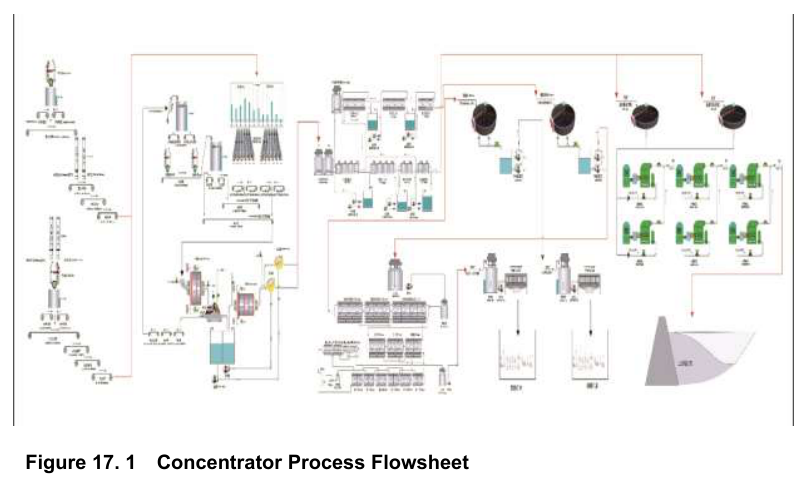
The No. 2 Concentrator Plant at the Jiama Copper Polymetallic Mine in Tibet uses a flowsheet designed for multiple ore types, with separate circuits for copper-lead-zinc and copper-molybdenum ores.
The Jiama Copper Polymetallic Mine is an operating mine located in Tibet, China. The project is owned by China Gold International Resources Corp. Ltd. and operated by Tibet Huatailong Mining Development Co., Ltd. The processing facilities described in this report focus on the No. 2 Concentrator Plant, which is designed to process 12.6 Mtpa of copper-molybdenum ore and copper-lead-zinc ore sourced from both open-pit and underground mining operations.
The report does not state a development status or expected construction timing for this concentrator plant. The information that follows covers the process flowsheet and engineering design basis for the existing facility.
Critical Data
| Parameter | Value | Unit | Notes |
|---|---|---|---|
| Plant name | No. 2 Concentrator Plant | Not applicable | Operated by Tibet Huatailong Mining Development Co., Ltd. |
| Design throughput | 12.6 | Mtpa | Combined copper-molybdenum and copper-lead-zinc ore |
| Crushing feed top size | Less than 300 | mm | Feed to ROM stockpile |
| SAG mill dimensions | Φ10.37 × 5.19 | m | Dual-drive |
| Ball mill dimensions | Φ7.32 × 12.5 | m | Dual-drive overflow |
| Hydrocyclone size | G660 × 10 | Not applicable | Cluster configuration |
| Flotation cell types | KYF-200, KYF-50, XCF-24/KYF-24, XCF-16/KYF-16, XCF-12/KYF-12, XCF-8/KYF-8, XCF-6/KYF-6 | Not applicable | Various sizes for different stages |
| Concentrate thickener type | GZN45 | Not applicable | Copper and copper-lead-zinc |
| Concentrate filter press type | CJZH-18/100/30 | Not applicable | Plate-and-frame filter press |
| Molybdenum filter press type | XMZGE80/1000-U | Not applicable | Plate-and-frame filter press |
| ROM stockpile storage | 124.16 | kt | 64,000 m³ effective volume |
| ROM stockpile duration | 3.1 | days | Not applicable |
| Upstream buffer bin capacity | 1,127 | t | 575 m³ volume |
| Downstream buffer bin capacity | 1,229 | t | 627 m³ volume |
| Lime stockpile capacity | 1,700 | t | 1,400 m³ volume |
| Concentrate storage area | 1,980 and 720 | m² | Two separate areas |
| Concentrate storage duration | 24 and 60 | days | Not applicable |
Overview
The No. 2 Concentrator Plant encompasses the complete mineral processing chain from crushing through final concentrate shipment and tailings disposal. The concentrator process design is based on test work results, evaluation data, trade-off studies, and related design information described elsewhere in the report.
The major processing facilities include crushing, grinding and classification, flotation, concentrate thickening and filtration, and supporting auxiliary facilities.
Key Process Stages
The processing plant uses a single-stage open-circuit crushing process. The crushing system has separate open-pit and underground circuits with identical processing capacities and configurations. For the open-pit circuit, ore is transported by truck to a primary crushing station and fed into a 50-65 hydraulic gyratory crusher. Crushed ore discharges into a surge bin, then a heavy-duty apron feeder withdraws ore onto the open-pit conveyor system. Multiple belt conveyors transport the material to the ROM stockpile feed point.
For the underground circuit, ROM ore is transported by electric locomotives and fed by a vibrating feeder into a 50-65 hydraulic gyratory crusher. Crushed ore enters a surge bin, then a heavy-duty apron feeder withdraws ore onto the underground conveyor system. Multiple belt conveyors transport the ore to the ROM stockpile feed point.
Dust suppression measures have been incorporated into the crushing plant design.
The grinding and classification circuit consists of two parallel processing lines. Each line is dedicated to a different ore type, and both have identical capacities and process configurations. The circuit uses a Semi-Autogenous Grinding plus Pebble Crushing plus Ball Milling configuration, known as an SABC circuit.
Ore is fed from the heavy-duty apron feeder via belt conveyor into a Φ10.37 m × 5.19 m dual-drive SAG mill. Mill discharge passes through a linear vibrating screen. Oversize material goes to a pebble bin and then through an HP500 cone crusher before returning to the SAG mill. Screen undersize combines with discharge from a Φ7.32 m × 12.5 m dual-drive overflow ball mill and flows into a slurry pump sump. The slurry is pumped to a cluster of G660 × 10 hydrocyclones. Cyclone overflow reports to flotation, and cyclone underflow returns to the ball mill for further grinding.
Performance targets for the grinding circuit include SAG mill product at 30% passing 0.074 mm, ball mill product at 50-55% passing 0.074 mm, and hydrocyclone overflow at 70% passing 0.074 mm. These are design targets, not test results.
In the flotation section, the plant operates two independent circuits. Circuit 1 handles copper-lead-zinc bulk flotation. Circuit 2 handles copper-molybdenum bulk flotation followed by copper-molybdenum separation. Final products include copper-lead-zinc bulk concentrate, copper concentrate, and molybdenum concentrate.
The copper-lead-zinc bulk flotation flowsheet has one rougher stage, three scavenger stages, and two cleaner stages. Conditioning uses two Φ8,000 × 8,500 mm high-efficiency mixing tanks. Rougher and scavenger flotation use KYF-200 flotation cells arranged as 6 rougher cells and three groups of 2 scavenger cells. The two cleaner stages use KYF-50 flotation cells arranged as two groups of 3 cleaner cells. All middlings are returned via froth pumps.
The copper-molybdenum bulk flotation flowsheet has one rougher stage, three scavenger stages, and three cleaner stages. Conditioning uses two Φ8,000 × 8,500 mm high-efficiency mixing tanks. Rougher and scavenger flotation use KYF-200 flotation cells arranged as 6 rougher cells and three groups of 2 scavenger cells. The three cleaner stages use KYF-50 flotation cells arranged as two groups of 3 cleaner cells and one group of 2 cleaner cells. All middlings are returned via froth pumps.
The copper-molybdenum separation circuit has one rougher stage, two scavenger stages, and five cleaner stages. Rougher and scavenger flotation use XCF-24/KYF-24 flotation cells arranged as 2 rougher cells and two groups of 2 scavenger cells. Cleaner stages use XCF-16/KYF-16, XCF-12/KYF-12, XCF-8/KYF-8, XCF-8/KYF-8, and XCF-6/KYF-6 cells in a 2+2+2+2+2 configuration. Scavenger tailings constitute the final copper concentrate. The fifth cleaner concentrate constitutes the final molybdenum concentrate.
For dewatering, copper-lead-zinc bulk concentrate is thickened in a GZN45 thickener and filtered using a CJZH-18/100/30 plate-and-frame filter press. Final concentrate moisture is maintained below 12%, and the concentrate is bagged for sale. Copper concentrate follows the same process with the same equipment and moisture target.
Molybdenum concentrate is stored in agitated tanks and dewatered using an XMZGE80/1000-U plate-and-frame filter press. Overflow from the agitation tanks and filtrate from the filter press are directed to a ZXN200 inclined-plate thickener. Settled molybdenum concentrate recovered in the thickener is returned to the filter press, reducing molybdenum losses.
Additional Interesting Data and Summary
The ROM stockpile has an effective storage volume of 64,000 m³ with an ore storage capacity of 124.16 kt and a storage duration of 3.1 days. Buffer ore bins installed upstream and downstream of the rock crusher accommodate choke-fed rock crushing operation and balance the different operating schedules between crushing and grinding. The upstream bin has a volume of 575 m³ and capacity of 1,127 t with a retention time of 2.2 hours. The downstream bin has a volume of 627 m³ and capacity of 1,229 t with a retention time of 2.4 hours.
Bagged concentrate storage areas are located within the concentrate dewatering facility. Two storage areas measure 1,980 m² and 720 m². Their corresponding storage durations are approximately 24 days and approximately 60 days.
A covered quicklime storage yard ensures continuous operation. A small lime surge bin is installed upstream of the ball mill for process control. The lime stockpile holds 1,400 m³ or 1,700 t with a 17.5-day storage duration. The lime bin holds 42 m³ or 50 t with a 0.6-day storage duration.
All flotation reagents are purchased externally and delivered to site in drums by truck. Reagents requiring preparation are stored in the reagent preparation building and lifted by crane to mixing tanks, where water is added to achieve the required concentration. Prepared reagents are pumped to reagent storage tanks equipped with level sensors that automatically control pump operation. Reagents not requiring preparation are lifted directly to the reagent storage tank platform and manually transferred into storage tanks.
All process areas are equipped with maintenance cranes for routine servicing. Maintenance lifting equipment is installed in the crushing plant, screening plant, grinding plant, flotation plant, and concentrate dewatering and drying plant. Adequate maintenance access and working areas are incorporated into the facility layout. Belt conveyors are equipped with 1-5 t electric hoists to facilitate maintenance activities. Major plant overhauls are outsourced to specialized contractors.
A dedicated grinding media storage facility ensures uninterrupted ball consumption requirements. Grinding balls are transferred by crane to ball addition hoppers located at the mill feed end. Electromagnetic metal detectors are installed above conveyor belts upstream of the rock crushing equipment to remove tramp iron and prevent equipment damage.
Flotation air is supplied by dedicated blowers. Due to elevated noise levels, the blower installation is housed in a separate blower building adjacent to the flotation area. Wastewater from all plant areas is collected and routed to centralized treatment facilities to prevent uncontrolled discharge and maintain plant hygiene. Each operating area contains isolated operator rooms and instrument and control rooms to provide a safe and comfortable working environment.
The plant is designed with adequate ventilation throughout, including dedicated dust collection and ventilation systems in dust-generating areas. The overall safety design follows applicable national occupational health and safety regulations and adheres to the principle of Safety First. All operating platforms exceeding 0.6 m in height are equipped with guardrails or protective barriers. Warning signs are installed in hazardous areas throughout the plant to ensure personnel safety.
Key Processes
- Single-stage open-circuit crushing using 50-65 hydraulic gyratory crushers for both open-pit and underground ore sources
- SABC grinding circuit comprising a Φ10.37 m × 5.19 m dual-drive SAG mill, HP500 cone pebble crusher, and Φ7.32 m × 12.5 m dual-drive overflow ball mill
- Hydrocyclone classification using G660 × 10 cluster with overflow targeted at 70% passing 0.074 mm
- Copper-lead-zinc bulk flotation using KYF-200 rougher and scavenger cells and KYF-50 cleaner cells
- Copper-molybdenum bulk flotation using KYF-200 rougher and scavenger cells and KYF-50 cleaner cells
- Copper-molybdenum separation using XCF-24/KYF-24 rougher and scavenger cells with five stages of XCF/KYF cleaner cells
- Concentrate dewatering using GZN45 thickeners and CJZH-18/100/30 plate-and-frame filter presses for copper and copper-lead-zinc concentrates
- Molybdenum concentrate dewatering using XMZGE80/1000-U plate-and-frame filter press with ZXN200 inclined-plate thickener for recovery of settled solids
- Auxiliary systems including ROM stockpile, buffer ore bins, lime milk preparation, reagent facilities, maintenance facilities, grinding media storage, and tramp iron detection
Source: NI 43-101 Technical Report Jiama Copper Polymetallic Mine Mineral Resource and Reserve Update, June 30, 2026. Project website: Jiama Copper Polymetallic Mine
Consolidated report summaries
The following former standalone pages about this operation were consolidated here on October 25, 2026. They are retained for source traceability; dates and figures reflect each report’s own effective date and may be superseded by the current information above.
Jiama Phase 2 Expansion Project — 2014 Technical Report
This technical report presents the processing facilities and expansion plans at the Jiama copper-molybdenum operation as of January 2014.
Report context
The Jiama Phase 2 Expansion Project 2014 Technical Report, dated January 2014, describes the existing processing plants at the Jiama operation, together with design parameters for the planned Huatailong No. 2 New Mineral Processing Plant. The report covers the Huatailong No. 1 Plant, a 600 tpd Pilot Plant, and the proposed 43,500 tpd expansion plant. The existing Huatailong No. 1 Plant commenced operation in 2010 and currently treats copper-molybdenum ore from the Tongquianshan and Niumatang open cut mines.
Processing route
Huatailong No. 1 Plant
The existing 6,500 tpd Huatailong processing plant was designed to treat both Copper-Molybdenum and Copper-Molybdenum-Lead-Zinc ores. For treatment of copper-molybdenum ores, the flotation cells installed to separate lead from copper concentrates are not in operation. If the molybdenum content is too low to be economic, the copper-molybdenum separation flotation circuit is shutdown. Currently, copper concentrate containing gold and silver credits is produced through a conventional beneficiation circuit.
Run-of-Mine is reduced in three stages of crushing, then delivered to a fine ore storage bin. The bin discharges to parallel Primary Ball Grinding Mills operating in closed circuit with hydro-cyclone classifiers. The grinding circuit product at p70 of 74 microns reports to a bulk flotation rougher-scavenger circuit, followed by three cleaning stages. The rougher-scavenger tailings feed a zinc flotation circuit to produce a zinc concentrate and final tailings, which are dewatered in a press filter press and stockpiled.
The copper-molybdenum-lead concentrate is refloated to separate the lead. The copper-molybdenum tail is reground in a ball mill closed with hydrocyclones, then refloated to separate molybdenum from the copper. In Column Cells, all concentrates are thickened and filtered in ceramic disc filters and delivered to stockpiles.
The fine regrind in the copper molybdenum circuit, coupled with the high altitude location, results in high moisture content (approximately 13%) in the copper concentrate through the ceramic disc filter. A filter press with air blow facility would be necessary to improve this.
Pilot Plant
The process plant rated at 600 tpd was constructed using equipment from an earlier processing plant and used for pilot plant testwork. This plant was modified in 2011. The copper-lead-zinc ore represents approximately 3% of the total ore resource and requires a different processing route to produce saleable copper, lead and zinc concentrates.
The flowchart comprises conventional three stage crushing, primary ball mill grinding delivered to flotation circuits for sequential copper, lead and zinc separation. The parallel ball mills are closed with spiral classifiers; the overflow reports to flotation and the sands return to the mill. The flotation feed size is p70 of 74 microns. Copper, lead and zinc concentrates are thickened and then dewatered in ceramic disc filters.
Huatailong No. 2 New Mineral Processing Plant (Proposed Design)
The 43,500 tpd nameplate capacity plant will treat skarn and hornfels hosted copper-molybdenum ores. The design provides for separate or blended treatment. The process flowchart was developed from the results of testwork carried out by the General Research Institute Beijing, and operational experience with the current plant.
The front end comminution will comprise a Primary Gyratory crusher to prepare feed for parallel SAG Mill-Ball Mill circuits. The SAG Mills circuit will incorporate cone crushers to reduce any critical size pebbles. The Primary Ball mills are closed with Hydrocyclones and produce a grind size of p70 = 74 microns for bulk copper-molybdenum flotation.
The two ore types (skarn and hornfels) have different characteristics in terms of mineral assemblage, head grades, and hardness. The parallel circuits will provide flexibility for separate or blended treatment, and flexibility in maintenance scheduling.
The flotation circuitry and reagent regime is conventional, comprising bulk flotation and cleaning of the copper and molybdenum, regrinding of the cleaner concentrate to p90 = 45 microns, followed by selective flotation of the molybdenum from the copper using column flotation cells to achieve the best molybdenum concentrate grades and recovery.
The copper concentrate will be thickened and filtered in a ceramic disc; the molybdenum concentrate will be dewatered in a pressure filter and dried in a rotary dryer. Flotation tailings will be dewatered in filter presses and delivered to a tailing storage facility.
Key reported parameters
| Parameter | Basis | Unit | Value |
|---|---|---|---|
| Huatailong No. 1 Plant capacity | Historical design | tpd | 6,500 |
| Pilot Plant capacity | Historical design | tpd | 600 |
| Huatailong No. 2 Plant capacity | Proposed design | tpd | 43,500 |
| Grind size (all plants) | Design and historical | p70 | 74 microns |
| Regrind size (No. 2 Plant) | Proposed design | p90 | 45 microns |
| Skarn Copper-Molybdenum Design Criteria | |||
| Copper head grade | Design | % | 0.615 |
| Copper concentrate grade | Design | % | 22 |
| Copper recovery | Design | % | 88 |
| Gold in copper concentrate grade | Design | g/t | 4.06 |
| Gold recovery to copper concentrate | Design | % | 45 |
| Silver in copper concentrate grade | Design | g/t | 263.4 |
| Silver recovery to copper concentrate | Design | % | 65 |
| Molybdenum head grade | Design | % | 0.057 |
| Molybdenum concentrate grade | Design | % | 47 |
| Molybdenum recovery | Design | % | 70 |
| Hornfels Copper-Molybdenum Design Criteria | |||
| Copper head grade | Design | % | 0.411 |
| Copper concentrate grade | Design | % | 22 |
| Copper recovery | Design | % | 88 |
| Molybdenum head grade | Design | % | 0.019 |
| Molybdenum concentrate grade | Design | % | 47 |
| Molybdenum recovery | Design | % | 70 |
| Skarn Copper-Lead-Zinc Design Criteria (Pilot Plant/No. 1 Plant) | |||
| Copper head grade | Design | % | 0.564 |
| Copper concentrate grade | Design | % | 22 |
| Copper recovery | Design | % | 88 |
| Lead head grade | Design | % | 1.451 |
| Lead concentrate grade | Design | % | 70 |
| Lead recovery | Design | % | 88 |
| Zinc head grade | Design | % | 0.807 |
| Zinc concentrate grade | Design | % | 40 |
| Zinc recovery | Design | % | 75 |
| Operating cost (Cu-Mo ore) | Estimated after commissioning | RMB/tonne | 60.17 |
| Operating cost (Cu-Mo ore) | Estimated after commissioning | USD/tonne | 9.86 |
| Additional operating cost (Cu-Pb-Zn ore) | Estimated | RMB/tonne | 13.00 |
| Additional operating cost (Cu-Pb-Zn ore) | Estimated | USD/tonne | 2.13 |
| Life-of-mine capital cost (Phase II processing plant) | Estimated | USD | 221,300,000 |
| Allocation for completion of processing plant capital works | Estimated | USD | 110,700,000 |
Project website: https://www.chinagoldintl.com/operations/jiama/
Technical qualifications
This technical report is dated January 2014. The Huatailong No. 2 New Mineral Processing Plant was at the time over 50% complete, supported by the "Jiama Phase 2 Preliminary Design Capital Cost Report" dated November 2013. The report presents design criteria for skarn and hornfels copper-molybdenum ores based on testwork at the General Research Institute Beijing, and design criteria for skarn copper-lead-zinc ore based on pilot plant testwork. Capital and operating cost estimates were prepared using standard project engineering methodology, with major equipment quotes obtained from vendors. The report notes that the copper-molybdenum and copper-lead-zinc circuits are not operating for the current ore feed at the Huatailong No. 1 Plant, as the molybdenum content is too low to be economic.
Source: Jiama Phase 2 Expansion Project , 2014 Technical Report, Section 17 Recovery Methods, dated January 2014.
