

The Eagle River Mine, an active underground gold operation in Ontario, is advancing processing upgrades through a 2025 debottlenecking study while maintaining its established gravity and Merrill-Crowe flowsheet.
The Eagle River Mine (ERM) is a producing underground gold operation located approximately 50 km west of Wawa, Ontario, Canada. The site is wholly owned by Wesdome Gold Mines Ltd. as part of the Eagle River Gold Mining Complex, which also includes the Eagle River Mill, the Magnacon underground mine, and the Mishi open pit mine. Both Magnacon and Mishi are no longer in production. Commercial production at ERM began in 1996. A Pre-Feasibility Study was commissioned in March 2025, with the technical report effective 31 December 2025. The operation processes gold ore through the Eagle River Mill, which is permitted for up to 1,200 t/d on a crushing basis and planned around 1,000 t/d.
Critical Data
| Parameter | Value | Unit | Notes |
|---|---|---|---|
| Mill permit capacity | 1,200 | t/d | Crushing basis |
| Planned throughput | 1,000 | t/d | Not stated |
| Mill utilization | 90 | % | Design value |
| Daily mill throughput (design) | 900 | t/d | Design value |
| Daily mill throughput (nominal) | 770 | t/d | Nominal value |
| Crushing product size, 80% passing | 19 | mm | Lower screen, design value |
| Grinding product size, 75% passing | 74 | µm | Design value |
| Gravity circuit feed source | Not applicable | Not applicable | Cyclone feed |
| Thickener underflow density | 58 | % | Design value |
| Leach pH range | 10.5 – 11.2 | Not applicable | Design value |
| Gravity recovery (average) | 59.8 | % | Design value |
| Merrill-Crowe recovery (average) | 37.7 | % | Design value |
| Overall recovery (average) | 96.7 | % | Design value |
| Daily produced ounce (average) | 290 | oz | Design value |
| Sodium cyanide usage | 0.246 | kg/t | From 2021 data |
| Hydrated lime usage | 0.470 | kg/t | From 2021 data |
| Zinc dust usage | 0.059 | kg/t | From 2021 data |
| Grinding media 1.5 inch usage | 0.708 | kg/t | From 2021 data |
| Grinding media 3 inch usage | 0.642 | kg/t | From 2021 data |
| Hydrogen peroxide usage | 0.848 | kg/t | From 2021 data |
| Total tonnes processed (LOM) | 2,887 | kt | From process plan |
| Average feed grade (LOM) | 7.3 | g/t Au | Tonnage-weighted basis |
| Life-of-mine gold recovery | 95.7 | % | Metal-weighted basis |
| Contained gold (LOM) | 675 | koz Au | From process plan |
| Recovered gold (LOM) | 646 | koz Au | From process plan |
Overview
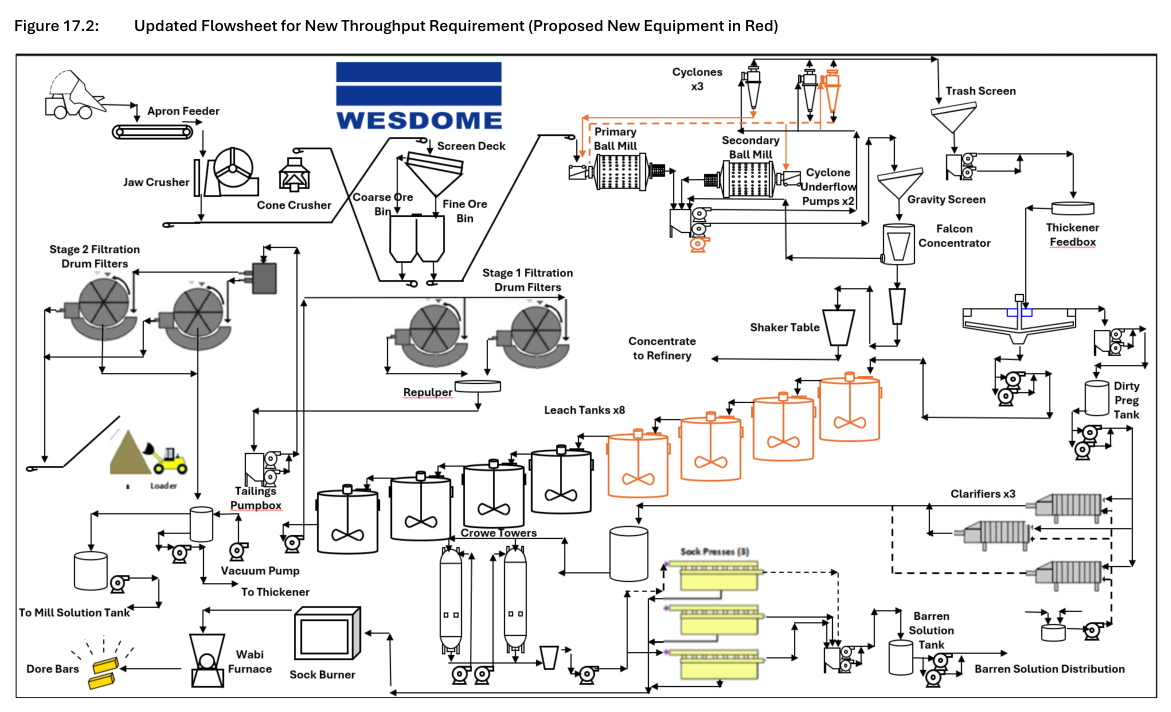
The Eagle River Mill is a conventional gold processing facility that integrates gravity concentration with cyanide leaching and Merrill-Crowe precipitation. The flowsheet includes three stockpile pads for grade blending, followed by two-stage crushing and two-stage grinding. A gravity circuit recovers free gold from a portion of the grinding circuit slurry. Leaching occurs in six mechanically agitated tanks arranged in series, with compressed air sparging for oxygen supply. Gold is recovered from pregnant solution by zinc precipitation in the Merrill-Crowe circuit, and tailings are filtered for dry stacking. Cyanide detoxification is performed using hydrogen peroxide addition to reclaim pond water, and the mill operates on a largely closed-loop water balance. In a 2025 debottlenecking study, the operation identified potential modifications to support increased throughput to a nominal 46 t/h and a 48.5 t/h design basis.
Key Process Stages
Material from the mine reports to three stockpile pads where it is blended by head grade before reclaim. A front-end loader feeds the run-of-mine bin. Two-stage crushing uses a primary jaw crusher and a secondary cone crusher in closed circuit with a vibrating screen. Screen undersize goes to the fine ore bin while oversize is conveyed to the cone crusher.
The grinding circuit pairs a primary ball mill with a secondary ball mill in closed circuit with hydrocyclones. Fine feed is conveyed to the primary mill. Discharge flows by gravity to the cyclone pumpbox where it combines with secondary mill discharge and gravity circuit tailings. Lime slurry is added at the pumpbox for pH control ahead of cyanidation. Slurry is pumped to classification, with a portion of the circulating load directed to the gravity circuit. Cyclone underflow returns to the secondary mill. Cyclone overflow passes through a trash screen to the thickener pumpbox.
A 2 mm guard screen protects the gravity circuit. Feed is a portion of the grinding circuit slurry. Screen undersize reports to a centrifugal concentrator operating on a semi-batch basis. Concentrate is upgraded on a shaking table and further treated by magnetic separation before smelting. Tailings from the concentrator and shaking table return to the cyclone pumpbox.
Potassium permanganate is added at the thickener pumpbox which receives trash screen undersize. Flocculant and cyanide are added at the thickener feedbox. Thickener overflow goes to the dirty pregnant solution tank. Underflow is pumped to the leach circuit. The existing leach circuit contains six mechanically agitated tanks in series. Slurry moves by gravity displacement through upcomers. Compressed air sparging provides dissolved oxygen. Discharge from the final leach tank goes to first-stage vacuum drum filters. One filter operates while one is on standby. Filter cake is washed, repulped with barren solution, and pumped to the tailings building.
Clarifiers operating in parallel remove suspended solids from thickener overflow. The clarifiers are precoated with Dicalite and Solka Floc. Clarified pregnant solution is de-aerated in vacuum towers before zinc addition. Lead nitrate is added as required for gold and silver precipitation. Precipitate is recovered by sock filtration. Filtrate goes to the barren solution tank.
Final tailings filtration occurs in the tailings building using two additional vacuum drum filters. One filter operates with one on standby. Filtrate returns to the mill solution system. Filtered tailings are washed with reclaim water and conveyed to the tailings management area for dry stacking.
The refinery treats two concentrate streams. Shaking table concentrate comes from the gravity circuit. Precipitation concentrate comes from the Merrill-Crowe circuit. Gold-bearing socks are burned to remove filter media. Gravity concentrate and precipitation concentrate are mixed separately with smelting and oxidizing reagents before furnace treatment. Doré typically contains 80% to 94% gold.
Cyanide detoxification uses 50% hydrogen peroxide addition to reclaim pond solution. Cyanide in tailings moisture reports to the reclaim pond through runoff. Peroxide oxidizes cyanide to cyanate, which decomposes through hydrolysis. The closed-loop water balance reduces net cyanide mass requiring treatment.
Additional Interesting Data and Summary
Metallurgical testwork completed in 2025 found that overall leach residence time of more than 90 hours is required to achieve gold recoveries above 96%. This exceeds the capacity of the existing six-tank circuit. The feed grade averages 7.27 g/t Au over the life of mine on a tonnage-weighted basis. Annual grades are front-loaded, at 11.77 g/t Au in 2026 declining to around 5 g/t Au by 2030. Forecast gold recovery ranges from 94.74% to 96.52%. The life-of-mine recovery is 95.70% calculated on a metal-weighted basis. ERM material has moderate-to-hard comminution characteristics with Bond Ball Mill Work Index values from 13.6 to 18.3 kWh/t. Laboratory gravity recovery was approximately 81.7%. Cyanidation testing achieved combined gravity and cyanidation recoveries between 98.74% and 99.79% in the 2025 program. That program found oxygen improved early leach kinetics but did not materially improve final recovery compared with air sparging. Finer grinding produced the highest final recovery but increased reagent consumption. Increasing cyanide above 400 ppm did not materially improve recovery, while reducing cyanide to 200 ppm lowered final recovery.
Key Processes
- Crushing: two-stage arrangement with primary jaw crusher and secondary cone crusher in closed circuit with vibrating screen
- Grinding: primary ball mill followed by secondary ball mill in closed circuit with hydrocyclones
- Gravity concentration: centrifugal concentrator with shaking table and magnetic separation
- Leaching: six mechanically agitated tanks in series with compressed air sparging
- Gold recovery: Merrill-Crowe precipitation with zinc dust and lead nitrate
- Tailings: two-stage vacuum drum filtration for dry-stack tailings
- Detoxification: hydrogen peroxide addition to reclaim pond for cyanide destruction
- Refining: separate smelting of gravity concentrate and Merrill-Crowe precipitate to produce doré
Source: Independent Technical Report for the Eagle River Mine, Ontario, Canada, 31 December 2025. Project website: Eagle River Mine
