

The Galaxy Gold Mine is an underground and tailings retreatment operation in Mpumalanga Province, South Africa, with the processing plant currently on care and maintenance, requiring upgrades before recommissioning.
Galaxy Gold Mine is currently in a care and maintenance phase. Bravura and M2M have mined underground and retreated tailings material intermittently since 2011. Sections of the processing plant have been dismantled to protect equipment from theft, and some equipment has corroded and requires upgrading and repairs before commissioning can commence. Provision for this work has been made in the capital programme and scheduling.
During the mining ramp-up, the operation will treat tailings material as a filler together with Run-of-Mine (RoM) material to produce a flotation concentrate. The tailings will be mined from the nearby Hostel tailings dumps. A flotation recovery of 55% was assumed for the tailings material, based on current and historic recoveries achieved at the mine, and 90% for the RoM material. In this phase, RoM material will be fed through the crushing and milling circuits prior to flotation. Tailings material will be trucked from the Hostel Dump and fed into the milling circuit together with the crushed RoM. The mill will polish the tailings and mill the crushed RoM to 80% passing 75 µm at a total throughput of 15 ktpm. The milled material will then be floated to produce a concentrate, which will be sold as a high-grade gold concentrate.
The plant historically operated under unfavourable conditions, mainly due to a short supply of ore resulting in stop-start conditions, which affected flotation and BIOX stability. In the 2011 period, a flotation recovery of 87% was achieved from January to August, with an average RoM head grade of 2.49 g/t. The plant also treated RoM material between early 2012 and early 2013 at an average rate of 4,100 ktpm with a RoM head grade of 1.96 g/t, but only achieved recoveries of about 84% for both flotation and BIOX. With stable plant operation, it is assumed flotation recoveries can be improved to approximately 90%. The Technical Report notes that the 2012-2013 recoveries were below expectations due to the same stop-start ore supply issues.
Critical Data
| Parameter | Value | Unit | Notes |
|---|---|---|---|
| Design throughput | 15 | ktpm | Total throughput at 80% passing 75 µm |
| Crushed product size | 80% passing 75 | µm | Cyclone overflow target |
| Assumed flotation recovery, RoM | 90 | % | Based on assumption for stable operation |
| Assumed flotation recovery, tailings | 55 | % | Based on current and historic recoveries |
| Historic flotation recovery | 87 | % | January to August 2011 |
| Historic overall recovery | 73.1 | % | January to August 2011 average |
| Historic RoM head grade | 2.49 | g/t | January to August 2011 average |
| Power consumption | 1,070 | MWh/month | Estimated |
| Plant labour | 73 | persons | Management, engineering, and production |
| TSF expansion capacity | 1 | Mt | 2019/2020 estimate |
| TSF expansion capital cost | 4 | ZAR million | Estimated |
| Historic RoM feed rate | 4,100 | ktpm | 2012-2013 period; likely corrupted unit, see editorial note |
| Historic RoM head grade | 1.96 | g/t | 2012-2013 period |
Overview
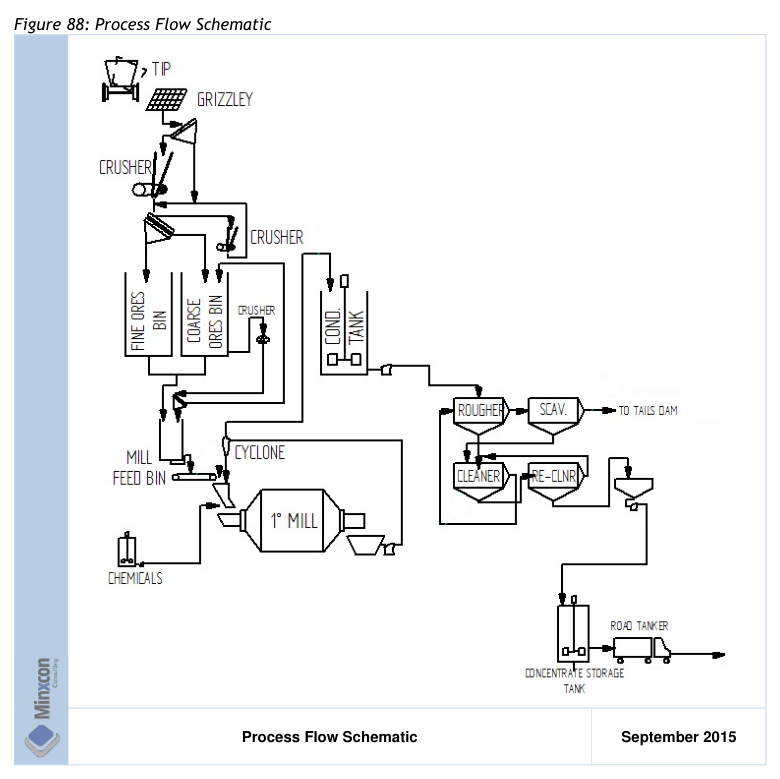
The Galaxy Gold Mine is an underground gold operation located in Mpumalanga Province, South Africa. The processing plant is designed to treat both RoM material and historic tailings to produce a high-grade gold concentrate via sulphide flotation. The plant is currently on care and maintenance, with some equipment dismantled and corroded. The proposed production plan involves treating RoM and tailings at a total rate of 15 ktpm, with the ball mill serving to polish the tailings and mill the crushed RoM to the target product size prior to flotation.
Water for the operation will be sourced from underground, with a water treatment plant producing potable water for the mine and plant. Power will be provided by Eskom, the national power supplier.
Key Process Stages
The processing circuit is comprised of several distinct stages. Crushing is achieved by jaw and cone crushers, with the crushed material fed to a ball mill and cyclone classification circuit. The cyclone overflow, averaging 80% passing 75 µm, is fed to the flotation conditioning tank; underflow gravitates back to the mill. The flotation circuit consists of rougher, scavenger, cleaner, and recleaner circuits, designed to achieve gold recoveries of approximately 90% at mass pulls of 4% to 6%. Flotation tails are pumped to the Tailings Storage Facility (TSF), while the concentrate is transferred to a thickener. Thickener overflow (process water) is returned to the plant and re-used. The concentrate thickener underflow is pumped to a storage tank for loading into a tanker for transport. A receiving area for historic tailings retreatment is also included. Tailings deposition will utilise the existing ring-dyke dam, Tailings Dam B, which was built in 1985. An expansion to accommodate approximately 1 Mt was estimated to be required in 2019 or 2020, with a capital cost of ZAR4 million, subject to review by qualified tailings dam engineers.
Additional Interesting Data and Summary
The mine has a history of processing both RoM and tailings material, with production data available from 2011 and 2012-2013. The 2011 period saw a total of 35.05 kt RoM milled at an average head grade of 2.49 g/t, achieving an average flotation recovery of 86.6% and an average overall recovery of 73.1%. The 2012-2013 period operated at a lower recovery of about 84% for both flotation and BIOX processes, attributed to the unfavourable stop-start operating conditions. The plant's labour complement consists of 73 personnel.
The operation plans to use existing Tailings Dam B, but since little to no deposition has occurred since 2011, the planned expansion has been deferred. The rate of rise of the dam may be sufficient to negate the need to expand its footprint, but this will need to be confirmed by qualified engineers.
Key Processes
- Crushing (jaw and cone crushers)
- Ball milling and cyclone classification
- Sulphide flotation (rougher, scavenger, cleaner, recleaner)
- Concentrate thickening, storage, and load-out
- Tailings storage and water recovery
- Reagent mixing and addition
- Historic tailings receiving and retreatment
Source: Galaxy Gold Mine , 2013 Technical Report (Item 17), 2013.
Editorial Note: The 2012-2013 RoM feed rate of 4,100 ktpm is mutually exclusive with the stated total plant throughput of 15 ktpm; the source text appears to contain an OCR error or a unit transcription issue, and the affected figure has been omitted from the body of this article.
Project website: Galaxy Gold Mine, 2013 Technical Report (Item 17)
