

Technical article on the GC processing plant flowsheet, equipment, and production performance at Silvercorp Metals Inc.’s Gaocheng silver-lead-zinc project in Guangdong Province, China.
The Gaocheng (GC) silver-lead-zinc project is an operating underground mine located in Yunfu City, Guangdong Province, China, that has been producing plant feed ore since Q2 2014. The project is 99 percent owned by Silvercorp Metals Inc. and processes polymetallic mesothermal vein infill mineralization containing silver, lead, and zinc for commercial extraction. The GC processing plant has a designed processing capacity of 528 thousand tonnes per annum (ktpa), equivalent to 1,600 tonnes per day (tpd), and was completed and commissioned in 2014. The plant sits on a steep hillside next to the main shaft, using the terrain to allow slurry to flow by gravity and reduce pumping costs. Construction timing for the existing operation is stated as 2014, while future expansion would depend on further study and permitting.
Critical Data
| Parameter | Value | Unit | Notes |
|---|---|---|---|
| Designed processing capacity | 528 | ktpa | Equivalent to 1,600 tpd |
| Crushing product size (P80) | 15 | mm | Less than or equal to 15 mm |
| Grinding overflow fineness | 75 | µm | 80% passing (P80=75µm) |
| Grinding circuit concentration | 35 to 38 | % | Final overflow |
| Lead concentrate grade (historical) | 45 (about) | % Pb | Production records show 37–45% in 2022–2025 |
| Lead recovery (historical) | 90 (about) | % | Range 88.9–90.3% in 2022–2025 |
| Silver in lead concentrate | 1,500 (about) | g/t | Silver recovery ~60% |
| Zinc concentrate grade (historical) | 44 (about) | % Zn | Production records show 42–44% in 2022–2025 |
| Zinc recovery (historical) | 89 (about) | % | Range 89.5–91.0% in 2022–2025 |
| Silver in zinc concentrate | 290 (about) | g/t | Silver recovery ~23% |
| Sulphur concentrate grade | 45 (about) | % S | Sulphur recovery ~49% |
| Concentrate final moisture | 10 to 12 | % | After ceramic filter |
| Concentrate thickener discharge | 40 to 50 | % | First stage dewatering |
| Tailings thickener underflow | 72 | % | Concentration can reach more than 72% |
| TSF total design height | 99.5 | m | Elevation 233 m ASL |
| TSF total storage capacity | 2,989,300 | m³ | Design value |
| Current tailings stacking height | 71 | m | Elevation 204.5 m ASL |
| Tailings stacking volume to date | 1,356,000 | m³ | 45.4% of capacity |
| Remaining TSF capacity | 1,633,300 | m³ | Corresponds to ~2,858 kt |
| Pre-sorting discarding rate (2024) | 12.38 | % | From production records |
| Pre-sorting discarding rate (2025) | 16.66 | % | From production records |
| Water consumption | 5 | m³/t | Mainly from return water and mine water |
| Electricity consumption (2025) | 50.23 | kWh/t | From annual average |
| Steel ball consumption (2025) | 1.26 | kg/t | From annual average |
| Number of grinding-flotation lines | 2 | lines | Identical parallel circuits |
| Single line capacity | 800 | tpd | Each |
| Number of crushing production lines | 1 | line | Flexible operation |
| XRT sorting lines | 1 | line | Installed March 2023 |
| Tin recovery production lines | 1 | line | Gravity separation from tailings |
| Concentrate dewatering lines | 4 | lines | Lead, zinc, sulphur |
| Tailings dewatering line | 1 | line | Press filtration |
| Plant commissioning year | 2014 | year | Actual |
| XRT sorting commissioning | March 2023 | month-year | Trial production |
| Actual ore processing range | 260 to 630 | ktpa | Annual range stated |
| Lead content in lead concentrate | 5 to 6 | % | Approximate |
| Copper content in lead concentrate | 2 to 3 | % | Present |
Overview
The GC processing plant was designed by GDMAI with the preliminary design completed in April 2011. Construction finished in 2014. Depending on mining supply, one or two grinding and flotation lines can run. The actual annual ore processing volume has ranged between 260 kt and 630 kt. The plant uses a two-stage closed-circuit crushing process with a ROM feed size of up to 350 mm producing a product less than 15 mm. An XRT intelligent sorting system replaced manual hand-sorting in March 2023, with the system still undergoing optimization.
Historical production records from 2022 to 2025 show lead concentrate grading approximately 45 percent lead with about 90 percent recovery, containing roughly 1,500 g/t silver (about 60 percent silver recovery) and 6 percent zinc. Zinc concentrate grades approximately 44 percent zinc with about 89 percent zinc recovery, containing about 290 g/t silver (about 23 percent silver recovery). Sulphur concentrate grades about 45 percent sulphur with about 49 per cent recovery.
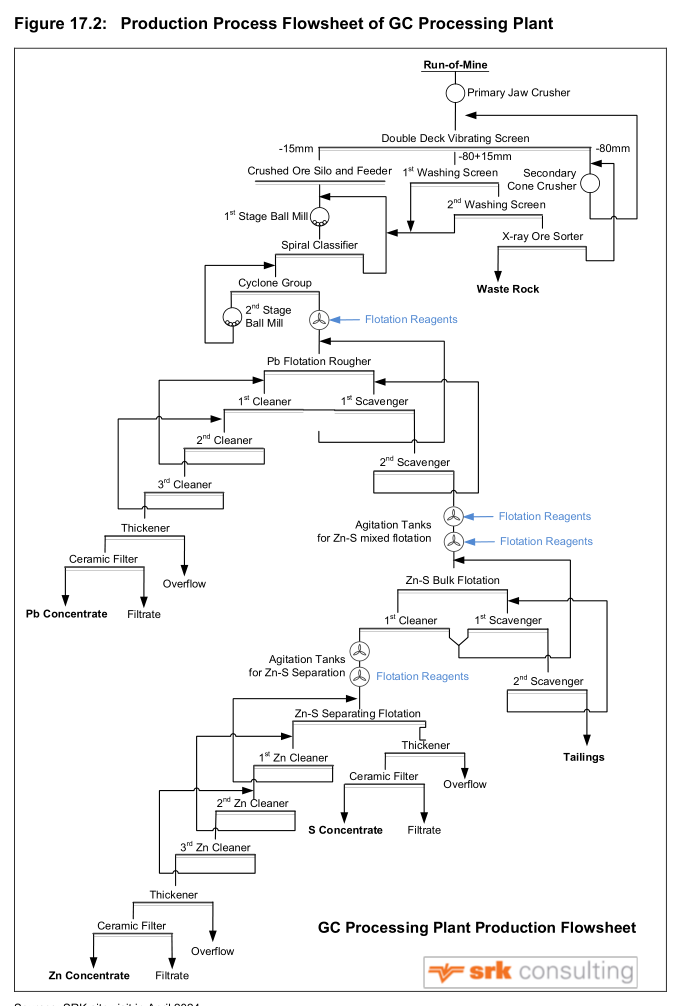
The processing flowsheet includes crushing and screening, XRT intelligent sorting, two-stage closed-circuit grinding and classification, lead preferential flotation, zinc-sulphur mixed flotation followed by zinc-sulphur separation flotation, tin recovery by gravity separation from tailings, concentrate thickening and filtering, tailings thickening and filtering, and dry-stacking tailings deposition. A regrinding-flotation test on lead concentrate has been proposed to reduce zinc content and produce copper concentrate.
Key Process Stages
Crushing and Screening. ROM ore enters a bin and is drawn by vibrating feeder into a primary jaw crusher. The jaw crusher product passes over a double-deck vibrating screen. Fines under 15 mm convey directly to the fine ore bin. Material over 60 mm feeds a secondary cone crusher via a buffer bin to maintain choke feeding. The 15 to 60 mm intermediate product goes to the XRT sorting system by belt conveyor. The crushing system typically operates at night during low electricity price periods, with peak versus valley prices differing by roughly double.
XRT Intelligent Ore Sorting. The XRT sorting system started trial production in March 2023. Intermediate screening product enters two-stage vibrating screens for washing. The washing pulp pumps to the grinding circuit. The oversize clean ore goes to the XRT machine for waste rock discarding. Waste rock is sold, and the concentrate returns to the secondary cone crusher buffer bin. The system remains under optimization to improve the tailings discarding rate.
Grinding and Classification. The grinding process uses two-stage closed circuit with grate ball mills and spiral classifiers in the first stage and overflow ball mills with hydrocyclone groups in the second stage. Final overflow fineness is P80 of 75 micrometres at 35 to 38 percent solids. Two parallel series each have a design capacity of 800 tpd.
Flotation. Hydrocyclone overflow goes to lead rougher conditioning with reagents and then to flotation cells. The lead circuit uses one roughing stage, two scavenging stages, and three cleaning stages to produce lead concentrate. Lead tailings flow to zinc-sulphur mixed flotation, which uses one roughing, two scavengings, and one cleaning to produce tailings and a bulk zinc-sulphur concentrate. That concentrate then enters zinc-sulphur separation flotation using one roughing, two scavengings, and three cleanings to simultaneously produce zinc concentrate and sulphur concentrate.
Concentrate Dewatering. Lead, zinc, and pyrite concentrates each use two-stage dewatering. First stage uses a thickener discharging at 40 to 50 percent solids. Second stage uses a ceramic filter achieving 10 to 12 percent final moisture. Dewatered concentrate is bagged and loaded into trucks by front-end loader for transport to smelter customers.
Tailings Handling. Tailings pump to a deep cone thickener for concentration. The underflow, which can reach over 72 percent solids, is valved either to the press filtration system or to the underground backfill system. Filtered tailings convey by belt to the dry-stacking tailings storage facility (TSF) and are spread by bulldozer on a bench-by-bench basis. The TSF is a third-class dam with displacement and phreatic line monitoring. The latest Safety Production Permit was obtained on August 31, 2023, valid until August 30, 2026.
Tin Recovery. An exploratory test on tin recovery from tailings achieved 34 percent recovery through gravity separation using shaking tables. The plant includes one production line for tin recovery from flotation tailings.
Laboratory and Maintenance. The GC processing plant is supported by an on-site laboratory, GC Laboratory, equipped with XRF, ICP-OES, AAS, infrared carbon and sulphur analyser, fire assay, and volumetric analysis rooms. It handles production samples, exploration samples, and conducts process tests. The maintenance workshop has craneage, welding, and basic machine shop capabilities. Major overhauls can be outsourced.
Additional Interesting Data and Summary
Production records from 2022 through 2025 show lead concentrate grades ranging from about 37 to 45 percent lead with lead recoveries of 89 to 90 percent. Lead concentrate contains roughly 1,500 g/t silver with approximately 60 percent silver recovery and also carries about 6 percent zinc. Zinc concentrate grades range from about 42 to 44 percent zinc with recoveries of 89 to 91 percent, containing roughly 290 g/t silver with about 23 percent silver recovery. Sulphur concentrate grade is approximately 45 percent sulphur with about 49 percent recovery. The copper content in the lead concentrate reaches 2 to 3 percent. The XRT intelligent pre-sorting system replaced manual hand-sorting in March 2023 and is still being optimized. Reagent consumptions for 2025 include ZnSO4 at 1.24 kg/t, CuSO4 at 124.79 g/t, and lime at 1.42 kg/t. Steel ball consumption in 2025 was 1.26 kg/t and electricity consumption was 50.23 kWh/t. Fresh water comes from the Hashui River via a riverside intake well and purification facility, while most process water is recycled return water and treated mine water. The remaining TSF capacity is about 1,633,300 m³ corresponding to roughly 2,858 kt at 1.75 t/m³ specific gravity.
Key Processes – Two-stage closed-circuit crushing (jaw crusher and cone crusher) with vibrating screen classification to minus 15 mm – XRT intelligent ore sorting for pre-concentration of 15–60 mm fraction, replacing manual hand-sorting – Two-stage closed-circuit grinding with grate ball mill and spiral classifier followed by overflow ball mill and hydrocyclone – Sequential preferential flotation: lead rougher-scavenger-cleaner circuit, followed by zinc-sulphur bulk flotation, then zinc-sulphur separation flotation – Two-stage concentrate dewatering using thickeners and ceramic disc filters to 10–12% moisture – Tailings dewatering via deep cone thickener and press filtration, with dry-stacking deposition at TSF – Tin recovery from tailings using gravity separation (shaking tables)
Source: Technical Report on Gaocheng Silver-Lead-Zinc Project in Guangdong Province, China, December 31, 2025. Project website: Gaocheng
